
What mandate? Joe Biden’s agenda faces a divided Congress
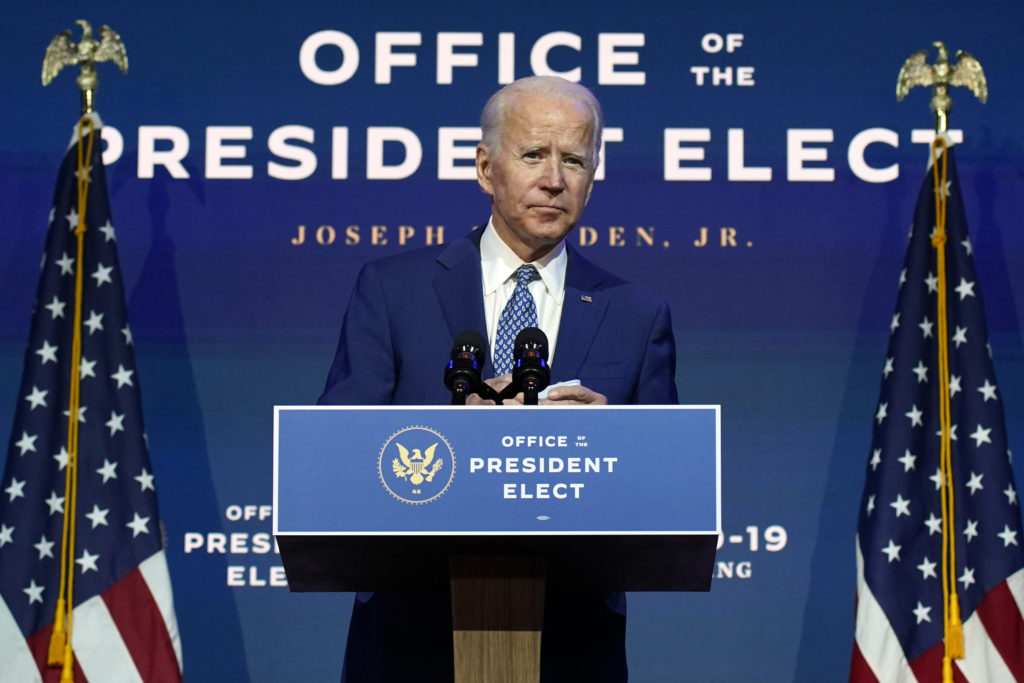
President-elect Joe Biden wants to “restore the soul of America.” First, he’ll need to fix a broken and divided Congress. Biden is rushing headlong into a legislative branch ground down by partisanship, name-calling and, now, a refusal by some to acknowledge his win over President Donald Trump. Democratic allies, struggling to regroup after their own election losses, harbor deep divisions between progressive and moderate voices. Republicans, rather than graciously congratulating the incoming president, are, intentionally or not, delegitimizing Biden’s presidency while catering to Trump’s refusal to accept the election results. At a time when the country needs a functioning government perhaps more than ever to confront the crises of COVID-19, a teetering economy and racial injustice, Washington is being challenged by the president-elect to do better than it has. It’s going to be a hard opening. “The country used to want gridlock because they saw gridlock as a way to protect them. Now the country’s actually hungry for action and progress,” said Jesse Ferguson, a Democratic strategist. “That’s a mandate to flip the switch.” The idea of a Biden mandate, though, is relative, certainly embraced by Democrats who want to push ahead with his agenda. Emboldened Republicans, though, who didn’t lose a single House seat, but in fact expanded their ranks and brushed back many Senate Democratic challengers, see their own mandate to serve as a block on a Biden agenda. California Rep. Kevin McCarthy, the House’s Republican leader, said the election “was a mandate against socialism,” stepping up the relentless GOP attacks, even though Biden is a centrist Democrat. Biden comes to the presidency like few in recent history, with a rare mix of experience but also a potentially divided Congress. Not since President George H.W. Bush has the White House had an executive with such a deep Washington resume. Rarely in modern times has a Democrat started an administration without a full Democratic Congress. While the House is in Democratic hands, the Senate remains undecided, a 50-48 lead for Republicans heading into a Jan. 5 runoff for two seats in Georgia that will determine party control. Asked this past week how he will be able to work with Republicans if they aren’t acknowledging his victory, Biden said, “They will.” What Biden is presenting is a new normal in Washington that he said voters demanded from the election. “If we can decide not to cooperate, then we can decide to cooperate,” he said at his election victory speech. Much has been made of Biden’s relationship with Capitol Hill, where he served as a senator for 36 years, particularly his deal-making as Barack Obama’s vice president with Senate Republican leader Mitch McConnell of Kentucky. Yet McConnell has not revived that approach as he enables Trump to delve into a legal battle rooted in unfounded allegations of voter fraud, even as state officials say the elections ran smoothly and there is no widespread evidence of fraudulent voting. McConnell won his own reelection in Kentucky. Whether McConnell emerges in the new Congress as majority or minority leader with a narrowly divided Senate, the longest serving Republican leader in history will have great leverage over legislation that arrives on Biden’s desk. Biden could seek a repeat of Newt Gingrich’s era when the Republican House speaker served up legislative victories for President Bill Clinton, infuriating Democrats with conservative budget and welfare bills but helping Clinton win a second term. Or Biden could find McConnell rerunning his politically charged GOP blockade of Obama’s agenda. Hopes of overcoming McConnell by ending the Senate filibuster, which would allow bills to advance on a simple majority rather than a 60-vote threshold, are slipping out of reach without Democratic control. “Gingrich insisted the American people wanted it,” said Rick Tyler, a former Gingrich top aide who left the Republican Party in the Trump era. He said McConnell will move on Biden’s agenda when Biden has the nation behind him. “That’s how you do it. Let’s see if Biden can do it,” he said. But it’s not just McConnell. House Speaker Nancy Pelosi, D-Calif., Senate Democratic leader Chuck Schumer of New York and even McCarthy will have oversize roles because of the changed makeup of the new Congress. Biden faces a restive liberal flank, powered by a new generation of high-profile progressives including Rep. Alexandria Ocasio-Cortez, D-N.Y., They helped deliver his victory and may not be so eager to compromise over health care, climate change, income inequality and racial justice issues that have growing popular support. At the same time, while Pelosi and Schumer have long histories with Biden, McCarthy is close to Trump, who is expected to hold a heavy influence on Republicans even after he leaves office. With a slimmer majority in the House, McCarthy’s ability to wrangle votes suddenly matters. “They can, but will they?” said Jim Kessler, a former Schumer aide and executive vice president at the center-left Third Way think tank. “This is a real veteran group of people. They know how to get things done. They know how to stop things from getting done.” An early test for Biden will be the Cabinet nominations, which can be approved by a slim 51 votes in the Senate. Republicans can also block nominees with time-consuming procedural hurdles that could quickly stall the new administration if top positions go unfilled. Democrats did as much to Trump, in some ways as payback after McConnell blocked Obama’s Supreme Court nominee Merrick Garland. “I think there’s a likelihood that Mitch McConnell will Merrick Garland every single Cabinet nominee and will force Joe Biden to negotiate on every single one,” said Sen. Chris Murphy, D-Conn. “Trump is still going to be running the Republican Party. And so, in reality, Joe Biden may have to negotiate every Cabinet pick with Donald Trump.” Republished with the permission of the Associated Press.
Donald Trump fires Mark Esper as Pentagon chief after election defeat

President Donald Trump fired Defense Secretary Mark Esper on Monday, an unprecedented move by a president struggling to accept election defeat and angry at a Pentagon leader he believes wasn’t loyal enough. The decision was widely expected as Trump had grown increasingly unhappy with Esper over the summer, including sharp differences between them over the use of the military during the civil unrest in June. But the move could unsettle international allies and Pentagon leadership and injects another element of uncertainty to a rocky transition period as Joe Biden prepares to assume the presidency. Presidents who win reelection often replace Cabinet members, but losing presidents have kept their Pentagon chiefs in place until Inauguration Day to preserve stability in the name of national security. Trump announced the news in a tweet, saying that “effective immediately” Christopher Miller, the director of the National Counterterrorism Center, will serve as acting secretary, sidestepping the department’s No.2-ranking official, Deputy Defense Secretary David Norquist. “Chris will do a GREAT job!” Trump tweeted. “Mark Esper has been terminated. I would like to thank him for his service.” In a letter to Trump, Esper referred to his efforts to keep the Pentagon apolitical — a resistance that often angered Trump. Esper said he served as defense secretary and Army secretary “in full faith to my sworn oath to support and defend the Constitution, and to safeguard the country and its interests while keeping the Department out of politics and abiding by the values Americans hold dear.” The Associated Press obtained a copy of the letter. Esper didn’t thank Trump, but he also didn’t openly criticize the president or his policies. He said he accepts Trump’s decision to replace him, adding, “I step aside knowing there is much we achieved at the Defense Department over the last eighteen months to protect the nation and improve the readiness, capabilities, and professionalism of the joint force, while fundamentally transforming and preparing the military for the future.” U.S. defense officials said Miller arrived at the Pentagon in the early afternoon to take over the job, and that White House chief of staff Mark Meadows informed Esper of the firing before Trump announced the move on Twitter. Esper and Miller were in the building at the same time for a while, but Esper left by the end of the day, said defense officials who spoke on condition of anonymity to discuss internal matters. Trump’s abrupt move to dump Esper triggers questions about what the president may try to do before he leaves office, including adjustments in troop presence overseas or other national security changes. More broadly, the U.S. military continued to operate as usual. U.S. officials said Gen. Mark Milley, chairman of the Joint Chiefs of Staff, met with Miller on Monday and also gathered the top military commanders and chiefs for a secure meeting. Officials said Miller’s message so far is that he won’t make immediate changes, and the department will stay the course. Military leaders, meanwhile, were calling top officials in their various geographic regions to assure them that the U.S. military is maintaining a stable presence around the world. In a separate message to the force, Esper expressed a twinge of disappointment, saying “I step aside knowing that there is much more we could accomplish together to advance America’s national security.” He said much was achieved, and “through thick and thin, however, we have always put People and Country first,” he said. Trump’s decision brings to five the number of men who have held the job of defense chief under Trump — either in an acting capacity or confirmed by the Senate. The move was quickly condemned by Democratic members of Congress. “Dismissing politically appointed national security leaders during a transition is a destabilizing move that will only embolden our adversaries and put our country at greater risk,” said Rep. Adam Smith, D-Wash., chairman of the House Armed Services Committee. “President Trump’s decision to fire Secretary Esper out of spite is not just childish, it’s also reckless.” Former military leaders weighed in. Jim Stavridis, a retired four-star Navy admiral, wrote on Twitter that, “Things are already unstable internationally, and this does not help.” Republicans praised Esper but largely avoided criticizing Trump. GOP Sen. Jim Inhofe, the Senate Armed Services Committee chairman, told reporters it was Trump’s decision and said, “I learned a long time ago I don’t tell the president not to do anything.” Biden has not said who he would appoint as defense chief, but is widely rumored to be considering naming the first woman to the post — Michele Flournoy. Flournoy has served multiple times in the Pentagon, starting in the 1990s and most recently as the undersecretary of defense for policy from 2009 to 2012. She is well known on Capitol Hill as a moderate Democrat and is regarded among U.S. allies and partners as a steady hand who favors strong U.S. military cooperation abroad. Miller most recently served as director of the National Counterterrorism Center and before that was a deputy assistant defense secretary and top adviser to Trump on counterterrorism issues. He spent more than 30 years in the military, including as an Army Green Beret, and was deployed multiple times to both Iraq and Afghanistan. After his retirement from the military, Miller worked as a defense contractor. Esper’s strained relationship with Trump came close to collapse last summer during civil unrest that triggered a debate within the administration over the proper role of the military in combating domestic unrest. Esper’s opposition to using active duty troops to help quell protests in Washington, D.C., infuriated Trump, and led to wide speculation that the defense chief was prepared to quit if faced with such an issue again. The tensions fueled rumors that Esper would be ousted if Trump won reelection. Presidents historically have put a high priority on stability at the Pentagon during political transitions. Since the creation of the Defense Department and the position of defense secretary in 1947, the only three presidents
Joseph Lowery, civil rights leader and MLK aide, dies at 98
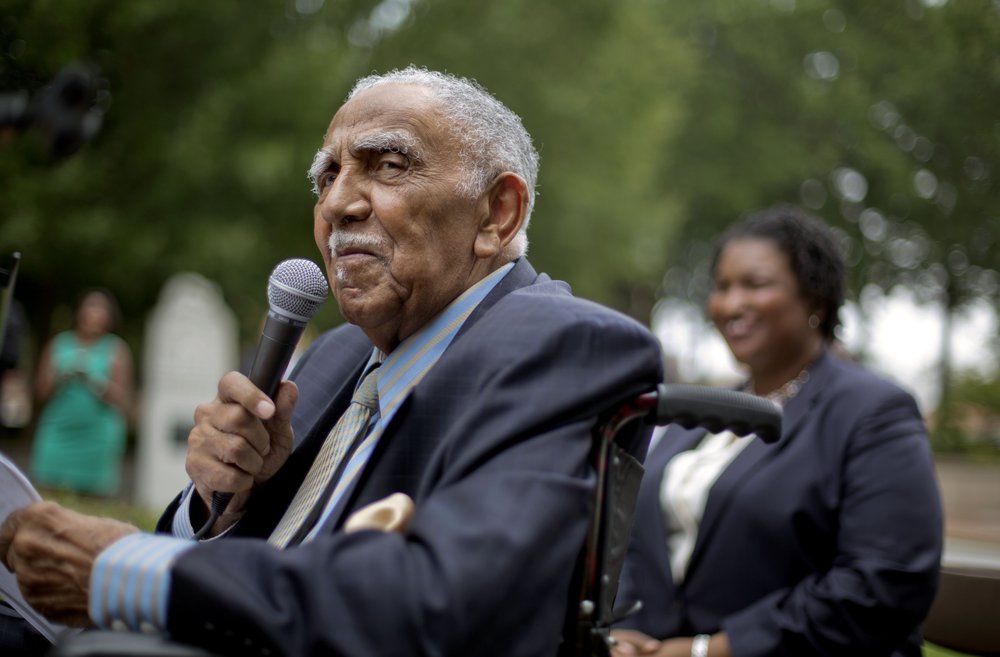
Rev. Lowery was born in Huntsville and was considered the dean of civil rights veterans.
Dan Sutter: Socialism and the horrors of communism

Dan Sutter discusses the history fo socialism, which has been brought to the forefront of debate by Bernie Sanders’ candidacy for President.
Donald Trump defends his rhetoric in 1st TV town hall of 2020

The first question in the town hall concerned the coronavirus.
Doctors to keep George HW Bush in hospital a few more days
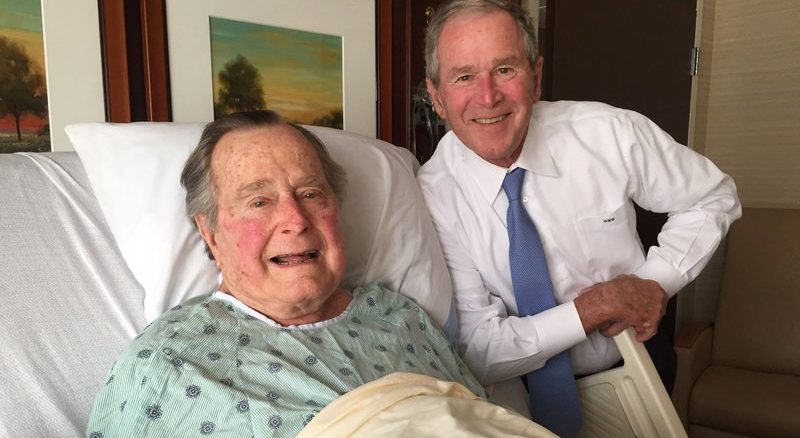
A spokesman for former President George H.W. Bush says the nation’s 41st president will remain in a Houston hospital for a few more days of observation while he recovers from a mild case of pneumonia. Family spokesman Jim McGrath said Monday that the medical team at Houston Methodist Hospital hopes to discharge the 92-year-old Bush by the end of the week. McGrath says Bush “continues to be in good spirits and is resting comfortably” at the hospital. Bush was hospitalized April 14 for treatment of a persistent cough. Physicians say his pneumonia was treated and resolved. But he has been held while he regains his strength. Bush served as president from 1989 to 1993. He spent 16 days in the hospital in January for treatment of pneumonia. Republished with permission of The Associated Press.
George H.W. Bush improving, Barbara staying night in hospital
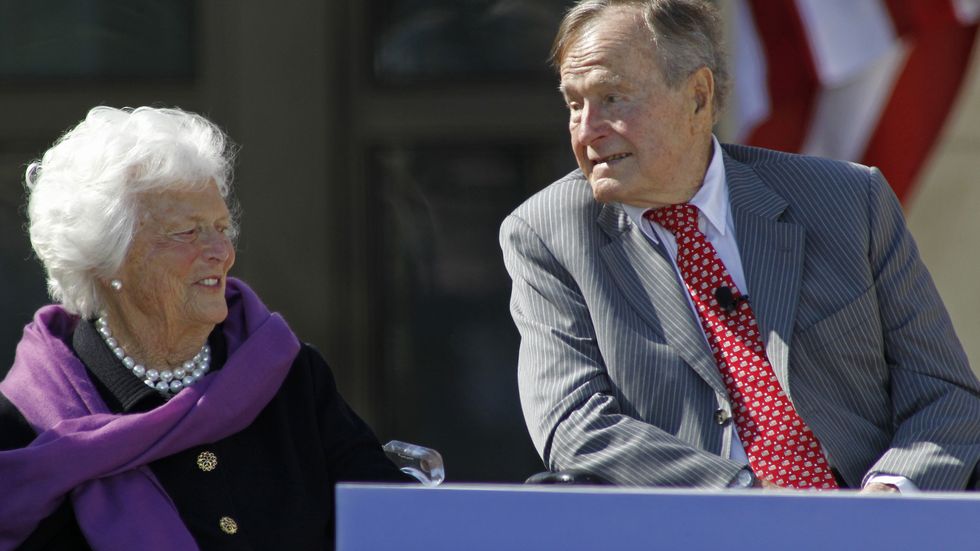
Former President George H.W. Bush‘s health continues to improve and his wife, who is also recovering from illness, has chosen to remain hospitalized one more night to be “closer to her husband,” a family spokesman said Sunday. The 92-year-old former president and his wife Barbara remained at Houston Methodist Hospital. He has been receiving treatment for breathing difficulties from pneumonia while she is recovering from bronchitis. The 41st president’s vital signs are normal and doctors hope he can be moved out of intensive care in the next day or two, said Bush family spokesman Jim McGrath. Bush has been in the Houston hospital now for a week. Doctors on Wednesday inserted a breathing tube, and a ventilator was employed to assist his breathing. The tube was removed Friday. Barbara Bush, 91, entered the hospital Wednesday after feeling run down and coughing for the past few weeks. Doctors determined she had bronchitis. Her health has improved since receiving treatment. “Mrs. Bush was given the option of being discharged today, but has elected to remain at Houston Methodist Hospital one more evening to continue her recovery and to be closer to her husband,” McGrath said. McGrath added the Bushes wanted to make sure “they thank their well-wishers for their kindness, and especially their prayers.” In a tweet on Saturday, McGrath said the couple’s spirits were up, they were very interested “in inauguration doings” and were “very happy” that President Donald Trump went to see the men and women of the CIA. On Saturday, Trump traveled to CIA headquarters in Langley, Virginia, and spoke to a group of about 400 people in attendance. Bush served as CIA director from 1976 to 1977. The couple’s 72-year marriage is the longest of any presidential couple in American history. Republished with permission of the Associated Press.
Former President George H.W. Bush, wife Barbara hospitalized
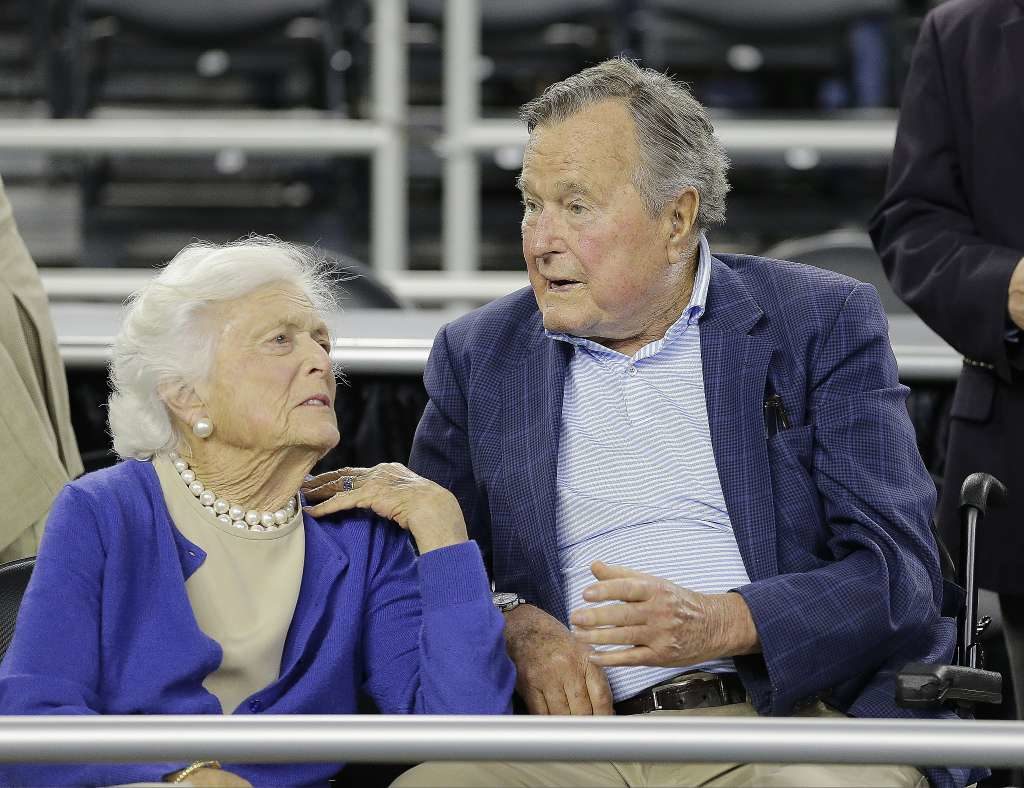
Former President George H.W. Bush was admitted to an intensive care unit on Wednesday, and his wife, Barbara, was hospitalized as a precaution, according to his spokesman. The former president was admitted to the ICU at Houston Methodist Hospital to “address an acute respiratory problem stemming from pneumonia,” family spokesman Jim McGrath said in a statement. McGrath said the former first lady was hospitalized as a precaution after experiencing fatigue and coughing. “Doctors performed a procedure to protect and clear his airway that required sedation. President Bush is stable and resting comfortable in the ICU, where he will remain for observation,” McGrath said in the statement. The 41st president was admitted to the hospital on Saturday for shortness of breath, McGrath said in an email to The Associated Press earlier Wednesday. McGrath said the 92-year-old was responding well to treatments. The 41st president was admitted to the hospital on Saturday, McGrath said in an email to The Associated Press earlier Wednesday. “Doctors and everyone are very pleased, and we hope to have him out soon,” McGrath said. Bush’s chief of staff, Jean Becker, told the Houston Chronicle and KHOU-TV that Bush was expected to go home in a couple of days. Bush, who served as U.S. president from 1989 to 1993, has a form of Parkinson’s disease and uses a motorized scooter or a wheelchair for mobility. He was hospitalized in Maine in 2015 after falling at his summer home and breaking a bone in his neck, and was hospitalized in Houston the previous December for about a week for shortness of breath. He spent Christmas 2012 in intensive care for a bronchitis-related cough and other issues. Despite the loss of mobility, Bush celebrated his 90th birthday by making a tandem parachute jump in Kennebunkport, Maine. Last summer, Bush led a group of 40 wounded warriors on a fishing trip at the helm of his speedboat, three days after his 92nd birthday celebration. Bush’s office announced earlier this month that he and his wife of more than 70 years, Barbara, would not attend Donald Trump’s inauguration this week due to the former president’s age and health. George Herbert Walker Bush, born June 12, 1924, in Milton, Massachusetts, also served as a congressman, CIA director and Ronald Reagan‘s vice president. His son, George W. Bush, was elected president in 2000 and served two terms. Another son, Jeb — a former Florida governor — made an unsuccessful bid for the GOP nomination in 2016. Only one other U.S. president, John Adams, had a son who also became president. Republished with permission of The Associated Press.
Bill and Hillary Clinton to attend Donald Trump inauguration
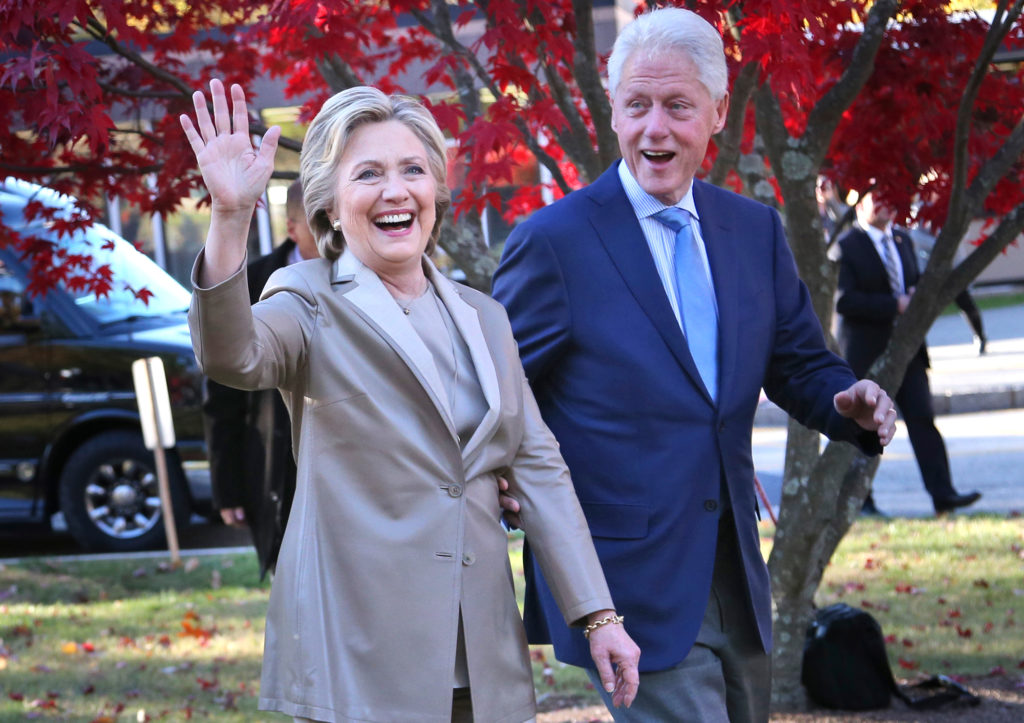
Falling in line with tradition, Bill and Hillary Clinton plan to attend Donald Trump’s inauguration. It’s a decision that will put Hillary Clinton on the inaugural platform as her bitter rival from the 2016 campaign assumes the office she long sought. The Clintons announced their decision to attend the Jan. 20 inauguration shortly after former President George W. Bush’s office said Tuesday he would attend along with former first lady Laura Bush. The Bushes are “pleased to be able to witness the peaceful transfer of power — a hallmark of American democracy — and swearing-in of President Trump and Vice President Pence,” Bush’s office said in a statement. It is traditional for former presidents and their spouses to attend the inauguration. But the decision to attend was fraught for the Clintons, given Hillary Clinton’s bitter campaign against Trump. The 2016 Democratic presidential nominee has largely avoided public appearances since Trump defeated her in November. Bush, too, has had a difficult relationship with Trump. His brother Jeb ran against Trump in the GOP primaries. George and Laura Bush let it be known they voted for “none of the above” for president rather than cast a ballot for Trump, but the ex-president did call to congratulate Trump after his victory. Former President Jimmy Carter and his wife, Rosalynn, earlier said they plan to attend Trump’s inaugural. Former President George H.W. Bush, 92, and his wife, Barbara, do not plan to attend the inauguration due to the former president’s age and health, his office said. Republished with permission of the Associated Press.
Martin Dyckman: A European perspective on Donald Trump

“Associate yourself with Men of good Quality if you Esteem your own Reputation; for ‘tis better to be alone than in bad Company.”– George Washington‘s 56th rule of civility and decent behavior. A recent cruise in the Baltic Sea took us to eight northern European nations where we were impressed yet again with how much alike all the world’s people are. But there is a dark side to that. In 1932, amidst a grave worldwide depression, Americans elected President Franklin D. Roosevelt, a decent man who told us we had nothing to fear but fear itself. At almost the same moment, the people of Germany — perhaps the most advanced nation in Europe — got Adolf Hitler. When we toured Berlin and beheld a friendly and prosperous city with an enviable quality of life, the hideous events of the Nazi era seemed almost improbable. A visit to the impressive Jewish Museum Berlin is the antidote to selective memory. To see the exhibits of Jewish life in Germany in the millennium before the Shoah, one first must pass the exhibits dedicated to the Holocaust. Nothing is held back Yes, the people who did that were decent and highly civilized by all the standards of their times. I have never thought that what happened there could not happen here in similar circumstances. And now it is happening here. A man who emulates Adolf Hitler in significant ways is poised to be the nominee of a once great, now degraded political party, and could become president of a nation whose proudest boast is to be the leader of the free world. If you doubt the parallels, read the British historian Alan Bullock‘s magisterial biography, “Hitler: A Study in Tyranny.” Like Hitler, Donald Trump inflames the latent, and not so latent, prejudices of a substantial element of the populace. The targets are different, but not the hate-filled rhetoric. Like Hitler, Trump is capitalizing on the public’s justifiable dissatisfaction with the apparent political paralysis in Washington. Hitler’s promise to end a similar situation and make government function again was his primary issue in the pivotal 1932 campaign that he won with only a plurality. Like Hitler, Trump spews hate at people — not just journalists but critics in his own adopted party — who oppose or criticize him. Like Hitler, he would tame and muzzle the judiciary. Could any threat be clearer? Like Hitler, Trump has no coherent policy positions — other than bigotry — and is conspicuously disinterested in the details of how government works. He would have his vice president do all the real work. Nothing in the Constitution contemplates that. No president has been so blissfully ignorant and lazy. Many industrialists and politicians in Germany rationalized that Hitler, their inferior in every respect but cunning, could be put to their use. They learned better, to their sorrow. Rick Scott, Paul Ryan and the other opportunists scurrying aboard Trump’s ship figure they can use him too. Ryan, for one, claims to believe that Trump would promote the congressional Republicans’ entire far right agenda. Can’t they see that Trump will do only that which promotes himself? They don’t love their country half as much as they hate Democrats in general and Hillary Clinton in particular. They would sooner see America ruined than muddle along, if not prosper, under Clinton. Why do I say that? It’s because Trump’s presence would defile an office in which almost every occupant has tried to project the senses of dignity and responsibility that are so grossly lacking in that vulgar, thuggish, bombastic, bullying, fundamentally amoral man. Trump as a successor to George Washington? Abraham Lincoln? Teddy Roosevelt? FDR? George H.W. Bush? It makes one want to vomit. Vladimir Putin likes Trump. The bloodstained boy dictator of North Korea likes him. David Duke, the professed Nazi and Ku Kluxer, likes him. What company you keep, Speaker Ryan. Welcome to the sewer, Governor Scott. Where is your integrity, Mel Sembler? Have you forgotten the Holocaust? The foreign dictators relish the prospect of someone so unfit, unprepared, unworthy and amoral defiling the White House. They figure that America would become a laughing stock, an irrelevancy, a faded former power in the hands of such an unfit, unprepared, unworthy person. You have to wonder, though, whether they weigh the risk of such a thin-skinned, irascible bully’s finger on the nuclear button. Trump’s apologists argue that he can’t be compared to Hitler because he has never had a perceptible, consistent ideology and lacks the organized cadres — the Hitler Youth, the brownshirts — who put the muscle and murder into Hitler’s campaigns. But he does have an ideology. It’s his Id, his ego, the persistent, insatiable promotion of himself, his greed. No one could be more dangerous. And he has the brownshirts too, lacking only similar organization. The people harassing Muslims and other foreigners, roughing up protesters at Trump rallies, bedeviling journalists with unspeakably anti-Semitic emails and telephone calls, are their equivalent. And, as in Germany, their vocal and physical violence is provoking the opposition into replying in kind. Two wrongs make no ri0ght. Clinton is far from a perfect candidate but, as intellectually honest conservatives have observed, the country would survive her. That it would survive Trump is far too great a risk for any honest patriot to want to take. ___ Martin Dyckman is a retired associate editor of what is now the Tampa Bay Times. He lives in Asheville, North Carolina.
7 things to watch in monthlong sprint to Iowa’s caucuses

The 2016 presidential election has defied all expectations so far. An enormous field of GOP candidates, still a dozen strong with a month to go before the leadoff Iowa caucuses on Feb. 1. The billionaire outsider who has tapped into the anger and fears of a nervous nation. A son and brother of presidents who is struggling to connect with voters despite his tremendous financial advantage. In less than a month, voters will begin having their say in what could turn out to be a bitter, monthslong fight for the Republican nomination. On the Democratic side, front-runner Hillary Clinton is banking on neatly locking up the nomination as her GOP rivals tear each other down. Some things to watch for in the four-week sprint to the Iowa caucuses: DONALD TRUMP’S CHECKBOOK To date, wealthy businessman Donald Trump has run a frugal campaign, skipping expensive television advertising as his Republican rivals and their affiliated super political action committees spend tens of millions of dollars on airtime. Trump has promised that that’s about to change, announcing plans last week to spend $2 million a week on the air in three early voting states. Will Trump follow through on that promise? Television ad prices are only increasing as the voting draws closer, and Trump has yet to reserve any airtime. TED CRUZ’S CLERGY Texas Sen. Ted Cruz is building a large organization of support in Iowa, amassing county leaders across the state and tapping a member of the clergy in each of the 99 counties. The son of a preacher, Cruz aims to take a well-worn path to victory in Iowa: Former Arkansas Gov. Mike Huckabee in 2008 and former Pennsylvania Sen. Rick Santorum in 2012 generated similar support among the state’s evangelical voters, and each won the caucuses. The question is whether that network of religious conservatives will coalesce behind Cruz this time or splinter. Cruz has made strides, picking up the endorsements of Iowa evangelical leader Bob Vander Plaats and Focus on the Family founder James Dobson. ESTABLISHMENT CHOICES Former Florida Gov. Jeb Bush, who entered the race in June as the front-runner, jokes that his father, former President George H.W. Bush, has taken to throwing shoes at his television set in response to Trump. But as the caucuses near, the laugh lines have given to persistent frustration among party elders and its professional class that Trump remains a viable candidate. Several have said an effort must be mounted to take down Trump, but a coordinated campaign of negative ads has so far failed to materialize. That’s because in part to concerns that it could backfire and further motivate Trump’s supporters, but also because several candidates vying to be the establishment choice are still in the race. Will there be an attempt to undermine Trump? Will Bush — or Florida Sen. Marco Rubio, Ohio Gov. John Kasich or New Jersey Gov. Chris Christie — emerge as the clear alternative to Trump before Trump or Cruz collects too many delegates to matter? DEPARTURE LOUNGE Two low-polling Republicans quit in December: South Carolina Sen. Lindsey Graham and former New York Gov. George Pataki. While all the remaining candidates insist they’re not going anywhere, pressure could grow on other candidates to bow out and narrow the field. Among those feeling the heat: Santorum, who has failed to produce the kind of excitement that propelled him to that Iowa victory four years ago. If he and others at the bottom dropped out and endorsed the same candidate, it could give rise to the Trump alternative who some are desperately seeking. CLINTON’S TEST A third-place finish in 2008 in Iowa completely disrupted Clinton’s strategy to win the Democratic nomination, and she never could catch then-Illinois Sen. Barack Obama. This time, Clinton has poured significant resources and staff into the state. Polls show her with an edge over her chief rival, Sen. Bernie Sanders, a Vermont independent. If Clinton wins Iowa, a loss in New Hampshire to Sanders would be easier to contain. Back-to-back losses in Iowa and New Hampshire would generate fresh worries among Democrats about their front-runner. JANUARY SURPRISES The attacks in Paris and San Bernardino, California, shifted voters’ focus to national security issues. That was to the detriment of less-experienced and less-hawkish candidates, including retired neurosurgeon Ben Carson on the GOP side and Sanders. Another attack, especially on American soil, could further diminish candidates without experience in office or those uncomfortable with a campaign focus on foreign policy. FINAL DEBATES The Republicans have two more debates — Jan. 14 in South Carolina and Jan. 28 in Iowa — before the Feb. 1 caucuses. Democrats will debate Jan. 17, also in South Carolina. The GOP debates in 2015 broke viewership records, and the next two probably may provide make-or-break moments as undecided voters begin making up their minds. Republished with permission of the Associated Press.
