
$30 million allocated for Coastal Alabama projects
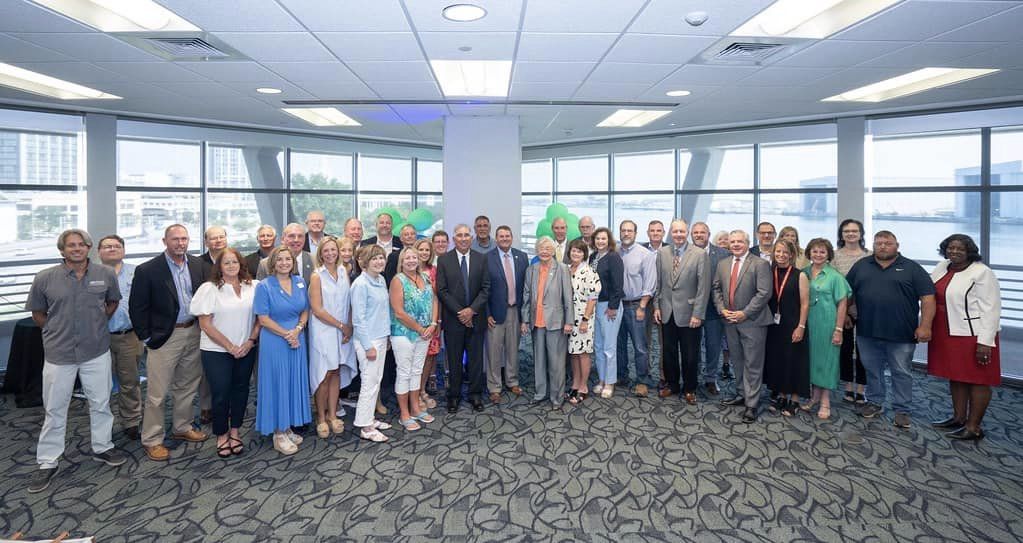
Governor Kay Ivey and Alabama Department of Conservation and Natural Resources Commissioner Chris Blankenship announced approximately $30 million for 25 projects in Coastal Alabama. The projects will be funded by the Gulf of Mexico Energy Security Act of 2006 (GoMESA). According to the Department of Interior website, “The Office of Natural Resources Revenue disburses GOMESA revenue to state and local governments for each of the four GOMESA states. The numbers below show the disbursements to the states and their local governments. Disbursements are made the year following the year of receipt and are subject to sequestration.” Alabama Recipient Fiscal Year 2024 Disbursement 2009-2023 Disbursements State of Alabama $39,864,143 $190,647,881.07 Baldwin County $4,671,961 $21,960,919.79 Mobile County $5,294,074 $25,701,097.66 Alabama Total $49,830,178 $238,309,898.52 These projects focus on environmental education and outreach, sewer and stormwater infrastructure, water quality improvements, recreational access improvements, and other important projects that are included in the original intent and authorized use of GoMESA funds. “I am thrilled to be joined today by many of our local leaders to announce 25 GoMESA-funded projects,” said Governor Ivey at the press event. “Working closely with Commissioner Blankenship and his team at the Alabama Department of Conservation and Natural Resources, we have secured more than $30 million dollars to fund the projects that improve and beautify this region we all love. With this announcement, more than $210 million dollars in GoMESA projects have been awarded during the Ivey Administration.” “One of the main themes for this year’s projects is Environmental and Nature Education and Outreach. Teaching future generations about the importance of protecting Alabama the Beautiful and all her natural habitats, wildlife and fish is critical. Several of these projects will make improvements at museums, education facilities, aquariums and along the waterfront – all to educate Alabamians and our visitors from far and wide,” added Governor Ivey. According to the Governor’s office, “GoMESA provides funding for the four Gulf Producing States and their eligible coastal political subdivisions (CPS) to share 37.5 percent of the qualified revenues from Outer Continental Shelf (OCS) oil and gas leases issued since December 20, 2006. With approval from the Governor’s Office, the Alabama Department of Conservation and Natural Resources administers the funds. Mobile and Baldwin Counties receive separate GoMESA disbursements directly from the Federal government.” “The GoMESA projects announced today will go a long way to continuing to improve the environment and quality of life in Coastal Alabama. I appreciate the work of the staff at the Department of Conservation and Natural Resources and our project partners as they work to leverage GoMESA funded projects with the good work happening with Deepwater Horizon Oil Spill projects and other funding sources,” said Alabama Department of Conservation and Natural Resources Commissioner Chris Blankenship. “The nature-based education, water quality improvements, and public access expansion projects announced today will have a long term positive impact.” 2024 State of Alabama Funded GoMESA Projects City of Creola Park, Conservation and Education Project $1,000,000 Exploreum Traveling Exhibit Gallery Refurbishment $829,012 Dauphin Island Programmatic Dredge Permit $300,000 Loxley Municipal Park Wetlands Acquisition Project $650,000 Fairhope Flying Creek Nature Preserve Phase II $1,328,400 Summerdale Miracle League Ballfields $1,538,000 Dauphin Island Middle Beach Access Improvements $1,500,000 Orange Beach Schools Sea, Sand, and Stars Education Project $979,864 Meaher State Park Headquarters Camp Store Project $1,100,000 Mobile County Cedar Point Boat Ramp Phase II $2,753,440 Dauphin Island Sea Lab’s Manatee Sighting Network $182,461 Town of Perdido Beach Comprehensive Drainage Improvements $307,670 National Maritime Museum Improvements (Mobile) $2,250,000 Saraland Water and Sewer System Upgrades $1,523,700 Blakeley Park Waterfront Access Improvement Project $1,970,500 Mobile Riverfront Park Enhancements – Phase II $3,023,667 Dauphin Island Sewer Collection System Improvements 2024 $2,965,981 Daphne Sewer Lift Station Permanent Bypass Pumps – Priority 1 $499,500 Daphne Sewer Lift Station Permanent Bypass Pumps – Priority 2 $445,500 Mobile County/TNC Coden Bayou Land Acquisition Project $753,575 City of Prichard Sweeney Lane Bridge $650,000 Honor Park – A City of Spanish Fort Project $3,000,000 Alabama Aquarium Improvements (DISL) $200,000 USA Lower Alabama Beach Education Facility $250,000 GoMESA Administration $398,641 $30,399,911
Richard Shelby, Doug Jones join forces, urge fairness for Gulf mineral development program
Alabama U.S. Senators Richard Shelby and Doug Jones reached across the aisle and joined forces on Wednesday asking the Chairman and Ranking Member of the Senate Energy and Natural Resources Committee to ensure coastal states receive their fair share of revenues from any new federal mineral reserves development. “Our states have experienced significant impacts from federal offshore mineral development, including environmental damage to our coasts,” the senators wrote. “We are committed to ensuring that our states are treated fairly and that our states are not forgotten when decisions are made about the disposition of unallocated federal mineral revenues.” Pending legislation would allow unallocated federal mineral revenues to be committed to specific causes, including the maintenance of national parks and increased support for the Land and Water Conservation Fund. The senators note that the majority of this funding would be generated from offshore oil and gas development in the Gulf of Mexico. Under the current Gulf of Mexico Energy Security Act (GOMESA), which governs offshore federal mineral development in the Gulf of Mexico, the states of Alabama, Mississippi, Louisiana, and Texas receive only 37.5 percent of the revenue generated from oil and gas reserves within their borders. Revenue is capped at $500 million and must be divided among the four states. In contrast, other states receive 50 percent of the revenue generated from mineral development within their borders and those revenues are not subject to an arbitrary cap. They were joined by Senators Roger Wicker (R-Miss.), John Cornyn (R-Texas), John Kennedy (R-La.), Ted Cruz (R-Texas), and Cindy Hyde-Smith (R-Miss.) in their request. The full text of the senators’ letter to Senators Lisa Murkowski (R-Alaska), and Maria Cantwell (D-Wash.), can be found below: Dear Chairman Murkowski and Ranking Member Cantwell: We strongly support addressing parity in revenue sharing for coastal states in any package that may be considered by your Committee or the Senate. Legislation is moving forward that would allow unallocated federal mineral revenues to be committed to various programs. The majority of this funding will be generated from offshore oil and gas development in the Gulf of Mexico. If Congress moves to designate federal mineral revenues to specific uses, then it is important this opportunity achieves equitable revenue sharing for the coastal producing states. You are well aware that mineral revenues generated from federal lands located within a state are governed by the Mineral Lands Leasing Act of 1920. Under that Act, 50 percent of the mineral funds generated are shared with the host state to offset the impacts of the federal mineral development. There is no cap on the amount of federal revenues that may be shared with these states. By contrast, under the Gulf of Mexico Energy Security Act, our states that host offshore federal mineral development receive only a 37.5 percent share of the revenue generated off our coasts, with a cap of $500 million annually that we must share among our four states. The current revenue sharing with coastal producing states is not equivalent to the sharing that is occurring with the mineral lands states. Our states have experienced significant impacts from federal offshore mineral development, including environmental damage to our coasts. We are committed to ensuring that our states are treated fairly and that our states are not forgotten when decisions are made about the disposition of unallocated federal mineral revenues. We look forward to working with both of you and your colleagues on the Senate Energy and Natural Resources Committee to ensure that parity in revenue sharing is included in any legislation that allocates federal mineral revenues, which in this case are primarily generated off our coasts. Thank you for your attention to the concerns of our coastal producing states.
Bradley Byrne: Standing up for the Gulf Coast
I am so proud to live on the Gulf Coast. From our delicious food to the abundant natural resources, our part of the country is unlike any other. My family has called this area home since the 1780s. My family has always enjoyed fishing, swimming, boating, and just spending time on the Gulf. It has become a way of life for my family, just like it has for so many others. For some people, the Gulf also provides for economic well-being, whether through the commercial seafood industry or our booming tourism industry. This is why I am always on the lookout for policies or proposals that might make life harder for families living and working on or near the Gulf. Our area faces unique challenges, and I wanted to share two specific areas where I am looking out for the Gulf Coast. First, President Barack Obama proposed in his annual budget to take offshore energy revenue away from the Gulf states and instead spend it all around the country to advance his radical climate agenda. The President’s proposal would take money from the Gulf of Mexico Energy Security Act (GOMESA) of 2006. GOMESA is the federal legislation that creates a revenue-sharing agreement for offshore energy revenue between Alabama, Texas, Louisiana, and Mississippi. Under GOMESA, each state receives 37.5 percent of federal oil revenue from drilling of their coasts. This money is critical to our coastal counties because it is used for important purposes like coastal restoration and hurricane preparedness. I have even suggested using a portion of Alabama’s GOMESA money to help fund the I-10 bridge project, given that I-10 serves as a hurricane evacuation route. GOMESA was structured to benefit Gulf states because we are the ones who provide a significant share of the infrastructure and workforce for the industry. Gulf states also have inherent environmental and economic risks posed by offshore energy production. The president’s proposal simply defies logic and is a slap in the face to all of us on the Gulf. So, I offered an amendment to the annual Department of Interior funding bill that would block any efforts to transfer GOMESA money away from the Gulf states. I’m pleased to report my amendment was adopted and included in the final bill. Secondly, I also stood up against President Obama’s efforts to implement a “National Ocean Policy.” Created through an executive order, the “National Ocean Policy” requires various bureaucracies to work together to “zone the ocean,” which would significantly affect the ways we utilize our ocean resources. The “policy” would restrict ocean activities while also redirecting money away from Congressionally directed priorities. Numerous and varied industries will suffer as a result of this ill-conceived policy, including but not limited to agriculture, energy, fisheries, mining, and marine retail enterprises. Those who are affected most by the policy don’t have a say or any representation in the rule-making process — there is no current system of oversight in place for the regional planning agencies created as an arm of the National Ocean Council. So, again I went to bat for the Gulf Coast and offered an amendment to block any funds from being spent on the “National Ocean Policy.” My amendment passed by a vote of 237 to 189. These are just two examples of my efforts to stand up for the Gulf Coast. I will continue to do everything I can to protect our coastal communities and make life easier for families all around the Gulf Coast. • • • Bradley Byrne is a member of U.S. Congress representing Alabama’s 1st Congressional District.
Bradley Bryne blocks Obama from using offshore drilling revenue to implement climate program
The U.S. House of Representatives on Tuesday adopted an amendment to block the Obama administration’s proposal to transfer money away from Alabama and other Gulf states to help fund the president’s “Coastal Climate Resilience” program that would help communities “prepare for and adapt to climate change.” The amendment, introduced by Alabama 1st District U.S. Rep. Bradley Bryne, prohibits any efforts to redirect funds allocated under the Gulf of Mexico Security Act (GOMESA) of 2006. GOMESA allows four Gulf states — Alabama, Louisiana, Mississippi and Texas — to receive 37.5 percent of federal oil revenue from drilling off their coasts, capped at $500 million a year, beginning in 2017. In February, President Barack Obama proposed transferring GOMESA money away from the Gulf States to pay for the Coastal Climate Resilience program by redirecting the funds toward climate projects, including $400 million to help Native American tribes in Alaska deal with climate change. Calling the GOMESA payments “unnecessary and costly” the Obama administration has complained they go to only a “handful of States under current law.” Meanwhile, GOMESA states argue they have long received a lower percentage of revenue than interior states for federal drilling within their borders, explaining the money will help offset damage to the environment and infrastructure caused by oil drilling. Prior to the amendment’s passage, Byrne spoke on the House floor in support of it. “These Gulf States not only provide a significant share of the infrastructure and workforce for the industry in the Gulf, but they also have inherent environmental and economic risks,” said Byrne. “Unfortunately, in his budget proposal this year, President Obama recommended that the money be taken away from the Gulf States and instead be spread around the country to implement his radical climate agenda.” Byrne continued, “Not only does this proposal directly contradict the current federal statute, it vastly undermines the purpose of the law — to keep revenues from these lease sales in the states that supply the workforce and have the inherent risk of a potential environmental disaster.” The amendment passed by unanimous voice vote. Watch Byrne’s floor speech on the amendment below:
