
Donald Trump’s budget: Build up military, build the wall

President Donald Trump unveiled a $1.15 trillion budget Thursday, proposing a far-reaching overhaul of federal spending that would slash many domestic programs to finance a big increase for the military and make a down payment on a U.S.-Mexico border wall. Trump’s plan seeks to upend Washington with cuts to long-promised campaign targets like foreign aid and the Environmental Protection Agency as well as strong congressional favorites such as medical research, help for homeless veterans and community development grants. “A budget that puts America first must make the safety of our people its number one priority — because without safety, there can be no prosperity,” Trump said in a message accompanying his proposed budget that was titled “America First: A Budget Blueprint to Make America Great Again.” The $54 billion boost for the military is the largest since President Ronald Reagan‘s Pentagon buildup in the 1980s, promising immediate money for troop readiness, the fight against Islamic State militants and procurement of new ships, fighter jets and other weapons. The 10 percent Pentagon boost is financed by $54 billion in cuts to foreign aid and domestic agencies that had been protected by former President Barack Obama. The budget goes after the frequent targets of the party’s staunchest conservatives, eliminating the National Endowment for the Arts, legal aid for the poor, low-income heating assistance and the AmeriCorps national service program established by former President Bill Clinton. Such programs were the focus of lengthy battles dating to the GOP takeover of Congress in 1995 and have survived prior attempts to eliminate them. Lawmakers will have the final say on Trump’s proposal in the arduous budget process, and many of the cuts will be deemed dead on arrival. White House Budget Director Mick Mulvaney acknowledged to reporters that passing the cuts could be an uphill struggle and said the administration would negotiate over replacement cuts. Mulvaney also went after GOP favorites, including aid to rural schools and health research, while eliminating subsidies for rural air service and the federal flood insurance program that’s a linchpin for the real estate market, especially in coastal southern states and the Northeast. Trump’s GOP allies Capitol Hill gave it only grudging praise, if any. “Congress has the power of the purse,” reminded House Appropriations Committee Chairman Rodney Frelinghuysen, R-N.J. “I look forward to reviewing this,” said House Speaker Paul Ryan, R-Wis. “This is not a take-it-or-leave-it budget,” Mulvaney admitted. Law enforcement agencies like the FBI would be spared, while the border wall would receive an immediate $1.4 billion infusion in the ongoing fiscal year, with another $2.6 billion planned for the 2018 budget year starting Oct. 1. Trump repeatedly claimed during the campaign that Mexico would pay for the wall when, in fact, U.S. taxpayers will foot the bill. Twelve of the government’s 15 Cabinet agencies would absorb cuts under the president’s proposal. The biggest losers are Agriculture, Labor, State, and the Cabinet-level EPA. The Defense Department, Department of Homeland Security and Department of Veterans Affairs are the winners. More than 3,000 EPA workers would lose their jobs and programs such as Obama’s Clean Power Plan, which would tighten regulations on emissions from power plants seen as contributing to global warming, would be eliminated. Popular EPA grants for state and local drinking and wastewater projects would be preserved, however, even as research into climate change would be eliminated. Trump’s proposal covers only roughly one-fourth of the approximately $4 trillion federal budget, the discretionary portion that Congress passes each year. It doesn’t address taxes, Social Security, Medicare and Medicaid, or make predictions about deficits and the economy. Those big-picture details are due in mid-May, and are sure to show large — probably permanent — budget deficits. Trump has vowed not to cut Social Security and Medicare and is dead set against raising taxes. “The president’s going to keep his promises” to leave Social Security and Medicare alone, Mulvaney said. But the budget increases user fees, boosting the airline ticket tax by $1 per one-way trip. The so-called “skinny budget” is indeed skimpy, glossing over cuts to many sensitive programs such as community health centers, national parks, offering only a vague, two-page summary of most agencies, including the Pentagon, where allocating its additional billions is still a work in progress. Trump’s proposal is sure to land with a thud on Capitol Hill, and not just with opposition Democrats outraged over cuts to pet programs such as renewable energy, climate change research and rehabilitation of housing projects. Republicans like Sen. Rob Portman of Ohio are irate over planned elimination of a program to restore the Great Lakes. Top Republicans like Majority Leader Mitch McConnell of Kentucky and Senate Foreign Relations Committee Chairman Bob Corker of Tennessee are opposed to drastic cuts to foreign aid. And even GOP defense hawks like Armed Services Committee Chairman Mac Thornberry of Texas aren’t satisfied with the $54 billion increase for the military. Before the two sides go to war over Trump’s 2018 plan, they need to clean up more than $1.1 trillion in unfinished agency budgets for the current year. A temporary catchall spending bill expires April 28; negotiations have barely started and could get hung up over Trump’s request for the wall and additional border patrol and immigration enforcement agents, just for starters. Some of the most politically sensitive domestic programs would be spared, including food aid for pregnant women and their children, housing vouchers for the poor, aid for special education and school districts for the poor, and federal aid to historically black colleges and universities. But the National Institutes of Health would absorb a $5.8 billion cut despite Trump’s talk in a recent address to Congress of finding “cures to the illnesses that have always plagued us.” Subsidies for airlines serving rural airports in Trump strongholds would be eliminated. It would also shut down Amtrak’s money-losing long-distance routes and kill off a popular $500 million per-year “TIGER Grant” program for highway projects created by Obama. Republished with permission of The Associated Press.
Big surge for military in Trump budget, big cuts elsewhere
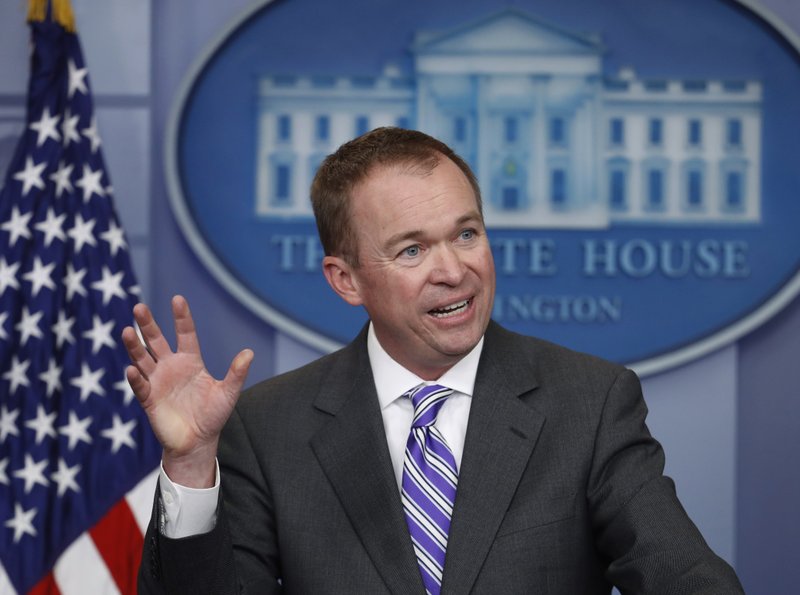
President Donald Trump is proposing a huge $54 billion surge in U.S. military spending for new aircraft, ships and fighters in his first federal budget while slashing big chunks from domestic programs and foreign aid to make the government “do more with less.” The Trump blueprint, due in more detail next month, would fulfill the Republican president’s campaign pledge to boost Pentagon spending while targeting the budgets of other federal agencies. The “topline” figures emerged Monday, one day before Trump’s first address to a joint session of Congress, an opportunity to re-emphasize the economic issues that were a centerpiece of his White House run. Domestic programs and foreign aid would as a whole absorb a 10 percent, $54 billion cut from currently projected levels — cuts that would match the military increase. The cuts would be felt far more deeply by programs and agencies targeted by Trump and his fellow Republicans, like the Environmental Protection Agency as well as foreign aid. Veterans’ programs would be exempted, as would border security, additional law enforcement functions and some other areas. “We’re going to start spending on infrastructure big. It’s not like we have a choice — our highways, our bridges are unsafe, our tunnels,” the president told a group of governors at the White House on Monday. He added, “We’re going to do more with less and make the government lean and accountable to the people.” However, Trump’s final version of the budget is sure to leave large deficits intact — or even add to them if he follows through on his campaign promise for a huge tax cut. His plan faces strong opposition from Democrats, who possess the power to block it. The immediate reaction from Republicans was mixed, with prominent defense hawks like Sen. John McCain of Arizona saying it would do too little to help the Pentagon and fiscal conservatives and supporters of domestic agencies expressing caution. The White House indicated that the foreign aid cuts would be particularly large. Asked about those plans, top Senate Republican Mitch McConnell of Kentucky would say only, “We’ll see how it works out.” A congressional showdown is inevitable later this year, and a government shutdown a real possibility. White House Budget Director Mick Mulvaney said the spike in Pentagon spending would bring the total defense budget to a record $603 billion — and that’s before including tens of billions of dollars for overseas military operations. The United States already spends more on defense than the next seven countries combined, but military leaders have complained repeatedly that aircraft are aging. Congress was told recently that the average age of Air Force aircraft is 27 years, and more than half of the service’s inventory would qualify for antique vehicle license plates in Virginia. “It is a true America first budget. It will show the president is keeping his promises and will do exactly what he said he was going to do,” Mulvaney said. “It prioritizes rebuilding our military, including restoring our nuclear capabilities, protecting the nation and securing the border, enforcing the laws currently on the books, taking care of vets and increasing school choice.” The border wall would cost $2.9 billion in 2018, according to draft documents for the Department of Homeland Security, which assume the agency would hire 500 new members of the Border Patrol and 1,000 new Immigration and Customs Enforcement agents next year. Detention beds for apprehended immigrants would receive $2 billion over current-year spending. The Transportation Security Administration ticket fee would increase by $1 to $6.60 for each one-way flight. Senate Democratic leader Chuck Schumer of New York said, “It is clear from this budget blueprint that President Trump fully intends to break his promises to working families by taking a meat ax to programs that benefit the middle class.” Mulvaney said the plan wouldn’t add to the budget deficit — currently projected to hit about $500 billion next year — but it wouldn’t reduce it, either. The administration again made clear that the government’s largest benefit programs, Social Security and Medicare, would be exempt from cuts when Trump’s full budget submission is released in May. GOP Rep. Mike Simpson of Idaho, a member of the Appropriations Committee, said the large cuts Trump envisions making to domestic programs won’t fly. “There’s a lot of members that have a lot of interest in a lot of these programs,” Simpson said. “There’s more to our government than just defense.” But McCain said Trump’s Pentagon plans would fall short by almost $40 billion and represent just a small increase over former President Barack Obama’s recent Pentagon wish list. “With a world on fire, America cannot secure peace through strength with just 3 percent more than President Obama’s budget,” said McCain, chairman of the Armed Services Committee. On Monday, tentative proposals for the 2018 budget year that begins Oct. 1 were being sent to federal agencies, which will have a chance to propose changes. Before the new budget year, there’s an April 28 deadline to finish up spending bills for the current 2017 budget year, which is almost half over, and any stumble or protracted battle could risk a government shutdown then as well. There’s expected to be an immediate infusion of 2017 cash for the Pentagon of $20 billion or more, and also the first wave of funding for Trump’s promised border wall and other initiatives like hiring immigration agents. Republished with permission of The Associated Press.
Martha Roby: Automatic spending growth is unsustainable

Every American should be concerned about the growing national debt and the out-of-control government spending that contributes to it. Frankly, I believe this issue isn’t discussed enough on the national level. While the complexity of government debt and deficits might not make for exciting television news, Washington’s spending problem will have real and profound consequences for all of us if it isn’t addressed. Most everyone agrees with the need to eliminate waste, fraud and abuse in the budget. Generally, the federal government needs to be smaller, and some functions ought to be left to the states as I believe our founders intended. However, even the most aggressive restructuring of government would only scratch the surface of the true problem because of deeper-seated spending issues that aren’t often explained and discussed. There are two basic types of federal spending. The first is discretionary, which Congress votes to authorize and appropriate each year to fund the functions of government, such as the military and the various agencies. The second type is mandatory or automatic spending, which funds social benefit programs like Social Security, Medicaid and Medicare. This type of spending does not require annual authorization by Congress, but rather continues in perpetuity relying on set rules to determine eligibility. This automatic spending accounts for more than two thirds of all government spending and is by far the largest contributor to the national debt. So, the funding Congress works all year to allocate only adds up to less than a third of all spending. The rest continues on “autopilot,” growing at an unsustainable rate without so much as a vote. To change the way these programs are funded requires actively changing the law. If current policies remain in place, automatic spending will consume as much as 78 percent of all federal spending in just ten years. That’s because costs for Medicare, Social Security and Medicaid will each nearly double by 2026, according to the nonpartisan Congressional Budget Office (CBO). There are serious consequences to the unrestrained growth of “auto-pilot” programs. First, out-of-control costs jeopardize the long-term solvency of programs people depend on for their health and livelihood. Second, as automatic spending grows its share of the budget, the share of everything else shrinks. That threatens our ability to properly fund other functions of government, from the military to transportation infrastructure to veterans benefits. Finally, uncontrolled growth in automatic spending will continue to add to the already unhealthy national debt. CBO estimates that interest on the debt alone will exceed $5.7 trillion over the next ten years. What is the solution? Bringing the federal budget into balance will require smart reforms to social benefit programs to control costs combined with significant growth in the economy to generate revenue. Fair and sensible policy reforms such as premium support for Medicare and a pro-growth overhaul of the tax code would be good places to start. In any case, there must be a more robust discussion with the American people about the fiscal calamity we are facing down the road and what can be done to avoid it. • • • Martha Roby represents Alabama’s 2nd Congressional District. She lives in Montgomery, Alabama, with her husband, Riley and their two children.
