
Rob Vaughn introduced as new University of Alabama head baseball coach

The University of Alabama has chosen Rob Vaughn to lead the Alabama baseball team. The announcement was made on Tuesday at a press conference at the Mal Moore Athletics Facility attended by University of Alabama President Stuart Bell, Coach Vaughn, and Alabama Athletic Director Greg Byrne. “I want my program to be known for two things: culture and development,” Vaughn said. “It’s what we’re all about. It’s what I care about as a coach. My goal is that this group of people that I get to coach and we get to work alongside, will finish their time here equipped to be unbelievable dads, unbelievable husbands, and unbelievable leaders. Vaughn spent the last six seasons coaching at the University of Maryland. “There’s a lot of excitement around your first few days on campus,” said Vaughn. “I’ve had the opportunity to spend the last day and a half around the young people from the 2023 team, around JJ (Associate Head Coach Jason Jackson) and the rest of the coaching staff just getting to be a fly on the wall and listen to the way they communicate. As you do that, it becomes very, very evident and very clear how they were able to do what they did (this past season), and I’m so proud to get to be a small part of that.” “As I looked at ‘why Alabama?’” Vaughn continued, “You have the easy stuff. You have the SEC, and obviously, this is the most competitive brand of baseball there is. As a young kid, you always aspire to play there, and as a young coach, you always aspire to coach in and to have the opportunity to stand here to be a part of this and to get to coach these young people moving forward. That is something that we are so excited about. We understand what comes with that. There is pressure and a lot of expectations, especially based on what the 2023 team just did, but that’s what we want. That’s what we’re built for.” “Today is an exciting day for Alabama Athletics as we welcome Rob Vaughn as our new head baseball coach,” Byrne said. “As I mentioned, a lot has happened with our program over the last six weeks, but I’m so incredibly proud of the way our team finished out the season. I’ve been around this game for a long time, and this is as fine a group of young men as I’ve been around in any baseball program. Everybody around the program knows it, and even in our early conversations with Coach Vaughn, he says he can sense the same thing.” Vaughn led the Maryland Terrapins to a 183 and 117 record, with an 84 to 54 mark in conference play. The University of Alabama fired head baseball Coach Brad Bohannon midseason after he was implicated in a game-fixing scandal involving legal sports betting in Ohio. Despite the drama swirling around the program, the Tide was still able to make a deep NCAA playoff run under interim coach Jason Jackson, eventually losing to Wake Forest in the Super Regionals on Sunday. To connect with the author of this story or to comment, email brandonmreporter@gmail.com.
Gun laws, campus policies perplex college sports programs
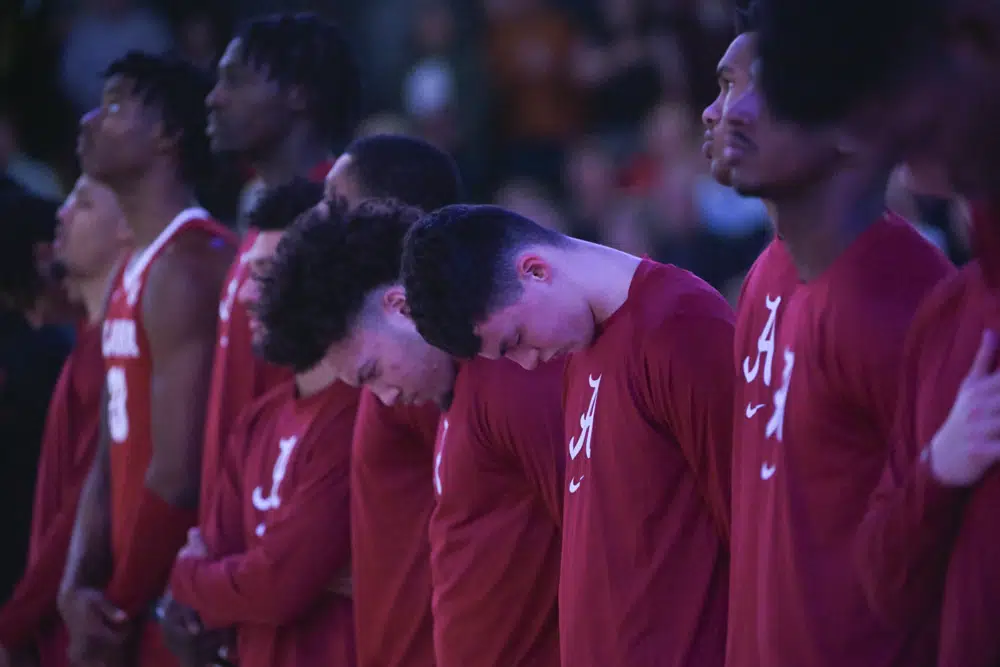
At Alabama, one of the team’s best players allegedly delivered a gun that was used in a fatal shooting. At New Mexico State, a player avoided charges for shooting and killing a student in what he said was self-defense, even though he was carrying a gun in violation of school rules. At Michigan State, sports were suspended after gun violence on campus left three students dead. At LSU, the team’s leading wide receiver was arrested, but not charged, for carrying a gun through the French Quarter in New Orleans. The headlines over the past few months illustrate the challenge for athletic departments in determining how gun laws in their states and regulations at their schools should be applied to their programs and communicated to their players. An Associated Press analysis of more than a dozen schools in the NCAA tournaments shows a wide range of policies that govern guns at those schools and uneven efforts to regulate them. “I have no idea,” Michigan State basketball coach Tom Izzo told AP when asked what he should say to players who legally possess a gun. “Whatever the law is, you can’t supersede the law on your team or in your program.” Mississippi State coach Chris Jans, when asked about his own team’s gun policy: “That’s a good question. Not sure I know the correct answer to that right now.” The NCAA has no gun policy on its books, calling it a law-enforcement issue. That means rules for sports teams, if they exist, are derived from a mixture of state laws, university policies and, in some cases, supplements to those policies in the student-athlete handbooks. In some instances, coaches implement their own team rules. But as cases across the country have shown — just in the past four months alone — there is confusion, mixed messages and what some perceive as seat-of-the-pants decision-making on issues that can have life-or-death consequences. Marquette coach Shaka Smart said he’s been “yelled at by my superiors” over the years when he brings up sensitive topics such as guns to his players. So, he says, he treads lightly on the subject. “Now, should you be driving around with a gun in your glove compartment or whatever?” Smart said. “I’m not passing judgment on anyone anywhere else as it relates to that. But no, our players should not be doing that and I should not be doing that. And so I don’t, and they don’t.” Guns are prohibited in buildings on the Marquette campus in Milwaukee. At Kansas State, concealed weapons are allowed on campus, so long as they are legally owned. “We have to explain to them why we feel like one decision may be, in this moment in time, a little more prudent than another decision in another moment of their life,” K-State coach Jerome Tang said. “Like, later on in life, if they want to get a license, that’s fine. But right now, in this moment, it may not be as wise for you.” The AP’s analysis found that in many instances, school policies differ from state to state, and sometimes from campus to campus within the same state. Most student-athlete handbooks simply reiterate school policy regarding weapons. In Texas, open carry is not allowed at either the University of Houston or at the University of Texas in Austin, the site of a 1966 mass shooting from the clock tower on campus. But concealed carry is allowed in some areas of each campus, the listings of which are available on the school websites. The NCAA bans guns on the premises of its championship events, presumably meaning the Final Four sites — in Dallas (women) and Houston (men) — will be gun free. In Alabama, a state law that went into effect this year made it legal to openly carry a gun without a permit. Still, guns are prohibited on campus. Police say Alabama star Brandon Miller delivered a gun to a teammate and another person who are charged with the Jan. 15 fatal shooting of 23-year-old Jamea Harris. Miller has not been charged with a crime and has continued to play for his team, which is the overall top seed in the tournament that gets into full swing Thursday. But the school’s handling of Miller’s status in the aftermath of the shooting underscores the confusion over the topic. There was more than a month between the killing and police testimony that Miller had brought the gun to his teammate, Darius Miles, who was removed from the team after he was charged, then later indicted, in Harris’ death. “Our role in a criminal investigation is to support law enforcement, not to conduct our own investigation — and not to interfere with their efforts,” athletic director Greg Byrne said in an ESPN interview. At New Mexico State, campus officials appeared unprepared to deal with a shooting that resulted in the death of a student from University of New Mexico. NMSU forward Mike Peake said he was acting in self-defense when he shot and killed Brandon Travis last November while the Aggies were on a road trip in Albuquerque. Guns are prohibited on New Mexico State’s campus and on school road trips. Still, police say Peake brought the gun with him on the team bus; it took the school 16 days to permanently suspend him from the team after the shooting. “I don’t know if it’s a rule you talk about with the players, that you can’t bring a gun on the bus,” said Rus Bradburd, a former coach and current professor at New Mexico State whose book, “All the Dreams We’ve Dreamed,” tells the story of gun violence and basketball in Chicago. “But do you need to write that down? It’s like, I always wear pants to a faculty meeting, but that’s not anywhere in the bylaws. It’s sort of understood.” LSU receiver Malik Nabers was disciplined by the school (no specifics were given) but will not miss games next season after being arrested for illegally carrying a weapon on Bourbon Street last month. Had the incident happened on a busy
Nick Saban tapes message encouraging Alabamians to get vaccinated
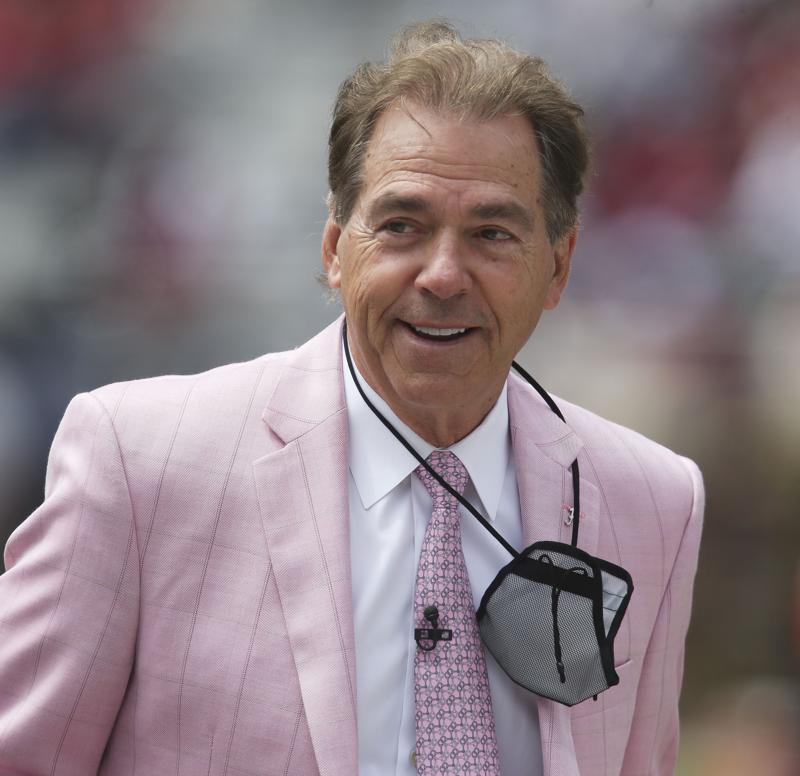
Alabama football coach Nick Saban and other sports figures have taped a public service announcement encouraging Alabamians to get the COVID-19 vaccine. The Alabama Department of Public Health says Saban and others, including former NBA star Charles Barkley, participated in the PSA saying vaccinations are the way to make sure sports stadiums are filled and “loud again” this fall. “College football fans and players both want full stadiums this fall. Let’s make sure we can safely make this happen by getting vaccinated. Please get your COVID-19 vaccine,” Saban says in the spot, according to a script provided to The Associated Press. “We want Bryant-Denny Stadium loud again this coming season and Roll Tide!” The public service announcement is expected to be released next week. It comes as state health officials are looking for ways to boost lagging vaccination rates and persuade people to sign up for shots. Less than 25% of Alabamians have been fully vaccinated, which ranks last nationally, according to the Centers for Disease Control and Prevention. The public service announcement is part of a campaign by the Alabama Department of Public Health to address vaccine hesitancy, State Health Officer Scott Harris said. University of Alabama athletic director Greg Byrne has said the school intends to allow 100% capacity next season for the defending national champions. Byrne posted a tweet saying he appreciated “Coach Saban’s leadership encouraging vaccination.” Republished with the permission of the Associated Press.
Virus wreaking havoc on SEC with Nick Saban now testing positive
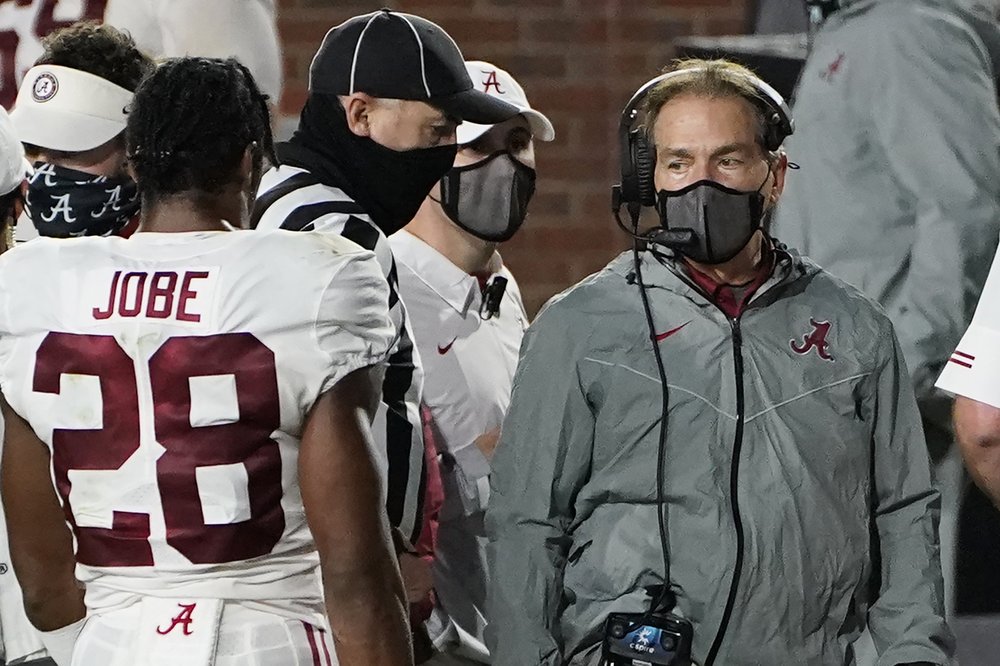
The Southeastern Conference had to postpone two games in the last three days because of positive COVID-19 tests, and now Alabama coach Nick Saban and his athletic director have tested positive for the virus ahead of the league’s biggest regular-season showdown. Saban said in a statement Wednesday that he’ll be working from home with offensive coordinator Steve Sarkisian overseeing the second-ranked Crimson Tide’s preparations to play No. 3 Georgia on Saturday night. “At this time, I do not have any symptoms relative to COVID, and I have taken another PCR test to confirm my diagnosis,” said Saban, whose AD Greg Byrne also tested positive. No. 10 Florida’s game against defending national champion LSU was postponed Wednesday to tentatively Dec. 12 after the SEC postponed Missouri-Vanderbilt on Monday. More positive tests could derail other games after the league waited until the end of September to kick off the season due to the coronavirus pandemic. The Gators started testing daily Sunday and paused activities Tuesday after 19 positives with about a dozen more quarantined through contact tracing. Athletic director Scott Stricklin said they had 18 positives among scholarship players plus three walk-ons for a total of 21. That left the Gators with less than 50 scholarship players available. Stricklin said it can sneak up on a team in a hurry and the key is hitting the brake. “The SEC schedule was set up with something with an event like this in mind,” Stricklin said. “As much as we want to give our kids the opportunity to compete, we understand this isn’t a normal year and we’re going to have to have the ability to adapt to unusual circumstances such as this.” Florida is hoping those numbers don’t rise further, not that coach Dan Mullen wanted to speculate on the tests. “We’re certainly hoping and everybody that we’ve worked for getting these tests back before we conduct any team activity to make sure that we’re keeping everyone as safe as possible,” Mullen said. Vanderbilt coach Derek Mason is going through a similar situation. He said his Commodores (0-3) are a “shell” after he had an estimated group of players in the “high 40s” available for practice Wednesday with a couple of coaches involved in this outbreak. Vanderbilt has an open date Oct. 24 and won’t play again until hosting Mississippi on Oct. 31. Mason also noted this issue isn’t a Vanderbilt problem, noting how the NFL’s Tennessee Titans were down for 16 days while testing players daily. Every coach will be watching to see how many players are available the rest of this season. “For college football, it’s a red flag or something that we really have to be aware of in terms of understanding that we don’t control everything,” Mason said. Ole Miss coach Lane Kiffin said his Rebels are dealing with their first COVID-19 issue of the season. He called it a “big challenge” for a team already banged up after a very physical game in a 63-48 loss to No. 2 Alabama. His Rebels (1-2) are scheduled to visit Arkansas (1-2) on Saturday after their 63-48 loss to No. 2 Alabama. Kiffin wouldn’t be more specific. “Just like injuries, we’re not going to get into details on that,” Kiffin said. “We’re just trying to manage it the best we can. Ole Miss, like Vanderbilt and now Florida, could quickly find the game schedule changing depending on the next batch of test results. “I hope not,” Kiffin said of a potential postponement. “If we were to play today, we could play. So hopefully it stays that way.” Tennessee coach Jeremy Pruitt said Monday that he had his entire team together for just the third straight week after testing and tracing had left players sidelined in isolation or quarantine. Georgia coach Kirby Smart said he knows his team is one exposure away from having an issue. “We’ve been very fortunate so far, but we don’t have our test results back even from this week,” Smart said Tuesday. Vanderbilt already was hit hard by having so many players opt-out of this season because of the pandemic. The number has been reported as six Commodores opting out, including the kicker and four offensive linemen. Mason said Wednesday that total is closer to 10, which would be an SEC-high. The numbers coaches will be monitoring most closely will be how many scholarship players are available. To play, the SEC requires at least 53 on game days. Vanderbilt had only 56 last weekend in a 41-7 loss to South Carolina. Having an open date should help Vanderbilt suit up enough players to play Oct. 31. Mason said Vanderbilt has anyone who tests positive go into isolation for 10 days, followed by cardiac screening and then a cardiac MRI adding another three days to the process. Players also need at least three or four days of conditioning to play. Timing is critical depending on the day of the week a positive test or tracing result returns. “Every time you’re taking a test,” Mason said, “you’re crossing your fingers … you don’t have anybody in harm’s way.” Republished with the permission of the Associated Press.
Nick Saban, Alabama players hold protest march on campus

The group marched the short distance Monday on the school’s campus from the Mal M. Moore Athletic Facility to Foster Auditorium.
Alabama college crowds raise questions about pandemic safety

Police already are “depleted and exhausted,” and leaders don’t want to add to restrictions that already include early closing times and crowd limits at nightspots.
