
Gov. Kay Ivey signs bill to protect patients right to receive visitors
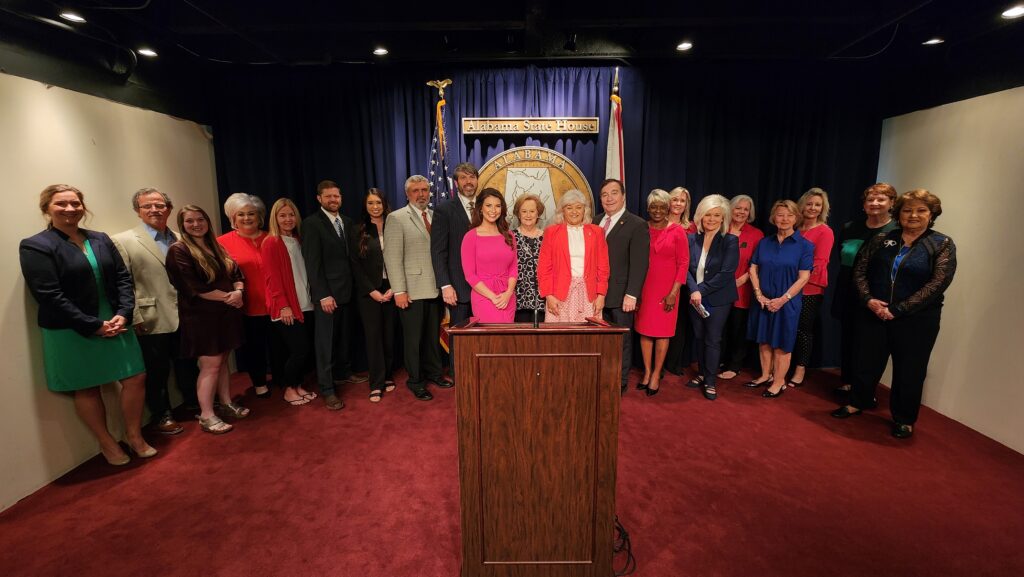
Governor Kay Ivey held a formal bill signing ceremony for legislation on Thursday, strengthening patients’ rights by allowing their family members to be present in a hospital room. Senate Bill 113 (SB113) was sponsored by State Senator Garlan Gudger. It was carried in the House of Representatives by Representative Debbie Wood. “I was also proud to place my signature on SB 113, allowing hospital and nursing home patients the right to visit with loved ones,” Gov. Ivey said on Twitter. “Certainly, allowing visitation is the right thing to do. Once again, I commend the Legislature on passing these good bills.” “I’m thankful that this bill has corrected that wrong and that we have worked together as a team,” Sen. Gudger said. “Everyone on this stage, Senate and House, passed [this bill] almost unanimously through both chambers, and the process at the State Government worked this time. I’m thankful that our heavenly father has given us tools and attributes to use, and those tools in the state government are the process of getting bills passed that are good bills we can all stand behind.” “We heard an outcry from the public of people who wanted to be with their loved one while they were in a hospital, nursing home, or any kind of healthcare facility,” says Rep. Wood. Wood’s mother died from COVID in 2021, and the family was not allowed into the facility. “What haunted me was the fact my mother may have thought that we abandoned her because we were not with her,” Wood said. “When she needed us the most, we were cut off. That’s what this bill is about.” During the COVID-19 global pandemic, the Centers for Disease Control and Prevention advised that hospitals and nursing homes limit visitation to prevent the spread of the coronavirus strain that was causing the illness. Despite those precautions, 21,133 Alabamians died of the illness. Most died alone while their loved ones were forced to remain outside. Thousands of Alabamians who died of things other than COVID also died in isolation in hospitals and nursing homes – in many cases, the first time they had ever been separated from all their friends and family. One of those who perished was Harold Sachs – the longtime chief of staff of the Alabama Republican Party. SB113 was named the Harold Sachs and Anne Roberts Act. State Sen. Dan Roberts lost his beloved wife, Anne, to the pandemic. He and Gudger set about writing SB113 after an earlier 2021 version of the legislation proved to be ineffective. Roberts and his sons were barred from seeing Anne in 2022, much like the Sachs family was barred from visiting Harold during his final weeks on this Earth in 2020. “This has been a team effort,” said Sen. Roberts. “The Sachs family first kicked off this idea, but it was the result of an outcry that we heard all over the state. Then it was our turn, the Roberts family. We said goodbye to my beloved wife of 42 and a half years, and that was it. All of us were denied the opportunity to be with our loved ones in their final days. Thank you for the support we’ve had from all who are on this stage, but also from others across the state.” Emee Baldwin is the granddaughter of the late Harold Sachs and the founder of PoppysPurpose.org, the grassroots organization that energized people around the state to get behind these bills. “I’m so excited that this bill has passed. [During COVID] Our nurses and doctors did great,” Baldwin said. “They did everything that they could, but sometimes you just need that familiar face in the room with you. You need that familiar touch to be there with you. You need someone there to pray with you, to lay hands over you, just to encourage you and have a smiling face. Thank you to everyone who worked so hard to get this bill passed. It’s truly going to change patients’ lives here in Alabama.” Baldwin now serves as a neonatal intensive care nurse in Birmingham. The Harold Sachs and Anne Roberts Act is set to take effect immediately. Tuesday will be day 16 of the 2023 Alabama Regular Legislative Session. To connect with the author of this story or to comment, email brandonmreporter@gmail.com.
Governor Kay Ivey signs legislation to give patients the right to receive visitors
On Tuesday, Alabama Governor Kay Ivey signed legislation into law that protects the rights of hospital and nursing home patients to receive visitors. “The ability to visit a cherished loved one, whether in a hospital or nursing home, should be a fundamental right,” Ivey stated. However, all over the country, during the pandemic, many family members, caregivers, and even clergy were denied access to visit and provide emotional support to patients in healthcare facilities. Such restrictions defy the norms of a caring society, and I was pleased to sign this legislation to signal that in Alabama, we support our patients having this fundamental right.” Senate Bill 113 (SB113) is sponsored by State Sen. Garlan Gudger. It was carried in the House by Rep. Debbie Wood. Senate Bill 113 requires healthcare facilities to adopt specific visitation policies. The bill provides that patients have a right to visitation and can designate an essential caregiver. It also guarantees that the caregiver has visitation rights. “I supported that bill,” said Speaker of the House Nathaniel Ledbetter. “It is only fair.” Thousands of Alabamians have died without their loved ones present since COVID restrictions began in 2020. “I would hate to know that I couldn’t visit my loved one,” Ledbetter said. Rep. Wood explained that patients could change their caregivers while in the hospital. For example, one adult child could be the designated caregiver on one day and their sibling on the next. Wood also said the bill prohibits a healthcare facility from requiring visitors to show proof of vaccination. They are also prohibited from banning consensual physical contact between visitors and patients. The Alabama Department of Public Health (ADPH) will be tasked with requiring healthcare facilities to provide visitation policies to the Department of Public Health. That visitation policy cannot be more restrictive than the policy that the hospital has for its staff. ADPH will develop a mechanism for complaints to be lodged and will have a page on its website that explains the visitation rights law. SB113 also provides for certain immunity from liability. A doctor may, in certain circumstances, exempt a psychiatric care facility from the visitation requirement. The bill is named after Harold Sachs – the longtime Chief of Staff of the Alabama Republican Party. Sachs was diagnosed with COVID-19 and pneumonia in late 2020. His condition deteriorated quickly, and after a few weeks, he passed away. Sachs’ family – like many Alabama families- were not allowed to visit Harold in the COVID-19 ward. The Sachs family for their efforts in getting the bill passed. The bill also was amended to include the name Ann Roberts in the title. Ann Roberts was the wife of State Sen. Dan Roberts. She lost a long battle with COVID-19 in 2021. SB113 passed the Alabama House of Representatives 100 to 1. SB113 has already passed the Senate on a 33 to 0 vote. Wednesday will be the 12th legislative day of the 2023 Alabama Regular Legislative Session. The Alabama Constitution limits the legislature to no more than thirty legislative days in a regular session. To connect with the author of this story or to comment, email brandonmreporter@gmail.com.
Legislature passes bill guaranteeing the rights of patients to receive visitors

On Thursday, the Alabama House of Representatives voted in favor of legislation that would guarantee that family members may spend time with their sick and dying loved ones in an Alabama hospital or nursing home. The legislation has already passed the Senate, so it now is in the Governor’s office awaiting her signature. Senate Bill 113 (SB113) is sponsored by State Sen. Garlan Gudger. It is being carried in the House by Rep. Debbie Wood. SB113 requires healthcare facilities to adopt certain visitation policies. Specifically, it provides that patients have a right to visitation. Patients are allowed to designate an essential caregiver, and this bill guarantees that that caregiver has visitation rights. Rep. Wood explained that a patient could change their caregiver while in the hospital. For example, one adult child could be the designated caregiver on one day and their sibling on the next. Wood also said that the bill prohibits a healthcare facility from requiring visitors to show proof of vaccination. They also are prohibited from banning consensual physical contact between visitors and patients. Wood explained that the Alabama Department of Public Health (ADPH) will be tasked with requiring healthcare facilities to provide visitation policies to the Department and of Public Health. That visitation policy cannot be more restrictive than the policy that the hospital has for its staff. ADPH will develop a mechanism for complaints to be lodged and will have a page on its website that explains the visitation rights law. SB113 also provides for certain immunity from liability. Woods said that a doctor may, in certain circumstances, exempt a psychiatric care facility from the visitation requirement. The legislature passed a bill last year establishing patients’ visitation rights, but that bill was virtually unenforceable. “Last year, we passed House Bill 521,” Wood said in Committee. “The problem was we still had family members who were not able to get into see their loved ones.” This bill would allow a health care facility to suspend in-person visitation of a specific visitor if a visitor violates the facility’s policies and procedures.” The impetus for this bill resulted from highly restrictive (in many cases – complete and total bans on visitations) during the COVID-19 global pandemic. The bill is named after Harold Sachs – the longtime Chief of Staff of the Alabama Republican Party. Sachs was diagnosed with COVID-19 and pneumonia in late 2020. His condition deteriorated quickly, and after a few weeks, he passed away. Sachs’ family – like many Alabama families- were not allowed to visit Harold in the COVID-19 ward. Woods credited the Sachs family for their efforts in getting the bill passed. The bill also was amended to include the name Ann Roberts in the title. Ann Roberts was the wife of State Sen. Dan Roberts. She lost a long battle with COVID-19 in 2021. State Rep. Mary Moore felt that the bill went too far in limiting a hospital’s ability to pass rules to prevent the spread of disease. SB113 passed the Alabama House of Representatives 100 to 1. SB113 has already passed the Senate on a 33 to 0 vote. It now goes to Governor Kay Ivey for her consideration. Ivey could sign the bill into law, or she could veto it and send it back to the Legislature with a recommendation for changes. It takes a simple majority of each house of the legislature to override a governor’s veto in Alabama. Tuesday will be the eighth legislative day of the 2023 Alabama Regular Legislative Session. The Alabama Constitution limits the legislature to no more than thirty legislative days in a regular session. To connect with the author of this story or to comment, email brandonmreporter@gmail.com
House Committee advances legislation guaranteeing that patients can have visitors
On Wednesday, the Alabama House Healthcare Committee voted to advance legislation that would guarantee that family members may spend time with their sick and dying loved ones in an Alabama hospital or nursing home. Senate Bill 113 (SB113) is sponsored by State Sen. Garlan Gudger. It is being carried in the House by Rep. Debbie Wood. The bill replaces last year’s patient visitation law. “Last year, we passed House Bill 521,” Wood said. “The problem was we still had family members who were not able to get into see their loved ones.” “Sen. Gudger worked hard to come up with another one with teeth in it,” Wood explained. The synopsis states, “Under existing law, a health care facility must follow certain requirements related to visitation for patients, clients, or residents. This bill would repeal existing law related to healthcare facility visitation and would require healthcare facilities to adopt visitation policies and procedures that meet certain standards. This bill would provide that residents, clients, or patients of a health care facility have the right to visit with any individual of their choosing during the facility’s visiting hours.” “This bill would allow a resident, client, or patient to designate an essential caregiver and would require healthcare facilities to allow essential caregivers at least two hours of daily visitation. This bill would require that any safety-related policies or procedures may not be more stringent than those established for the health care facility’s staff. This bill would prohibit a healthcare facility from requiring visitors to submit proof of vaccination or from prohibiting consensual physical contact between a visitor and a resident, client, or patient. This bill would allow a health care facility to suspend in-person visitation of a specific visitor if a visitor violates the facility’s policies and procedures.” Our healthcare facilities are the greatest asset we have,” Wood said. The bill also defines “end of life.” “End of life means something totally different to different people,” Wood explained. “I would think end of life would mean the last few weeks of life, but to a healthcare facility, end of life might mean the last fifty minutes.” Wood explained that the substitute bill carves out an exception for psychiatric care facilities from the visitation requirements if a doctor signs that the patient cannot receive visitors. During the COVID-19 global pandemic, hospitals and nursing homes banned visitors to try to halt the spread of the SARS-CoV-2 virus. Those measures largely failed, as did vaccine requirements once the vaccine was commercially accessible. Thousands of Alabamians died, many of them believing their family had abandoned them because of the strict limits against visiting the sick and seniors in nursing homes. “We also learn when we go through something traumatic,” Wood said. State Rep. Arnold Mooney said, “Thank you both for your work on this.” “We are a state that respects the dignity of life,” Mooney continued. Rep. Pebblin Warren asked, “Was there any conversation or dialogue with the institutions? The Hospital Association and the Nursing Home Association.” “This bill is a joint effort of everyone to make sure that we have policies and procedures that we The bill is named after Harold Sachs – the longtime Chief of Staff of the Alabama Republican Party. Sachs was diagnosed with COVID-19 and pneumonia in late 2020. His condition deteriorated quickly, and after a few weeks, he passed away. Sachs’ family – like many Alabama families- were not allowed to visit Harold in the COVID-19 ward. “They have been instrumental in pushing this issue,” Wood said. Rep. Paul Lee. is the Chairman of the Healthcare Committee Rep. Mooney made a motion to give the bill a favorable report. The favorable report motion passed unanimously. SB113 has already passed the Senate on a 33 to 0 vote. It could be taken up by the full House of Representatives as early as Thursday. Wednesday is the sixth legislative day of the 2023 Alabama Regular Legislative Session. To connect with the author of this story or to comment, email brandonmreporter@gmail.com.
Longtime Alabama GOP chief of staff Harold Sachs dies

The longtime chief of staff for the Alabama Republican Party has died after what his wife described as a battle with the coronavirus. The Alabama Republican Party on Tuesday announced the death of Chief of Staff Harold Sachs. His family has previously disclosed his hospitalization for COVID-19. Sachs was a longtime fixture of the state GOP. He filled many roles in the party before becoming chief of staff since 2011. “Harold was deeply invested in our mission, but mostly he loved all of the people he met. If you met Harold, you were automatically a friend,” the party said in a statement. His passing brought a multitude of condolence messages from state officials. “Harold was a conservative stalwart whose dedication to advancing the Republican mission will be dearly missed by all who knew him,” Alabama Secretary of State John Merrill said. Republished with the permission of the Associated Press.
