
Alabama Senate passes anti ESG legislation
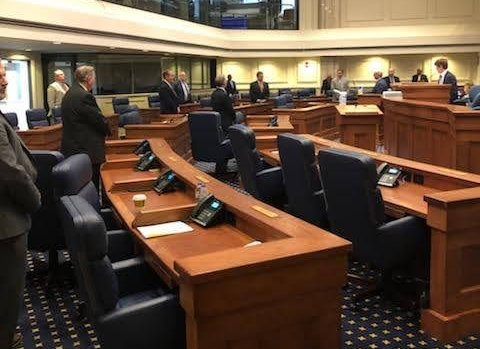
On Thursday, the Alabama Senate passed legislation that would require companies that want state of Alabama contracts to forgo any ESG (environmental, social, and governance) woke corporations or ESGs. Senate Bill 261 (SB261) is sponsored by State Senator Dan Roberts. Senate Bill 261 has been billed as the “strongest” anti-ESG legislation in the nation. The bill prohibits governmental entities from entering into certain contracts with companies that boycott businesses because the business engages in certain sectors, does not meet certain environmental or corporate governance standards, or does not facilitate certain activities. The legislation authorizes the Attorney General to take action to investigate and enforce this act. “I appreciate the support of my colleagues in the Senate for working to pass this legislation,” Sen. Roberts told reporters. “The Alabama Senate has made it clear that we want businesses to focus on growing and expanding and not working to push any political agenda with left-wing ESG policies.” If a company engages in social activism banned by the legislation, it can’t do business with any local or state government. According to the bill, “This bill would prohibit a governmental entity from entering into a public contract for goods or services with certain companies or businesses that engage in the economic boycott of businesses in certain sectors and industries; that fail to meet or commit to meet certain environmental standards; that fail to meet or commit to meet certain corporate governance criteria; or that fail to facilitate certain activities.” Companies would have to sign a verification that it does not engage in boycotts of other companies and industries. Governments can opt out of this provision if they can prove that it would have an adverse economic effect on that government if they can’t do business with that company. The bill states, “The Attorney General shall seek to prohibit the adoption of federal laws, rules, regulations, bulletins, executive orders, or other federal actions that may penalize, inflict economic harm on, limit commercial relations with, or change or limit the activities of a company in the state or a resident of the state based on the furtherance of economic boycott criteria or other similarly oriented rating.” It also protects companies from state or local governments trying to pressure them company into adopting woke political action. “No company in this state shall be penalized, have economic harm inflicted on it, have commercial relations limited, or have the activities of the company changed or limited by a governmental entity because the company will not engage in economic boycotts; will not establish or implement policies, procedures, guidelines, rules, reports, products, services, notices, disclosures, or rates or pricing; will not provide or submit answers to surveys or other information requests or disclosures; will not invest in or divest of certain securities, stocks, bonds, bills, partnerships, or other investment arrangements; or will not initiate other corporate or business practices that further social, political, or ideological interests including, but not limited to, economic boycott criteria or other similarly oriented rating.” Sen. Rodger Smitherman said that the bill was unconstitutional. “I am trying to save you from yourselves,” Smitherman said. “You either don’t know the Constitution or don’t understand the Constitution.” “If you say that they don’t have free expression, you are going to lose,” Smitherman said. “I have been a constitutional law professor for 25 years. Doing something that is unconstitutional just because it feels good does not make sense.” “We have industry in our state that can be hurt by things going on nationally,” Roberts explained. “We are trying to put them in position so they can thrive. We are trying to make sure that they have access to the mother’s milk of capital in the future.” Sen. Bobby Singleton brought an amendment to the committee substitute of the bill. “It was given to me by the governor’s office,” Singleton said. “The finance department; they just wanted to make sure that they are protected in dealing with the state’s debt obligations.” Roberts accepted the Singleton amendment as friendly. “I think this is an anti-business bill,” Singleton said. “You are telling people that do business in the state of Alabama that you can’t have a social conscience.” “This is not a pro-business bill,” Singleton said. “Dan, you are wrong on this one. I will tell you, Dan, that you are wrong on this one.” “You can’t listen to Fox and decide what you are going to do,” Singleton continued. “We can’t be Florida 2.0. We won’t be able to recruit with this on the ground. This is a threat to business. If I don’t sign this paragraph, I can’t do business in Alabama.” Senate President Pro Tempore Greg Reed said, “This is a difficult topic. This is one that is at a national level that we have to deal with.” Roberts left after he learned that his friend, Pastor Harry Reeder, had died driving home from a meeting with Roberts and legislators. Sen. Sam Givhan then assumed the role of advocating for the bill. “We did have great dialogue,” Givhan said of talks with the Alabama business community on the bill. “We had businesses across the gamut in the state of Alabama. We sat down in a room with them, and they presented us with their redlines.” “They are never going to tell you no because they feel vulnerable,” Singleton said. “They know you can pass it anyway.” “They probably walk out of the room and cuss you out once they are out of the room,” Singleton said. “I am sure if they had their way, it would just go away.” Sen Robert Stewart said, “Corporations do have an obligation to be good actors.” Givhan responded, “Their job is to maximize shareholder wealth.” “Why are we trying to tell businesses what they can and can’t do even businesses we do not give incentives,” Smitherman said, “How do we make these God-like decisions? Just because we have authority does not mean that we are God.” Givhan explained the Singleton amendment. “Debt obligations – that is targeted at the bond market,” Givhan said. “There is not
Dr. Harry Reeder dies in a car accident

On Thursday, Pastor Dr. Harry Reeder spoke to the Legislative prayer service in Montgomery. After worshipping and fellowshipping with legislators and policy influencers, he never returned home. The longtime pastor at Briarwood Presbyterian Church PCA died in an automobile crash on I-65. State Senate President Pro Tempore Greg Reed announced the news on the Senate floor at the close of the legislative day. “It has been a sad day,” said Reed. “It has been a difficult day.” “He was a very close personal friend of one of our colleagues,” Reed said. That colleague was State Senator Dan Roberts. Roberts had been in the midst of carrying legislation on the Senate floor when he received the news. Congressman Gary Palmer said on Facebook, “I am heartbroken to hear the news my pastor, Harry Reeder, has passed away. Dr. Reeder was more than a pastor, he was a dear friend, mentor, and a man who understood and exemplified Godly leadership. Harry had an enormous impact on the lives of countless men and women. I will miss his teaching and his friendship, but I’m confident in knowing that one day I will see him again. Ann and I are praying for his family during this time.” Former Alabama Republican Party Chairman and State Senator Bill Armistead said on Facebook, “Today, many in Birmingham and throughout the Christian community in America and the World are grieving the loss of Briarwood Presbyterian Church, PCA Senior Pastor Harry Reeder who was killed in a tragic automobile accident this morning. Pastor Reeder has been a dear friend of mine for 25 years and I was blessed to have lunch with him yesterday along with some other brothers in Christ. As a tribute to Pastor Reeder, I am attaching a link to his daily 10 minute radio program “Today In Perspective” that aired yesterday which provides a Biblical World and Life View analysis of current events and issues. May God bless Pastor Reeder’s family and his family in Christ.” Alabama Citizens Action Program Director and radio host Greg Davis said on Facebook, “In January Dr. Harry Reeder pastor of Briarwood Presbyterian Church, PCA accepted my invitation to speak on May 18th to legislators at the ALCAP – Alabama Citizens Action Program prayer breakfast in Montgomery. He graciously accepted with nothing to gain for himself. He only came from a desire to impact legislators with the gospel and to be with Senator Dan Roberts for Alabama. He arrived last night and visited with me for about an hour. We met early this morning and he spoke to our group. Only God knew it would be his last message as he never made it home. Hear the entire story and my tribute. We hurt his family and the church but Harry is now truly home.” Members of the Briarwood Congregation were informed in a statement from the Church on Facebook that read as follows: “Dear Congregation, It is with a deeply heavy heart that I communicate to you that our Lord has called Pastor Reeder home through a car accident. Please pray for Cindy, Jennifer, Ike, Abby, and their entire family as well as our staff and church family as we all grieve this tremendous loss together. But we do not grieve without hope because we know our pastor is with His Savior and has been received by grace with – “Well done My good and faithful servant.” In Christ our Lord! Bruce Stallings” Dr. Harry L. Reeder III has been the pastor of Briarwood since 1999. He and his wife, Cindy, are natives of Charlotte, North Carolina. They have three children: Jennifer Hay, Harry Reeder IV, and Abigail Leib. They have nine grandchildren. He studied at East Carolina University and finished his bachelor’s degree at Covenant College. After completing his B.A. Degree in History and Bible, he began to attend Tennessee Temple Seminary part-time while serving an Independent Bible Church as a student pastor. Reeder then went into a Pastorate of the Presbyterian Church in America in Miami, Florida—Pinelands Presbyterian Church—while completing a Master of Divinity degree with Westminster Seminary through the Florida Theological Center. Reeder has a Doctor of Ministry Degree from Reformed Theological Seminary, Charlotte, North Carolina. After three years at Pinelands Presbyterian, Reeder became the founding pastor at Christ Covenant Presbyterian Church as their founding Pastor. The ministry began with 38 committed members, and in seventeen years, attendance grew to over 3,000 while planting a number of daughter churches. Reeder also hosted a Bible-teaching radio ministry entitled “In Perspective.” Reeder also hosted a podcast program called “Today in Perspective.” Reeder is the author of The Leadership Dynamic, From Embers to a Flame – How God Can Revitalize Your Church, and other published works, Reeder served as an adjunct faculty member at Reformed Theological Seminary in Charlotte while holding the same status at Birmingham Theological Seminary and Westminster Seminary in Philadelphia, where he also served on the Board of Trustees. To connect with the author of this story or to comment, email brandonmreporter@gmail.com.
