
Donald Trump strains to balance diplomacy, military threat to Iran
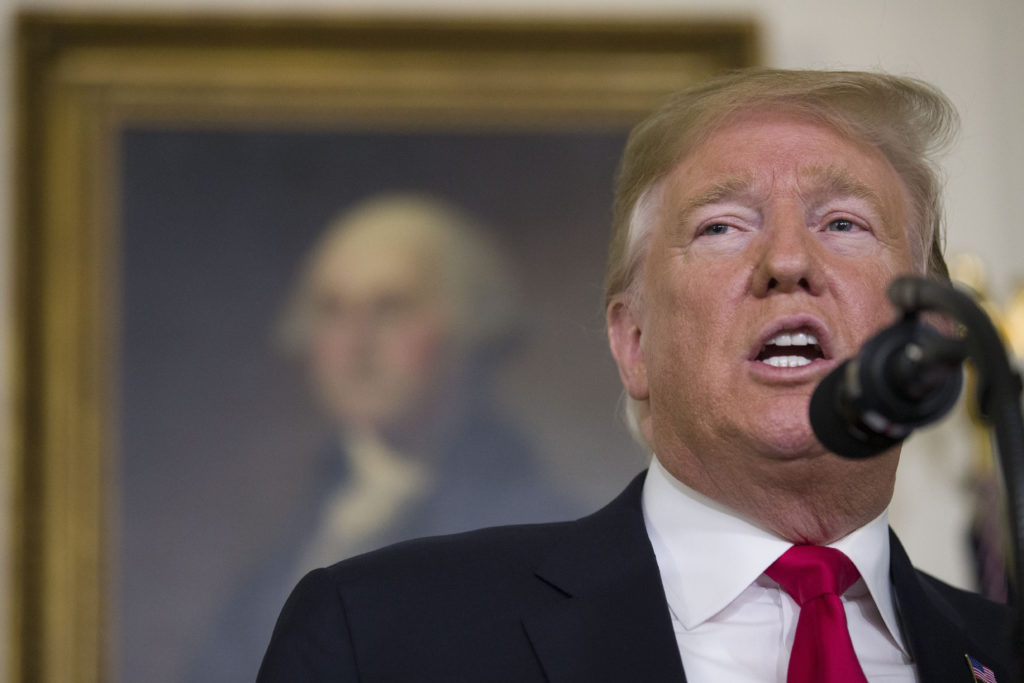
The Trump administration tried to balance diplomacy with fresh talk of military action Tuesday in response to the fiery missile and drone attack on the heart of Saudi Arabia’s oil industry — a strike marking the most explosive consequence yet of the “maximum pressure” U.S. economic campaign against Iran. Secretary of State Mike Pompeo was headed to Jiddah in Saudi Arabia to discuss possible responses to what U.S. officials believe was an attack coming from Iranian soil. President Donald Trump said he’d “prefer not” to meet with Iranian President Hassan Rouhani at next week’s U.N. session but “I never rule anything out.” Iran continued to deny involvement in last weekend’s attack on Saudi Arabia’s Abqaiq oil processing plant and its Khurais oil field, a strike that interrupted the equivalent of about 5 percent of the world’s daily supply. Saudi Arabia’s energy minister said Tuesday that more than half of the country’s daily crude oil production that was knocked out by the attack had been recovered and production capacity at the targeted plants would be fully restored by the end of the month. The Trump administration was moving cautiously as it navigated competing impulses — seeking to keep up a pressure campaign aimed at forcing Tehran to negotiate on broader issues with the U.S. while deterring any further Iranian attacks and avoiding another Middle East war. It all was occurring as the administration deals with a host of other foreign policy issues and has no national security adviser, following the recent ouster of John Bolton. Echoing Trump’s warning from earlier in the week, Vice President Mike Pence said American forces were “locked and loaded” for war if needed. But he also noted that Trump said he doesn’t want war with Iran or anyone else. “As the president said yesterday, it’s ‘certainly looking like’ Iran was behind these attacks,” Pence said. “And our intelligence community at this very hour is working diligently to review the evidence.” The analysts’ task was to connect the dots provided by satellite data and other highly classified intelligence with physical evidence from the scene of the attack, which American-provided Saudi defenses had failed to stop. Fourteen months before voters will decide on Trump’s reelection, he is increasingly mindful of his 2016 campaign promises, including his pledge to bring American troops home after nearly two decades of continuous war. But he also promised to apply fresh pressure on Iran, a pledge complicated by the latest apparent provocation. The at-times divergent messages from his administration, officials say, mirror internal staff divisions and even the president’s own hesitations. “You know, I’m not looking to get into new conflict,” Trump said Monday, “but sometimes you have to.” Aides say he’s taking a prudent pause. “The president’s being cautious, and if he were banging the gong today about Iran being the culprit, inevitably, without presenting the case to the American people, everyone would be saying he’s a warmonger,” said White House spokesman Hogan Gidley. The crisis comes amid upheaval in Trump’s national security team. His national security adviser, Bolton, departed earlier this month after policy clashes, including disagreements over how best to pressure Iran into returning to the negotiating table on its nuclear and missile programs. Iran’s alleged involvement in a recent series of provocations in the Gulf coincides with key moments in the unraveling of the country’s 2015 nuclear deal with world powers, from which Trump unilaterally withdrew the U.S. in May of last year. That was followed by a U.S. economic sanctions campaign, dubbed “maximum pressure,” that has cut off much of Iran’s international oil exports. Iran, in turn, has said that no one will be able to export oil from the region if Tehran can’t In effect, the country has answered Trump’s economic warfare with its own version — attacks on economic targets that have been audacious but thus far not caused casualties. Marine Gen. Joseph Dunford, chairman of the Joint Chiefs of Staff, said Tuesday that U.S. military experts were in Saudi Arabia working with counterparts to “do the forensics on the attack” — gleaning evidence that could help build a convincing case for where the weapons originated. Speaking to reporters in London, Dunford noted — as Trump had on Monday — that the attack was not aimed at the United States or U.S. forces. Therefore, he said, no steps were being taken to beef up the U.S. military presence in the Gulf region, which includes air defense forces and support troops at Prince Sultan Air Base south of the Saudi capital of Riyadh. The U.S. Navy has an aircraft carrier battle group in the area and fighter and bomber aircraft elsewhere in the Gulf. A senior administration official said the U.S. sees a role to play for the U.N. Security Council, which was created to address threats to international peace and security. The U.S. believes the attack meets that threshold, but the administration first needs to “gather the releasable” information and intelligence it has collected about the strike, according to the official, who was not authorized to publicly discuss the attacks and spoke only on condition of anonymity. The security council meets next week in New York. Jon Alterman, director of the Middle East program at the Center for Strategic and International Studies, said Trump must fashion a response to Iran that fits his administration’s stated priority of shifting from decades of insurgency warfare in Afghanistan and the Middle East to better position the U.S. for more serious international conflict. “The military’s instinct is increasingly that you can continue to pour resources into confronting Iran, but you’re never going to fix the problem and, most importantly, you’re taking resources away from confronting the real threats to the United States, which are China and Russia,” he said. Trump also faces a skeptical Congress. A bipartisan group of House members on Monday called for new language in 2020 defense spending bills that would prevent the president from starting a war with Iran without congressional authorization. Pence met behind
Donald Trump’s warlike tweet just one sign of rising Iran tension
President Donald Trump‘s explosive twitter threat to Iran’s leader comes as his administration is ratcheting up a pressure campaign on the Islamic republic that many suspect is aimed at regime change. No one is predicting imminent war. But Trump’s bellicose, all-caps challenge addressed to President Hassan Rouhani followed a speech by Secretary of State Mike Pompeo in which he accused Iran’s leadership of massive corruption and widespread rights abuses and urged Iranians to rise up in protest. Both the tweet and the speech landed less than two weeks before the administration will begin re-imposing sanctions on Iran that had been lifted under the 2015 nuclear deal. In the meantime, the U.S. is stepping up Farsi-language outreach that is intended to support Iranians demonstrating against the policies of their government. Trump’s tweet doesn’t appear to have been prompted by any notable shift in rhetoric from Iran. It could have been an impulsive reaction to reports from Tehran quoting Rouhani as giving the U.S. an oft-repeated reminder that conflict with Iran would be “the mother of all wars.” Yet animosity directed at the Iranian leadership is an established part of the administration’s broader foreign policy. Iran has dismissed Trump’s late Sunday message — “NEVER EVER THREATEN THE UNITED STATES AGAIN OR YOU WILL SUFFER CONSEQUENCES THE LIKE OF WHICH FEW THROUGHOUT HISTORY HAVE EVER SUFFERED BEFORE” — as a “passive reaction” to Rouhani. But, Tehran was already aware of what was coming from the administration as consequences of Trump’s May withdrawal from the 2015 nuclear accord take shape. As Pompeo noted in his speech to Iranian-Americans and others in California late Sunday, the centerpiece of those consequences will be the re-imposition of U.S. economic sanctions; the first batch will go back into force on Aug. 4 targeting the Iranian automotive sector and trade in gold and other metals. A more significant set of sanctions that will hit Iran’s oil industry and central bank by punishing countries and companies that do business with them will resume on Nov. 4. “Right now, the United States is undertaking a diplomatic and financial pressure campaign to cut off the funds that the regime uses to enrich itself and support death and destruction,” Pompeo said in his speech at the Ronald Reagan Presidential Library and Museum in Simi Valley. “We have an obligation to put maximum pressure on the regime’s ability to generate and move money, and we will do so. Pompeo also slammed Iran’s political, judicial and military officials, accusing several by name of participating in rampant corruption, and called its religious leaders “hypocritical holy men” who amassed wealth while allowing their people to suffer. He said the government has “heartlessly repressed its own people’s human rights, dignity and fundamental freedoms,” and he hailed the “proud Iranian people (for) not staying silent about their government’s many abuses.” “The United States under President Trump will not stay silent either,” he said. He was right. True to form, Trump did not stay silent. But the White House blamed Rouhani for inciting the war of words with his comment that “America must understand well that peace with Iran is the mother of all peace and war with Iran is the mother of all wars.” “WE ARE NO LONGER A COUNTRY THAT WILL STAND FOR YOUR DEMENTED WORDS OF VIOLENCE & DEATH. BE CAUTIOUS!,” Trump wrote. Reaction from Congress, particularly Democrats, was swift and critical. Democratic Sen. Jeanne Shaheen of New Hampshire, a member of the Foreign Relations Committee, acknowledged that Iran’s terrorist activities in the Middle East pose a threat but suggested it wouldn’t be solved through a tweet from Trump. “Sadly, after pulling us out of the nuclear deal with Europe and Iran, there doesn’t seem to be strategy for how to move forward to fight Iran’s activities,” she said. And Virginia Sen. Tim Kaine, the former Democratic vice presidential candidate, called the Twitter blast from the White House “another warning sign that Trump is blundering toward war with Iran.” Trump’s National Security Council pushed back: “Our differences are with the Iranian regime’s actions and, in particular, with the actions of the Islamic Revolutionary Guard Corps, not the Iranian people. The Trump administration’s Iran policy seeks to address the totality of these threats and malign activities and to bring about a change in the Iranian regime’s behavior.” “If anybody’s inciting anything, look no further than to Iran,” said White House press secretary Sarah Sanders said. She added that Trump has been “very clear about what he’s not going to allow to take place.” Trump has a history of firing off heated tweets that seem to quickly escalate long-standing disputes with leaders of nations at odds with the U.S. In the case of North Korea, the verbal war cooled quickly and gradually led to the high-profile summit and denuclearization talks. Still there has been little tangible progress in a global push to rid North Korea of its nuclear weapons program since the historic Trump-Kim Jong Un summit on June 12. Republished with permission from the Associated Press.
Iran nuclear deal endangered if Donald Trump seeks to renegotiate its terms
Donald Trump isn’t going to rip up the Iran nuclear deal on day one as president, but his vows to renegotiate the terms and increase enforcement could imperil an agreement that has put off the threat of Tehran developing atomic weapons. Emboldened Republican lawmakers are already considering ways to test Iran’s resolve to live up to the deal. As a candidate, Trump issued a variety of statements about last year’s pact. He called it “stupid,” a “lopsided disgrace” and the “worst deal ever negotiated,” railing against its time-limited restrictions on Iran’s enrichment of uranium and other nuclear activity, and exaggerating the scale of U.S. concessions. Trump said that he doesn’t want to simply tear up the agreement. Instead, he spoke of reopening the diplomacy and declared that unlike President Barack Obama’s diplomats, he would have been prepared to walk away from talks. Trump’s exact plans are vague, however, and a renegotiation would be difficult. Iran has little incentive to open talks over a deal it is satisfied with. And none of the other countries in the seven-nation accord has expressed interest in picking apart an understanding that took more than a decade of stop-and-go diplomacy and almost two full years of negotiation to complete. As Iran’s supreme leader, Ayatollah Ali Khamenei, has said: If the U.S. tears up the agreement, “we will light it on fire.” President Hassan Rouhani said this week no country could simply change what was agreed, pointing to a U.N. Security Council resolution that endorsed the package. The deal, which went into effect in January, forced Iran to pull back from the brink of nuclear weapons capacity in exchange for an end to many of the U.S. and European sanctions that devastated Iran’s economy. It has been largely respected despite undiminished U.S.-Iranian tensions throughout the Middle East, including their support for rival sides in Syria and Yemen’s civil wars. Each side has leverage: Iran doesn’t want a new onslaught of U.S.-led economic pressure and America would be alarmed by any Iranian escalation of its nuclear program. But the accord rests on fragile ground, with powerful constituencies in Washington and Tehran vehemently opposed and looking for any excuse to break it apart. In such a climate, it’s unclear what Trump’s demands for a renegotiation might mean. “The agreement is valid only as long as all parties uphold it,” State Department spokesman Mark Toner acknowledged Wednesday in the agency’s first briefing since Trump’s stunning election victory over Hillary Clinton to become the 45th president. Last summer, Walid Phares, a Trump adviser on the Middle East, said Trump wouldn’t pull out of an agreement with America’s “institutional signature,” but rather revise elements through one-on-one negotiations with Iran or with a larger grouping of allies. Daryl Kimball, executive director of the pro-deal Arms Control Association, said that re-litigating the deal would unsettle American allies, with no clear picture of what Trump would be trying to accomplish. Trump could also send the deal to Congress, whose Republican majority has opposed it. GOP lawmakers are examining a slew of possible actions. Among the likeliest pieces of legislation is one targeting sectors of Iran’s economy supporting ballistic missile work, including those specifically exempted from sanctions under the nuclear deal. Another goes after Iran’s Revolutionary Guard for its military activity in Syria and support of terrorism. Iran could use either as an excuse to push past the limits of the nuclear deal, which may partly explain Republican motivations. Trump has largely avoided talk of killing the agreement, but has said he would police the deal “so tough they don’t have a chance.” The U.N. nuclear agency has confirmed minor Iranian violations, specifically on its stockpiling of heavy water that can be used in plutonium production. It has faced no punishment. Iran also has repeatedly breached a ballistic missile ban that was extended for eight years under the nuclear deal, prompting some limited sanctions from Washington. The Obama administration has been hamstrung. Determined to protect the president’s foreign policy legacy, it has gone above and beyond the agreement’s stipulation that no new nuclear-related sanctions be introduced. When Yemen’s Iran-backed Shiite rebels fired missiles at U.S. Navy vessels, the retaliatory action didn’t extend to Tehran. Nor has Iran faced repercussions for joining Syria and Russia’s offensive in Aleppo, which has drawn U.S. charges of war crimes and crimes against humanity. And whenever top Iranian officials have complained about the speed and scope of their post-deal economic recovery, top Obama officials like Secretary of State John Kerry have served as pitchmen to international banks and companies hesitant about investing in Iran. “It is a whole new reality,” said Mark Dubowitz, an Iran sanctions proponent at the hawkish Foundation for Defense of Democracies. What does he expect from Trump? “No more free lunches for the Iranians, no more unilateral concessions, no more excuses.” Republished with permission of the Associated Press.
