
Texas abortion ban stays in force as justices mull outcome
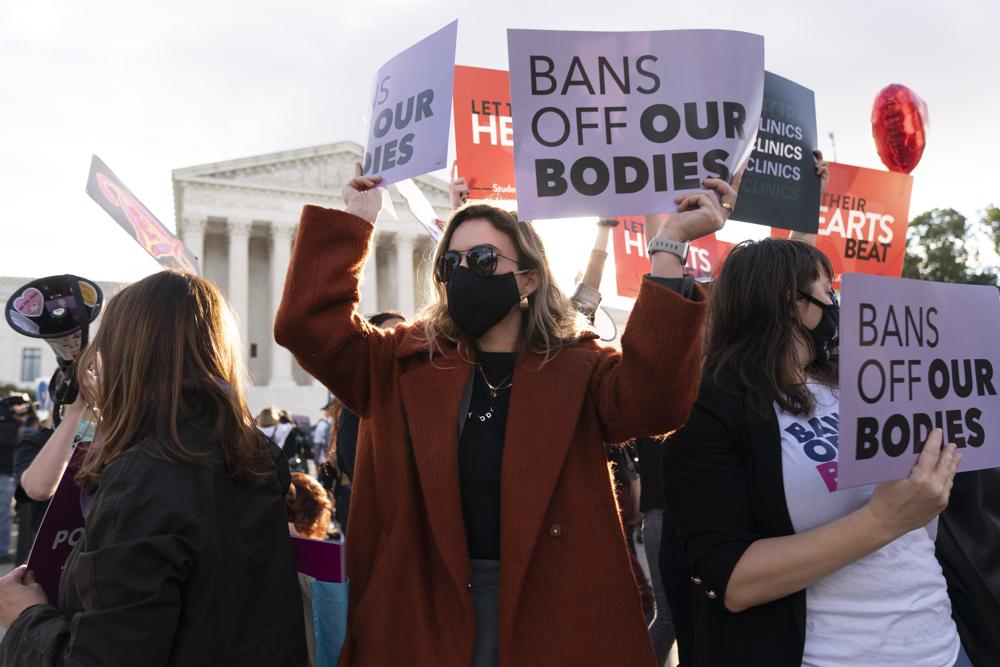
More than two weeks have passed since the Supreme Court’s extraordinarily rushed arguments over Texas’ unique abortion law without any word from the justices. They raised expectations of quick action by putting the case on a rarely used fast track. And yet, to date, the court’s silence means that women cannot get an abortion in Texas, the second-largest state, after about six weeks of pregnancy. That’s before some women know they’re pregnant and long before high court rulings dating to 1973 that allow states to ban abortion. There has been no signal on when the court might act and no formal timetable for reaching a decision. The law has been in effect since Sept. 1, and the court has been unable to muster five votes to stop it, said Mary Ziegler, a legal historian at Florida State University’s law school. “While there is some sense of urgency, some justices had more of a sense of urgency than others,” Ziegler said. Meanwhile, the justices are two weeks away from hearing arguments in another abortion case with potentially huge implications for abortion rights in the United States. The court will take up Mississippi’s call to overrule the two major Supreme Court rulings that, starting in 1973, have guaranteed a woman’s right to an abortion. The state law at issue bans abortions after 15 weeks, well before the point at which a fetus can survive outside the womb. Viability, typically around 24 weeks, has been the dividing line: Before it, states can regulate but not ban abortion. Even before the justices decide what to do about Mississippi’s law and the fate of Roe v. Wade and Planned Parenthood v. Casey, Texas’ law has effectively changed the standard, at least for the time being. It bans abortion after cardiac activity is detected in the fetus, usually around six weeks, and deputizes ordinary citizens to enforce the law in place of state officials who normally would do so. The law authorizes lawsuits against clinics, doctors, and anyone who “aids or abets” an abortion that is not permitted by law. It was designed to make federal court challenges difficult, if not impossible. Federal courts have had no trouble preventing other bans on abortion early in pregnancy from taking effect when they have relied on traditional enforcement. The Texas law is doing what its authors intended. In its first month of operation, a study published by researchers at the University of Texas found that the number of abortions statewide fell by 50% compared with September 2020. The study was based on data from 19 of the state’s 24 abortion clinics, according to the Texas Policy Evaluation Project. Texas residents who left the state seeking an abortion also have had to travel well beyond neighboring states, where clinics cannot keep up with the increase in patients from Texas, according to a separate study by the Guttmacher Institute. The Supreme Court is weighing complex issues in two challenges brought by abortion providers in Texas and the Biden administration. Those issues include who, if anyone, can sue over the law in federal court, the typical route for challenges to abortion restrictions, and whom to target with a court order that ostensibly tries to block the law. Under Supreme Court precedents, it’s not clear whether a federal court can restrain the actions of state court judges who would hear suits filed against abortion providers, court clerks who would be charged with accepting the filings, or anyone who might someday want to sue. People who sue typically have to target others who already have caused them harm, not those who might one day do so and not court officials who are just doing their jobs by docketing and adjudicating the cases. The justices’ history with the Texas law goes back to early September when, by a 5-4 vote, they declined to stop it from taking effect. At the time, five conservative justices, including the three appointees of President Donald Trump, voted to let the law take effect. Chief Justice John Roberts joined the court’s three liberals in dissent. The abortion providers had brought the issue to the court on an emergency basis. After they were rebuffed, the Justice Department stepped in with a suit of its own. U.S. District Judge Robert Pitman granted the Justice Department’s request for an order that put the law on hold. Pitman wrote in a 113-page ruling that the law denied women in Texas their constitutional right to an abortion, and he rejected the state’s arguments that federal courts shouldn’t intervene. But just two days later, the 5th U.S. Circuit Court of Appeals overrode Pitman and allowed the law to go back into effect. The Justice Department made its own emergency appeal to the Supreme Court. Rather than rule on that appeal, the court decided to hear the two suits just ten days later and without the benefit of an appellate court decision. At the arguments, two Trump appointees appeared to have doubts about the Texas law. Justices Amy Coney Barrett and Brett Kavanaugh questioned whether the law allowed people who are sued to air their constitutional claims in court and whether it would lead to a spate of copycat laws on abortion and other rights protected by the Constitution. The court seemed particularly concerned about the “chilling effect” similar laws would produce on other constitutional rights, including speech, religion, and gun possession, said Sarah Marshall Perry, a legal fellow at the Heritage Foundation. The court’s intervention has few counterparts in recent history, and those include Bush v. Gore, the fight over the publication of the government’s secret history of the Vietnam War known as the Pentagon Papers, and Richard Nixon’s effort to keep from handing over the Watergate tapes that ultimately doomed his presidency. The justices have never said why they opted to hear the Texas cases so quickly or how soon they might be decided. The time since the arguments is less than a blink of an eye in high-court terms, where months typically elapse between arguments and a decision. But the justices themselves created the expectation
New report shows every congressional district benefits from Trump’s tax reform

Voters in every congressional district across the country are benefiting from President Donald Trump’s tax reform package, according to a new report released Monday. In the report released by the conservative public policy think-tank Heritage Foundation analysts found “the average household and the average married couple with two kids in every congressional district in every state benefit from the tax cut, both in 2018 and over the next 10 years.” According to the report, due to Trump’s tax reform, the typical household in every congressional district will see a reduction in tax liability in 2018. Nationally, 89 percent of Americans will see either a tax cut or no change, and approximately four million additional low-income filers will not pay any income taxes in 2018. “Districts with smaller average income tax burdens tend to see the largest percentage reductions in their total income tax bills. High-income districts tend to see the largest tax cuts as measured by dollar value,” the report continued. The report did note that their estimates “assume that the tax cuts expire in 2025 and that Washington continues to run large and unsustainable deficits.” “Making the TCJA permanent and reforming spending to align with projected revenues could significantly increase our estimates of the changes in gross domestic product, income, investment, and wages,” it continued. “Repealing the TCJA, on the other hand, would undo its economic gains.”
For Donald Trump, speech a test of foreign policy and style

Donald Trump‘s highly anticipated foreign policy speech Wednesday will test whether the Republican presidential front-runner known for his raucous rallies and eyebrow-raising statements can present a more presidential persona as he works to coalesce a still-weary Republican establishment around his candidacy. Trump’s speech will focus on “several critical foreign policy issues” such as trade, the global economy and national security, according to his campaign. But as much as the content will be scrutinized, so, too, will Trump’s ability to deliver his message in a way that comes off as both presidential and authentic to himself. “This is all part of the normalization effort, or the mainstreaming of Donald Trump,” said Lanhee Chen, who served as 2012 GOP nominee Mitt Romney‘s chief policy adviser and advised Marco Rubio‘s campaign before the Florida senator dropped out of the race. Trump has a lot to prove when it comes to calming foreign leaders and policy professionals. They’ve been stunned by his often brash policy proclamations, like his vow to bar foreign Muslims from entering the country, and an apparent disregard for long-standing alliances. Those concerns were amplified when Trump introduced a foreign policy team last month that left many scratching their heads. Adding to the challenge, said Chen, is that Trump has already articulated foreign policy viewpoints in numerous interviews. “I think he’s made his views clear,” he said. “The challenge is that there isn’t a lot more he can say that will give people comfort about the way he will conduct foreign policy as president.” Trump’s speech is expected to be dressed with the trappings of gravitas. It will be held at Washington’s stately Mayflower Hotel (after a last-minute location change blamed on “overwhelming interest”) and will be presided over by Zalmay Khalilzad, a former U.S. ambassador to Afghanistan and Iraq, according to the campaign. Trump is expected to use a teleprompter, despite the fact that he has mercilessly mocked his rivals for doing the same, declaring at one point: “If you’re running for president you shouldn’t be allowed to use a teleprompter.” The speech comes as Trump has been working to professionalize his campaign with the addition of several new and experienced aides who have stressed the need to expand Trump’s policy shop and offer more specifics on his plans. “Tomorrow’s going to be, I think, interesting,” Trump told reporters Tuesday night. “It’s going to be some of my views on foreign policy and defense and lots of other things, and part of it is economics.” He added, however, that he would not be laying out a “Trump doctrine,” saying that “in life you have flexibility, you have to change.” Senior aide Paul Manafort said last week that he’d met people at a number of think tanks and members of Congress to talk about bulking up the team’s policy component, which is smaller than that of leading campaigns in the past. “We’re finding there’s a lot of interest in working with him, coming on board,” he told reporters. Manafort spent about an hour at the Heritage Foundation headquarters in Washington last week meeting policy experts at the conservative think tank. Heritage officials cast the meeting as part of an ongoing series of briefings for candidates and their advisers. While Trump’s speech marks a departure from his usual rally routine of speaking off the cuff, consulting only hand-scrawled notes, his remarks in front of the American Israel Public Affairs Committee last month provided a test run of sorts, with Trump speaking from prepared remarks using a teleprompter. While Trump largely stuck to his speech as he declared his support for Israel and railed against the Iran nuclear deal, he veered off-script after referring to President Barack Obama‘s last year in office. “Yay,” Trump said, drawing cheers. “He may be the worst thing to ever happen to Israel, believe me.” The asides prompted an unprecedented apology from the group’s president the next day, saying the committee took “great offense” to criticism of the president from its stage. Republished with permission of the Associated Press.
Tom O’Hara: Don’t thank me for my service, just send my disability check

It’s Veterans Day on Wednesday and I’m even more excited than usual. In researching this column, I learned that as a Vietnam veteran I may be eligible to collect VA disability benefits because I have diabetes – even though I’m sure my tedious year at Phu Cat Air Force Base has nothing to do with my blood-sugar levels today. It’s a great time to be a veteran. Gov. Rick Scott and his team are doing everything they can to lure more veterans to Florida. We already have 1.6 million of them here and I doubt they need much coaxing to flee Ohio and New Jersey. Nonetheless, the state has waived out-of-state college fees for vets and offered a buffet of other perks. The college fee waiver is a nifty ruse because few current vets have any interest in getting a college degree. The state has a Department of Veterans Affairs that spends $111 million each year to help more and more vets feed at the government trough. This is very good politics because veterans are overwhelmingly old, white and male. In other words, they vote Republican. And they vote in droves. About 70 percent of America’s 22 million veterans voted in the 2012 presidential election, compared with 56.5 percent of all Americans. Among the vets 65 and older, more than 75 percent cast a ballot. In the 2014 midterm elections, vets voted for Republicans by a 20-percentage-point margin over Democrats in House races, according to The Washington Post. But politicians of every stripe pander to veterans. Even if they don’t vote for you, you sound patriotic and sensitive if you praise them and approve billions of dollars in benefits for them. Veterans account for only 9 percent of the adult population. (I wonder how many people even know a veteran.) Nonetheless, they have extraordinary sway with politicians. Even as the percent of congressmen who served in the military plummets (less than 20 percent today compared with 73 percent in 1971), their urge to throw money at vets escalates. “More than 1.3 million veterans of the Vietnam era received $21 billion in disability pay last year. From Afghanistan and Iraq, the cost was $9.3 billion – but it is growing fast,” the Los Angles Times reported last year. In 1991, the total cost for VA disability payments was $16.6 billion; it’s $50 billion today, the Times reported. Even the Heritage Foundation – a very conservative think tank – is amazed at the exploding veterans largesse. “Nearly 60,000 disabled veterans received cash benefits from three different federal programs simultaneously. More than 2,300 veterans received $100,000 or more in annual benefits each, and the highest annual benefit amounted to more than $200,000,” according to a 2014 foundation article. OK. Where do I sign up? Some guy is getting more than $200,000 by triple dipping into VA disability, military retirement and Social Security disability. And my guess is that he’s a white guy who votes Republican because he’s so disgusted by government waste. I assume this veteran was unperturbed if he had to exaggerate a bit for his benefits. It’s not hard to game the system, however, because it appears VA staff are encouraging the fraud. “A 2014 paper in Psychological Injury and Law identified ‘collusive lying’ between disability-benefits applicants and VA staff as one possible problem” for the soaring costs, according to the Heritage Foundation. Frankly, I’m just jealous. I have not been paying attention. I only recently discovered that you could get a “V” for veteran put on your driver license and get discounts at Home Depot and movie theaters. However, I’m going for the big time now: the diabetes claim. In 2001, the VA added Type 2 diabetes to the list of disabilities. The disease has not been definitely linked to Agent Orange, but veterans groups lobbied to include it, according to the LA Times. “Through 2013, the number of veterans receiving compensation for diabetes climbed from 46,395 to 398,480,” the Times reported. So if you see me on Veterans Day, don’t thank me for my service. Just give me directions to the Veterans Affairs disability claims office so I can get started on my paperwork. Tom O’Hara is a veteran newspaperman. He is the former managing editor of The Palm Beach Post and the Plain Dealer in Ohio.
Conservative group calls on governor to reject federal Ex-Im Bank
In a letter circulated by Rainy Day Patriots, executive director Zan Green and state co-chair Ann Eubank chided Gov. Robert Bentley for his support for the 71-year old Export-Import bank, a trade credit agency created by Congress to facilitate international commerce. The group called the institution “a fund for corporate welfare,” and echoed sentiments from President Barack Obama who has opposed the extension of the bank’s charter. The group also praised Alabama U.S. Rep. Gary Palmer for opposing the bank as well, saying it is a relic of the past that no longer serves a legitimate public purpose, and instead has become a piggy bank for governmental financial adventures. “The bank largely benefits large corporations that shell out millions for multitudes of lobbyists to descend upon the lawmakers and bureaucrats in DC to secure funding for their exports — something that most small business owners cannot afford to do,” Green and Eubanks wrote. “For example, the bank loaned nearly half a billion dollars to First Solar — to sell solar panels to itself. It is past time for the bank to expire.” The group also criticized the other members of Alabama’s congressional delegation, linking to an item on the website for the conservative Heritage Foundation’s Action for America organization that lists 83 House members who have publicly voiced their opposition to the bank’s continued existence. The Rainy Day Patriots likened their efforts to that of the state Senate, which roundly rejected Bentley’s support for expanding Medicaid in the state to draw down federal healthcare dollars, a deeply unpopular position among state Republicans. “Our Alabama congressmen should reject Governor Bentley’s advice on the Ex-Im Bank, just as our State Senate resoundingly rejected Governor Bentley’s desire to expand Medicaid. Congressman Palmer deserves our gratitude, and it’s time for the rest of Alabama’s congressmen to join him,” the letter concluded.
