
House committee hears debate over prison transformation bill
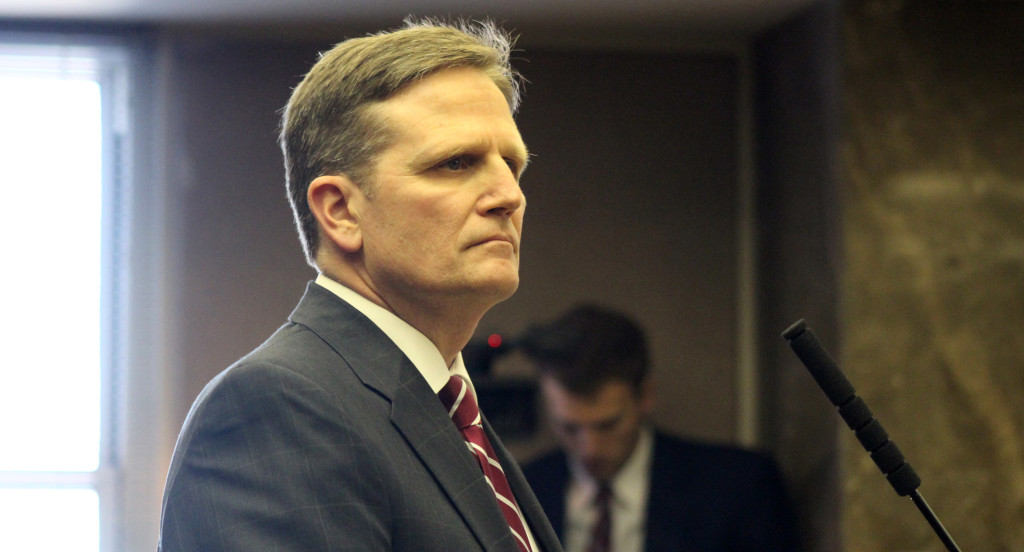
One of the hallmark ideas laid out in the “State of the State” address by Gov. Robert Bentley, a plan to demolish all but two of Alabama’s 16 prisons and replace them with four new facilities, went before the House Ways and Means General Fund Committee Wednesday. The Alabama Prison Transformation Initiative Act, HB313, provides for the sale of about $800 million in bonds for the construction of four super-prisons and the renovation of two facilities yet to be determined. The remaining 14 prisons would be demolished. During the committee hearing, it was revealed that these bonds are to be paid by the Alabama Department of Corrections (ADOC), which will pay a lease on the new facilities to the Alabama Corrections Institute Finance Authority (ACIFA). The rent paid to the ACIFA would then be used to pay off the bonds. In order to get a higher bond rating and, in turn, a lower interest rate, the state put up its 1 mill of property tax as collateral on the bonds. Those funds are currently used to help fund the Alabama Department of Veterans Affairs (ADVA). That raised the ire of ADVA Commissioner Clyde Marsh, who said the department wouldn’t be able to function without the money generated from the 1 mill tax. “We can’t do without that,” Marsh said, noting that the funds generated from the tax account for about $34 million in funding. “You’re putting veterans at risk if you do that.” State Finance Director Bill Newton clarified that the ADVA would still receive that money, it was simply “put up” as a way to acquire better rates from Wall Street. Despite that, Rep. John Knight (D-Montgomery) opposed using veterans’ funding as collateral and was joined in his disdain by Rep. Arnold Mooney (R-Birmingham). Mooney recommended offering up hard assets or land as collateral in place of the 1 mill tax, which Newton said he would explore. Additional concern over the bill came from a slew of architects, engineers and contractors who opposed language in the bill that they said would stifle competition and possibly put taxpayer dollars in jeopardy by allowing contractors to hire their own architects to oversee construction. The argument, as it was presented, notes that if contractors are able to hire their own architects or engineers, those workers will serve at the pleasure of the contractor and be less likely to make efforts to ensure the job is done correctly and efficiently. Rhonda Brownstein, Legal Director for the Southern Poverty Law Center, voiced concerns over building new prisons rather than passing further reforms to reduce the number of prisoners in Alabama’s prison system, noting that reforms passed last year have not even been allowed to play out yet. “Before we move forward with a plan to spend $1 billion, we should see how the current reforms work out,” Brownstein said. “We also need to engage in further reforms, deeper reforms, to get more people out of prison.” Brownstein’s comments drew the wrath of Rep. Connie Rowe (R-Jasper), who noted that the focus should be on attaining better conditions for those people already in prison, rather than finding ways to get people out of prison. “I would build several more prisons and lock a lot more people up,” Rowe said. Rep. Victor Gaston (R-Mobile) concurred saying, “We don’t lock up enough people.” ADOC Commissioner Jefferson Dunn discussed his department’s efforts in evaluating the state’s prison problems and instituting “effective, evidence-based” methods for improving conditions for Alabama’s prisoners. Alabama currently ranks third in the country for most people incarcerated. “A prison is much like a small city with a population that has to be cared for,” Dunn said. “To the extent that we can go from running 16 small cities to running six small cities, we will see significant savings from that alone.” Because public input was widespread, as well as questions and concerns from committee members, no vote was taken on the legislation and it will be taken up again in next week’s meeting.
Is 2016 the year Alabama lawmakers consider a lottery?

In 1999, Alabama voted down the idea of creating a state lottery. Sixteen years later, some Alabama legislators say it’s time reconsider the idea. Rep. Alan Harper, R-Northport, said he will introduce a lottery bill in the upcoming legislative session to put the idea to a public vote again. “People have constantly asked us, ‘When are you going to let us vote on a lottery?” Harper said. “I think it’s time the people had their say.” Former Alabama Gov. Don Siegelman proposed a Georgia-style lottery to fund college scholarships and prekindergarten programs. Voters rejected the referendum. Republican legislators in 1999 brought some of the staunchest opposition to Siegelman’s lottery bill during the debate. Republicans now hold majorities in both chambers of the Alabama Legislature and have never embraced gambling as a caucus. However, some Republicans appear to be warming to the idea, particularly after GOP legislators have faced difficulties putting together a state general fund budget without tax increases. House Ways and Means General Fund Committee Chairman Steve Clouse, R-Ozark, said he favors the idea, if the money goes to the general fund. “If you are going to do it, this is the year to do it – and let people vote on it in November,” Clouse said. Harper said his bill would just put the question of creating a state lottery before voters. He said that where the money went could be decided later. Forty-four states have lotteries. Only, Alabama, Mississippi, Utah, Nevada, Hawaii and Alaska do not. Alabama Gov. Robert Bentley won’t put a lottery on his legislative agenda, but said that it could provide a solution to the state’s perpetual general fund woes. “I think that a lottery, certainly if it were a clean lottery, all designated for the general fund is something that hopefully the legislature will consider. That could be a long-term funding source for the general fund,” Bentley said this month. Not all lawmakers are convinced. Sen. Trip Pittman, chairman of the Senate general fund budget committee, said he was doubtful the idea would get serious consideration. “I’m not sure gambling is the way we go in Alabama,” said Senate Rules Chairman Jabo Waggoner, R-Vestavia Hills. Senate President Pro Tem Del Marsh said he will no longer sponsor legislation that would have called for a public vote on a lottery and full-blown casinos. “There are probably a higher percentage of people that were open to the lottery than full-blown gambling. But it was never really tested so I don’t know if there is even really support for that. But we’ll see,” Marsh, R-Anniston, said. Chip Hill, executive director of the Alabama Jobs Foundation, a group formed to support Marsh’s bill, said lawmakers should consider both. “The Alabama Jobs Foundation will not support a standalone lottery referendum because a lottery alone will not create the jobs or economic impact we need to fix our long-term budget problems,” Hill said. Republished with permission of the Associated Press.
Alabama House committee votes down cigarette tax

A legislative committee on Tuesday voted down a proposed hike in Alabama’s cigarette tax, killing one of Gov. Robert Bentley‘s major proposals for filling a hole in the state’s general fund budget. Tempers and frustrations flared on the third day of Special Session as lawmakers grappled with a $200 million shortfall. Bentley said he was disappointed because lawmakers have had months to address the budget crisis. “The Legislature has failed to do that. They failed in the regular session and thus far they’ve failed in the special session,” Bentley said Tuesday evening. The House Ways and Means General Fund Committee voted down a 25-cent-per pack cigarette tax by an 8-7 vote. Committee Chairman Steve Clouse was visibly frustrated after the vote. He said the tax, which would have raised $66 million, would have helped level fund prisons, Medicaid and other crucial state functions. “I thought it was a good budget but evidently that all fell apart,” Clouse, R-Ozark, said. Clouse said he was frustrated that three of the seven ‘no’ votes were from Democrats even though their caucus endorsed the idea in past sessions. House Democrats have said they will not support tax increases as Republicans oppose Medicaid expansion and a vote on a lottery. In some political hardball, Clouse responded with a new budget that would cut the state’s Medicaid program by $156 million. State Health Officer Don Williamson said he was uncertain if the state could maintain a Medicaid program at that level. Clouse said Medicaid is the biggest problem facing the General Fund. The proposed budget will be up for debate Wednesday in the House of Representatives. Rep. Darrio Melton, D-Selma, called the move appalling. “To take and use Medicaid as a pawn is totally unfair,” Rep. John Knight, D-Montgomery, said. Testiness also was on display in the Alabama Senate as a committee narrowly approved a rival, but equally contentious, proposal to shore up the general fund by taking $225 million in use tax revenue from the state’s separate education budget. Sen. Trip Pittman, chairman of the Senate education budget committee, said taking the money increases the chances of future budget cuts and squelches chances for a teacher pay raise in coming years. Pittman said he could not support the shift without something to help backfill the budget. Senate President Pro Tem Del Marsh, the bill’s sponsor, said it was a way to help the anemic general fund. “Instead of backfill, we should be talking backbone,” Marsh said. Marsh is sponsoring a separate lottery and casino bill that he said could provide the money to the education budget if lawmakers and voters approve. Bentley has asked lawmakers to approve $302 million in taxes after failing to convince them to approve $541 million earlier this year. Lawmakers have rejected many of Bentley’s other ideas, but the cigarette tax until Tuesday appeared to have some traction in the House of Representatives. The governor on Tuesday partly blamed the gambling push for changing the landscape of the special session. “They really do not want a solution because they want to solve this with gambling,” he said. Republished with permission of The Associated Press.
