
Fox, Dominion reach $787M settlement over election claims
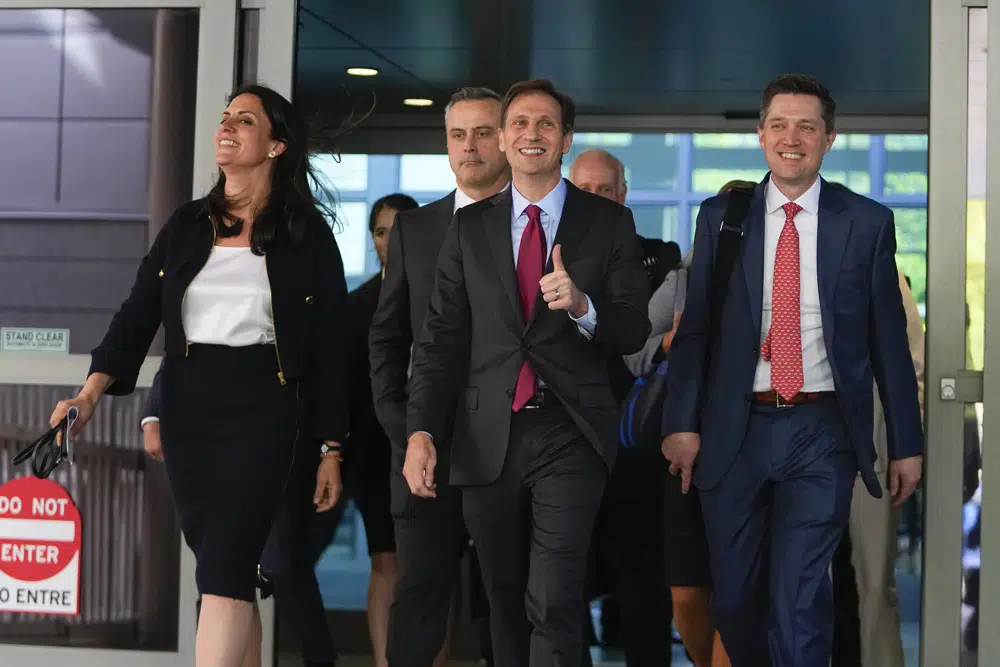
Fox and Dominion Voting Systems reached a $787 million settlement Tuesday in the voting machine company’s defamation lawsuit, averting a trial in a case that exposed how the top-rated network chased viewers by promoting lies about the 2020 presidential election. “The truth matters. Lies have consequences,” Dominion lawyer Justin Nelson said in a news conference outside the courthouse after a judge announced the deal. Dominion had asked for $1.6 billion in arguing that Fox had damaged its reputation by helping peddle phony conspiracy theories about its equipment switching votes from former President Donald Trump to Democrat Joe Biden. Fox said the amount greatly overstated the value of the Colorado-based company. The resolution in Delaware Superior Court follows a recent ruling by Judge Eric Davis in which he allowed the case to go to trial while emphasizing it was “CRYSTAL clear” that none of the allegations about Dominion aired on Fox by Trump allies were true. In a statement issued shortly after the announcement, Fox News said the network acknowledged “the court’s rulings finding certain claims about Dominion to be false.” It did not respond to an inquiry asking for elaboration. Inquiries to Dominion and Fox Corp. were not immediately returned. Records released as part of the lawsuit showed how Fox hosts and executives did not believe the claims by Trump’s allies but aired them anyway, in part to win back viewers who were fleeing the network after it correctly called hotly contested Arizona for Democrat Joe Biden on election night. The settlement, if formally accepted by the judge, will end a case that has proven a major embarrassment for Fox News. If the case had gone to trial, it also would have presented one of the sternest tests to a libel standard that has protected media organizations for more than half a century. Several First Amendment experts had said Dominion’s case was among the strongest they had ever seen. Still, there was real doubt about whether Dominion would be able to prove to a jury that people in a decision-making capacity at Fox could be held responsible for the network’s airing of the falsehoods. Dominion accused Fox of defaming it by repeatedly airing, in the weeks after the 2020 presidential election, false allegations by Trump allies that its machines and the software they used had flipped votes to Biden — even as many at the network doubted the claims and disparaged those who were making them. The company sued both Fox News and its parent, Fox Corp., and said its business had been significantly damaged. During a deposition, Fox Corp. Chairman Rupert Murdoch, who founded the network, testified that he believed the 2020 election was fair and had not been stolen from Trump. “Fox knew the truth,” Dominion argued in court papers. “It knew the allegations against Dominion were ‘outlandish’ and ‘crazy’ and ‘ludicrous’ and ‘nuts.’ Yet it used the power and influence of its platform to promote that false story.” In his March 31 summary judgment ruling, Davis pointedly called out the news organization for airing falsehoods while noting how the bogus election claims persist, 2 1/2 years after Trump lost his bid for reelection. “The statements at issue were dramatically different than the truth,” Davis said in that ruling. “In fact, although it cannot be attributed directly to Fox’s statements, it is noteworthy that some Americans still believe the election was rigged.” In its defense, Fox said it was obligated to report on the most newsworthy of stories — a president claiming that he had been cheated out of reelection. “We never reported those to be true,” Fox lawyer Erin Murphy said. “All we ever did was provide viewers the true fact that these were allegations that were being made.” Fox said Dominion had argued that the network was obligated to suppress the allegations or denounce them as false. “Freedom of speech and of the press would be illusory if the prevailing side in a public controversy could sue the press for giving a forum to the losing side,” Fox said in court papers. In a 1964 case involving The New York Times, the U.S. Supreme Court limited the ability of public figures to sue for defamation. The court ruled that plaintiffs needed to prove that news outlets published or aired false material with “actual malice” — knowing such material was false or acting with a “reckless disregard” for whether or not it was true. That has provided news organizations with stout protection against libel judgments. Yet the nearly six-decade legal standard has come under attack by some conservatives in recent years, including Trump and Republican Gov. Ron DeSantis of Florida, who have argued for making it easier to win a libel case. Two Republican-nominated Supreme Court justices, Clarence Thomas and Neil Gorsuch, have publicly expressed interest in revisiting the protection. Dominion’s lawyers argued that Fox made a deliberate decision to repeatedly air the false claims to appeal to viewers. They allowed guests to falsely claim that the company had rigged the election, flipped large numbers of votes to Biden through a secret algorithm, was owned by a company founded in Venezuela to rig elections for Hugo Chavez, the late president, and bribed government officials. “What they did to get viewers back was start this new narrative that the election had been stolen and that Dominion was the thief,” Dominion lawyer Rodney Smolla said during a March hearing. A mountain of evidence — released in the form of deposition transcripts, internal memos, and emails from the time — was damaging to Fox, even if some of it was only tangentially related to the libel argument. Dominion has pointed to text and email messages in which Fox insiders discounted and sometimes overtly mocked the vote manipulation claims. One Fox Corp. vice president called them “MIND BLOWINGLY NUTS.” Much of the material showed a network effectively terrified of its audience after its election night declaration that Biden had won Arizona. The race call infuriated Trump and many viewers who
Disputing Donald Trump, William Barr says no widespread election fraud
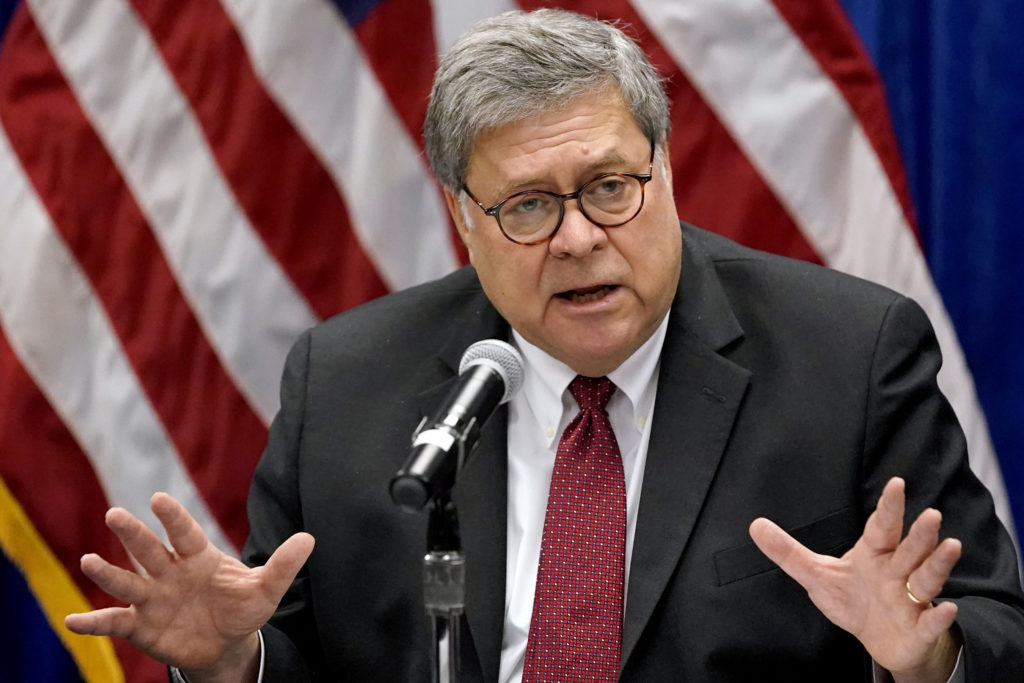
Disputing President Donald Trump’s persistent, baseless claims, Attorney General William Barr declared the U.S. Justice Department has uncovered no evidence of widespread voter fraud that could change the outcome of the 2020 election. Barr’s comments, in an interview Tuesday with The Associated Press, contradict the concerted effort by Trump, his boss, to subvert the results of last month’s voting and block President-elect Joe Biden from taking his place in the White House. Barr told the AP that U.S. attorneys and FBI agents have been working to follow up specific complaints and information they’ve received, but “to date, we have not seen fraud on a scale that could have effected a different outcome in the election.” The comments, which drew immediate criticism from Trump attorneys, were especially notable coming from Barr, who has been one of the president’s most ardent allies. Before the election, he had repeatedly raised the notion that mail-in voting could be especially vulnerable to fraud during the coronavirus pandemic as Americans feared going to the polls and instead chose to vote by mail. More to Trump’s liking, Barr revealed in the AP interview that in October he had appointed U.S. Attorney John Durham as a special counsel, giving the prosecutor the authority to continue to investigate the origins of the Trump-Russia probe after Biden takes over and making it difficult to fire him. Biden hasn’t said what he might do with the investigation, and his transition team didn’t comment Tuesday. Trump has long railed against the investigation into whether his 2016 campaign was coordinating with Russia, but he and Republican allies had hoped the results would be delivered before the 2020 election and would help sway voters. So far, there has been only one criminal case, a guilty plea from a former FBI lawyer to a single false statement charge. Under federal regulations, a special counsel can be fired only by the attorney general and for specific reasons such as misconduct, dereliction of duty, or conflict of interest. An attorney general must document such reasons in writing. Barr went to the White House Tuesday for a previously scheduled meeting that lasted about three hours. Trump didn’t directly comment on the attorney general’s remarks on the election. But his personal attorney Rudy Giuliani and his political campaign issued a scathing statement claiming that, “with all due respect to the Attorney General, there hasn’t been any semblance” of an investigation into the president’s complaints. Other administration officials who have come out forcefully against Trump’s allegations of voter-fraud evidence have been fired. But it’s not clear whether Barr might suffer the same fate. He maintains a lofty position with Trump, and despite their differences, the two see eye-to-eye on quite a lot. Still, Senate Democratic leader Chuck Schumer quipped: “I guess he’s the next one to be fired.” Last month, Barr issued a directive to U.S. attorneys across the country allowing them to pursue any “substantial allegations” of voting irregularities before the 2020 presidential election was certified, despite no evidence at that time of widespread fraud. That memorandum gave prosecutors the ability to go around longstanding Justice Department policy that normally would prohibit such overt actions before the election was certified. Soon after it was issued, the department’s top elections crime official announced he would step aside from that position because of the memo. The Trump campaign team led by Giuliani has been alleging a widespread conspiracy by Democrats to dump millions of illegal votes into the system with no evidence. They have filed multiple lawsuits in battleground states alleging that partisan poll watchers didn’t have a clear enough view at polling sites in some locations and therefore something illegal must have happened. The claims have been repeatedly dismissed including by Republican judges who have ruled the suits lacked evidence. But local Republicans in some battleground states have followed Trump in making unsupported claims, prompting grave concerns over potential damage to American democracy. Trump himself continues to rail against the election in tweets and in interviews though his own administration has said the 2020 election was the most secure ever. He recently allowed his administration to begin the transition over to Biden, but he still refuses to admit he lost. The issues they have pointed to are typical in every election: Problems with signatures, secrecy envelopes, and postal marks on mail-in ballots, as well as the potential for a small number of ballots miscast or lost. But they’ve gone further. Attorney Sidney Powell has spun fictional tales of election systems flipping votes, German servers storing U.S. voting information and election software created in Venezuela “at the direction of Hugo Chavez,” – the late Venezuelan president who died in 2013. Powell has since been removed from the legal team after an interview she gave where she threatened to “blow up” Georgia with a “biblical” court filing. Barr didn’t name Powell specifically but said: “There’s been one assertion that would be systemic fraud and that would be the claim that machines were programmed essentially to skew the election results. And the DHS and DOJ have looked into that, and so far, we haven’t seen anything to substantiate that.” In the campaign statement, Giuliani claimed there was “ample evidence of illegal voting in at least six states, which they have not examined.” “We have many witnesses swearing under oath they saw crimes being committed in connection with voter fraud. As far as we know, not a single one has been interviewed by the DOJ. The Justice Department also hasn’t audited any voting machines or used their subpoena powers to determine the truth,” he said. However, Barr said earlier that people were confusing the use of the federal criminal justice system with allegations that should be made in civil lawsuits. He said a remedy for many complaints would be a top-down audit by state or local officials, not the U.S. Justice Department. “There’s a growing tendency to use the criminal justice system as sort of a default fix-all,” he said, but first there must be a basis to believe there is a crime to investigate. “Most claims
