
Alabama to receive nearly $312 million to aid in Hurricane Sally, Zeta recovery

Almost $312 million in Community Development Block Grant (CDBG) funds have been allocated to Alabama for recovery from Hurricanes Sally and Zeta, two hurricanes that battered the coastal areas of the state in fall 2020. Hurricane Sally made landfall on September 16, 2020, in Gulf Shores as a category 2 hurricane. Hurricane Zeta made landfall on October 28, 2020, in Louisiana and quickly crossed near coastal Alabama. Both storms caused significant wind and storm-surge damage. The U.S. Department of Housing and Urban Development (HUD) allocated the CDBG Disaster Recovery funds totaling $311,732,000 to Alabama as part of the Disaster Relief Supplemental Appropriations Act 2022. The funds will be managed by the Alabama Department of Economic and Community Affairs (ADECA). A majority of the funds will be given to areas including all of Mobile and Baldwin counties as well as the 36502 zip code in western Escambia County. HUD made the determination based on data from Federal Emergency Management Agency. Gov. Kay Ivey said the funding would help areas with long-term recovery efforts. “Natural disasters like Sally and Zeta may test our resolve, but I have seen the resiliency of Alabama and her people time and time again as they recover, rebuild and come back stronger than ever,” Gov. Ivey stated. “These funds will provide a boost to long-term recovery efforts in the communities affected by these disasters.” In the coming months, ADECA will lead public meetings to gather feedback, and the final plan will include details on the types of recovery projects, eligibility for local governments, and the application process. After the plan is approved by HUD, ADECA will begin the application process. “Community Development Block Grants do so much to help Alabama communities complete needed projects that they otherwise would not be able to afford, and that need becomes even greater when a community is recovering from an unexpected natural disaster,” ADECA Director Kenneth Boswell commented. “ADECA is pleased to play a role with Governor Ivey in this funding process, and we will work in the coming months to develop a clear action plan for deploying the grants in an effective manner.”
Secretary of State John Merrill awards Alabama Power, others for polling place help after Zeta
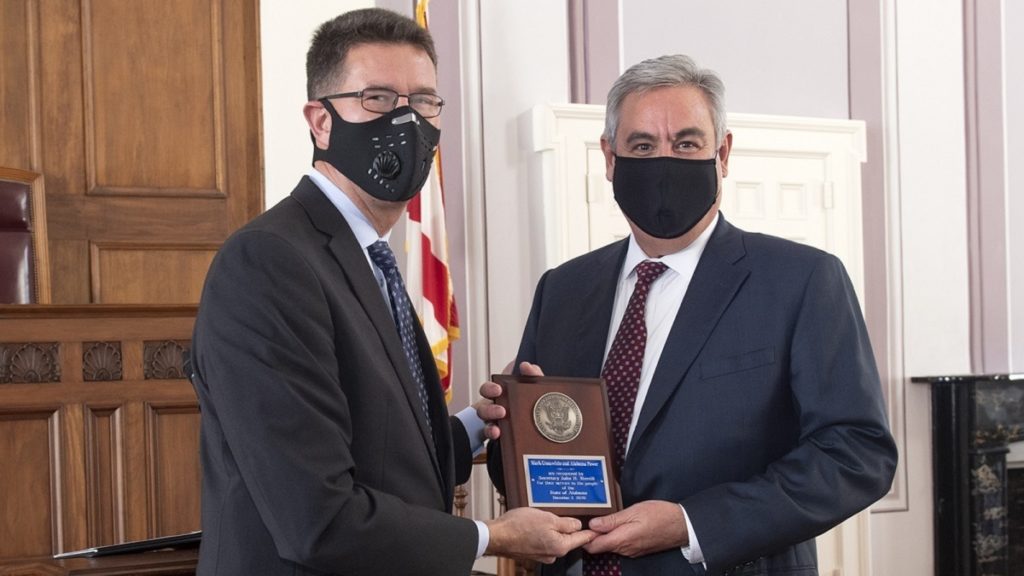
Hurricane Zeta will be remembered as one of the most destructive storms in Alabama history and for its late-season impact – days ahead of the Nov. 3 election. Zeta left many in the state without power, with companies executing a significant response to provide service to both those affected and polling locations for voters to safely cast their ballots. In acknowledgment of this multifaceted response from the public and private sectors, Secretary of State John Merrill on Wednesday presented six National Association of Secretaries of State (NASS) Medallion Awards “to recognize outstanding service and dedication to furthering the mission of NASS.” Merrill gave medallion awards to Alabama Power, PowerSouth, the Alabama Rural Electric Association, the Alabama Municipal Electric Authority, the Alabama Emergency Management Agency, and the Office of Information Technology for their efforts to ensure polling locations had power and that Alabama would have a smooth and successful election. “We are incredibly appreciative of the leadership of Alabama Power, and all organizations recognized today, who stepped up during the state’s time of need to protect our democracy. These brave men and women worked tirelessly around the clock to see that every eligible Alabamian had the ability to successfully cast his or her ballot during the general election,” Merrill said. “On behalf of all the Alabama Power team, it’s an honor to receive this award alongside the other organizations that serve our state,” said Alabama Power CEO Mark Crosswhite. “The damage from Zeta was the third-worst in our company history, requiring a strategic, multiday restoration effort. We appreciate the partnership with the Secretary of State’s office, election officials across the state, and the work of all the utility workers who assisted to restore service to polling locations, ensuring Alabamians had the opportunity to exercise their right to vote.” The ceremony took place in the Old House Chamber at the Capitol in Montgomery. Recipients of the National Association of Secretaries of State Medallion Awards stand with Alabama Secretary of State John H. Merrill. (Wynter Byrd / Alabama NewsCenter) Story and images republished with permission of the Alabama News Center.
Record response to Zeta as Alabama Power restores 600,000 customers
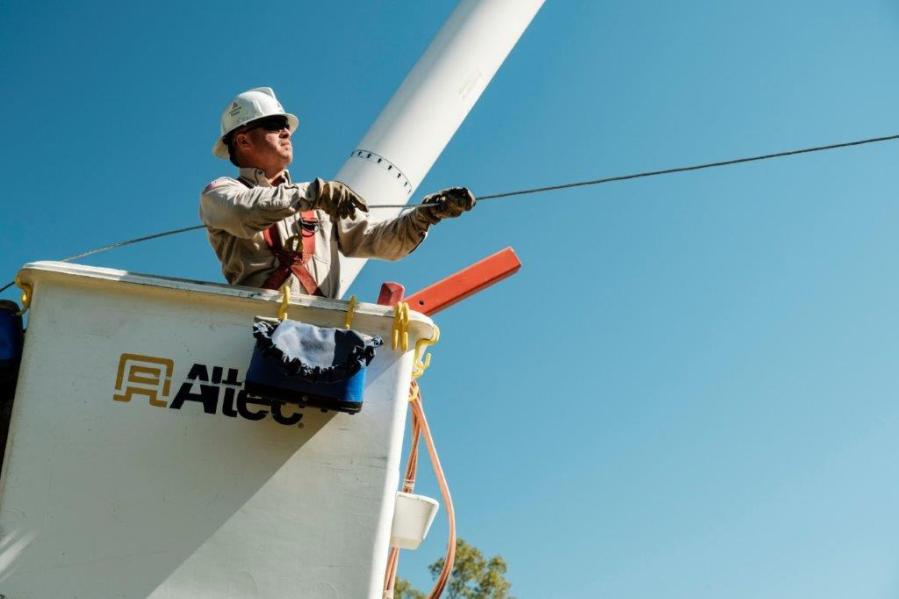
In the few days since Hurricane Zeta smashed through the state, Alabama Power crews and support teams have been working day and night to get the lights back on as quickly and as safely as possible. By Wednesday, with more than 6,000 personnel from two dozen states and Canada lending their support, the company had restored power to 99% of customers statewide. “Our crews faced multiple challenges during this difficult restoration, but we know it also wasn’t easy for many of our customers,” said Scott Moore, Alabama Power senior vice president of Power Delivery. “We appreciate our customers’ patience throughout this multiday restoration effort.” Instead of weakening as it reached the Gulf Coast, Zeta gathered and maintained strength as it tore through Alabama. It will be remembered as one of the worst storms in the state’s history. More than 600,000 Alabama Power customers lost service at some point because of Zeta, with its impact rivaling Hurricane Katrina and the deadly April 2011 tornadoes. Zeta’s high winds – which barely eased as they roared through – brought down trees and power lines and damaged substations from Dauphin Island to northeast Alabama. The storm also caused significant damage in Louisiana, Mississippi, Georgia and all the way to Virginia. Alabama Power wraps up restoration from Hurricane Zeta from Alabama NewsCenter on Vimeo. Within a day of Zeta making landfall, Alabama Power teams had restored service to more than half the customers affected by the Category 2 hurricane. But the dramatic damage identified by company assessment teams across a broad swath of the state made it clear the ongoing restoration operation would be extensive and daunting. Eastern and southern Alabama suffered the most damage, with tree-blocked roads hampering crews in many places. Particularly hard-hit were areas in Calhoun, Chilton, Clarke, Clay, Dallas, Randolph, and Talladega counties. Those locations posed extra challenges because of severely damaged infrastructure and difficult terrain in some spots. But the work to restore service never stopped. Crews worked through the weekend and by Tuesday night had replaced more than 1,100 poles, more than 1,000 transformers, and 1,950 spans of wire. In some cases, crews made temporary fixes to get the lights on as quickly as possible and will have to return to make permanent repairs. “I have lived through hurricanes since Camille in 1969 – Ivan in 2004 and Zeta are the only two that have scared me,” said James “Big Daddy” Lawler, a lifelong resident of Camden and longtime host of the Gettin’ Outdoors with BDL radio show and podcast. “The aftermath destruction in the rural areas was unbelievable. I don’t know how they have gotten as much service back as quick as they have, given the terrain and remote locations. Those guys are remarkable.” Alabama Power crews take a “hub and spoke” approach to restoration following major storms. After focusing immediately on restoring critical infrastructure, such as hospitals, police and fire stations, the company concentrates on making the fixes that will get the greatest number of customers on as fast as possible. Often that means special teams taking on the damage to the large transmission lines that bring power from the generating facilities to cities and communities. At the same time, distribution crews are attacking the downed wires and poles that run from substations through neighborhoods. Meanwhile, the work is 24/7 at the Alabama Control Center and the company’s distribution control centers (DCCs) across the state, where experts work with cutting-edge technology to oversee the grid and the shift the flow of power. At the company’s regional DCCs, teams supported each other, from Mobile to Birmingham, Tuscaloosa to Anniston, and coordinated with field crews to re-energize neighborhood lines as soon as possible. Amid the height of the storm recovery, they also worked with first responders and 911 centers to protect emergency workers when crises, such as reports of downed lines or overnight house fires, required quick action to reroute service or turn off power temporarily for safety. “We really worked to help each other, across the state, with a one-team philosophy,” said Ben Ayer, DCC supervisor in Birmingham. With Tuesday’s elections looming, storm teams focused on ensuring polling places had power well before the doors opened. The company’s community relations managers kept in close contact with elections officials, as well as state and county emergency management agencies and public officials (before, during, and after the storm) so they could keep their constituents and stakeholders apprised of restoration progress. Members of the Alabama Public Service Commission, meeting in Montgomery on Tuesday, praised the company’s restoration efforts amid clearly difficult conditions. “Thank you to the real heroes of this storm: the linemen,” Commission President Twinkle Andress Cavanaugh said during the panel’s monthly meeting. Customers, too, expressed appreciation for the hard work of getting the lights on, although the company acknowledges that the storm and its aftermath has been frustrating for many who spent time without service. At the company’s business office in Centreville, in Bibb County, a customer slipped a note into the overnight drop box Monday evening. It read: “God bless all the Ala Power employees who worked so hard to restore power to Bibb. It is appreciated!!” Republished with the permission of Alabama NewsCenter.
Gulf storm damage causes polling place moves, power outages

Elections officials in the Deep South spent election eve tending to lingering damage from Hurricane Zeta and other storms that damaged buildings or left polling places without power ahead of Tuesday’s election. Storm damage caused polling places to be moved in Louisiana, and power companies and election officials scrambled to restore power, or make sure generators were available, at polling places in Louisiana, Alabama, Georgia, and Mississippi. Election officials expressed confidence that the sites would be operational Tuesday. Thousands of voters in southwest Louisiana will be casting ballots in different locations Tuesday because Hurricane Laura wrecked their traditional polling sites in late August, and they have not yet been repaired. Across the state in the New Orleans area and in other southeastern parishes, several dozen voting locations will be running on generator power because outages caused by Hurricane Zeta last week have not been fixed. “No polling location will be without power on Election Day,” Louisiana Secretary of State Kyle Ardoin, the state’s chief elections officer, said in a statement. By far, the greater disruption in Louisiana was caused by Laura in southwestern Calcasieu and Cameron parishes, where Ardoin’s office provided charts showing locations for 95 polling precincts have shifted because of the destruction of the Category 4 storm. In rural Cameron Parish, most voters will be casting ballots at either a local fire station or a neighborhood market. Calcasieu Parish has created several consolidated voting sites, with most voters in Lake Charles casting their ballots at two mega-polling locations, the Burton Coliseum entertainment arena or the Lake Charles Civic Center. Elections officials have cautioned that the megasites may require longer waits for voters than usual. Some polling sites in southeastern Louisiana will be operating on generators to keep machines and lights running because of outages caused by Hurricane Zeta, which made landfall in the state as a Category 2 storm. The number of voting sites that will require generators “gets lower and lower as each hour passes” and power is restored, said Tyler Brey, a spokesman for Ardoin’s office. New Orleans Democratic Mayor LaToya Cantrell criticized the Republican-led secretary of state’s office Sunday for “failing to fulfill its duty” in providing the generators needed for polling sites, risking disenfranchisement of voters. But Brey said every polling location will have adequate power. He said the generators for voting sites were provided largely by Entergy, but also some by the state as well. Ardoin accused Cantrell of “trying to score cheap political points” with her criticism. Louisiana Gov. John Bel Edwards, a Democrat, had asked utility companies to prioritize restoration to voting locations even before Zeta struck. Across Louisiana, Mississippi, Alabama, and Georgia, more than 148,000 electrical customers had outages Monday because of recent storms, according to the utility tracking website poweroutage.us. In Alabama, Zeta caused damage along a line stretching from the southwestern to northeastern counties of the state. Multiple Alabama voting places remained without power Monday, but generators will be provided to any that still lack service on Election Day, said Secretary of State John Merrill. He declined to say how many were without power, saying the number was rapidly reducing. Merrill said all 1,980 polling locations will have power on Tuesday, either through regular service or by generator. A spokesman for Alabama Power said the company has assessed polling locations provided by election officials and is working to ensure that all polling locations in its service territory have power before the polls open Tuesday. Officials in some of the hardest-hit counties spent the final day before the election trying to determine just how many places might lack electricity or have storm damage. In Talladega County, which has 26 polling sites, chief probate clerk Lawana Patterson said emergency management officials had told her “everything is in working condition.” “I’m not saying everything is perfect, but I’m working on it,” she said. Dallas County Probate Judge Jimmy Nunn said all but one of the county’s 29 voting places had power back on, and state emergency management officials were connecting a generator at the rural Beloit Community Center, where normal service had not been restored. “They’ll have lights and everything, so people won’t even know they’re out,” Nunn said. In neighboring Mississippi, seven counties still had power outages in homes or businesses. Electricity has been restored to all polling places in four of those counties — Hancock, Harrison, Jackson, and Stone. In Mississippi’s George, Greene and Perry counties, a small number of precincts were without power Monday, but generators were available in all three if they are needed Tuesday. Perry County Circuit Clerk Christy Pittman Mayo said “one little bitty precinct” might have to use a generator. In Georgia, two or three polling places remained without power Monday, said Gabriel Sterling, statewide voting system implementation manager. Republished with the permission of the Associated Press.
