
Joe Biden reverses position on federal dollars for abortions
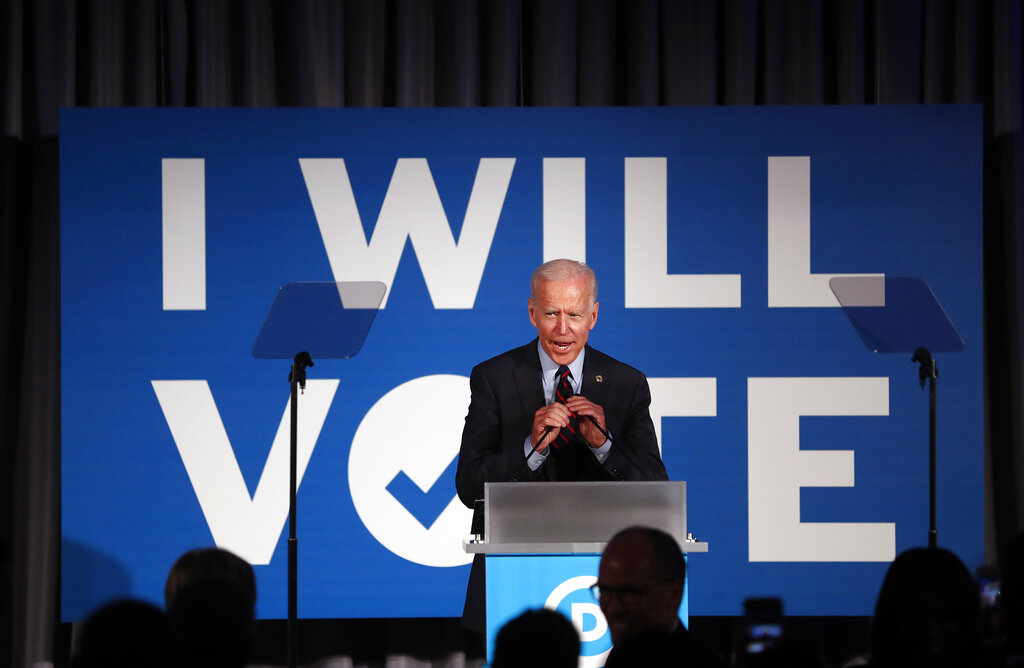
After two days of intense criticism, Democratic presidential candidate Joe Biden reversed course Thursday and declared that he no longer supports a long-standing congressional ban on using federal health care money to pay for abortions. “If I believe health care is a right, as I do, I can no longer support an amendment” that makes it more difficult for some women to access care, Biden said at a Democratic Party fundraiser in Atlanta. The former vice president’s reversal on the Hyde Amendment came after rivals and women’s rights groups blasted him for affirming through campaign aides that he still supported the decades-old budget provision. The dynamics had been certain to flare up again at Democrats’ first primary debate in three weeks. Biden didn’t mention this week’s attacks, saying his decision was about health care, not politics. Yet the circumstances highlight the risks for a 76-year-old former vice president who’s running as more of a centrist in a party in which some skeptical activists openly question whether he can be the party standard-bearer in 2020. And Biden’s explanation tacitly repeated his critics’ arguments that the Hyde Amendment is another abortion barrier that disproportionately affects poor women and women of color. “I’ve been struggling with the problems that Hyde now presents,” Biden said, opening a speech dedicated mostly to voting rights and issues important to the black community. “I want to be clear: I make no apologies for my last position. I make no apologies for what I’m about to say,” he explained, arguing that “circumstances have changed” with Republican-run states — including Georgia, where Biden spoke — adopting severe restrictions on abortion . A Roman Catholic who has wrestled publicly with abortion policy for decades, Biden said he voted as a senator to support the Hyde Amendment because he believed that women would still have access to abortion even without Medicaid insurance and other federal health care grants and that abortion opponents shouldn’t be compelled to pay for the procedure. It was part of what Biden has described as a “middle ground” on abortion. Now, he says, there are too many barriers that threaten that constitutional right, leaving some women with no reasonable options as long as Republicans keep pushing for an outright repeal of the Supreme Court’s 1973 decision that legalized abortion nationwide. The former vice president, who launched his 2020 presidential campaign in April, said he arrived at the decision as part of developing an upcoming comprehensive health care proposal. He has declared his support for a Medicare-like public option as the next step toward universal coverage. He reasoned that his goal of universal coverage means women must have full and fair access to care, including abortion. A Planned Parenthood representative applauded Biden’s reversal but noted that he has been lagging the women’s rights movement on the issue. “Happy to see Joe Biden embrace what we have long known to be true: Hyde blocks people — particularly women of color and women with low incomes — from accessing safe, legal abortion care,” said Leana Wen of Planned Parenthood, the women’s health giant whose services include abortion and abortion referrals. Other activists accepted credit for pushing Biden on the issue. “We’re pleased that Joe Biden has joined the rest of the 2020 Democratic field in coalescing around the Party’s core values — support for abortion rights, and the basic truth that reproductive freedom is fundamental to the pursuit of equality and economic security in this country,” said Ilyse Hogue, president of NARAL, a leading abortion-rights advocacy group. Repealing Hyde has become a defining standard for Democrats in recent years, making what was once a more common position among moderate Democrats more untenable, particularly given the dynamics of primary politics heading into 2020. At its 2016 convention, the party included a call for repealing Hyde in the Democratic platform, doing so at the urging of nominee Hillary Clinton. At least one prominent Democratic woman remained unconvinced. “I am not clear that Joe Biden believes unequivocally that every single woman has the right to make decisions about her body, regardless of her income or race,” said Democratic strategist Jess Morales Rocketto, who worked for Clinton in 2016. “It is imperative that the Democratic nominee believe that.” Republicans pounced, framing Biden’s change in position as a gaffe.“He’s just not very good at this. Joe Biden is an existential threat to Joe Biden,” said Tim Murtaugh, the communications director for President Donald Trump’s reelection campaign. A senior Biden campaign official said some aides were surprised at the speed of the reversal, given Biden’s long history of explaining his abortion positions in terms of his faith. But aides realized that as the front-runner, the attacks weren’t going to let up, and his campaign reasoned that the fallout within the Democratic primary outweigh any long-term benefit of maintain his previous Hyde support. The official spoke on condition of anonymity to discuss internal conversations. Biden’s decade long position first gained new scrutiny several weeks ago when the American Civil Liberties Union circulated video of the candidate telling an activist who asked about the Hyde Amendment that it should be repealed. His campaign later affirmed his support for his fellow Democrats’ call for a federal statute codifying the Roe v. Wade abortion decision into law. Associated Press writer Elana Schor and Juana Summers in Washington, Steve Peoples in New York and Thomas Beaumont in Des Moines, Iowa, contributed to this report. Republished with permission of the Associated Press.
Martha Roby: Pro-life movement momentum is strong
As a member of the House Appropriations Committee, I have the privilege each year to advocate for the priorities most important to the people who live and work in Alabama’s Second District. Among many other key issues, I have been proud to stand up and fight for a strong military and smart agriculture policy on this committee. On the reverse, I am also in a strong position fight against funding from being steered towards programs or organizations that I adamantly oppose. Recently when the Appropriations Committee approved our Labor, Health and Human Services, Education, and Related Agencies (Labor-HHS) Fiscal Year 2019 funding bill, I had the opportunity to speak up for those who cannot speak for themselves: the unborn. As a member of the Labor-HHS Subcommittee, I am extremely proud to report that our bill passed by the full Committee includes the strong pro-life language I have fought for year after year and implements additional policy riders to defend life. Every single one of these measures is critically important and further ensures that no taxpayer dollars can be used for abortions. Among the key pro-life provisions included in the Labor-HHS FY19 funding bill are the Hyde Amendment, which directs that no taxpayer dollars be used to fund abortions, and the Dickey-Wicker Amendment, which bans Labor-HHS funding from being used on research that harms human embryos. In addition to these longstanding pro-life measures, our bill also includes several other important pro-life provisions that continue our efforts to assign greater protections for life under the law. These measures include the Conscience Science Protection Act, which protects the rights of health care providers that do not participate in abortion. In addition, the bill includes language that prohibits funding for fetal tissue research obtained from abortion. This measure might sound familiar because it is a direct response to the 2015 scandal that revealed how Planned Parenthood officials were systematically altering abortion procedures to preserve babies’ organs in order to sell them to researchers for profit. Planned Parenthood’s action was sick, callous, and completely inhuman. Finally, the bill includes language to prohibit abortion providers like Planned Parenthood from receiving any available funding, including through Title X family grants. This measure works hand-in-hand with the Trump Administration’s “Protect Life” rule, which also directs that Planned Parenthood is not eligible to receive Title X grant money. As I have said many, many times: Abortion is not family planning. Abortion is not health care. Organizations that offer these services should not receive taxpayer dollars that are intended for family planning. Throughout my time in Congress, I have remained unapologetically pro-life. I believe life begins at conception, and our laws and policies should reflect a strong commitment to defending life at every stage. I have considered it a great privilege to have a platform with which I can serve as a voice for the voiceless. After eight long years of coming up short pro-life victories, I am encouraged that we now have a President who supports our efforts and is willing to sign important measures into law. The pro-life movement’s momentum is strong, and I look forward to seeing it grow as we continue to impact meaningful change on behalf of the unborn. I am eager to support our Labor-HHS funding bill when it comes before the full House for a vote. ••• Martha Roby represents Alabama’s Second Congressional District. She lives in Montgomery, Alabama with her husband Riley and their two children.
Bradley Byrne: A pro-life victory

A few weeks ago, I met a remarkable young boy named Micah. Micah is a five-year-old boy who seems like most any child. He is healthy, smart, and full of life. Most people are shocked when they learn that Micah was born at just 22 weeks. When Micah was born prematurely, he was no bigger than a pack of M&Ms, but his mom said he was “alive and he was fighting and he wanted to live.” Thankfully, due to the miraculous work of doctors and answered prayers, Micah survived. Every child deserves the chance Micah had. Sadly, the United States is one of only seven countries in the world that allows elective abortions after 20 weeks of pregnancy. This radical policy puts us among the likes of North Korea and China. Micah’s mother likely put it best when she said that her “heart is grieved that babies are allowed to be aborted at the same age that my own son was born and even later.” It is simply heartbreaking. Well, I recently voted to change the law and ban abortions in the United States after 20 weeks. Thankfully, the Pain-Capable Unborn Child Protection Act, also known as Micah’s Law, passed the House by a vote of 237 to 189. The bill now awaits action in the Senate. This is a commonsense, pro-life bill that simply states that abortions after 20 weeks are unlawful in the United States. The bill does include very limited exceptions in cases of rape, incest, or when the health of the mother is at risk. To be clear, I do not support abortion at any point, but there is great significance to the 20-week timeframe. Twenty weeks is the point at which doctors and scientists agree that babies can actually feel pain. The more premature an infant is, the worse the pain because they have yet to develop pain inhibitors. Sadly, thousands of babies right here in the United States are killed and subjected to excruciating pain due to late-term abortions. It is simply unconscionable. That is why this legislation is so critically important. We shouldn’t stop with Micah’s Law. As a member of the House Pro-Life Caucus, I am always looking for new opportunities to stand up for the unborn. For example, I am a staunch supporter of the Hyde Amendment, which is a provision included in annual government funding bills to ensure no taxpayer money is used to perform an abortion. I have also supported legislation to make the Hyde Amendment permanent, so it no longer must be passed each year. I also previously voted to eliminate funding for Planned Parenthood, an organization that promotes abortions. I support redirecting the money away from Planned Parenthood and putting it toward community health centers, which are more plentiful and provide a wider range of services. These are just a few examples. As I cast my vote in favor of the Pain-Capable Unborn Child Protection Act a few weeks ago, Micah was on my mind. I thought about his smile and how he was full of energy. I thought about others like him who may have been given a chance at life were it not for our nation’s broken laws As is written in Jeremiah 1:5, “Before I formed you in the womb I knew you, before you were born I set you apart.” I promise to always stand up for God’s precious gift of life and to support pro-life policies throughout my time in Congress. • • • Bradley Byrne is a member of U.S. Congress representing Alabama’s 1st Congressional District.
Alabama ranks high among states discouraging abortion
According to an analysis released Tuesday by the National Partnership for Women & Families, Alabama is among the 12 worst states in America for abortion coverage and select workplace policies for women. Released to mark the 40th year under the Hyde Amendment — a legislative provision barring the use of certain federal funds to pay for abortion except in the cases of rape, incest, or to save the life of the mother — A Double Bind: When States Deny Abortion Coverage and Fail to Support Expecting and New Parents is an issue brief and map that identify obstacles faced by low-income women across the country. Since the Supreme Court handed down its 1973 decisions in Roe v. Wade, states have constructed a latticework of abortion law, codifying, regulating and limiting whether, when, and under what circumstances a woman may obtain an abortion. The analysis found Alabama does not cover abortions for Medicaid enrollees and restricts coverage of abortions in the state health care marketplace, in addition to having no workplace protections for expecting and new parents. Arizona, Georgia, Idaho, Michigan, Mississippi, Missouri, Nevada, Oklahoma, South Carolina, South Dakota, and Wyoming, also rank among the nation’s 12 worst states for abortion coverage and select workplace policies for women.
