
Lawyers seek ‘Apprentice’ tapes in Donald Trump immigration suit

Lawyers suing President Donald Trump over his decision to end special protections shielding certain immigrants from deportation are seeking unaired footage from his reality TV show “The Apprentice” to try to bolster their case alleging the move was racially motivated, the attorneys said Wednesday. Lawyers for Civil Rights, which sued Trump in February, has issued subpoenas to MGM Holdings Inc. and Trump Productions LLC demanding any footage shot during the production of the show in which Trump “uses racial and/or ethnic slurs” or “makes remarks concerning race, nationality and/or ethnic background.” Former White House staffer and fellow reality-TV star Omarosa Manigault Newman claimed without evidence in a book released in August, “Unhinged,” that a tape exists of the president using the N-word on the reality show’s set. Trump has denied the existence of such tapes, tweeting that the show’s producer told him “there are NO TAPES of the Apprentice where I used such a terrible and disgusting word as attributed by Wacky and Deranged Omarosa.” “I don’t have that word in my vocabulary, and never have,” Trump said. The case filed in Boston’s federal court centers on the Trump administration’s decision to end temporary protected status for thousands of immigrants from Haiti, El Salvador and Honduras. Temporary protected status provides safe havens for people from countries experiencing armed conflicts, natural disasters and other challenges. Lawyers for Civil Rights says in the lawsuit that Trump’s move to rescind the program was rooted in animus against immigrants of color, citing comments he made on the campaign trial and in office. “Access to these videotapes will help further demonstrate that Defendant Trump holds racially biased views that impact his policy and decision making,” attorney Oren Nimni said in a written statement. The subpoenas also seek any relevant outtakes, audio clips and transcripts made during production of the show. Emails seeking comment were sent to an MGM lawyer, a Trump Production official and White House officials. A federal judge in July denied Trump’s request to throw out the lawsuit and rejected the administration’s bid to remove Trump as a defendant in the case. In a different case in California, another federal judge last month issued a temporary injunction that bars the Trump administration from ending the protections, saying there is evidence that president “harbors an animus against non-white, non-European aliens which influenced his … decision to end the TPS designation.” The Trump administration is appealing that ruling. Pressure on producers of the “The Apprentice” to release unaired footage of the show intensified during the 2016 presidential campaign after The Washington Post published a 2005 “Access Hollywood” recording of Trump boasting about aggressively groping women. MGM, which owns “The Apprentice,” said at the time that it couldn’t unilaterally release any unaired, archived material because of contractual obligations. The show’s producer, Mark Burnett, also said he didn’t have the ability or right to release footage. A former contestant on “The Apprentice” who has accused Trump of unwanted groping and kissing has also sought footage through a lawsuit against the president, but it’s unclear whether she has received any. The subpoena issued by Summer Zervos‘ attorney in May sought any “Apprentice” material that features Zervos, or Trump talking about her or discussing other female contestants in a sexual or inappropriate way. Republished with permission from the Associated Press.
Donald Trump stokes pre-election fear of immigrants to drive voters
Thousands of U.S. troops to stop an “invasion” of migrants. Tent cities for asylum seekers. An end to the Constitution’s guarantee of birthright citizenship. With his eyes squarely on next Tuesday’s elections, President Donald Trump is rushing out hardline immigration declarations, promises and actions as he tries to mobilize supporters to retain Republican control of Congress. His own campaign in 2016 concentrated on border fears, and that’s his final-week focus in the midterm fight. “This has nothing to do with elections,” the president insists. But his timing is striking. Trump says he will send more than 5,000 military troops to the Mexican border to help defend against caravans of Central American migrants who are on foot and still hundreds of miles away. Tent cities would not resolve the massive U.S. backlog of asylum seekers. And most legal scholars say it would take a new constitutional amendment to alter the current one granting citizenship to anyone born in America. Still, Trump plunges ahead with daily alarms and proclamations about immigration in tweets, interviews and policy announcements in the days leading up to elections that Democrats hope will give them at least partial control of Congress. Trump and many top aides have long seen the immigration issue as the most effective rallying cry for his base of supporters. The president had been expected to make an announcement about new actions at the border on Tuesday, but that was scrapped so he could travel instead to Pittsburgh, where 11 people were massacred in a synagogue during Sabbath services. Between the shootings, the deadliest attack on Jews in U.S. history, and the mail bomb scare targeting Democrats and a media organization, the caravan of migrants slowly trudging north had faded from front pages and cable TV. But with well-timed interviews on Fox and “Axios on HBO,” Trump revived some of his hardest-line immigration ideas: An executive order to revoke the right to citizenship for babies born to non-U.S. citizens on American soil. And the prolonged detention of anyone coming across the U.S.-Mexico border, including those seeking asylum, in “tent cities” erected “all over the place.” The administration on Monday also announced plans to deploy 5,200 active duty troops — more than double the 2,000 who are in Syria fighting the Islamic State group — to the border to help stave off the caravans. The main caravan, still in southern Mexico, was continuing to melt away — from the original 7,000 to about 4,000 — as a smaller group apparently hoped to join it. Trump insists his immigration moves have nothing to do with politics, even as he rails against the caravans at campaign rallies. “I’ve been saying this long before the election. I’ve been saying this before I ever thought of running for office. We have to have strong borders,” Trump told Fox News host Laura Ingraham in an interview Monday. Critics weren’t buying it. “They’re playing all of us,” said David W. Leopold, an immigration attorney and counsel to the immigration advocacy group America’s Voice. “This is not about locking people up. This is not about birthright citizenship. This is about winning an election next week.” Trump’s citizenship proposal would inevitably spark a long-shot legal battle over whether the president can alter the long-accepted understanding that the 14th Amendment grants citizenship to any child born on U.S. soil, regardless of his parents’ immigration status. Omar Jadwat, director of the Immigrants’ Rights Project at the American Civil Liberties Union in New York, said the Constitution is very clear. “If you are born in the United States, you’re a citizen,” he said. He called it “outrageous that the president can think he can override constitutional guarantees by issuing an executive order. James Ho, a conservative Trump-appointed federal appeals court judge, wrote in 2006, before his appointment, that birthright citizenship “is protected no less for children of undocumented persons than for descendants of Mayflower passengers.” Even House Speaker Paul Ryan, typically a supporter of Trump proposals, said on WVLK radio in Kentucky: “Well you obviously cannot do that. You cannot end birthright citizenship with an executive order.” But Trump says his lawyers have assured him that the change could be made with “just with an executive order” — an argument he has been making since his early days as a candidate, when he dubbed birthright citizenship a “magnet for illegal immigration” and pledged to end it. “We’re the only country in the world where a person comes in and has a baby, and the baby is essentially a citizen of the United States,” he said in an Axios interview excerpt released Tuesday. Not so, according to a 2010 study from the Center for Immigration Studies, a group that supports immigration restrictions, which said at least 30 countries offer birthright citizenship. Vice President Mike Pence said the administration was “looking at action that would reconsider birthright citizenship.” “We all know what the 14th Amendment says. We all cherish the language of the 14th Amendment. But the Supreme Court of the United States has never ruled on whether or not — whether the language of the 14th Amendment, ‘subject to the jurisdiction thereof,’ applies specifically to the people who are in the country illegally,” he said at a Politico event. The nonpartisan Migration Policy Institute estimates that more than 4 million U.S.-born children under the age of 18 have an unauthorized immigrant parent. A person familiar with the internal White House debate said the topic of birthright citizenship has come up inside the West Wing at various times — and not without some detractors. However, White House lawyers expect to work with the Justice Department to develop a legal justification for the action. The person was not authorized to discuss the policy debate so spoke on condition of anonymity. In Trump’s Monday interview with Fox, he said the U.S. also plans to build tent cities to house migrants seeking asylum, who would be detained until their cases were completed. Right now, some asylum seekers, particularly families, are
Pentagon sending 5,200 troops to Southwest border week before midterms
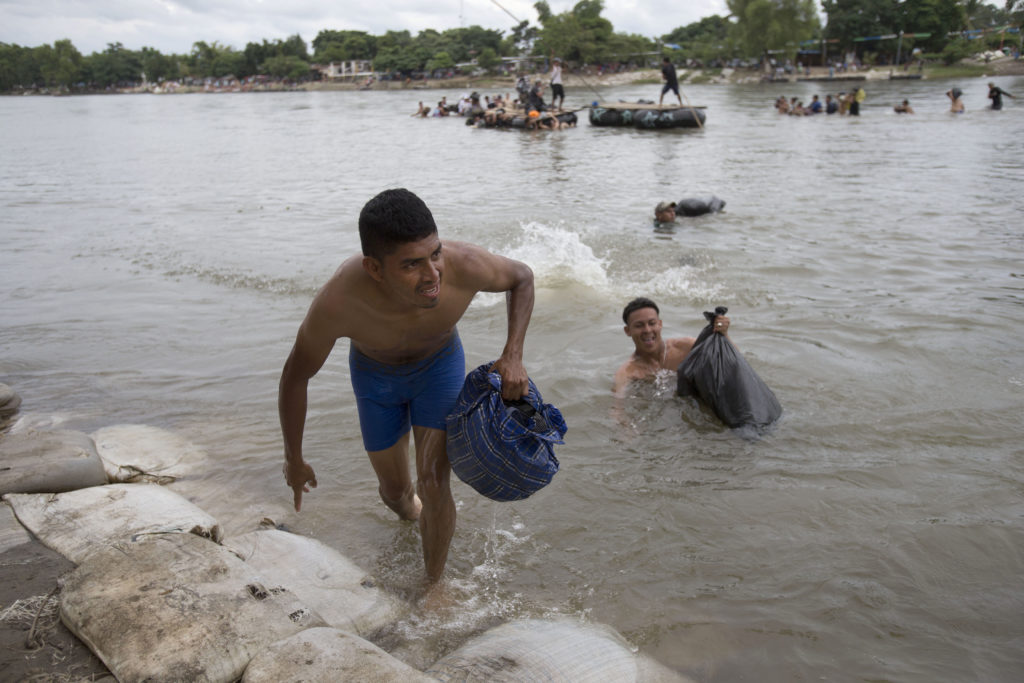
The Pentagon said Monday it is sending 5,200 troops to the Southwest border in an extraordinary military operation ordered up just a week before midterm elections in which President Donald Trump has put a sharp focus on Central American migrants moving north in slow-moving caravans that are still hundreds of miles from the U.S. The number of troops being deployed is more than double the 2,000 who are in Syria fighting the Islamic State group. Trump, eager to keep voters focused on illegal immigration in the lead-up to the elections, stepped up his dire warnings about the caravans, tweeting, “This is an invasion of our Country and our Military is waiting for you!” But any migrants who complete the long trek to the southern U.S. border already face major hurdles — both physical and bureaucratic — to being allowed into the United States. In an interview Monday, Trump said the U.S. would build “tent cities” for asylum seekers. “We’re going to put tents up all over the place,” told Fox News Channel’s Laura Ingraham. “They’re going to be very nice and they’re going to wait and if they don’t get asylum, they get out.” Under current protocol, migrants who clear an initial screening are often released until their cases are decided in immigration court, which can take several years. Trump denied his focus on the caravan is intended to help Republicans in next week’s midterms, saying, “This has nothing to do with elections.” The Pentagon’s “Operation Faithful Patriot” was described by the commander of U.S. Northern Command as an effort to help Customs and Border Protection “harden the southern border” by stiffening defenses at and near legal entry points. Advanced helicopters will allow border protection agents to swoop down on migrants trying to cross illegally, said Air Force Gen. Terrence O’Shaughnessy. Troops planned to bring heavy concertina wiring to unspool across open spaces between ports. “We will not allow a large group to enter the U.S. in an unlawful and unsafe manner,” said Kevin McAleenan, commissioner of Customs and Border Protection. Eight hundred troops already are on their way to southern Texas, O’Shaughnessy said, and their numbers will top 5,200 by week’s end. Some of the troops will be armed. He said troops would focus first on Texas, followed by Arizona and then California. The troops will join the more than 2,000 National Guardsmen that Trump has already deployed to the border. It remained unclear Monday why the administration was choosing to send active-duty troops given that they will be limited to performing the same support functions the Guard already is doing. The number of people in the first migrant caravan headed toward the U.S. has dwindled to about 4,000 from about 7,000 last week, though a second one was gaining steam and marked by violence. About 600 migrants in the second group tried to cross a bridge from Guatemala to Mexico en masse Monday. The riverbank standoff with Mexico police followed a more violent confrontation Sunday when the migrants used sticks and rocks against officers. One migrant was killed Sunday night by a head wound, but the cause was unclear. The first group passed through the spot via the river — wading or on rafts — and was advancing through southern Mexico. That group appeared to begin as a collection of about 160 who decided to band together in Honduras for protection against the gangs who prey on migrants traveling alone and snowballed as the group moved north. They are mostly from Honduras, where it started, as well as El Salvador and Guatemala. Another, smaller caravan earlier this year dwindled greatly as it passed through Mexico, with only about 200 making it to the California border. Migrants are entitled under both U.S. and international law to apply for asylum. But there already is a bottleneck of would-be asylum seekers waiting at some U.S. border crossings to make their claims, some waiting as long as five weeks. McAleenan said the aim of the operation was to deter migrants from crossing illegally, but he conceded his officers were overwhelmed by a surge of asylum seekers at border crossings. He also said Mexico was prepared to offer asylum to members of the caravan. “If you’re already seeking asylum, you’ve been given a generous offer,” he said of Mexico. “We want to work with Mexico to manage that flow.” The White House is also weighing additional border security measures, including blocking those traveling in the caravan from seeking legal asylum and preventing them from entering the U.S. The military operation drew quick criticism. “Sending active military forces to our southern border is not only a huge waste of taxpayer money, but an unnecessary course of action that will further terrorize and militarize our border communities,” said Shaw Drake of the American Civil Liberties Union’s border rights center at El Paso, Texas. Military personnel are legally prohibited from engaging in immigration enforcement. The troops will include military police, combat engineers and others helping on the border. The escalating rhetoric over the migrants and expected deployments come as the president has been trying to turn the caravans into a key election issue just days before elections that will determine whether Republicans maintain control of Congress. “This will be the election of the caravans, the Kavanaughs, law and order, tax cuts, and you know what else? It’s going to be the election of common sense,” Trump said at a rally in Illinois on Saturday night. On Monday, he tweeted without providing evidence, “Many Gang Members and some very bad people are mixed into the Caravan heading to our Southern Border.” “Please go back,” he urged them, “you will not be admitted into the United States unless you go through the legal process. This is an invasion of our Country and our Military is waiting for you!” It’s possible there are criminals mixed in, but Trump has not substantiated his claim that members of the MS-13 gang, in particular, are among them. The troops are expected
Donald Trump vilifies illegal immigrant caravan, says he’ll cut Central American aid
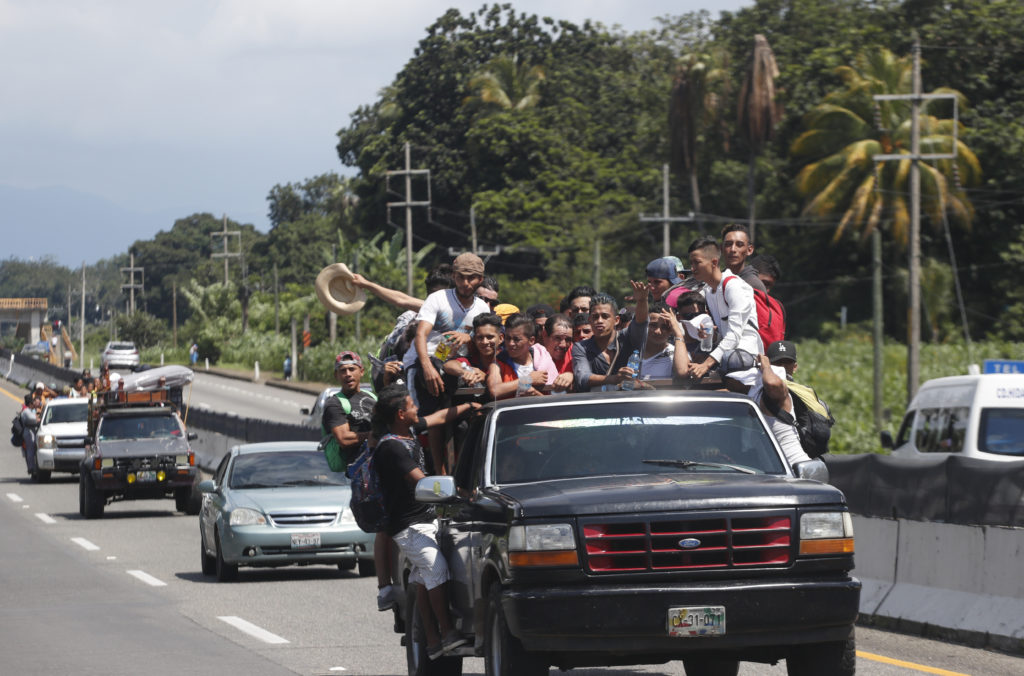
President Donald Trump says the U.S. will begin cutting aid to three Central American countries he accused of failing to stop thousands of migrants heading for the U.S. border. But across his administration there was no indication of any action in response to what he tweeted was a “National Emergy.” For hours on Monday, White House officials were unable to provide an explanation for the president’s threats, which reflected both his apparent frustration with the migrant caravan and his determination to transform it into Republican election gains. Federal agencies said they’d received no guidance on the president’s declaration, issued as he attempts to make illegal immigration a focus of next month’s midterm elections. If Trump should follow through with his threat to end or greatly reduce U.S. aid, that could worsen the poverty and violence that are a root cause of the migration he has been railing against, critics said. Trump tweeted, “Sadly, it looks like Mexico’s Police and Military are unable to stop the Caravan heading to the Southern Border of the United States.” He added without evidence that “criminals and unknown Middle Easterners are mixed in.” “I have alerted Border Patrol and Military that this is a National Emergy,” he wrote. “Must change laws!” Associated Press journalists traveling with the caravan for more than a week have spoken with Hondurans, Guatemalans and Salvadorans but have not met any of the “Middle Easterners” that Trump claimed had “mixed in” with the Central American migrants. It was clear, though, that more migrants were continuing to join the caravan. Trump’s tweets marked the latest escalation of his efforts to thrust immigration politics into the national conversation in the closing weeks of the congressional elections. He and his senior aides have long believed the issue — which was a centerpiece of his winning presidential campaign — is key to revving up his base and motivating GOP voters to turn out in November. “Blame the Democrats,” he wrote. “Remember the midterms.” At a campaign rally in Houston on Monday night, he falsely accused Democrats of “encouraging millions of illegal aliens to break our laws, violate our borders and overwhelm our nation.” Trump for months has sought to use foreign aid as a cudgel more broadly, threatening to withhold humanitarian and other aid from “enemies of America” and using it to pressure foreign governments to bend to his will. On Monday, he said he would be making good on his threat. “Guatemala, Honduras and El Salvador were not able to do the job of stopping people from leaving their country and coming illegally to the U.S. We will now begin cutting off, or substantially reducing, the massive foreign aid routinely given to them,” he wrote. He added later at the White House: “We have been giving so much money to so many different countries for so long that it’s not fair and it’s not good. And then when we ask them to keep their people in their country, they’re unable to do it.” However, it was unclear whether the president’s tweets had any policy implications. A Pentagon spokesman, Army Lt. Col. Jamie Davis, said the Pentagon had received no new orders to provide troops for border security. And a State Department official said the agency had not been given any instructions on eliminating or reducing aid to Central American countries. Last April, Defense Secretary James Mattis authorized up to 4,000 members of the National Guard to help the Department of Homeland Security with southern border security, and approximately 2,100 were sent under the control of border state governors. That number, Davis said, has not changed. The Pentagon also said it was going ahead with plans to include Honduras among the South American nations that will be visited this fall by the USNS Comfort, a hospital ship that Mattis has dispatched to help relieve stress on medical care systems as a result of refugees from Venezuela. The Comfort began treating patients in Ecuador on Monday and is scheduled to make stops in Peru, Colombia and Honduras, according to Pentagon spokesman Col. Rob Manning. “The deployment reflects the United States’ enduring promise of friendship, partnership and solidarity with the Americas,” Manning said. Asked what the administration was doing to operationalize the president’s tweet, White House spokeswoman Sarah Huckabee Sanders told reporters Monday evening that “we’re continuing to look at all options on the table.” “The president wants to make sure we’re doing everything we can to secure and protect our borders and that’s exactly what he’s been talking about,” she said. It is Congress, not the president, that appropriates aid money. The White House would have to notify Congress if it wanted to cut or reallocate aid, which could delay or complicate the process. Rep. Eliot Engel, the top-ranking Democrat on the House Foreign Affairs Committee, said Monday that “my colleagues and I will not stand idly by as this administration ignores congressional intent.” The three countries received about $500 million from the U.S. in fiscal year 2017. That money funds programs that promote economic development and education, as well as supporting democracy and human rights, among other issues. It was not immediately clear how much money Trump now hopes to cut, though the administration already had been pushing to reduce the government’s global aid and foreign operations budget by about 30 percent for fiscal 2019 that began Oct 1. Paul O’Brien, the vice president for policy and advocacy at Oxfam America, said that any attempts to decrease aid to the Central American countries would be “devastating” since the U.S. is a key investor in the region, funding programs on issues ranging from workforce development to reducing violence and improving human rights. In addition, other investors look to the U.S. as a guide. “If you take that money away or you make it unpredictable, you’re actually going to foster the very conditions that are driving people toward migration,” said O’Brien, who accused Trump of “essentially seeking to use migrants as a political chip.” Republished with
As immigrants flow across US border, American guns go south

Among the thousands of immigrants who have been coming across the U.S.-Mexico border in recent months, many are seeking to escape gang and drug violence raging in their homelands. The weapon of choice used to intimidate them? Often an American-made gun. While the flow of drugs and immigrants into the U.S. has been well-documented for decades and become a regular part of the political debate, what is often overlooked is how gangs and drug cartels exploit weaknesses at the border to smuggle guns from the U.S. into Latin America. A 2013 report by the University of San Diego says the number of firearms smuggled from the United States was so significant that nearly half of American gun dealers rely on that business to stay afloat. On average, an estimated 253,000 firearms each year are purchased in the United States expressly to be sent to Mexico, the report said, the vast majority of the sales originating in the border states of California, Texas, New Mexico and Arizona. Once in Mexico, the weapons end up in the hands of drug cartels or get shipped to gangs in Honduras, Guatemala and El Salvador — countries that are dealing with an epidemic of gun violence. Armed holdups on public transportation are a regular occurrence in Honduras, where nearly half of the unregistered weapons originated in the U.S., the federal Bureau of Alcohol, Tobacco, Firearms and Explosives reported in recent years. Gun violence in El Salvador is so rampant that the country has been averaging more than one shootout a day between police and gangs this year, said Ricardo Sosa, a criminologist specializing in gangs and security in El Salvador. “In every one of these operations, police are able to seize between two and six firearms at the scene,” he said. “That is one of the indicators that the gangs are armed on many occasions with long guns and short guns for each one of their members.” Mexico last year recorded its highest number of murders in nearly two decades, with more than 31,000 people killed, higher than even during the country’s drug war in 2011. It continues unabated with an average of 88 people killed each day in the first five months of this year. The bloodshed in Guatemala, Honduras and El Salvador has been a big driver of immigration into the U.S., with the government saying nearly 16,000 families came across the border in August alone — many of them from those three countries. Gun-control groups contend that the U.S. government is essentially exporting gang violence to Latin America with permissive gun laws — which in turn creates an immigration crisis along the border. “If the Trump administration were serious about wanting to stop refugees from fleeing violence in Latin America and Mexico to come north, they would be doing something about the southward gun trafficking that is fueling a lot of that migration,” said Adam Skaggs, chief counsel with the Giffords Law Center. Gun-rights activists say the issue is overblown and mischaracterized. The National Rifle Association and other gun-rights groups contend the most effective way to combat the problem is not with stricter gun laws but by eradicating drug cartels and other criminal enterprises. They say the numbers are inflated and that the industry has proactively sought to educate licensed gun dealers on how to detect “straw purchases,” in which a firearm is bought expressly to give it to someone who otherwise would not be able to legally own a gun. “Obviously, Mexico has a huge problem with rampant corruption that clearly cannot be blamed on the U.S.,” the NRA said in a position paper on the issue in 2009. “At the same time, Mexico has extremely prohibitive gun laws, yet has far worse crime than the U.S.” Under the Obama administration, federal authorities launched an operation dubbed Fast and Furious that allowed criminals to buy firearms with the intention of tracking them to criminal organizations. But the ATF lost most of the guns, including two that were found at the scene of a slaying of a U.S. Border Patrol agent. In 2011, gun dealers along the border states were required to report to the ATF anytime someone purchased two or more semiautomatic long guns in a five-day period. President Donald Trump issued an executive order in 2017 as his response to gun trafficking, directing federal agencies to ramp up prosecution aimed at going after foreign criminals and to improve coordination among federal agencies along the border. Nabbing the guns at the border is a challenge on several levels. They aren’t as detectable as drug shipments, and they can be disassembled and loaded with legal goods making their way from the U.S. “The effectiveness of this kind of gun smuggling still remains very high. It doesn’t take a whole lot,” said David Shirk, one of the University of San Diego report’s authors. Experts say a big reason gun trafficking remains one of the hot commodities flowing from the United States into Latin America is profit. Retired ATF agent Bernard Zapor noted that an AR-platform firearm that sells retail in the U.S. for $1,000 can fetch more than $4,000 in Mexico. A box of ammo that might go for just under $200 could command $3,000. “They’re not buying grandpa’s old shotgun that’s been lying around and found in a shed,” Zapor said. “They’re buying brand new Colt AR-15s.” Republished with permission from the Associated Press.
Census Bureau to respond to Alabama lawsuit in fall
The federal government has until mid-November to respond to Alabama’s lawsuit seeking to exclude immigrants living in the country illegally from U.S. Census counts. A federal judge last week gave the U.S. Department of Commerce and Census Bureau an extension until Nov. 13 to reply to the lawsuit. Lawyers had said the Department of Justice components needed additional time to finish “evaluating the arguments that the government will make in this matter.” Alabama Attorney General Steve Marshall filed the lawsuit against the federal government in June. Marshall argues the immigrants should not be included in census counts used to distribute congressional district. The lawsuit contends Alabama is at risk to lose a congressional seat, and thus an electoral vote, to a state with a “larger illegal alien population.” Republished with permission from the Associated Press.
Trump administration moves to detain migrant families longer
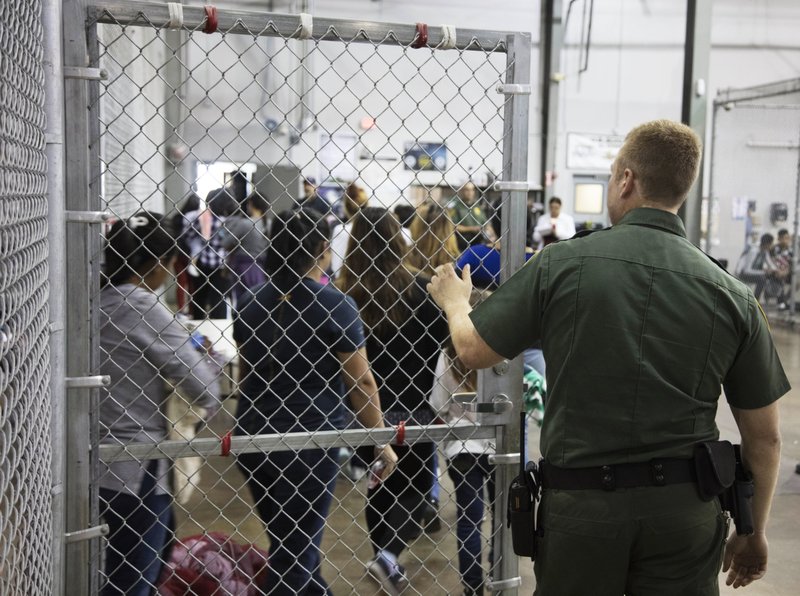
The Trump administration on Thursday moved to abandon a longstanding court settlement that limits how long immigrant children can be kept locked up, proposing new regulations that would allow the government to detain families until their immigration cases are decided. Homeland Security officials said that ending the so-called Flores agreement of 1997 will speed up the handling of asylum requests while also deterring people from illegally crossing the Mexican border. The move angered immigrant rights advocates and is all but certain to trigger a court battle. “It is sickening to see the United States government looking for ways to jail more children for longer,” said Omar Jadwat, director of the ACLU’s Immigrants’ Rights Project. “And it’s yet another example of the Trump administration’s hostility toward immigrants resulting in a policy incompatible with the most basic human values.” Vehicles leave the Port Isabel Detention Center, June 26, 2018, which holds detainees of the U.S. Immigration and Customs Enforcement in Los Fresnos, Texas. [Photo Credit: AP Photo/David J. Phillip, file] The Flores agreement requires the government to keep children in the least restrictive setting possible and to release them generally after 20 days in detention. For decades, because of those restrictions, many parents and children caught trying to slip into the country have been released into the U.S. while their asylum requests wind their way through the courts — a practice President Donald Trump has decried as “catch-and-release.” Such cases can drag on for years, and some immigrants stop showing up to court when it becomes clear their asylum requests are going to be denied. The newly proposed rules would allow the government to hold families in detention until their cases are completed. Homeland Security did not say how long it expects families to be kept locked up. But immigration officials say asylum cases involving detained families move much more quickly, taking months instead of years to resolve, in part because there are none of the delays that result when immigrants set free in the U.S. fail to show up for a hearing. “Today, legal loopholes significantly hinder the department’s ability to appropriately detain and promptly remove family units that have no legal basis to remain in the country,” said Homeland Security Secretary Kirstjen Nielsen. “This rule addresses one of the primary pull factors for illegal immigration and allows the federal government to enforce immigration laws as passed by Congress.” Earlier this summer, a federal judge in California rejected a request by the administration to modify Flores to allow for longer family detention. Administration officials say they have the authority to terminate the agreement, but that is likely to be tested in court. “They’re essentially trying to accomplish through regulation what the court has not permitted,” said Peter Schey, an attorney representing immigrant children under the settlement and president of the Center for Human Rights and Constitutional Law. Schey said he will oppose any effort to end Flores unless the government proposes acceptable regulations for the safe and humane treatment of youngsters. “Refugee children should not be made to suffer inhumane treatment and prolonged and unnecessary detention just to satisfy President Trump’s zero-tolerance approach to refugees seeking safety in the United States from the violence and lawlessness spreading throughout Central America,” Schey said. The Flores agreement became an issue last spring when the Trump administration adopted a policy of prosecuting anyone caught crossing illegally. More than 2,900 children were separated from their parents, prompting international outrage. Trump eventually backed down and stopped the separation of families. A federal judge ordered parents and children reunited; the government has said it has done so in as many cases as it could. But hundreds of parents were deported without their children, while others had criminal records or were not parents as they claimed to be, officials said. Because under Flores children cannot be kept in criminal custody with their parents or held for an extended period in immigration detention, the administration has limited options when dealing with families. The government operates three family detention centers that can hold a total of about 3,000 people, and they are at or near capacity. Homeland Security and the Pentagon have been working to line up as many as 12,000 beds for family members at Fort Bliss in El Paso, Texas. Another request for up to 20,000 beds for youngsters who arrive without parents is also pending. The ACLU’s Jadwat accused the administration of “trying to expand the trauma it is inflicting on these children in order to deter other people from coming to the country.” Rachel Prandini, staff attorney at the Immigrant Legal Resource Center, said the erosion of Flores’ protections would subject children to worsening conditions. “The Trump administration’s decision to exacerbate the suffering of kids, by imposing the cruel policy of family separation earlier this summer and now with this rule change to vastly expand detention of children, is horrifying,” she said. The regulations will be published in the Federal Register and will be subject to a 60-day public comment period starting Friday. Republished with the permission of the Associated Press.
Bradley Byrne confirms illegal immigrants will not be housed in Baldwin County
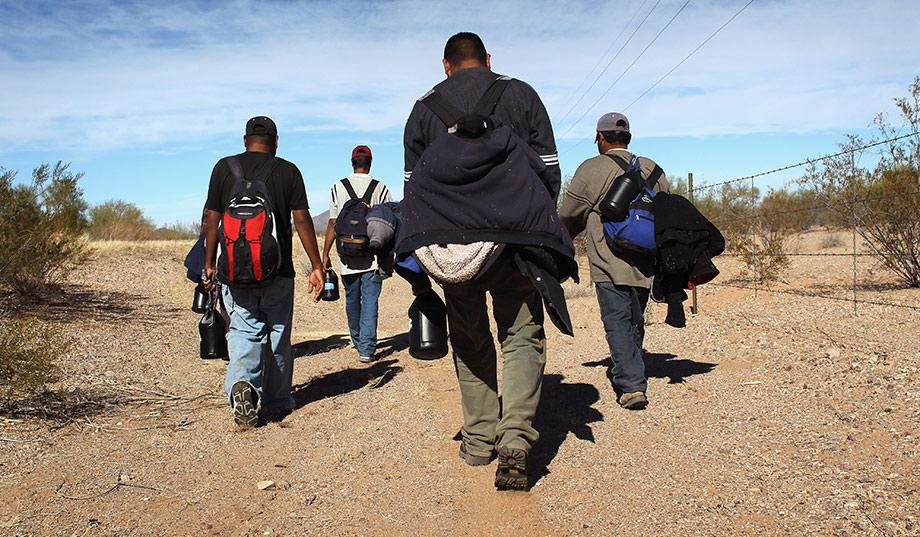
Alabama 1st District U.S. Rep. Bradley Byrne on Tuesday tweeted there are no plans to house immigrants at the Navy airfields in south Baldwin County. “BREAKING: My office has learned that there are no plans to house illegal immigrants at Navy airfields in south Baldwin County! This was a bad idea from the start, and I am pleased it will not come to fruition,” Byrne tweeted upon receiving confirmation from the Department of Homeland Security (DHS) and Immigration and Customs Enforcement (ICE). BREAKING: My office has learned that there are no plans to house illegal immigrants at Navy airfields in south Baldwin County! This was a bad idea from the start, and I am pleased it will not come to fruition. — Rep. Bradley Byrne (@RepByrne) August 14, 2018 “Housing illegal immigrants at ill-equipped airfields along the Gulf Coast was always a terrible idea, so I appreciate the confirmation that this plan is no longer being considered,” Byrne said in a statement following his tweet. “We had a team effort to push back this flawed idea, and I especially want to thank Baldwin County Commissioners Chris Elliott and Tucker Dorsey and Baldwin County Sheriff Hoss Mack for their advocacy on this issue.” Byne continued, While I am glad this issue is resolved, we must continue working to secure the border and eliminate the need for additional housing for illegal immigrants altogether. I remain 100% committed to working with President Trump to build a border wall, hire additional border patrol officers, and ensure our border security is as strong as possible.” Byrne led an effort in Washington in June to express opposition to housing up to 10,000 illegal immigrants at Naval Outlying Field Silverhill and Naval Outlying Field Wolf in south Baldwin County. He joined other members of the Alabama and Florida Congressional delegations in sending a letter to Secretary of Defense James Mattis and Secretary of Homeland Security Kirstjen Nielson outlining concerns with the proposal. Byrne also hosted Baldwin County officials in Washington for a series of meetings to convene local concerns with the proposal. Read the letter from ICE Deputy Director Ronald Vitiello below:
Groups call for Birmingham to be a sanctuary city after illegal immigrant arrests
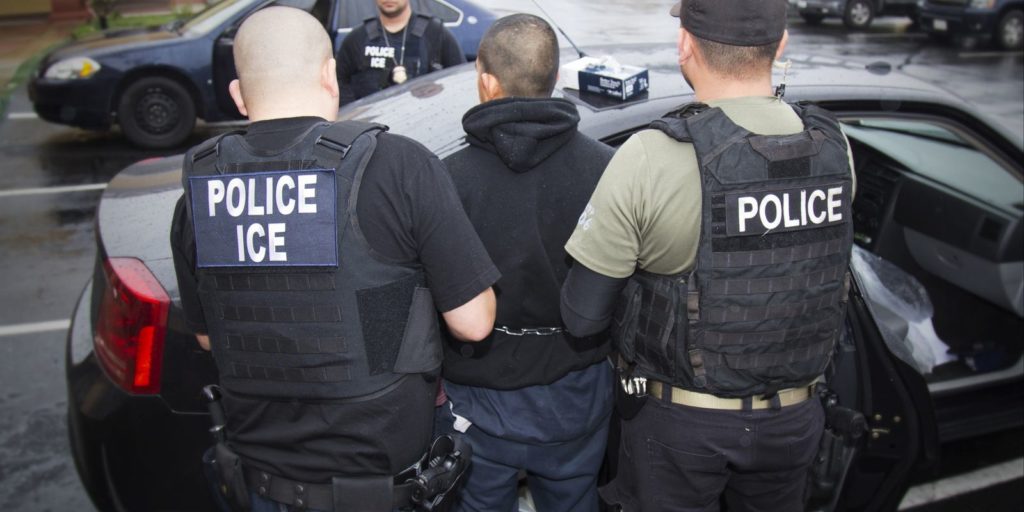
Across a five-state ICE region, which includes Alabama, on average 200 illegal immigrants are being arrested each week, according to Bryan Cox, Southern Region Communications Director for U.S. Immigration and Customs Enforcement (ICE) in a weekend AL.com piece. According to Cox, the region consists of Alabama, Arkansas, Louisiana, Mississippi and Tennessee, and “about 90 percent of arrests in fiscal year 2017 and the first two quarters of fiscal 2018 were criminal.” In light of the arrests, immigrant rights organizations such as Hispanic Interest Coalition of Alabama (HICA) and Alabama Coalition for Immigrant Justice (ACIJ) are pushing for Birmingham Mayor Randall Woodfin to make the Magic City a sanctuary city to protect the illegal immigrants. “At least have Birmingham to recognize the work of immigrants and undocumented immigrants in our city,” ACIJ Lead Organizer Miguel Carpizo said. Multi-year effort Last January, then-Birmingham Mayor William Bell held a press conference with community leaders naming Birmingham a “welcoming city” regardless of immigration status. “Every individual who resides, works, plays or come through the city will know they are welcome and have no fear in interacting with their municipal government in any way,” Bell said. Following his press conference, the Birmingham City Council unanimously passed a resolution supporting illegal immigrants, though they did not declare it as a sanctuary city. But the HB56, also known as the Beason Hammon Act, stopped the city from setting a policy contrary to federal or state law.
House rejects Republican immigration bill, ignoring Donald Trump
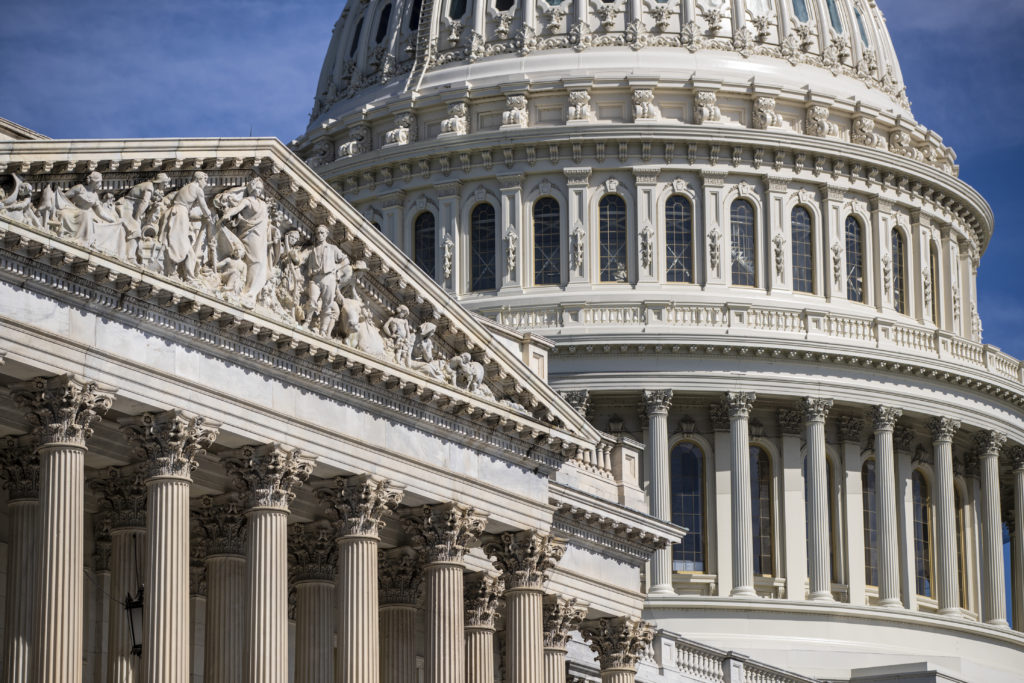
The Republican-led House resoundingly rejected a far-ranging immigration bill Wednesday despite an eleventh-hour endorsement by President Donald Trump, as the gulf between the GOP’s moderate and conservative wings proved too deep for leaders to avert an awkward election-year display of division. The bill was killed 301-121, with nearly half of Republicans opposing the measure. The depth of GOP opposition was an embarrassing showing for Trump and a rebuff of House leaders, who’d postponed the vote twice and proposed changes in hopes of driving up the tally for a measure that seemed doomed from the start. The roll call seemed to empower GOP conservatives on the fraught issue. Last week a harder-right package was defeated but 193 Republicans voted for it, 72 more than Wednesday’s total. In Wednesday’s vote, 112 Republicans voted “no,” including many of the party’s most conservative members. “We need to start securing the border and not reward bad behavior, and that’s what this bill did,” said Rep. Roger Williams, R-Texas. Conservatives have opposed the bill’s provision offering a chance at citizenship for hundreds of thousands of immigrants who came to the U.S. illegally as children. Calling it amnesty, they have said it doesn’t do enough to limit the number of relatives who immigrants here legally can sponsor for residence. Even if it passed, the bill rejected Wednesday would have been dead on arrival in the closely divided Senate, where Democrats have enough votes to kill it. House Democrats voted unanimously against it. “Show some compassion,” said Rep. Adriano Espaillat, D-N.Y., who came to the U.S. from the Dominican Republic with his parents at age 9. “Will we step up to be the country that allowed me, as a young boy, to find safety with my mother and father?” GOP leaders have been considering a Plan B: a bill focused narrowly on barring the government from wresting children from migrant families caught entering the country without authorization. With television and social media awash with images and wails of young children torn from parents, many Republicans have wanted to pass a narrower measure addressing those separations before Congress leaves at week’s end for its July Fourth break. But that seemed unlikely. GOP aides said Republicans had yet to agree on bill language, and the effort was complicated by a federal judge who ordered that divided families be reunited with 30 days. Republicans have been working on legislation that would keep migrant families together by lifting a court-ordered, 20-day limit on how long families can be detained. Senators are trying craft a bipartisan plan. Trump has issued an executive order reversing his own family separation policy, but around 2,000 children remain removed from relatives and are generating damaging daily stories that Republicans would love to halt. Besides creating a pathway to citizenship for some young immigrants, the defeated bill would provide $25 billion for Trump to build his coveted wall on the border with Mexico. It would restrict family-based immigration and bar the Homeland Security Department from taking migrant children from parents seized crossing into the country without authorization. In a startling turnabout earlier Wednesday, Trump made an all-caps pitch for the bill. Just Friday, he’d urged Republicans to stop wasting time on the effort until after the November elections. In his latest display of whiplash on the issue, Trump tweeted, “HOUSE REPUBLICANS SHOULD PASS THE STRONG BUT FAIR IMMIGRATION BILL, KNOWN AS GOODLATTE II, IN THEIR AFTERNOON VOTE TODAY, EVEN THOUGH THE DEMS WON’T LET IT PASS IN THE SENATE.” The vote capped months of futile GOP efforts to pass wide-ranging legislation on an issue that could color scores of congressional races in this fall’s contest for House and perhaps Senate control. The Senate rejected three proposals in February, including one reflecting Trump’s hard-line policies and two bipartisan plans. Democrats and centrist Republicans from swing districts say the GOP could suffer because the party, steered by Trump’s anti-immigrant harangues, could be alienating pivotal moderate voters. But conservatives relish such tough stances. Conservative Rep. Steve King, R-Iowa, who voted “no,” said lawmakers “couldn’t go home and face their constituents and say ‘I just gave you the largest amnesty ever without really a guarantee of enforcement.’” But Rep. Tom Cole, R-Okla., who backed the measure, said, “Some people can’t get to yes no matter what you do, and some people are just afraid of the issue.” Rep. Carlos Curbelo, R-Fla., and Rep. Jeff Denham, R-Calif., from competitive districts with large numbers of Hispanic voters, helped force Ryan to stage immigration votes. This spring they launched a petition that could have led to House passage of liberal-leaning measures creating a pathway to citizenship, bills backed by Democrats but opposed by most Republicans. Leaders headed off the petition by urging GOP lawmakers to not sign it, partly by crafting the compromise package the House rejected Wednesday. After the vote, Curbelo said too many lawmakers “simply lacked the courage” to help “victims of a broken immigration system.” Denham said the vote made it “very obvious that we need to have a bipartisan solution” — an avenue that the approach of campaign season makes highly unlikely. The more conservative bill the House rejected last week clamped down on legal immigration and provided no way for the young immigrants to become citizens. Republished with permission from the Associated Press.
U.S. Navy document reveals plans to house immigrants in Alabama tent cities
Alabama could be the new home of one of the controversial tent cities used to house illegal immigrants by the Trump administration. According to an exclusive report published by TIME magazine on Friday afternoon, the U.S. Navy is preparing to construct several new detention centers across the nation; with plans for one being placed at the Navy Outlying Field Wolf, and Navy Outlying Field Silverhill near Orange Beach, Ala. The new “tent city” could offer room for as many as 25,000 illegal immigrants detained at the border and transported to the Yellowhammer State. The immigrants could be housed in the new detention center for as long as a year, according to TIME. “Although the military has not yet been ordered to construct these new detention facilities, it is clear it bracing to join a policy challenge that is ricocheting throughout the whole of government,” continued the report. “What began as a crackdown on immigrants crossing the border illegally has now spread to the departments of Justice, Homeland Security, Defense and Health and Human Services.” The report comes in the wake of President Donald Trump‘s new “zero-tolerance” immigration policy announced by Jeff Sessions in May. “If you are smuggling a child then we will prosecute you, and that child will be separated from you as required by law,” Sessions said Monday at a law enforcement event in Scottsdale, Ariz. “If you don’t like that, then don’t smuggle children over our border,” said Sessions, according to TIME. “If you cross this border unlawfully, then we will prosecute you. It’s that simple,” Sessions added, describing the new policy as zero tolerance. “We are dealing with a massive influx of illegal aliens across our Southwest Border. But we’re not going to stand for this.”
Why the selective outrage over children and families in crisis?
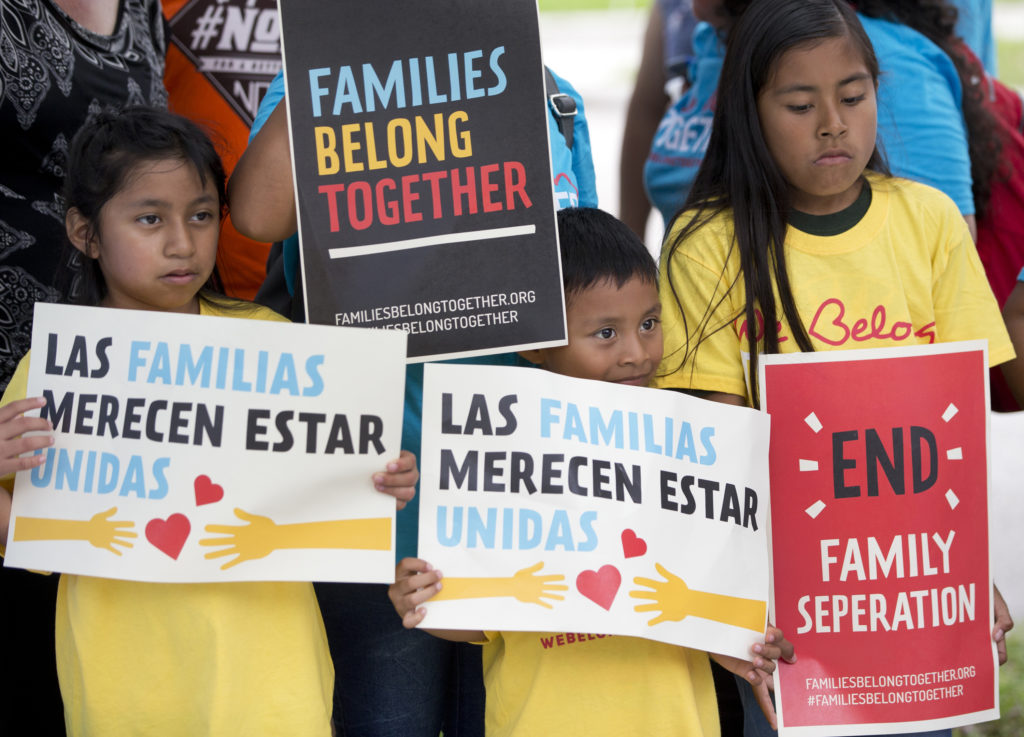
For weeks, the outrage over families separated at the Mexican border has dominated media coverage and many personal conversations. Celebrities have weighed-in. Religious leaders have weighed-in. Politicians have certainly weighed-in. The issue is gut-wrenching. I have yet to find a single soul, regardless of political affiliation, who is not moved by the heartache of children being torn from their parents. The question is what to do about it? The old policy of “catch and release” has failed us and has failed the children involved. It has led to human-traffickers using children as props to cross the border and exploit them. The new policy of prosecuting all adults who illegally cross the border including those with the children, thus requiring the separation, has led to heartbreaking stories as the parents and children are torn apart from one another. Albeit temporarily. With every passing day I am reminded how incredibly fortunate it is that I am an American and to be able to provide housing, food, a quality education and a safe environment for my children. I know it’s easy to take any one of those factors for granted and the reality that those attempting to cross our border lack those basic necessities is not lost on me. Their lives are no less valuable than mine, or my children’s, simply because they weren’t born here. The problem is that our nation isn’t in a position financially, or with human capitol needed, to provide resources to those coming for America to have open borders, or to take in every person or family that seeks refuge here. We have our own problem with poverty, violence, failing schools, and opioid addiction, just to name a few. What would life in the U.S. be like if the liberals, celebrities, and media talking about the children at the border gave the same attention and the same resources to the children in foster care or in poverty? Why don’t they feel they need to? Because it’s the government’s job to provide for them? We can’t, or more appropriately we don’t, care for those families in need in our communities well enough and yet there are some that just want to open the borders and take more and more in. Where does it stop? No one, I repeat, no one wants a world in which children are separated from their families or are treated with anything but respect and tenderness, but compassion can’t be a substitute for enforcement of the laws. Many criminals in the U.S. have a backstory that would break your heart. A life of poverty, abuse, living in bad conditions in unsafe neighborhoods, an education system that failed them, etc. When these individuals are arrested their children are put into foster care or go to a family member. Those children are scared and confused and they want their parents as much as the children at the border want theirs. Why do these children not get the same media coverage? Don’t tell me that it’s not either or and that you can advocate for both, because the fact is in life some things are truly black and white. United States citizens in the U.S. are afforded unalienable rights, protections and benefits that non-citizens are not. As I explained to a friend, yes we do have to choose. So long as their are limited resources for food, housing, healthcare and education in our nation then it would be wrong and immoral for us to continue to allow people to come in and burden the same failing systems that are already not working for so many Americans in dire need of their assistance. Yes, we can be outraged about the children at the border being separated from their parents, but to fault only the government officials who are trying to stem a problem is wrong. What would actually help these families, and other families like them in the future, are rules and processes that are ironclad with no ambiguity. Do we need a complete overhaul of our legal immigration system? Yes. Our guest-worker program needs to be looked at. Our refugee system needs to be looked at. It’s endless, but right now the crisis is with illegal immigrants those who are seeking to enter our nation knowing that they aren’t doing so legally and hoping for the best. Our country is built on a foundation of laws and that includes laws about immigration. Just because people want in doesn’t mean we have to or should allow them in. Yes, the poverty and violence in the home countries of these individuals is heartbreaking, but so is the violence and poverty in parts of Birmingham, Chicago, D.C. and other American cities. These families have to be turned away because it’s what’s best for those already here. Is that sad and heartbreaking, yes but it’s reality. We don’t have the resources to provide for an unlimited number of people and we can’t afford policies that encourage further migration. That would only make things worse. If we were guided strictly by our hearts in choosing which laws to enforce then could we allow people a pass when they steal cars or rob banks “for their families”? Would the “Robin Hood” defense suddenly become acceptable? If it’s just in the name of children’s well-being that we turn a blind eye to criminal activity, where do we draw the boundaries? I read a story today of a family of nine coming to the border with two young children. Should all nine be allowed in because they brought children? What about the human-traffickers, gang members, drug and weapon runners who transport children? Do they get a pass to walk through the border and should the government leave the children with them? If someone wants to sit at the Mexican side of the border and make it their mission to find and improve the lives of the children who would otherwise come here and face separation from their families — more power to you. I believe that’s
