
Dan Sutter: Why is inflation costly?
Inflation exceeded 5 percent in June. Double-digit inflation burdened Americans in the 1970s. Although we treat inflation as bad, economists find its costs hard to pin down. The three economic functions of money help us think about inflation’s costs. Money’s first role is a medium of exchange, meaning a good way to conduct transactions. With barter, if you have oranges and want potatoes, you must find someone with potatoes who wants oranges. The second role is a store of value, or a way to avoid your oranges spoiling before you buy potatoes. Finally, money is a unit of account, or a convenient way to express prices. A pure inflation means proportional increases in all prices, including wages and salaries. Consequently, inflation should not make households poorer since incomes should go up about the same as expenses. Any stress on budgets should be temporary, due to some prices rising before wages. Rising prices reduce the dollar’s purchasing power, impairing money as a store of value. Suppose you plan to use $500 from a garage sale in August to buy Christmas presents. If the dollar loses half its value by Christmas, it is as if half your garage sale proceeds were stolen. This is a cost, but a modest one for inflation of 5 or 10 percent. Many assets besides money provide stores of value and earn interest or capital gains to offset inflation, so people should limit how long they hold cash. Do not put your savings in a mattress during inflation. Trying to hold as little cash as possible produces “shoe leather” costs, called this because in the 1970s, depositing or withdrawing cash required trips to the bank. Prior to deregulation, banks were open limited hours. Electronic banking has dramatically reduced shoe leather costs. Money still works as a medium of exchange with modest inflation because people can shift dollars into other assets after trading. Money stops working with extremely high levels of inflation, say thousands or millions of percent a year. This is called hyperinflation and is enormously costly; economists do not question the costs of hyperinflation. Changing prices can also be costly. Economists refer to these as menu costs, from the case of a restaurant having to print new menus when increasing prices. Restaurants will raise prices more frequently with 12 percent inflation than 2 percent. Yet menu costs have fallen sharply with electronically posted prices. Several other costs exist but also seem to be small. One potentially significant cost exists related to long-term contracts. Inflation benefits borrowers and hurts lenders. Fixed interest rate mortgages provide an example. My parents bought the home I grew up in in 1962 with a mortgage from a savings and loan. After inflation averaged 7.5 percent in the 1970s, my parents’ mortgage payments were, adjusting for inflation, only a fraction of what the lender expected to receive. The 1970s inflation ruined the savings and loans, even though most did not go bankrupt until the 1980s. Do we finally have a significant cost of inflation? Not necessarily. The wealth transfers result from contracts using nominal (or not adjusted for inflation) interest rates or wages. Economic theory predicts, and the evidence bears out, that nominal interest rates should be set based on the rate of inflation expected over the term of the loan. Accurately forecasting inflation can limit the wealth transfers, although forecasting is itself costly. But an even simpler fix exists: adjust the contracted interest rate using observed inflation. Make a mortgage interest rate be, say, 3 percent plus the inflation rate in the previous year. We began adjusting many contracts for inflation after the 1970s; Congress even began indexing income tax brackets to eliminate “bracket creep.” The costs of a modest inflation are normally small, and indexing contracts limits them further. The problem with inflation may be moral more than economic. To obtain money legally, people must either work or sell something of value. Counterfeiters do not earn their fake dollars, yet undetected counterfeit bills compete with ours to buy goods and services. Government-created money is like counterfeiting, and government should not be in the counterfeiting business. Daniel Sutter is the Charles G. Koch Professor of Economics with the Manuel H. Johnson Center for Political Economy at Troy University and host of Econversations on TrojanVision. The opinions expressed in this column are the author’s and do not necessarily reflect the views of Troy University.
Daniel Sutter: Two paths forward for healthcare

Numerous prominent Democrats now support Medicare for All, the most recent proposal for a single-payer healthcare system. A recent Trump Administration report, Reforming America’s Healthcare System Through Choice and Competition, offers a different path forward, detailing the numerous ways government restricts competition and increases costs. Medicare for All suggests that we would be turning away from markets and private insurance to government healthcare. In truth, government rules have dominated the industry for over fifty years. A handful of economists have argued for more competition. These arguments have been largely ignored. Until now. Market proponent and economist John Goodman describes the new report as “astonishingly bold,” and “the first time any administration has explicitly acknowledged” government as the source of our most serious problems in healthcare. Competition for profits in markets controls costs. Let doctors and hospitals compete and we can see who offers patients the best service for the best price. Yet we do not truly use markets for healthcare. For instance, doctors rarely quote prices for treatments or procedures ahead of time. People seem to fear that profitable medicine must involve cutting costs and offering low quality care. Yet luxury thrives under competition. Luxury hotels succeed because they deliver high quality, albeit costly, service. Examples like the Mayo Clinic demonstrate that reputations for excellence in medicine can be maintained. Concierge doctors provide high quality care for paying customers. Reforming America’s Healthcare System’s list of how government inhibits competition is too long to thoroughly examine. I will consider some highlights. Scope of practice laws often prevent medical professionals like physician assistants, advanced practice nurses, and pharmacists from offering services consistent with their training. These professionals can competently diagnose many routine conditions or prescribe standard drugs but are restricted by law. A Mercatus Center study estimated that eliminating state scope of practice laws would save over $800 million annually. Such restrictions particularly hurt rural areas facing a shortage of physicians. Certificate of Need laws require government-appointed boards to approve new or expanded healthcare facilities. Alabama’s law covers hospitals, nursing homes, and out-patient surgery centers, among others. Executives from hospitals and clinics often staff these boards, letting existing providers deny entry to would-be challengers. This is a dubious idea. Sears would have loved to keep Walmart and Amazon out of retail. Telemedicine promises considerable cost savings. Smart phones can already transmit a significant amount of information to a medical professional. The barriers to telemedicine today are primarily regulatory. And the benefits extend beyond dollars: patients with limited mobility can avoid painful trips to a doctor’s office. America arguably needs more doctors. We have fewer doctors per capita than most other developed nations despite spending a larger percentage of our GDP on healthcare. Medical doctors must be smart and spend years in intensive training, so the supply will always be limited. But the restrictions are artificial, not natural. Medical organizations run by physicians – who benefit from restricted supply – determine the number of slots in America’s medical schools. The report proposes redirecting Federal medical education dollars to gradually increase enrollment in U.S. medical schools. Simplifying the process for approving foreign-trained doctors to practice in the U.S. offers more immediate relief. Residency and licensure burdens could be waived for doctors completing foreign medical training judged comparable to American programs. The alternative to markets and competition is governance by experts. State Certificate of Need laws resulted from one such Federal planning effort in the 1970s. Government experts would avoid investments in unneeded hospitals and facilities to help control costs. Yet the healthcare costs have outpaced inflation since the 1970s. Experts never seem to outperform competition in controlling cost. Government control and markets provide alternative ways to organize our economy. We rely on markets to supply us with food, which is as much a necessity as medical care, with ever-declining prices and an incredible array of options as a result. Perhaps we should give a healthcare market a chance before turning to Medicare for All. ••• Daniel Sutter is the Charles G. Koch Professor of Economics with the Manuel H. Johnson Center for Political Economy at Troy University and host of Econversations on TrojanVision. The opinions expressed in this column are the author’s and do not necessarily reflect the views of Troy University.
Daniel Sutter: Gold, inflation and theft
President Donald Trump is reportedly considering former Godfather’s Pizza CEO and one-time presidential candidate Herman Cain for the Federal Reserve Board of Governors. Mr. Cain’s potential selection caused a stir for at least three reasons: accusations of sexual harassment which surfaced during his presidential run, a lack of training as an economist, and his advocating a return to a gold standard in a Wall Street Journal op-ed. Gold standard proponents perplex monetary economists because, I think, they raise primarily moral rather than economic arguments. Today most nations have government currencies managed by a central bank, like our Federal Reserve. Government monies are paper currencies, in contrast with the commodity or metallic monies of history. The dollar is money because the Federal government declares it to be. As each dollar states, “This note is legal tender for all debts, public and private.” Governments, though, did not invent money. Indeed, no one invented money; it emerged through the economic actions of people, particularly specialization in production and trade. A cobbler must trade the shoes she makes for food, clothing, and other things. Without money, the cobbler must use barter, and find a farmer, blacksmith, and clothier willing to take shoes for payment. Trading is easier to carry out when everyone accepts the same item in exchange for shoes, clothes, food, and everything else. This is money’s role. A commodity becomes money when people who do not want it for their personal use accept it in trade. No one person hit upon this idea and ordered everyone to use gold or silver as money. People saw how money made life easier. Money is an institution created by human action but not the product of human design. Money must maintain value to be useful in trading. If the money the cobbler accepts for her shoes disappeared or became worthless before she could buy food and clothes, she would get shortchanged. Counterfeiting threatens money. Today counterfeiters try passing off fake dollars for real dollars. Counterfeit currency allows people to acquire valuable goods and services without giving up anything of value. A law-abiding person’s money, if not a gift, represents something of value not yet traded away, unspent earnings, or a person’s time and effort. Counterfeiters effectively steal from people who acquire money honestly. Taking over supplying money allowed kings, and today governments, to create money not backed by production. No one could create commodity or metallic money out of nothing; alchemists tried in vain to turn lead into gold. Discoveries of gold or silver create riches, but still provide economic value – more gold to use as money. Under the gold standard, dollars were convertible into gold at a fixed rate. When the dollar was convertible at $35 per ounce, the supply of dollars was limited to $70,000 for every ton of gold reserve. The U.S. eliminated the domestic convertibility of dollars in 1933 and abandoned the last vestiges of a gold standard in 1971. Deliberate expansion of the money supply typically produces inflation and taxes everyone holding dollars. Modern monetary economists argue that the “tax” from inflation, or seigniorage, is typically very small, while control over the money supply can help stabilize the economy. Today the effective money supply exceeds the amount of currency in circulation, creating the potential for banking crises to destabilize the economy. Economists recognize the potential for governments to create too much money. Inflation, for example was a significant problem in the 1970s. Central bank independence, however, can curb politicians’ control over the money supply: enlightened monetary economists running the Federal Reserve will manipulate the money supply to our nation’s benefit. Monetary economists presume that whether governments should provide money was settled long ago and focus instead on managing our economy. Gold standard proponents want to relitigate this question, in large part to end the government’s ability to take wealth from citizens through inflation. ••• Daniel Sutter is the Charles G. Koch Professor of Economics with the Manuel H. Johnson Center for Political Economy at Troy University and host of Econversations on TrojanVision. The opinions expressed in this column are the author’s and do not necessarily reflect the views of Troy University.
Daniel Sutter: The battle against inflation
Inflation fears rose briefly during 2018, as the increase in the Consumer Price Index (CPI) approached 3 percent. In 1980, three percent annual inflation would have set off celebrations. Our success in reducing inflation provides a lesson about policy making by elected officials. To avoid confusion we should be clear about the meaning of inflation. Americans often mean the cost of living when they say inflation. Economists, by contrast, specifically mean an increase in the overall price level. A pure 5 percent inflation would be exactly a 5 percent increase in every price. Salaries and wages are prices and would be included. Inflation should not reduce the ability of households to buy goods and services, as income and expenses both increase equally. Economists call an increase in the price of gasoline or housing a change in relative prices, not inflation, even though either raises living costs. Housing costs more in New York or San Francisco than in Alabama. That the cost of living in Manhattan is more than double that in Montgomery matters for weighing job offers. Differences in living costs, however, are also not inflation. The CPI does not include wages and rises even for relative price increases, yet still measures inflation pretty well. The annual change in the CPI exceeded 10 percent in 1974 and 1979-1981, hitting 13.5 percent in 1980. By 1983, inflation was below 5 percent and has only topped this level once since. The U.S. has not been the only nation to bring inflation under control. U.S. inflation fell from 8.5 to 1.7 percent over 1974-83 and 2008-17. Yet over these decades, inflation fell from 11.3 to 1.1 percent in France and from 16.7 to 1.1 percent in Italy and Spain. Even Latin America has experienced progress; inflation fell from 33 to 4 percent in Mexico and from 112 to 6 percent in Brazil. International success argues against a uniquely American explanation for our decline in inflation. For instance, I might wish to credit Ronald Reagan for defeating inflation. While President Ronald Reagan undoubtedly deserves some credit, a “great person” story would require great leaders in many nations, which seems less likely. During the 1970s, many blamed inflation on rising world oil prices. A decline in oil supply would raise oil prices and hike the CPI, but would be a relative price change, not inflation as defined by economists. And significant oil price increase last decade did not produce double digit inflation. One economist who never wavered about the cause of inflation during the 1970s was Milton Friedman, who insisted that “inflation is everywhere and always a monetary phenomenon.” Governments and their central banks, like our Federal Reserve, inflate the money supply, driving up prices. Behind the focus on oil, the Federal Reserve did indeed fuel the 1970s inflation with money supply growth. With Paul Volcker as Federal Reserve Chair and Ronald Reagan in the White House, the brakes were put on the money creation and inflation fell accordingly. The economics profession now largely accepts that Professor Friedman was right on inflation. Why then did so many nations cause themselves the pain of inflation? And what has changed? Monetary economists have identified central bank independence as a key. A central bank is like a bank for the nation’s banking system, and generally controls the money supply. Politicians find easy money and credit irresistible, particularly when running for reelection. If politicians have too much control, they will inevitably inflate the money supply. The Federal Reserve has always had some political independence. When the Fed Chair and Governors want monetary stability, as Mr. Volcker and his successor Alan Greenspan did, they can often prevail over the President and Congress. Other nations increased their central banks’ independence, based on economists’ advice. The European Central Bank was modeled on Germany’s independent Bundesbank. People are imperfect and face problems of self-control. Our elected officials are human, and the potential to shift blame in politics exacerbates self-control problems. The world’s success battling inflation shows that elections alone do not always ensure wise economic policy. Daniel Sutter is the Charles G. Koch Professor of Economics with the Manuel H. Johnson Center for Political Economy at Troy University and host of Econversations on TrojanVision. The opinions expressed in this column are the author’s and do not necessarily reflect the views of Troy University.
Fed set to leave rates alone amid signs of rising inflation
The Federal Reserve achieved an inflation milestone this week, but that isn’t likely to alter expectations for what the Fed will announce when its latest policy meeting ends Wednesday. After six years of mostly missing its annual 2 percent target for inflation, the Fed learned Monday that its preferred gauge of consumer inflation had reached a year-over-year pace of 2 percent. And in the coming months, inflation is widely expected to stay around that level. The debate the Fed is now likely to have is whether it should accept a period in which inflation rises above 2 percent without accelerating its pace of rate increases. But for now, a rate increase is considered unlikely. In a statement it will issue Wednesday afternoon, the Fed is expected to leave its benchmark rate unchanged at a still-low level of 1.5 percent to 1.75 percent. Solid economic growth, low unemployment and evidence of inflation pressures, though, are expected to keep the central bank on a path of gradual rate hikes the rest of the year. Most Fed watchers foresee either two or three additional increases in the Fed’s key rate by year’s end, coming after an earlier hike in January. The central bank is meeting as its board is undergoing a makeover, with a raft of new appointees by President Donald Trump who appear generally supportive of the Fed’s cautious approach to rates since the Great Recession ended. Despite Trump’s complaints during the presidential race that the Fed was aiding Democrats in keeping rates ultra-low under President Barack Obama, his choices for a chairman and for other slots on the Fed’s board have been moderates rather than hard-core conservatives who would favor a faster tightening of credit. “The Trump Fed could have been a much more hawkish Fed but so far, these choices are pretty middle-of-the road,” said Diane Swonk, chief economist at Grant Thornton in Chicago. As Jerome Powell, Trump’s hand-picked new Fed chairman, said at a news conference after the central bank’s most recent meeting in March, “We’re trying to take the middle ground, and the committee continues to believe that the middle ground consists of further gradual increases in the federal-funds rate.” Bond investors are signaling that they expect a pickup in U.S. inflation, having bid up the yield on the 10-year Treasury note last week above 3 percent before the yield settled just below that by week’s end. A year ago, the 10-year yield was just 2.3 percent. Under Powell’s predecessors, Janet Yellen and Ben Bernanke, the Fed’s board endured criticism from House Republicans over its decision to pursue a bond purchase program designed to lower long-term borrowing rates and to leave its key rate at a record low near zero for seven years. The critics charged that those policies would eventually produce destructive bubbles in the prices of stocks and other assets and, eventually, undesirably high inflation. But so far, Trump’s reshaping of the Fed’s board reflects a generally status quo approach. “Trump’s criticisms during the campaign have not been borne out by his decisions on who to put on the Fed,” said Mark Zandi, chief economist at Moody’s Analytics. Since the Fed began raising rates in December 2015, the pace has been modest and gradual: One quarter-point rate increase in 2015, one in 2016, three in 2017 and one so far this year. When the Fed announced its most recent rate hike in March, it forecast that it would raise rates twice more this year. But some economists think that the Fed will respond to the increased government stimulus in the form of tax cuts and higher spending to accelerate the rate hikes slightly from three to four this year. Congress in December passed a $1.5 trillion tax cut that took effect in January. And then in February, it approved $300 billion more in government spending for this year and next year. That stimulus, coming at a time when unemployment is at a 17-year low of 4.1 percent, could raise the threat of higher inflation. Yet even against this backdrop, the prevailing view is that the Trump-shaped Fed will remain cautious about rate increases. “The central bank does not want to make the mistakes made in the past when the Fed raised rates too high, too fast and became the No. 1 cause of a recession,” said Sung Won Sohn, an economics professor at California State University, Channel Islands. Republished with the permission of the Associated Press.
Fed is likely to leave rates alone at a time of uncertainty
At some point in the coming months, the Federal Reserve is widely expected to resume raising interest rates. Just not quite yet. On Wednesday, the Fed will likely end its latest policy meeting with an announcement that it’s keeping its benchmark rate unchanged at a time of steady economic gains but also heightened uncertainty surrounding the new Trump administration. In its statement, the Fed will likely acknowledge that the economy has continued to move toward the central bank’s dual goals of full employment and annual inflation of roughly a moderate 2 percent. But the Fed is nevertheless expected to signal that it wants more time to monitor the economy’s performance and that it still expects those rate increases to occur gradually. “We are moving in the direction of more rate hikes this year, but the January meeting is not where that will start,” said David Jones, chief economist at DMJ Advisors. At the moment, most economists foresee no rate increase even at the Fed’s next meeting in March, especially given the unknowns about how President Donald Trump‘s ambitious agenda will fare or whether his drive to cancel or rewrite trade deals will slow the economy or unsettle investors. It’s always possible that the central bank could surprise Fed watchers Wednesday by sending a signal that a rate hike is coming soon. In Fed parlance, that signal could be as slight as changing language in its statement to say “near-term risks to the economic outlook appear in balance,” instead of “roughly in balance,” the phrase it has been using. The statement will not be accompanied by updates to the Fed’s economic forecasts or by a news conference with Chair Janet Yellen, both of which occur four times a year . Last month, the Fed modestly raised its benchmark short-term rate for the first time since December 2015, when it had raised it after keeping the rate at a record low near zero for seven years. The Fed had driven down its key rate to help rescue the banking system and energize the economy after the 2008 financial crisis and the Great Recession. When it raised rates last month, the Fed indicated that it expected to do so three more times in 2017. Yet confusion and a lack of details over what exactly Trump’s stimulus program will look like, whether he will succeed in getting it through Congress and what impact it might have on the economy have muddied the outlook. And while Trump’s tax and spending plans are raising hopes for faster growth, his proposals to impose tariffs on such countries as China and Mexico to correct trade imbalances could slow the economy if U.S. trading partners retaliate and collectively impede the flow of imports and exports. “The Fed is unlikely to signal intentions to raise rates as early as March given the heightened uncertainty about the timing and scope of fiscal and protectionist policies,” said Sal Guatieri, senior economist at BMO Capital Markets. Nariman Behravesh, chief economist at IHS Markit, predicts that the economy will grow a modest 2 percent to 2.5 percent this year, before accelerating next year to 2.6 percent to 2.7 percent on the assumption that Trump’s policy proposals will have begun to take full effect by then. The outlook for both years would mark an improvement over the economy’s lackluster growth of 1.6 percent in 2016, its weakest performance since 2011. Even though economic growth, as measured by the gross domestic product, was underwhelming last year, the job market appears close to full health. Hiring was consistently solid in 2016, and the unemployment rate ended the year at 4.7 percent, just below the 4.8 percent level the Fed has identified as representing full employment. And inflation, by the Fed’s preferred measure, rose 1.6 percent in the 12 months that ended in December, moving closer to the Fed’s 2 percent goal. Republished with permission of The Associated Press.
Janet Yellen says she expects Fed to raise rates by year’s end
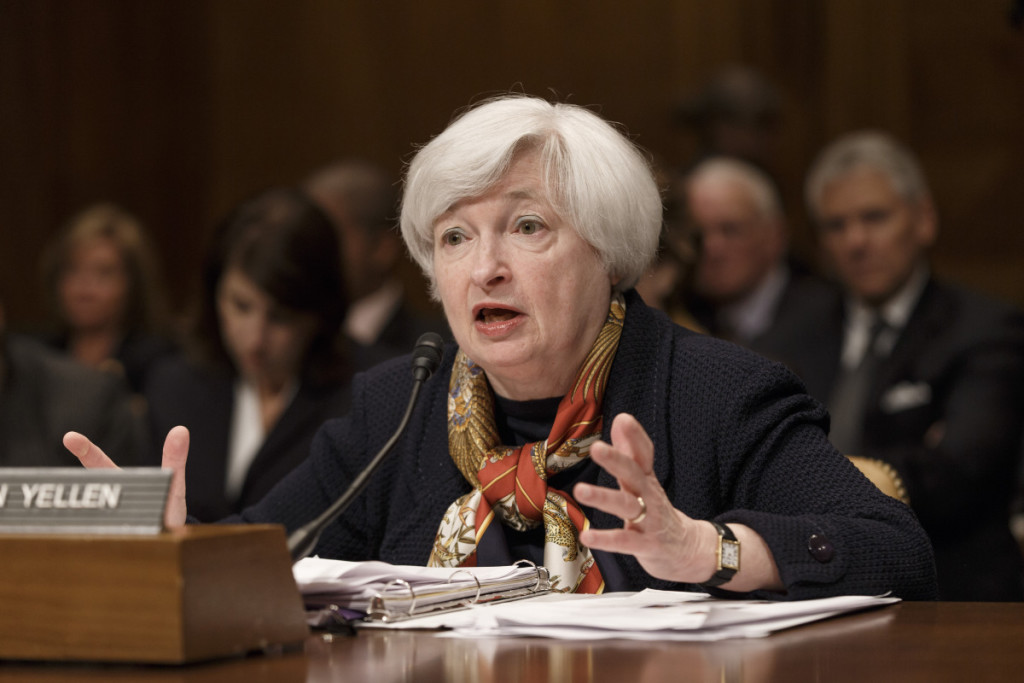
Chair Janet Yellen said Thursday that she expects the Federal Reserve to begin raising interest rates from record lows by the end of the year. In a lecture at the University of Massachusetts at Amherst, Yellen said she thought inflation would gradually move up to the Fed’s target rate of 2 percent as unusually low oil prices and other factors prove temporary. And she suggested that global economic weakness won’t likely be significant enough to dissuade the Fed from raising its key short-term rate from zero by December. Yellen’s comments may help clarify doubts about the Fed’s intentions that deepened last week after its latest policy meeting ended. The Fed chose not to raise rates, citing global economic pressures and concern about excessively low inflation. That decision raised worries that the Fed had greater concerns about economic problems in China and falling stock markets than investors had previously thought. In her speech Thursday, Yellen said Fed officials continue to monitor economic troubles abroad. But she said officials don’t think those challenges will significantly influence the central bank’s interest-rate decisions. Toward the end of the speech, Yellen, 69, paused twice for several seconds, appearing to have lost her place in the text. The Fed said in a statement later that Yellen “felt dehydrated at the end of a long speech under bright lights.” The Fed statement said she was seen by emergency medical personnel and “felt fine afterward and has continued her schedule Thursday evening.” At a news conference last week, Yellen had avoided saying whether she herself still thought a rate hike would be justified this year. She said she preferred to convey the collective view of the Fed’s policymaking committee, which establishes the central bank’s rate decisions. But on Thursday, Yellen included herself, saying, “Most of my colleagues and I anticipate that it will likely be appropriate to raise the target range for the federal funds rate sometime later this year.” The Fed has two remaining meetings for this year, Oct. 27-28 and Dec. 15-16. Many economists say they doubt the Fed would have enough new information to be confident about hiking rates in October but say they do expect a move in December as long as nothing unexpected happens to threaten the economy. “Our base-case scenario is still that the Fed will begin to hike rates in December,” said Paul Ashworth, chief U.S. economist at Capital Economics. He cautioned, though, that any government shutdown caused by battles over the federal budget or a failure to raise the government’s borrowing limit in a timely way could cause the Fed to further delay a rate increase. As she has before, Yellen stressed that when the Fed does begin raising rates, it expects the increases to be extremely gradual. The central bank has left its benchmark rate at a record low since 2008. It last raised rates in 2006. She also emphasized that the Fed has made no final decision about a rate hike. The decision still depends on further progress toward the Fed’s dual mandates: Maximizing employment and maintaining price stability, which the Fed defines as inflation rising at a modest annual pace of 2 percent. In August, the U.S. unemployment rate reached a seven-year low of 5.1 percent, essentially achieving the Fed’s job goal. But inflation has been running below the Fed’s target for more than three years and recently has fallen even farther from the 2 percent goal. Ultra-low inflation has resulted in part from a plunge in energy prices over the past year and a higher-valued dollar, which has made imports cheaper. Yellen said Fed officials still think the depressive effects of the dollar and energy prices will fade, allowing inflation to return to the 2 percent level. She noted that the Fed expects low unemployment to eventually accelerate wage gains. Republished with permission of the Associated Press.
