
As Democrats face-off, Hillary Clinton keeps her focus on the GOP
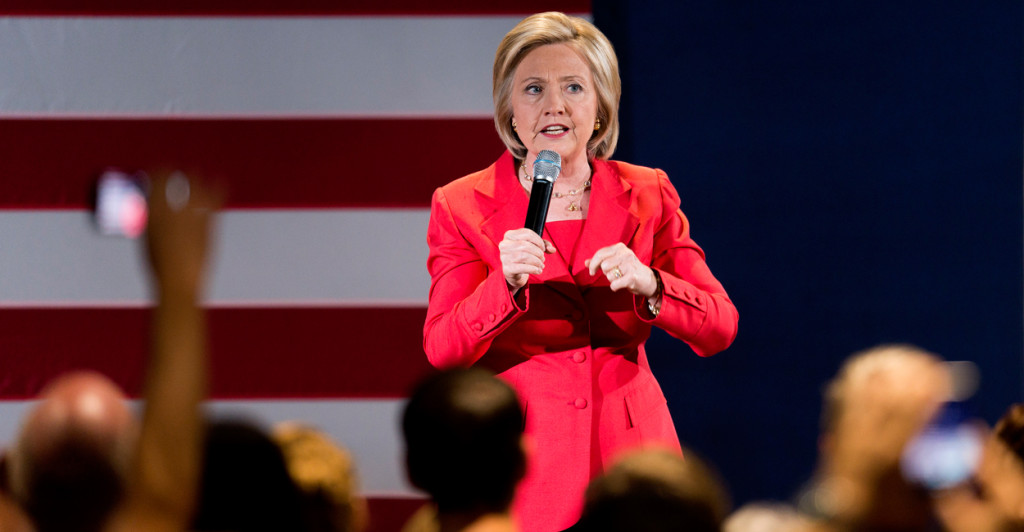
Ignoring her primary challengers, Hillary Rodham Clinton focused instead on the expanding field of Republican contenders as she and her fellow Democrats tried to impress influential party activists in Iowa. The fundraising face-off for the benefit of the state party came Friday night as the Democratic primary fight – long assumed to be just short of a coronation for Clinton – appeared to be heating up into a slightly more serious contest. In recent weeks, Vermont Sen. Bernie Sanders has risen in the polls and packed arenas with voters eager to hear the message of the self-described socialist who’s become Clinton’s chief rival. But rather than confront her most immediate political obstacle in a crucial primary state, Clinton took aim at the other party, vowing to never let Republicans “rip away the progress” made during the Obama administration. “Trickle-down economics has to be one of the worst ideas of the 1980s,” Clinton said, evoking Republican policy from the Reagan era. “It is right up there with New Coke, shoulder pads and big hair.” Sanders, too, refused to criticize his primary opponent directly. Earlier in the day he edged closer to an attack when he questioned whether Clinton would back the kinds of tough regulations for Wall Street that’s become a rallying call for liberal Democrats. “You’ll have to ask Hillary Clinton her views on whether we should break up these large financial institutions,” he said during an afternoon appearance in Cedar Rapids. At the evening forum, Sanders called for a “political revolution” fueled by a “mass movement from coast to coast” that would end the influx of money into politics and take the country off “the path to oligarchy.” “The greed of the billionaire class has got to end and we are going to end it for them,” he said. He added: “Please don’t think small. Think big.” The Clinton campaign has signaled that it considers Sanders to be a legitimate challenger who will be running for the long haul, noting the $15.2 million he’s raised – largely from small donors – in the first three months of the race. They believe he will find a measure of support in Iowa, where the caucus system typically turns out the most passionate voters, and in New Hampshire, given Sanders’ many decades representing neighboring Vermont in Congress. On Friday, Clinton’s campaign said it bought $7.7 million worth of television advertising time in early voting states, its first ad buy for the 2016 contest. In Iowa, the campaign paid $3.6 million for time in all eight media markets that serve the state. An additional $4.1 million of airtime was purchased in New Hampshire, which holds the nation’s first primary. Unlike her rivals, Clinton has already built a vast campaign infrastructure, run from a multistory headquarters in New York City, with hundreds of staffers across the country. But so far the Clinton team has resisted any direct engagement with Sanders, fearing such an exchange might alienate the activists and small-dollar donors who will form the base of support in the general election if Clinton should win the nomination. “You can see that Democrats are united, we are energized, and we are ready to win this election,” Clinton said Friday night. In a fiery address, she slammed the economic policy of former Florida Gov. Jeb Bush, joked that businessman and TV star Donald Trump is “finally a candidate whose hair gets more attention than mine,” and criticized Wisconsin Gov. Scott Walker for targeting union power. Besides Sanders and Clinton, the forum featured former Maryland Gov. Martin O’Malley, former Virginia Sen. Jim Webb and former Rhode Island Gov. Lincoln Chafee. O’Malley introduced himself as a can-do former chief executive who tackled a series of problems in Maryland by promoting public education, freezing college tuition, passing a “Dream Act” for young immigrants and expanding family leave policies. But like Sanders, he got some of his biggest applause when he talked about regulating and punishing Wall Street – underscoring the populist mood of the most active Democratic voters. “Main Street struggles while Wall Street soars,” he said. “If a bank is too big to fail, too big to jail and too big to manage, then it’s too damn big.” Republished with permission of The Associated Press.
Hillary Clinton looks to build organizational edge in Iowa
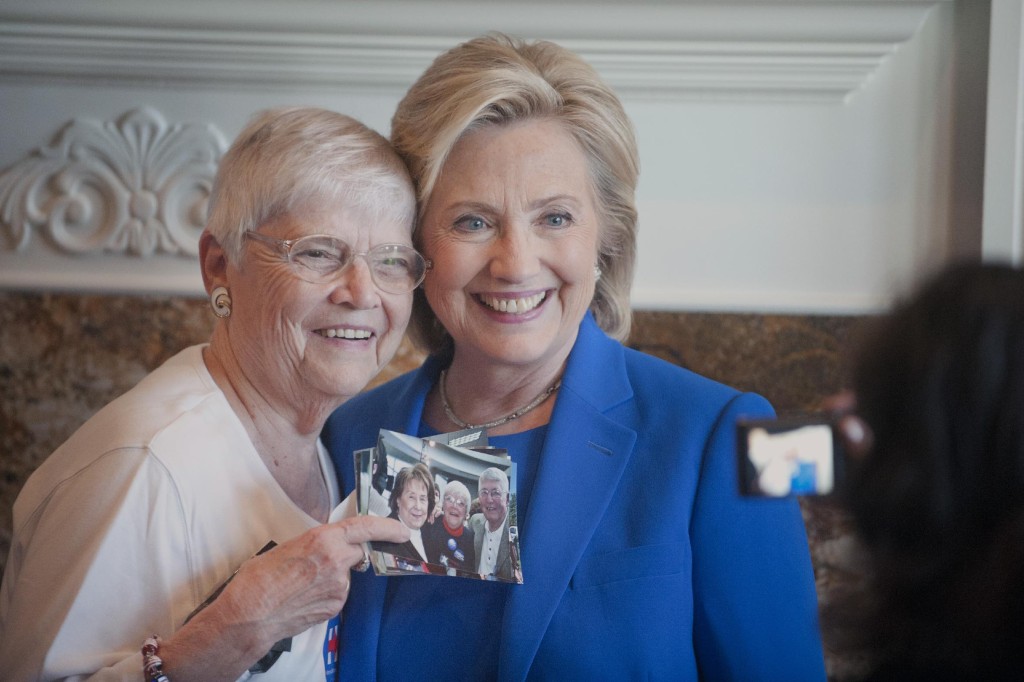
Seeking an army of volunteers, Hillary Rodham Clinton is trying to build an organizational edge in Iowa as some of her lesser-known Democratic rivals clamor for attention in the state that tripped up her first presidential campaign. Clinton flew to Iowa on Saturday night after her high-profile New York kickoff, telling supporters at a Sioux City house party that her campaign would seek to rally the country around an agenda for the future. “Everybody has a role to play,” Clinton said, urging supporters to sign up to join her campaign. Despite her dominant position in the Democratic primaries, Clinton’s allies are trying to erase the memories of her third-place finish in Iowa’s 2008 caucuses, the contest that fueled Barack Obama‘s rise to the White House. The former secretary of state’s Iowa event was streamed online to more than 600 similar gatherings around the country, covering every congressional district in an effort to add volunteers to the campaign’s roster. Clinton planned to address supporters at the Iowa State Fairgrounds in Des Moines on Sunday and then travel to the Mississippi River city of Burlington. But she had company in the state: One of her main Democratic challengers, Vermont Sen. Bernie Sanders, was campaigning across the state during the weekend. Former Virginia Sen. Jim Webb, who is exploring a potential Democratic bid, was holding events in Iowa on Sunday. During her New York speech, Clinton remained silent on some issues of critical importance to the Democratic base, most notably a Pacific Rim trade pact backed by Obama but opposed by organized labor, liberals and others who say it will cost the U.S. jobs. The agreement has not been finalized or submitted to Congress. Sanders, who has opposed the trade deal, again questioned Clinton’s refusal to say where she stood on the Trans-Pacific Partnership. “Most Democrats in the Congress are against it. But I don’t understand how you don’t have a position on this issue,” he said Saturday in Des Moines, where he opened a new campaign office. “You can’t take a position on a trade bill that you can’t see,” Clinton’s campaign manager, Robby Mook, told CBS’ “Face the Nation” on Sunday. Clinton and her advisers are not saying whether she supports legislation in Congress to give the president special negotiation authority on trade deals. In New Hampshire, former Maryland Gov. Martin O’Malley pointed to his executive experience while his campaign noted to supporters in an email that Clinton “didn’t say that she would take any substantive actions to hold Wall Street CEOs accountable for reckless behavior. Nor did she weigh in on the secretive TPP deal that could depress American wages and cost American jobs.” In New York, Clinton offered herself as a fierce advocate for those still struggling from the Great Recession. “I think you know by now that I’ve been called many things by many people,” Clinton said to cheers and laughter from the crowd of roughly 5,500 gathering on New York’s Roosevelt Island in the East River. “Quitter is not one of them.” Hours later in Iowa, Clinton added, “I don’t believe we should ever quit on our country.” Republished with permission of the Associated Press.
