
Revelers bid adieu to a year of conflicts, celebrity deaths

As 2016 draws to a close, revelers around the world are bidding a weary adieu to a year filled with political surprises, prolonged conflicts and deaths of legendary celebrities. How people are ushering in the new year: AUSTRALIA Sydney sent up a dazzling tribute to 2016’s fallen icons with a New Year’s Eve fireworks display honoring the late singer David Bowie and late actor Gene Wilder, becoming the first major city to bid a bittersweet adieu to a turbulent year. The glittering display over Sydney’s famed harbor and bridge featured Saturn and star-shaped fireworks set to “Space Oddity,” the classic song by Bowie — one of the seemingly endless parade of beloved entertainers who died in 2016. Wilder was also honored as the bridge lit up in a rainbow of colors while a song from Wilder’s famed film “Willy Wonka and the Chocolate Factory” played. “This year, sadly, we saw the loss of many music and entertainment legends around the world,” fireworks show co-producer Catherine Flanagan said. “So celebrating their music as part of Sydney New Year’s Eve fireworks displays is an opportunity to reflect on the year that has been and what the future may hold.” ___ LAS VEGAS More than 300,000 visitors are expected to descend on Las Vegas for an extravagant New Year’s Eve celebration. Nightclubs are pulling out all the stops with performances from DJ Calvin Harris, rappers T-Pain and Kendrick Lamar and artists Drake and Bruno Mars. The city’s celebrity chefs have crafted elaborate prix fixe menus complete with caviar and champagne toasts. An eight-minute fireworks show will kick off at the stroke of midnight, with rockets launching from the tops of half a dozen casinos. Federal officials have ranked the celebration just below the Super Bowl and on par with the festivities in Times Square. FBI and Secret Service agents will work alongside local police departments that are putting all hands on deck for the big night. ___ GERMANY In Berlin the mood was more somber than celebratory. “I don’t like the way politics is going,” said Daniel Brandt. “Fears are being fanned and people are so angry with each other.” The tone of public debate in Germany has become shriller over the past two years with the influx of hundreds of thousands of migrants. Some Germans blame Chancellor Angela Merkel for attacks such as the recent rampage in Berlin, where a failed asylum-seeker from Tunisia rammed a truck into a crowded Christmas market, killing 12 people and injuring dozens more. As the country heads for a general election in which the anti-immigration Alternative for Germany party is expected to poll strongly, Brandt said he was hoping for “proper solutions to our problems.” Two Israeli tourists, on a visit to the German capital, seemed at a loss when asked about their wishes for 2017. “Peace on Earth. Just happiness, really,” said Nathan and Libat, declining to give their last names. Walking by the Reichstag, Germany’s Parliament building, Hamed Noori said 2016 had been a good year. “I came to Germany from Afghanistan,” he said. “Life is better here.” Birgitta Bergquist, a recent retiree visiting Berlin from Sweden, said she looked forward to spending more time with her 3-year-old granddaughter. “And we hope the family stays healthy.” Nicole Durand-Nusser, originally from France but living in Berlin for almost 50 years, said 2016 had been a difficult year: “Brexit, Trump, Erdogan — it’s all getting worse. “I’m a convinced European and I hope Europe doesn’t collapse in 2017,” she said. ___ TURKEY Neslihan Dogruol, a restaurant owner in a chic Istanbul neighborhood, said she hopes for peace in 2017 following a year filled with “unrest and death.” “2016 affected everyone badly,” she said, referring to major attacks that hit Turkey in the past year. The restaurant, adorned with snowflakes and tiny decorative lights for the evening, will have fewer people for dinner. “There is a serious gap between 2015 and 2016 in terms of business, people are going out less,” Dogruol said, adding that she expects more people to come for drinks. Security measures were heightened in major Turkish cities. Traffic leading up to key squares in Istanbul and the capital, Ankara, will be closed, police said. In Istanbul, 17,000 police officers have been put on duty, some camouflaged as Santa Claus and others as street vendors, Turkey’s state-run Anadolu news agency reported on Friday. Ankara and Istanbul were targeted by bomb attacks in 2016, killing more than 180 people. Turkey has been in the throes of violence, combatting the Islamic State group, Kurdish militants and a coup attempt blamed on the U.S.-based cleric Fethullah Gulen. ___ RUSSIA President Vladimir Putin invoked a bit of seasonal enchantment in his New Year’s Eve remarks to the nation. “Each of us may become something of a magician on the night of the New Year,” Putin said in a short televised address broadcast in the closing minutes of 2016 in each of Russia’s 11 time zones. “To do this we simply need to treat our parents with love and gratitude, take care of our children and families, respect our colleagues at work, nurture our friendships, defend truth and justice, be merciful and help those who are in need of support. This is the whole secret,” he said. New Year’s Eve is Russia’s major gift-giving holiday, and big Russian cities were awash in festive lights and decorations. The Moscow subway offered a special holiday train, festooned with lights and artificial greenery. “I wish for the next year to better than this,” said rider Alexander Pisaryev. “We are waiting for good, for peace and order,” said another, Valentina Daineka. ___ THE VATICAN Pope Francis has called on the faithful to help young people find a place in society, noting the paradox of “a culture that idolizes youth” and yet has made no place for the young. Francis said during vespers marking New Year’s Eve that young people have been “pushed to the margins of public life, forcing them to migrate
U.S. election voted top news story of 2016
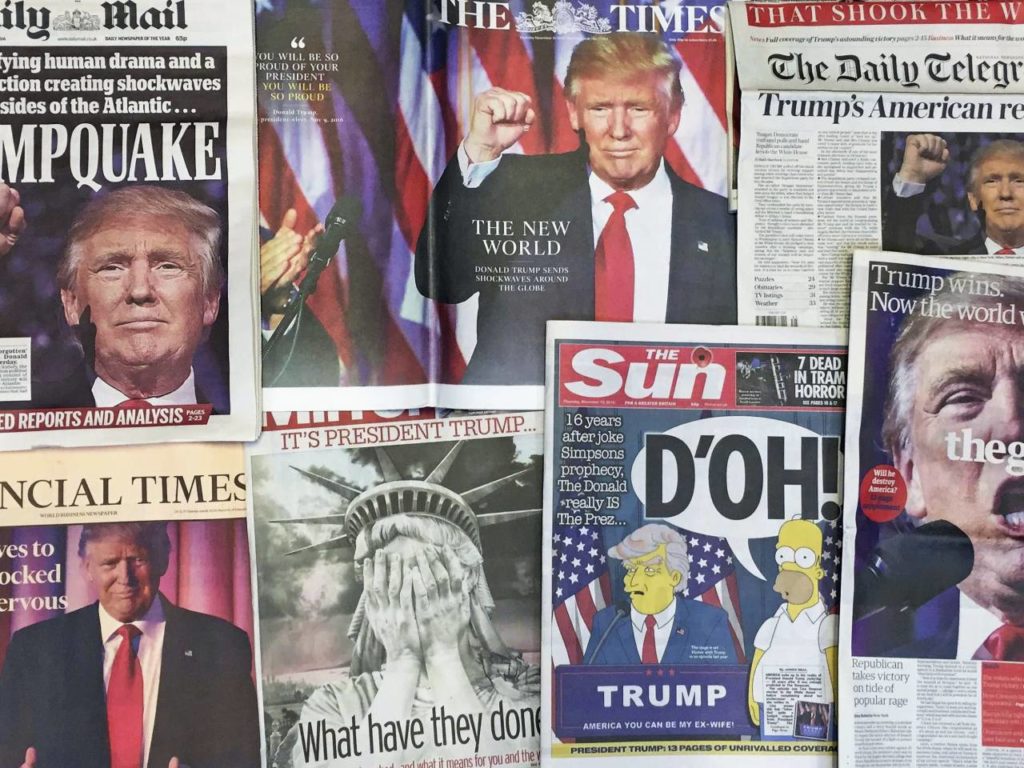
The turbulent U.S. election, featuring Donald Trump‘s unexpected victory over Hillary Clinton in the presidential race, was the overwhelming pick for the top news story of 2016, according to The Associated Press’ annual poll of U.S. editors and news directors. The No. 2 story also was a dramatic upset — Britons’ vote to leave the European Union. Most of the other stories among the Top 10 reflected a year marked by political upheaval, terror attacks and racial divisions. Last year, developments related to the Islamic State group were voted as the top story — the far-flung attacks claimed by the group, and the intensifying global effort to crush it. The first AP top-stories poll was conducted in 1936, when editors chose the abdication of Britain’s King Edward VIII. Here are 2016’s top 10 stories, in order: 1. US ELECTION: This year’s top story traces back to June 2015, when Donald Trump descended an escalator in Trump Tower, his bastion in New York City, to announce he would run for president. Widely viewed as a long shot, with an unconventional campaign featuring raucous rallies and pugnacious tweets, he outlasted 16 Republican rivals. Among the Democrats, Hillary Clinton beat back an unexpectedly strong challenge from Bernie Sanders, and won the popular vote over Trump. But he won key Rust Belt states to get the most electoral votes, and will enter the White House with Republicans maintaining control of both houses of Congress. 2. BREXIT: Confounding pollsters and oddsmakers, Britons voted in June to leave the European Union, triggering financial and political upheaval. David Cameron resigned as prime minister soon after the vote, leaving the task of negotiating an exit to a reshaped Conservative government led by Theresa May. Under a tentative timetable, final details of the withdrawal might not be known until the spring of 2019. 3. BLACKS KILLED BY POLICE: One day apart, police in Baton Rouge, Louisiana, fatally shot Alton Sterling after pinning him to the ground, and a white police officer shot and killed Philando Castile during a traffic stop in a suburb of Minneapolis. Coming after several similar cases in recent years, the killings rekindled debate over policing practices and the Black Lives Matter movement. 4. PULSE NIGHTCLUB MASSACRE: The worst mass shooting in modern U.S. history unfolded on Latin Night at the Pulse, a gay nightclub in Orlando. The gunman, Omar Mateen, killed 49 people over the course of three hours before dying in a shootout with SWAT team members. During the standoff, he pledged allegiance to the Islamic State. 5. WORLDWIDE TERROR ATTACKS: Across the globe, extremist attacks flared at a relentless pace throughout the year. Among the many high-profile attacks were those that targeted airports in Brussels and Istanbul, a park teeming with families and children in Pakistan, and the seafront boulevard in Nice, France, where 86 people were killed when a truck plowed through a Bastille Day celebration. In Iraq alone, many hundreds of civilians were killed in repeated bombings. 6. ATTACKS ON POLICE: Ambushes and targeted attacks on police officers in the U.S. claimed at least 20 lives. The victims included five officers in Dallas working to keep the peace at a protest over the fatal police shootings of black men in Minnesota and Louisiana. Ten days after that attack, a man killed three officers in Baton Rouge, Louisiana. In Iowa, two policemen were fatally shot in separate ambush-style attacks while sitting in their patrol cars. 7. DEMOCRATIC PARTY EMAIL LEAKS: Hacked emails, disclosed by WikiLeaks, revealed at-times embarrassing details from Democratic Party operatives in the run-up to Election Day, leading to the resignation of Democratic National Committee chair Debbie Wasserman Schultz and other DNC officials. The CIA later concluded that Russia was behind the DNC hacking in a bid to boost Donald Trump’s chances of beating Hillary Clinton. 8. SYRIA: Repeated cease-fire negotiations failed to halt relentless warfare among multiple factions. With Russia’s help, the government forces of President Bashar Assad finally seized rebel-held portions of the city of Aleppo, at a huge cost in terms of deaths and destruction. 9. SUPREME COURT: After Justice Antonin Scalia‘s death in February, President Obama nominated Merrick Garland, chief judge of the U.S. Court of Appeals, to fill the vacancy. However, majority Republicans in the Senate refused to consider the nomination, opting to leave the seat vacant so it could be filled by the winner of the presidential election. Donald Trump has promised to appoint a conservative in the mold of Scalia. 10. HILLARY CLINTON’S EMAILS: Amid the presidential campaign, the FBI conducted an investigation into Clinton’s use of a private computer server to handle emails she sent and received as secretary of state. FBI Director James Comey criticized Clinton for carelessness but said the bureau would not recommend criminal charges. Stories that did not make the top 10 included Europe’s migrant crisis, the death of longtime Cuban leader Fidel Castro, and the spread of the Zika virus across Latin America and the Caribbean. Republished with permission of The Associated Press.
Updates from the 1st presidential debate

The Latest on the first of three presidential debates between Democrat Hillary Clinton and Republican Donald Trump (all times EDT): 10:45 p.m. Both candidates concluded the first presidential debate by saying they will accept the outcome if the other wins. Hillary Clinton spoke directly to viewers and said, “It’s not about us, it’s about you.” Donald Trump initially dodged the same question, saying he would make a “seriously troubled” America “great again.” He added: “I’m going to be able to do it. I don’t believe Hillary Clinton will.” But Trump finished his answer by saying that if Clinton wins, “I will absolutely support her.” ___ 10:43 p.m. Hillary Clinton is punching back at Donald Trump’s assertions that she doesn’t have the “stamina” to be president. Trump has questioned whether Clinton has the physical fitness to be president and he repeated the criticism to her directly during the debate. Clinton’s response? Trump shouldn’t talk about stamina until he’s tried out the busy schedule she kept up as secretary of state. Trump didn’t answer moderator Lester Holt’s original question about his past comments that Clinton doesn’t have the “presidential look.” Clinton suggested the remarks were about gender, and she reminded the crowd of Trump’s past comments calling women “pigs” and other derogatory names. ___ 10:42 p.m. Donald Trump says NATO needs to “go into the Middle East with us” to combat the Islamic State group. And he is taking credit for NATO focusing resources on combating terrorism. In fact, the alliance agreed in July to contribute aircraft and conduct training in Iraq and has increased intelligence coordination there. And NATO set up an anti-terrorism program in 2004 — years before Trump criticized them as a presidential candidate. Earlier this year, Trump criticized NATO for not focusing on terrorism. He said that afterward, he saw an article reporting that NATO was opening a new, major anti-terrorism division. He said Tuesday that NATO’s action was “largely because of what I was saying, and my criticism of NATO.” ___ 10:40 p.m. Donald Trump is avoiding a specific declaration on how he would use nuclear weapons if he’s elected president. The Republican nominee said during the first presidential debate that he “would not do first strike” because “once the nuclear alternative happens, it’s over.” That statement suggests he would not authorize a nuclear attack unless the U.S. was struck first. But in the same answer Trump said he “can’t take anything off the table.” He mentioned adversary nations such as North Korea and Iran. President Barack Obama has considered changing existing policy to state clearly that the United States would not deploy nuclear weapons without first being attacked by nuclear weapons. But he met resistance and has elected not to make such a shift. ___ 10:38 p.m. Hillary Clinton is accusing Donald Trump of being too easily provoked to keep the United States from going to war — perhaps even one involving nuclear weapons. Trump says: “I have much better judgment than she does. I have much better temperament.” That drew laughs from some in the debate crowd, and prompted Clinton to exclaim: “Woo! OK!” Clinton then pivoted to policy, defending the U.S.-led war in Afghanistan. Clinton said Iran was “weeks away” from a nuclear bomb when she became secretary of state — and says the Obama administration thwarted that progress. She continued that Trump didn’t have “good judgment or the right temperament” because he could take the country to war over small issues, like being mocked on Twitter. ___ 10:35 p.m. Donald Trump is continuing to insist he opposed the Iraq War before the U.S. invasion despite evidence to the contrary. Trump says during the debate that he “did not support the war in Iraq,” calling that charge “mainstream media nonsense.” But there is no evidence Trump expressed public opposition to the war before the U.S. invaded. Trump was asked in September 2002 whether he supported a potential Iraq invasion in an interview with Howard Stern. Trump briefly hesitated, then responded: “Yeah, I guess so.” Presented with the comment during the debate, Trump responds: “I said very lightly, I don’t know, maybe, who knows.” He’s also telling reporters to call Fox News host Sean Hannity to confirm private conversations he said they had about the war. Hannity is a top Trump supporter. Clinton voted in favor of the invasion in 2002 while she was a New York senator. She has since said it was a mistake. ___ 10:27 p.m. Donald Trump is interrupting the moderator of the first presidential debate to insist he has the best temperament for the office. Trump repeatedly made the assertion after clashing with moderator Lester Holt over his early support for the Iraq War. Then he segued to his temperament. “I think my strongest asset by far is my temperament,” Trump said. “I know how to win.” Clinton and her allies have repeatedly hit Trump over his temper and inability to take criticism. ___ 10:23 p.m. Hillary Clinton says one key to fighting terrorism in the United States is working closely with Muslims living here. Clinton says Donald Trump has “consistently insulted Muslims abroad, Muslims at home.” She says Muslim people can provide information that law enforcement may not be able to obtain anyplace else. Both candidates were asked to explain how they would combat terrorism in the U.S. Clinton says her plan includes an intelligence surge to obtain “every scrap of information” and to “do everything we can to vacuum up intelligence from Europe, from the Middle East.” ___ 10:20 p.m. Hillary Clinton says defeating the Islamic State group and taking out its leaders would be a top priority as president. Clinton says she’s hopeful the Islamic State group would be pushed out of Iraq by the end of the year. She says the U.S. could then help its allies “squeeze” the terrorist group in Syria. Clinton says she would do everything possible to take out the group’s leaders, and make that one of her administration’s organizing principles
Hillary Clinton campaign reports 34.2 percent tax rate
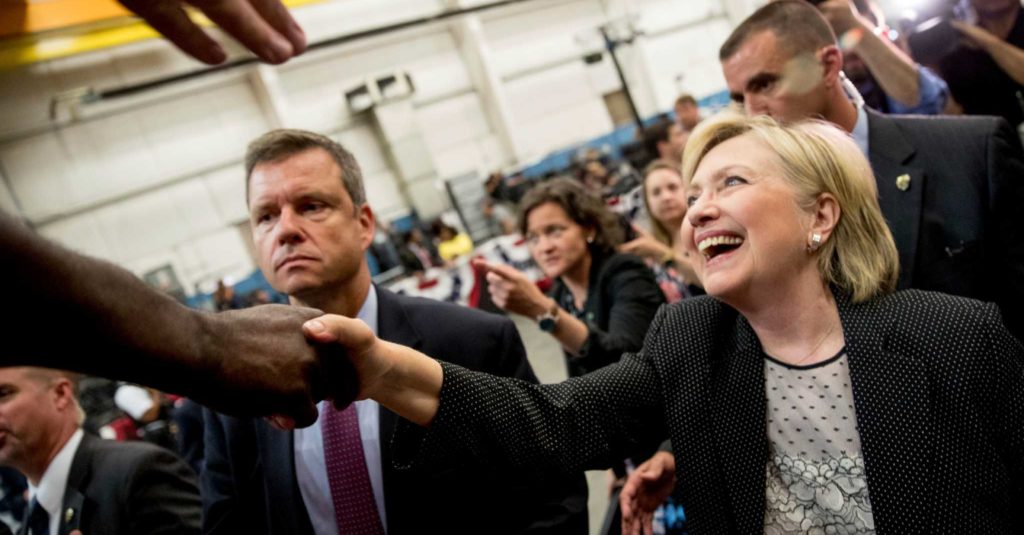
Hillary Clinton‘s campaign says the Democratic nominee and her husband paid a federal tax rate of 34.2 percent and donated 9.8 percent of their income to charity last year. The Clintons are releasing their 2015 filings on Friday. Her campaign is also releasing returns from running mate Tim Kaine and his wife. The campaign says the Kaines have donated 7.5 percent of their income to charity over the last decade. They paid an effective tax rate of 25.6 percent in 2015. Clinton is trying to undercut the trustworthiness of rival Donald Trump. He has refused to disclose any returns, breaking tradition with all recent presidential candidates. Trump says he won’t release them until Internal Revenue Service completes audits of his returns. The Clintons have disclosed returns for every year since 1977. Republished with permission of the Associated Press.
Terror fears permeated GOP week — Dems barely mention them
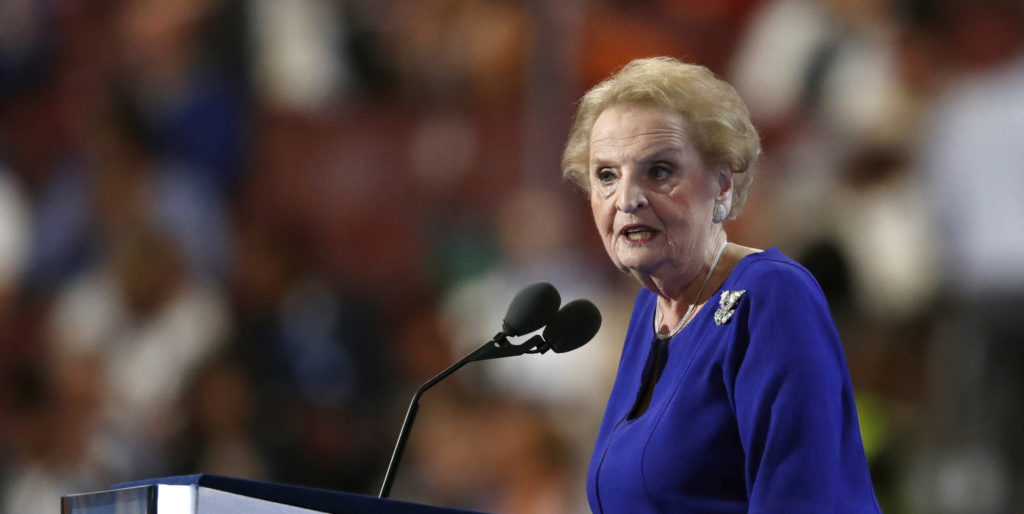
After terrorism fears permeated Republican speeches a week ago, Democrats have barely mentioned the Islamic State group through two days of their convention. That is perhaps a result of the militant group’s emergence from a localized, Middle East insurgency to a self-proclaimed caliphate and worldwide terrorism threat during President Barack Obama‘s time in office. It also reflects a Republican strategy to blame Obama — and, by extension, Democratic nominee Hillary Clinton — for allowing the Islamic State group to expand. “After four years of Hillary Clinton, what do we have?” Republican nominee Donald Trump said at his party’s convention. “ISIS has spread across the region, and the entire world.” Clinton served as Obama’s first secretary of state, but was out of government by the time IS began making territorial advances. She will have a chance to respond later this week. So far, few have directly addressed Trump’s charge in her place. Instead, they’ve centered their national security criticism on Trump by calling him rash and irresponsible, ridiculing his suggestions of a weaker NATO and allowing more nuclear powers, or his occasionally favorable comments about authoritarian rulers. Even Madeleine Albright, another onetime top U.S. diplomat, avoided any mention of IS or its various acronyms. President Bill Clinton, Hillary’s husband, also didn’t refer to the group. Clinton is “the only candidate with a specific plan to work with our allies and fight ISIS,” Virginia Gov. Terry McAuliffe said Tuesday in a rare reference. Stephanie Murphy, a House candidate from Florida who worked for the Defense Department, said: “Democrats know we need to be strong and smart to destroy ISIS and protect America, not reckless and rash.” Neither elaborated on the plan. For his part, Trump said he had his own secret plan. “You have no idea what my strategy on ISIS is, and neither does ISIS (a good thing),” he tweeted Wednesday to FOX News’ Megyn Kelly. The dissonance between the parties reflects not just different campaign priorities, but starkly differing world views. Whereas Trump and Republicans focused on recent jumps in crime rates and killings of police officers, Democrats have prioritized the longer-term declines in violent crime and the particular problem of police killings of unarmed black men. Republicans complained about high corporate taxes stifling growth; Democrats, particularly those backing runner-up Bernie Sanders, have railed against the power of “millionaires and billionaires.” The Islamic State would appear to be one more topic of disagreement. Republished with permission of The Associated Press.
