
Mike Pompeo says Israel, Palestinian peace still a U.S. priority
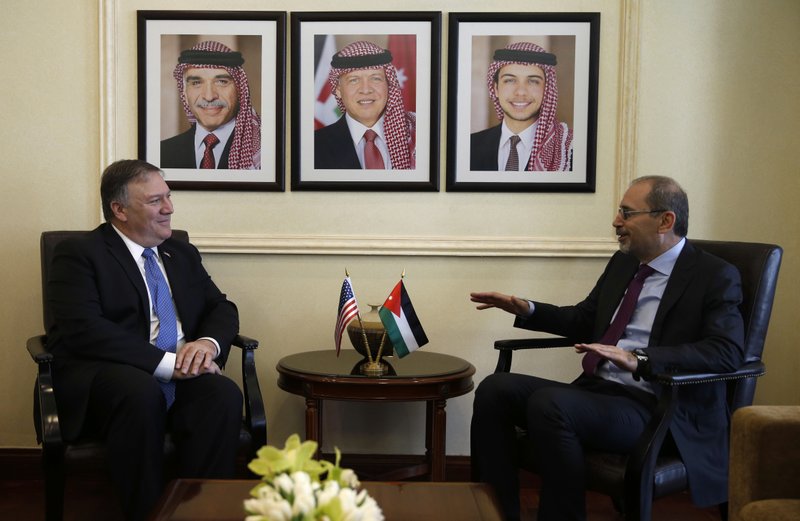
U.S. Secretary of State Mike Pompeo said Monday that a resolution to the Israeli-Palestinian conflict remains a priority for the Trump administration, despite its recognition of Jerusalem as Israel’s capital and its planned move of the U.S. Embassy to the holy city over Palestinian protests. Pompeo also said the U.S. is “fully supportive” of Israel’s right to defend itself and declined to criticize the Israeli military for its use of live fire against Palestinian protesters along the Gaza border. He spoke in the Jordanian capital of Amman as he wrapped up the Middle East leg of his first overseas trip as America’s top diplomat. Pompeo called on the Palestinians to return to long-stalled peace talks with Israel. He said the United States is open to a two-state solution to the conflict if both parties agree, calling it a “likely outcome.” But he would not agree with Jordanian Foreign Minister Ayman Safadi’s characterization of the conflict as “the main cause of instability” in the region. “The parties will ultimately make the decision as to what the correct resolution is,” Pompeo told reporters at a joint news conference with Safadi. “We are certainly open to a two-party solution as a likely outcome.” But, he said, the Palestinians had to return to a political dialogue to get there. “An important piece of achieving Middle East stability is to resolve this conflict,” he added. “Precisely how to rank it among all the various challenges, I’ll defer on that. Know that it is an incredible priority for the United States to provide whatever assistance we can to allow the two parties to come to a resolution.” Safadi had opened the news conference with an apparent appeal for the U.S. to boost efforts to end the conflict. “This is the main cause of instability in the region and its resolution is the key to achieving the peace and stability we want,” he said. “Yes, the two-state solution is being challenged. Yes, there are many obstacles. But what is the alternative? We cannot give up in our efforts and there is no viable alternative.” Pompeo’s comments came at the end of a two-day visit to Israel and Jordan during which he did not meet Palestinian representatives. The Palestinians have essentially boycotted contacts with the U.S. since Trump announced in December that the United States was recognizing Jerusalem as Israel’s capital. The Palestinians claim east Jerusalem — captured by Israel in 1967 and then annexed — as the capital of a future state. Pompeo’s visit is also taking place just two weeks before the planned May 14 opening of the new U.S. Embassy in Jerusalem and expected massive Palestinian protests the following day. Over the past month, 39 Palestinians have been killed and more than 1,600 wounded in weekly border protests along the Gaza border, prompting human rights groups to ask Israel’s Supreme Court on Monday to restrict or ban the use of live ammunition. They say the military’s use of lethal force against unarmed protesters is unlawful. Israel’s military argues that the border protests are part of a long-running conflict with Gaza’s ruling Hamas, which it considers a terror group, and that the rules of armed conflict apply. Asked about the situation, Pompeo demurred, referring to “activities in Gaza over the past days and weeks.” “We do believe the Israelis have the right to defend themselves and we are fully supportive of that,” he said. In addition to the Jerusalem decisions, the Trump administration has also angered the Palestinians in recent months by ordering their office in Washington closed, although it remains open for business related to negotiations, slashing funding for the U.N. agency that supports Palestinians in the West Bank, Gaza and elsewhere in the region, and putting on hold all bilateral assistance to the Palestinians. Although the White House sponsored a conference on aid to Gaza last month, the Palestinians did not attend. And, a peace plan devised by Trump’s son-in-law and senior adviser Jared Kushner and his special envoy for international negotiations Jason Greenblatt appears to be on hold. Republished with the permission of the Associated Press.
Egypt: Donald Trump should have chance to resolve Mideast conflict
Egypt says its president received a call from President-elect Donald Trump in which they both agreed to give the incoming U.S. administration a chance to try and resolve the Israeli-Palestinian conflict. The call came hours after Egypt indefinitely postponed a U.N. vote on a Security Council resolution criticizing Israeli settlements following pressure from Israel and Trump, who had called on members to veto it. A statement from the Egyptian presidency says the two men spoke by phone early Friday and agreed on “the importance of giving a chance for the new American administration to deal in a comprehensive way with the different aspects of the Palestinian issue with the aim of achieving a comprehensive and a final resolution.” Republished with permission of the Associated Press.
Donald Trump irks Jewish donors with comments on Mideast peace
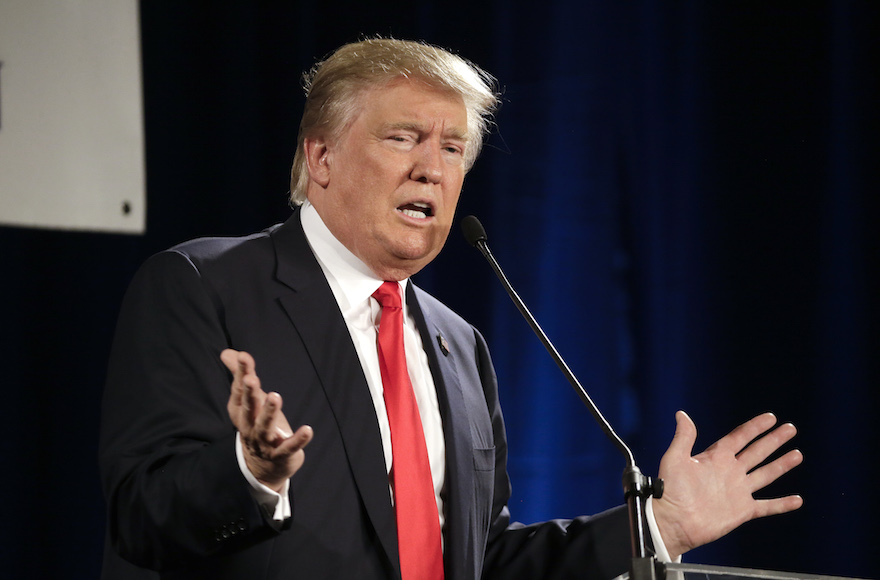
The Jewish donors gathered Thursday had two demands of the Republican presidential candidates who’d come to speak to them: unambiguous support for Israel and respect. Donald Trump seemed to fail at both. The party’s 2016 front-runner openly questioned Israel’s commitment to the Mideast peace process in his remarks to the Republican Jewish Coalition, echoing comments he made the night before in an interview with The Associated Press. He drew boos after refusing to endorse Jerusalem as the nation’s undivided capital. And he suggested to the influential group simply wanted to install a puppet in the White House. “You’re not going to support me even though you know I’m the best thing that could happen to Israel,” Trump said. “I know why you’re not going to support me — because I don’t want your money. You want to control your own politician.” It was an extraordinary speech to a group used to deferential treatment. And Trump’s comments on Israel — particularly the billionaire businessman’s repeated questioning of its commitment to making a peace deal with the Palestinians — sparked an aggressive backlash from his Republican rivals. “Some in our own party — in the news today — have actually questioned Israel’s commitment to peace,” Florida Sen. Marco Rubio told the crowd. “Some in our own party actually call for more sacrifice from the Israeli people. They are dead wrong, and they don’t understand the enduring bond between Israel and America.” The primary benefactor of the Republican Jewish Coalition is casino magnate Sheldon Adelson, who spent more on the 2012 federal elections than any other donor. Adelson’s willingness to make a huge political investment helps explain why his signature group attracted all of the major GOP presidential candidates to its forum in Washington — even though the man himself wasn’t among the hundreds in attendance. On the eve of the event, Trump weighed in on the Israeli-Palestinian conflict in an interview with The Associated Press. He questioned for the first time both sides’ commitment to peace, adding that he would know within six months of being elected president whether he could broker an elusive peace accord. He doubled down on those comments Thursday in an auditorium packed with Israel’s most loyal supporters. “I don’t know that Israel has the commitment to make it, and I don’t know the other side has the commitment to make it,” Trump said. The comment drew murmurs of disapproval. Later, a smattering of boos broke out after he refused to say whether Jerusalem should serve as the undivided capital of Israel, a priority for many in America’s pro-Israel lobby. Trump shrugged off the criticism. “Do me a favor, just relax,” he told one of the people booing. Perhaps more than any other candidate, he can afford to. The billionaire frequently calls himself a “self-funded” candidate. Compared to his rivals, he has raised — and spent — dramatically less, depending largely on free publicity to drive his campaign. He began his candidacy by loaning his campaign almost $2 million and has suggested a willingness to spend much more of his own money. Yet he hasn’t ignored donors altogether. Fundraising records show that supporters have handed over $4 million, enough to cover his presidential efforts in recent months. Regardless of his relationship with donors, Trump’s comments mark a sharp contrast from his Republican rivals who pledged unconditional allegiance to Israel. Several candidates blasted him from the stage. “This is not a real estate deal with two sides arguing over money” Rubio said. “It’s a struggle to safeguard the future of Israel.” Said Texas Sen. Ted Cruz, “We need a president who will stand unapologetically with the nation of Israel.” Former Arkansas Gov. Mike Huckabee seemed to target Trump when he mentioned that some in his party support the “head-scratching” proposal that Mideast peace is possible only if Israel and the Palestinians both come to the table. “I want to say where have you been for the last 70 years?” Huckabee charged. Trump’s comments also fell flat among many Thursday’s crowd. Michael Leventoff, a New York businessman and member of the Republican Jewish Coalition, said Trump questioning Israel’s commitment to the peace process is another example of him “just getting it wrong.” “There’s plenty of evidence of Israel’s repeated attempts at peace,” he said. “This is exactly why Trump is what I like to call a brilliant idiot. He should know better, and probably does.” Trump told RJC members that while he doesn’t want their money, he does want their support. He noted he has won several awards from Jewish groups and recently said he has “a very good relationship” with Adelson. The casino magnate has yet to make up his mind how who he’ll support in the GOP primary, said Adelson’s political adviser, Andy Abboud. Each of the candidates is strong on the issues that concern Adelson the most, chief among them protection of Israel, he said. “The Adelsons are generally pleased with all of the Republican candidates and feel that the primary process will work its way out.” Republished with permission of the Associated Press.
