
Donald Trump says illegal crossings down; they’re up
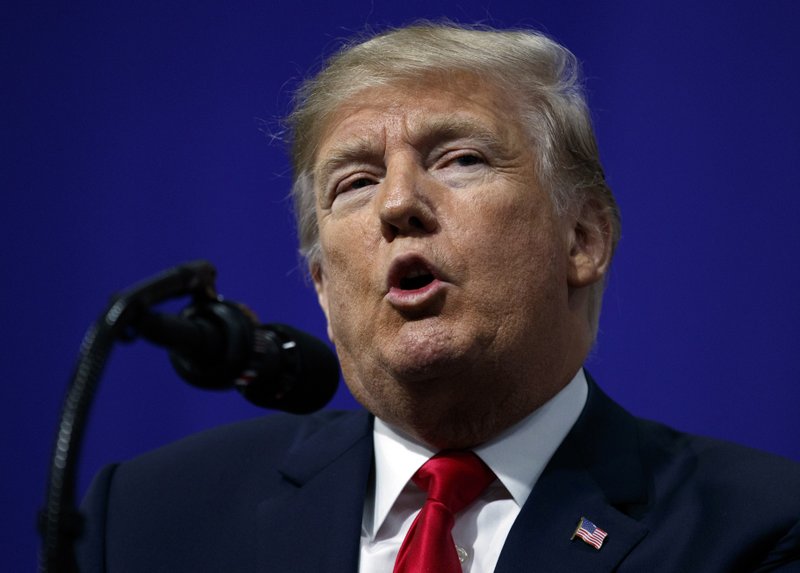
Illegal border crossings, as President Donald Trump measures them, have gone up since he took office, even as he speaks to audiences about a drop of more than 40 percent. That disconnect was among several that stood out over the past week as he opened up on the Russia investigation via Twitter, forsaking accuracy in the process, and made the false claim that he’s delivering the first big military pay increase in a decade. A look at some of his statements: TRUMP: “We’ve done a lot of work on the wall. We’re doing a lot of work on security, generally speaking, security and border — border security. The border’s down over 40 percent, and don’t forget, we have a great economy, probably the best economy the country’s ever had. So people come across, but we’re going to get the rest.” — interview broadcast Thursday with “Fox & Friends.” TRUMP: “We’re down on immigration crossing the border — more than 40 percent.” — forum Wednesday in Bethpage, New York. THE FACTS: Illegal crossings actually are up 20 percent since he became president, according to the yardstick he uses to measure them — the number of Border Patrol arrests. There is no precise measure of illegal crossings because some people don’t get caught. The Trump administration uses arrests as the best gauge of whether crossings are going up or down. The Obama administration did likewise. Border Patrol arrests did fall last year to the lowest level since 1971. But since April of last year, arrests have climbed steadily. One factor in that increase may be that people are now taking their chances to cross into the U.S. illegally after an initial wait-and-see attitude about Trump’s tough-talking approach to people sneaking into the country. Last month, there were more than 50,000 overall border arrests, which are made up of people who are stopped at land crossings and other official points of entry, according to federal data. That was more than triple the number from April 2017, which was the lowest tally on record since the Homeland Security Department was created in 2003. Overall, border arrests have increased 20 percent since January 2017, from 42,463 in January 2017 to 50,924 in April. ___ TRUMP, to U.S. Naval Academy graduates: “Going to have new equipment and well-deserved pay raises. We just got you a big pay raise. First time in 10 years. We got you a big pay increase. First time in over 10 years. I fought for you. That was the hardest one to get, but you never had a chance of losing.” — speech Friday. THE FACTS: That’s not right. U.S. military members have gotten a pay raise every year for the past 10 years and several have been larger than this year’s 2.6 percent increase. Pay increases in 2008, 2009 and 2010, for example, were all 3.4 percent or more. ___ TRUMP: “We have now the lowest number of ships that we’ve had since World War I, and very soon you’re going to get to 355 beautiful ships. 355. That’s almost a couple of hundred more ships.” — speech to academy graduates Friday. THE FACTS: No it isn’t. The Navy now has 283 ships. ___ TRUMP on former CIA Director John Brennan: “Brennan started this entire debacle about President Trump. We now know that Brennan had detailed knowledge of the (phony) Dossier…he knows about the Dossier, he denies knowledge of the Dossier, he briefs the Gang of 8 on the Hill about the Dossier, which…….they then used to start an investigation about Trump…” — tweets Monday. THE FACTS: Trump quotes conservative commentator Dan Bongino to falsely claim the Russia probe is based on a “phony dossier.” In fact, the FBI’s investigation began months before it received a dossier of anti-Trump research financed by the Democratic Party and Hillary Clinton’s campaign. The FBI probe’s origins were based on other evidence — not the existence of the dossier. The Republican-controlled House intelligence committee found the Russia probe was initiated after the FBI received information related to Trump campaign foreign policy adviser George Papadopoulos, not the dossier. The committee’s final report released in March was praised by Trump, who pointed to it as evidence that the investigation was nothing but a “witch hunt.” ___ TRUMP, on President Barack Obama’s national intelligence director, James Clapper: “Clapper has now admitted that there was Spying in my campaign. Large dollars were paid to the Spy, far beyond normal. Starting to look like one of the biggest political scandals in U.S. history. SPYGATE – a terrible thing!” — tweet Thursday THE FACTS: That’s a distortion of Clapper’s statements on ABC’s “The View” on Tuesday when he was asked about recent reports that an FBI informant spoke with several members of the Trump campaign. “They were spying on — a term I don’t particularly like but — what the Russians were doing,” Clapper said. “Trying to understand, were the Russians infiltrating? Trying to gain access, trying to gain leverage and influence? Which is what they do.” He did not say a spy was implanted “in” the campaign and he denied the FBI was spying “on” the campaign. The effort was focused on Russians, he said, was meant to “protect the campaign” and the U.S. political system. Special counsel Robert Mueller’s investigation is looking into Russian interference in the election, any collusion between Russia and the Trump campaign, possible obstruction of justice and whatever associated criminal activity might be uncovered. The probe has produced several criminal convictions of Trump campaign officials. Those charges do not implicate the president directly. Republished with the permission of the Associated Press.
Donald Trump leaves possibility of bailing on meeting with Kim open
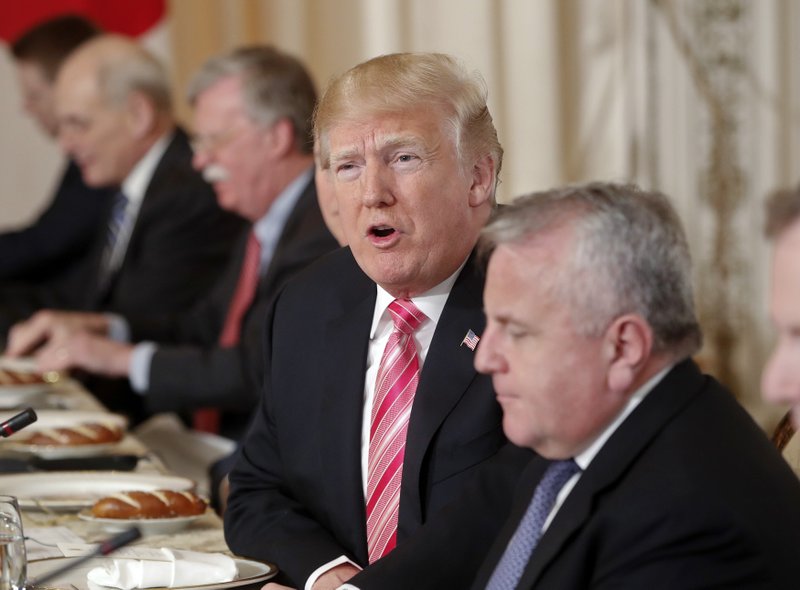
President Donald Trump said that although he’s looking ahead optimistically to a historic summit meeting with North Korean leader Kim Jong Un he could still pull out if he feels it’s “not going to be fruitful.” Trump said that CIA Director Mike Pompeo and Kim “got along really well” in their recent secret meeting, and he declared, “We’ve never been in a position like this” to address worldwide concerns over North Korea’s nuclear weapons. But speaking alongside Japanese Prime Minister Shinzo Abe on Wednesday, after the allies met at Trump’s Florida resort, he made clear that he’d still be ready to pull the plug on what is being billed as an extraordinary meeting between the leaders of longtime adversaries. “If I think that if it’s a meeting that is not going to be fruitful we’re not going to go. If the meeting when I’m there is not fruitful I will respectfully leave the meeting,” Trump told a news conference. He also said that a U.S.-led “maximum pressure” campaign of tough economic sanctions on North Korea would continue until the isolated nation “denuclearizes.” Abe echoed the sentiment. “Just because North Korea is responding to dialogue, there should be no reward. Maximum pressure should be maintained,” he said. Trump has said his summit with Kim, with whom he traded bitter insults and threats last year as North Korea conducted nuclear and missile tests, could take place by early June, although the venue has yet to be decided. It would be the first such leadership summit between the two nations after six decades of hostility following the Korean War. Other than the threat posed to by North Korea’s weapons of mass destruction, another issue overhanging the summit plans is the fate of three Americans detained there. Trump said that was under negotiation and there was a “good chance” of winning their release, but he wouldn’t say whether that was a precondition for sitting down with Kim. Pompeo raised the question of the three Americans in his meeting with Kim, a U.S. official said. Trump also said he had promised Abe he would work hard for the return of Japanese nationals abducted by North Korea. Tokyo says at least a dozen Japanese said to have been taken in the 1970s and 1980s remain unaccounted for. News of Pompeo’s trip to North Korea, which took place more than two weeks ago, emerged on Tuesday, as lawmakers weighed whether he should be confirmed to become secretary of state. Trump and Republican senators held up his highly unusual, secret mission as sign of Pompeo’s diplomatic ability. But the prospect of his confirmation hung in the balance as Democrats lined up against him. Sen. Robert Menendez, top-ranking Democrat on the committee that will have the first vote on confirmation, expressed frustration that the CIA chief had not briefed him on the visit that took place more than a week before Pompeo’s public hearing last Thursday. He is the most senior U.S. official to meet with a North Korean leader since Secretary of State Madeleine Albright met with Kim’s father in Pyongyang in 2000. “Now I don’t expect diplomacy to be negotiated out in the open, but I do expect for someone who is the nominee to be secretary of state, when he speaks with committee leadership and is asked specific questions about North Korea, to share some insights about such a visit,” Menendez said at the Center for Strategic and International Studies. The Senate Foreign Relations Committee is expected to vote on the nomination next week. Pompeo, whose hawkish foreign policy views and comments about minorities have raised Democratic hackles, would replace Rex Tillerson, who was pushed out by Trump last month. In the U.S. Senate, Republicans have a single-vote advantage on the 21-member panel that will have the first say on Pompeo’s nomination. With nine of the 10 Democrats already declaring they will oppose Pompeo, and at least one Republican, Rand Paul of Kentucky, also opposed, the panel could be forced to take the unusual step of sending the nomination to the full Senate without a favorable recommendation. Trump said Wednesday he expects Paul to come through on Pompeo. The president called Paul and the senator agreed to meet with Pompeo, but Paul’s spokesman said, “Nothing else has changed.” As for opposition by Democrats, Republican Cory Gardner, who chairs an Asia subcommittee, said in an interview that they “want to play partisan politics.” Despite meeting Pompeo on Tuesday, Gardner said he hadn’t been briefed on the trip and was awaiting more information about it. Still, he said the fact that the meeting happened gave weight to Pompeo’s testimony last week that the administration was committed to the “complete and verifiable denuclearization” of North Korea and sustaining sanctions pressure. It is not unprecedented for U.S. intelligence officials to serve as conduits for communication with Pyongyang. In 2014, the then-director of U.S. national intelligence, James Clapper, secretly visited North Korea to bring back two American detainees. Clapper did not, however, meet with Kim, who has only in recent weeks emerged from international seclusion after taking power six years ago and super-charging North Korea’s push to become a nuclear power. Kim met last month with China’s president and is to meet South Korea’s leader April 27. Republished with the permission of the Associated Press.
James Comey compares Donald Trump to mob boss
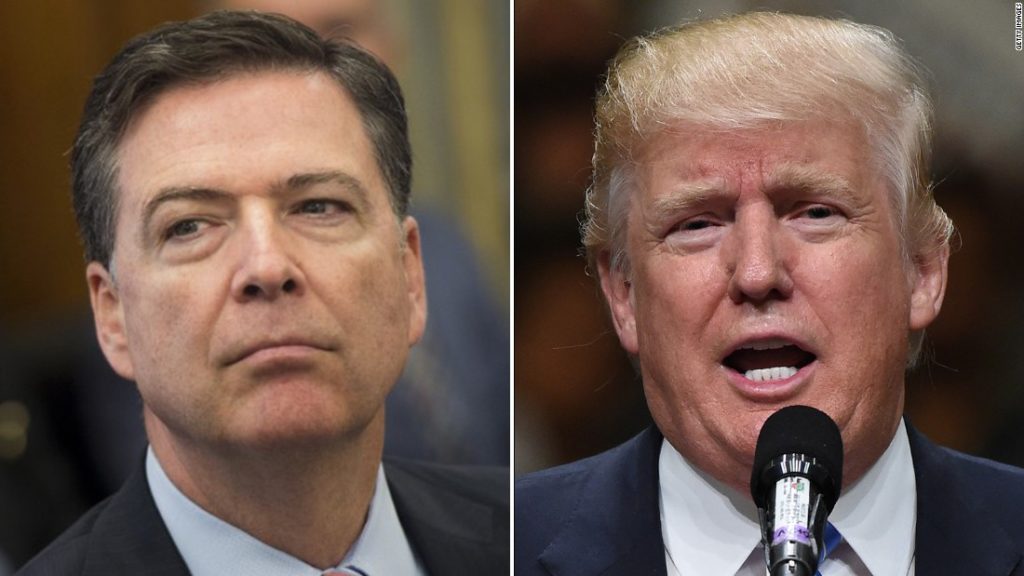
Firing back at a sharply critical book by former FBI director James Comey, President Donald Trump blasted him Friday as an “untruthful slime ball,” saying, “It was my great honor to fire James Comey!” Trump reacted on Twitter early Friday, the day after the emergence of details from Comey’s memoir, which says Trump is “untethered to truth,” and describes him as fixated in the early days of his presidency on having the FBI debunk salacious rumors he said were untrue but that could distress his wife. The book, “A Higher Loyalty,” is to be released next week. The Associated Press purchased a copy this week. In the book, Comey compares Trump to a mafia don and calls his leadership of the country “ego driven and about personal loyalty.” Comey also reveals new details about his interactions with Trump and his own decision-making in handling the Hillary Clinton email investigation before the 2016 election. He casts Trump as a mobster-like figure who sought to blur the line between law enforcement and politics and tried to pressure him personally regarding his investigation into Russian election interference. The book adheres closely to Comey’s public testimony and written statements about his contacts with Trump and his growing concern about Trump’s integrity. It also includes strikingly personal jabs at Trump that appear sure to irritate the president. The 6-foot-8 Comey describes Trump as shorter than he expected with a “too long” tie and “bright white half-moons” under his eyes that he suggests came from tanning goggles. He also says he made a conscious effort to check the president’s hand size, saying it was “smaller than mine but did not seem unusually so.” “Donald Trump’s presidency threatens much of what is good in this nation,” Comey writes, calling the administration a “forest fire” that can’t be contained by ethical leaders within the government. On a more-personal level, Comey describes Trump repeatedly asking him to consider investigating an allegation involving Trump and Russian prostitutes urinating on a bed in a Moscow hotel, in order to prove it was a lie. Trump has strongly denied the allegation, and Comey says that it appeared the president wanted it investigated to reassure his wife, Melania Trump. Trump fired Comey in May 2017, setting off a scramble at the Justice Department that led to the appointment of Robert Mueller as special counsel overseeing the Russia investigation. Mueller’s probe has expanded to include whether Trump obstructed justice by firing Comey, which the president denies. Trump has assailed Comey as a “showboat” and a “liar.” Top White House aides also criticized the fired FBI director on Friday. White House spokeswoman Sarah Huckabee Sanders questioned Comey’s credibility in a tweet and White House counselor Kellyanne Conway said Comey took “unnecessary, immature pot shots.” Comey’s account lands at a particularly sensitive moment for Trump and the White House. Officials there describe the president as enraged over a recent FBI raid of his personal lawyer’s home and office, raising the prospect that he could fire Deputy Attorney General Rod Rosenstein, who appointed Mueller, or try to shut down the probe on his own. The Republican National Committee is poised to lead the pushback effort against Comey by launching a website and supplying surrogates with talking points that question his credibility. Trump has said he fired Comey because of his handling of the FBI’s investigation into Clinton’s email practices. Trump used the investigation as a cudgel in the campaign and repeatedly said Clinton should be jailed for using a personal email system while serving as secretary of state. Democrats, on the other hand, have accused Comey of politicizing the investigation, and Clinton herself has said it hurt her election prospects. Comey writes that he regrets his approach and some of the wording he used in his July 2016 press conference in which he announced the decision not to prosecute Clinton. But he says he believes he did the right thing by going before the cameras and making his statement, noting that the Justice Department had done so in other high profile cases. Every person on the investigative team, Comey writes, found that there was no prosecutable case against Clinton and that the FBI didn’t find that she lied under its questioning. He also reveals new details about how the government had unverified classified information that he believes could have been used to cast doubt on Attorney General Loretta Lynch’s independence in the Clinton probe. While Comey does not outline the details of the information — and says he didn’t see indications of Lynch inappropriately influencing the investigation — he says it worried him that the material could be used to attack the integrity of the probe and the FBI’s independence. Comey’s book will be heavily scrutinized by the president’s legal team looking for any inconsistencies between it and his public testimony, under oath, before Congress. They will be looking to impeach Comey’s credibility as a key witness in Mueller’s obstruction investigation, which the president has cast as a political motivated witch hunt. The former FBI director provides new details of his firing. He writes that then-Homeland Security Secretary John Kelly — now Trump’s chief of staff — offered to quit out of disgust at how Comey was dismissed. Kelly has been increasingly marginalized in the White House and the president has mused to confidants about firing him. Comey also writes extensively about his first meeting with Trump after the election, a briefing in January 2017 at Trump Tower in New York City. Others in the meeting included Vice President Mike Pence, Trump’s first chief of staff, Reince Priebus, Michael Flynn, who would become national security adviser, and incoming press secretary, Sean Spicer. Comey was also joined by NSA Director Mike Rogers, CIA Director John Brennan and Director of National Intelligence James Clapper. After Clapper briefed the team on the intelligence community’s findings of Russian election interference, Comey writes, he was taken aback by what the Trump team didn’t ask. “They were about to lead a country
Democrat criticizes Barack Obama for slow response to Russian hacks
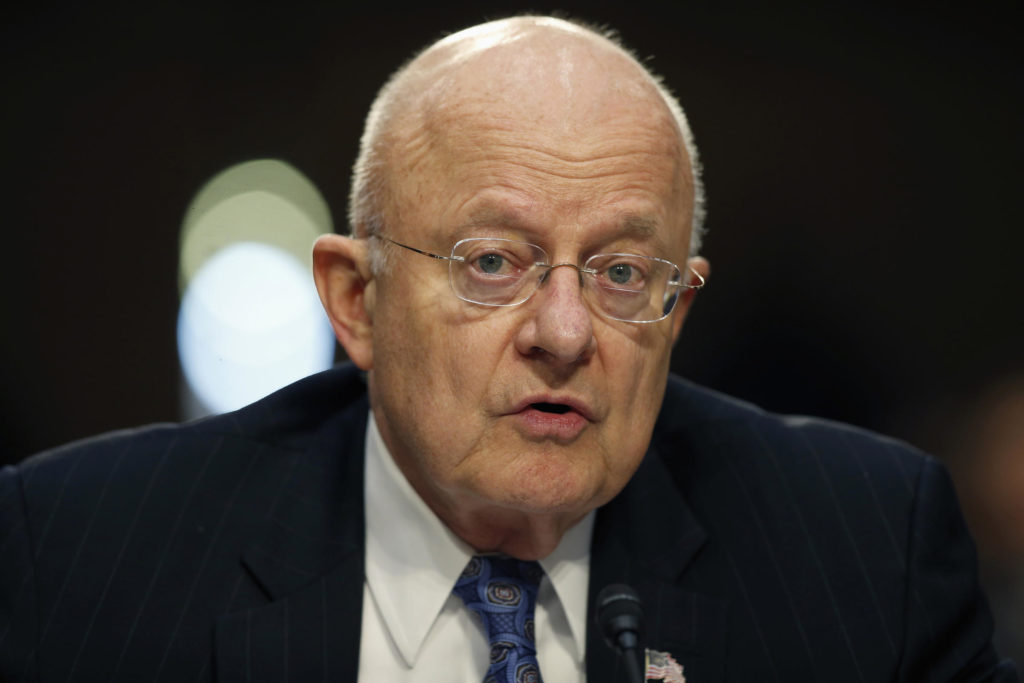
The Senate intelligence committee’s top Democrat criticized the Obama administration on Tuesday for its slow response to allegations of Russian hacking during the presidential campaign as the panel heard from the director of the FBI, whom several Democrats criticized for announcing a new probe of Hillary Clinton‘s emails 11 days before the election. Sen. Mark Warner‘s comments reflected the ongoing discontent among Democrats with how President Barack Obama handled evidence of the Kremlin’s tampering with the U.S. democratic process. The Virginia Democrat said the administration deserved at least some criticism for the pace of its response and made clear he thought it should have acted sooner and stronger. FBI Director James Comey and James Clapper, the director of national intelligence, were speaking to the committee about the conclusions of a report presented last week by U.S. intelligence agencies to Obama, President-elect Donald Trump and senior members of Congress. An unclassified version also was made public, outlining the agencies’ claims of Russian actions designed to undermine the election and help Trump by hurting Clinton. While Democrats say they accept the vote, many lawmakers feel that if Obama and his intelligence agencies were more forthright in the run-up to the election about putting up red flags and warning signs, the result may have been different. Sen. Richard Burr, R-N.C., the intelligence committee’s chairman, said he had no reason to doubt the findings of last week’s report. But he said “our democracy is not at risk,” adding that Americans can have faith in the democratic process. And he said his committee’s staff would assess the sourcing behind the intelligence agencies’ conclusions. The declassified report explicitly tied Russian President Vladimir Putin to the hacking of email accounts of the Democratic National Committee and individual Democrats like Clinton’s campaign chairman, John Podesta. Russia also used state-funded propaganda and paid “trolls” to make nasty comments on social media services, the report said, although there was no suggestion such operations affected the actual vote count. The report lacked details about how the U.S. learned what it says it knows, such as any intercepted conversations or electronic messages from Russian leaders, including Putin. It also said nothing about specific hacker techniques or digital tools the U.S. may have traced back to Russia in its investigations. Putin spokesman Dmitry Peskov told reporters on Monday the Kremlin believes the U.S. accusations of election hacking have no substance. He called them “amateurish.” According to U.S. intelligence agencies, Russia provided the emails to WikiLeaks. The website’s founder, Julian Assange, has denied that is the case, but Democratic and Republican members of Congress have largely backed the accusation and many have demanded a sterner response than Obama has ordered. Obama struck back at Moscow in late December with penalties aimed at Russia’s leading spy agencies, the GRU and FSB, that the U.S. said were involved in the hacking. The GRU is Russia’s military intelligence agency. The FSB is the main successor to the Soviet-era KGB. On Monday, the U.S. levied economic sanctions against five Russians in connection to a 2012 U.S. law punishing Russian human rights violators. Americans are now banned from doing business with the men and any assets they may have in the United States are now frozen. The most prominent individual targeted by the new sanctions is Alexander Bastrykin, who heads Russia’s main investigative agency and is close to Putin. The two attended the same university together. Republish with permission of The Associated Press.
Bradley Byrne: National security should always be our top priority
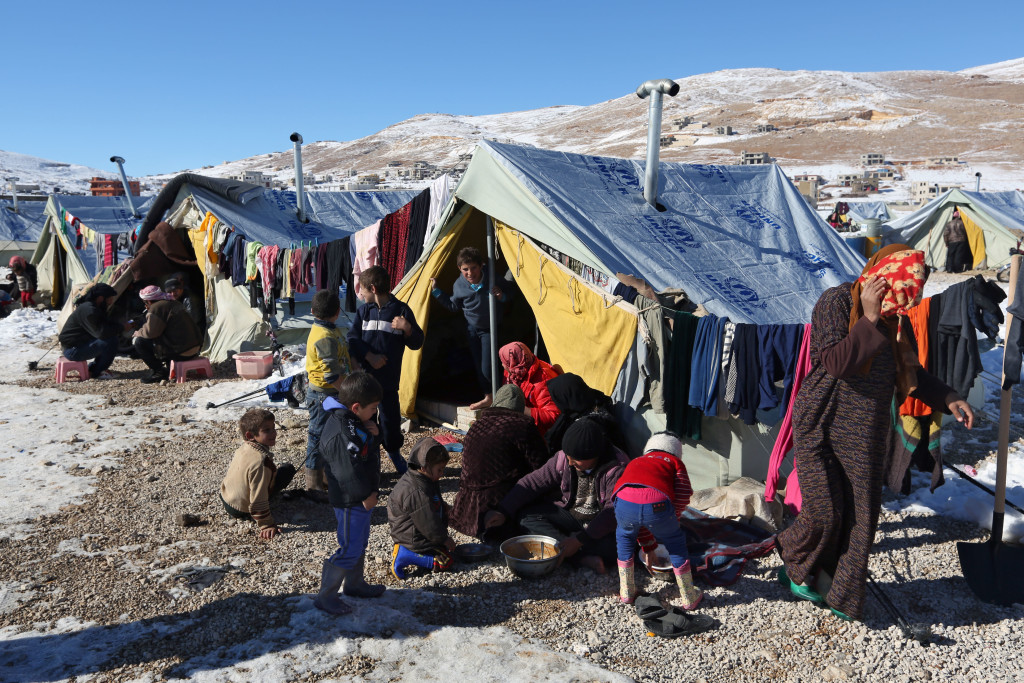
When considering whether to vote in favor of legislation, I often ask myself a simple question: Is this in the best interest of the American people? I believe that should be a guiding principle for all our elected officials when they are faced with a major decision. Recently, President Barack Obama and Secretary of State John Kerry announced a plan to increase the number of refugees allowed into the United States. Under their plan, the Obama Administration plans to accept at least 10,000 refugees from Syria. As soon as I heard this news, I had major concerns about the impact this decision would have on the American people and the national security of our country. Let me explain why. Currently, Syria is home to a major conflict between the regime of President Bashar al-Assad, fighters with the Islamic State, and many different factions of rebels who wish to overrun the government. This brutal fighting has resulted in a mass exodus of Syrian people looking to escape their war torn country. That’s where President Obama’s decision comes into play. As defined by the Immigration and Nationality Act, a refugee is someone who is unable or unwilling to return to his or her home country because of a “well-founded fear of persecution.” The federal government has a process for screening and accepting these individuals before allowing their admission into the US, and the Syrian people can certainly make a strong case to be admitted. However, I have serious concerns about the threat of terrorists infiltrating the refugee system and entering the United States. Groups like the Islamic State have made clear that they would attempt to disguise terrorist operatives as refugees. I am not the only one who has these concerns. In fact, Director of National Intelligence James Clapper recently called the migrant issue a “huge concern” and said that “we don’t put it past the likes of [the Islamic State] to infiltrate operatives among these refugees.” At a recent House Homeland Security Committee hearing, officials from the Federal Bureau of Investigation (FBI) and Department of Homeland Security (DHS) implied that bringing in a large number of Syrian refugees would represent a threat to our national security. DHS officials have even admitted that Syria does not have a computer database to check the criminal and terrorist records of these refugees. The issue is especially of interest to those of us in Southwest Alabama because Mobile is home to one of the 190 State Department refugee affiliates. This means Syrian refugees could be placed in our local community. That is why I sent a letter to the Department of State asking for information about the screening process the refugees would be required to go through. In response to my letter, I was invited to attend a classified briefing to learn more about the screening process. Unfortunately, I left the briefing with many of the same concerns. So after listening to the concerns of my constituents and getting more information from the State Department, I decided to support H.R. 3573, the Refugee Resettlement Oversight and Security Act. This bill would require approval from both the House and the Senate before refugees could be admitted to the United States. The bill would also give Congress the authority to block any inadequate refugee resettlement plan. There is simply no way to know for sure that terrorist groups, like the Islamic State, are not going to infiltrate the refugee process, and the Refugee Resettlement Oversight and Security Act will ensure that Congress, and in turn the American people, have the final say when it comes to increasing the number of refugees. On this issue, like many others, I can’t help but ask myself: Is this in the best interest of the American people? At this point, it seems clear the answer is no. Bradley Byrne is a member of the U.S. Congress representing Alabama’s 1st Congressional District.
