
Joe Biden visits Lockheed plant as weapons stockpile strained
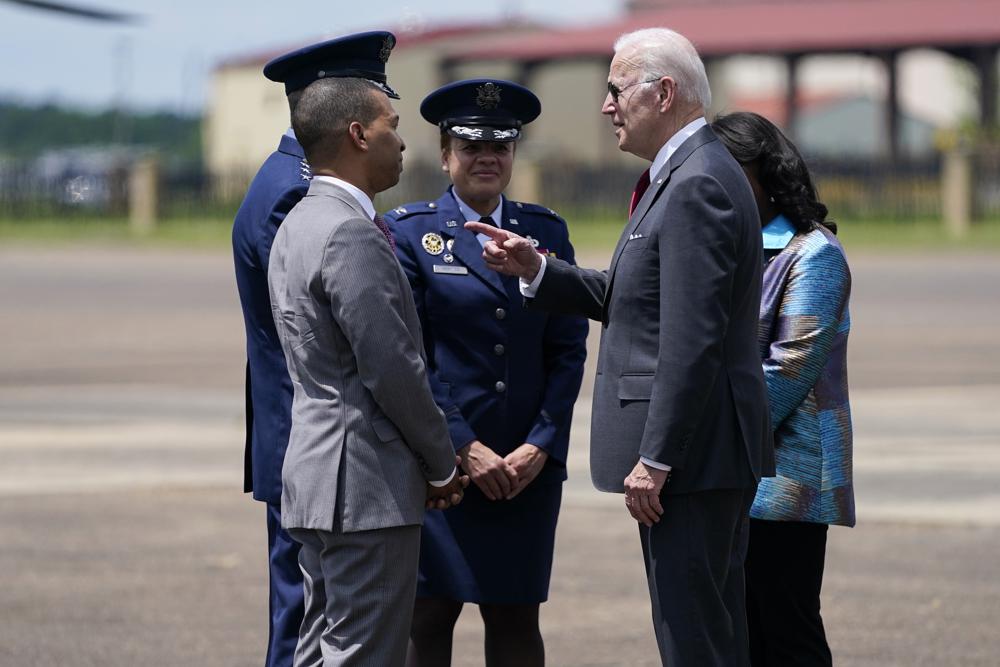
President Joe Biden on Tuesday visited a Lockheed Martin plant that manufactures an antitank weapons system, aiming to herald the U.S.-made arms as a gamechanger for Ukraine’s stiff resistance to Russia’s invasion. But Biden’s visit to the Alabama factory line is also drawing attention to a growing concern as the war drags on: Can the U.S. sustain the cadence in shipping vast amounts of arms to Ukraine while maintaining a healthy stockpile it may need if conflict erupts with North Korea, Iran or elsewhere? The U.S. has provided at least 7,000 Javelins, including some transferred during the Trump administration, or about one-third of its stockpile, to Ukraine in recent years, according to an analysis by Mark Cancian, a senior adviser with the Center for Strategic and International Studies international security program. The Biden administration says it has committed to sending 5,500 Javelins to Ukraine since the February 24 invasion. Analysts also estimate that the United States has sent about one-quarter of its stockpile of shoulder-fired Stinger missiles to Ukraine. Raytheon Technologies CEO Greg Hayes told investors last week during a quarterly call that his company, which makes the weapons system, wouldn’t be able to ramp up production until next year due to parts shortages. “Could this be a problem? The short answer is, ‘Probably, yes,’” said Cancian, a retired Marine colonel and former Office of Management and Budget specialist on Pentagon budget strategy, war funding, and procurement programs. He added that Stingers and Javelins were where “we’re seeing the most significant inventory issues,” and that production of both weapons systems has been limited in recent years. The Russian invasion offers the U.S. and European defense industry a big opportunity to bolster profits as lawmakers from Washington to Warsaw are primed to increase defense spending in response to Russian aggression. Defense contractors, however, face the same supply chain and labor shortage challenges that other manufacturers are facing, along with some others that are specific to the industry. Military spending by the U.S. and around the world was rising even before Russia’s Feb. 24 invasion. Biden’s proposed 2023 budget sought $773 billion for the Pentagon, an annual increase of about 4%. Globally, total military spending rose 0.7% to more than $2 trillion for the first time in 2021, according to an April report from the Stockholm International Peace Research Institute. The war will mean increased sales for some defense contractors, including Raytheon, which makes the Stinger missiles Ukrainian troops have used to knock out Russian aircraft. The company is also part of a joint venture with Lockheed Martin that makes the Javelins. Biden will visit Lockheed Martin’s facility in Troy, Alabama, which has the capacity to manufacture about 2,100 Javelins per year. The trip comes as he presses Congress to quickly approve his request for an additional $33 billion in security and economic assistance for Kyiv. Senate Majority Leader Chuck Schumer, D-N.Y., said Monday he hoped quick bipartisan agreement on the security package could be reached so the Senate could begin considering it “as early as next week.” A White House official, who was not authorized to comment publicly and insisted on anonymity, said the Pentagon is working with defense contractors “to evaluate the health of weapons systems’ production lines and examine bottlenecks” in the manufacturing process. The administration is also considering a range of options, if needed, to boost production of Javelins and Stingers, the official said. Pentagon press secretary John Kirby said Monday that America’s military readiness is not dependent on one system. He said that every time the Pentagon develops a package of weapons and systems to send to Ukraine, the chairman of the Joint Chiefs of Staff and the department do an assessment on what the impact will be on readiness. “It’s not about counting, say, Javelins and being able to say that when you reach a certain level, then all your readiness is gone,” Kirby said. “The Javelin is an anti-armor capability, so we judge it all as a conglomerate of what’s our ability to meet this particular mission set, realizing that a Javelin isn’t the only capability you have against armor.” The lightweight but lethal Javelin has helped the Ukrainians inflict major damage on Russia’s larger and better-equipped military. As a result, the weapon has gained almost mythic regard, celebrated with a Javelin song and images of Mary Magdalene carrying a Javelin becoming a meme in Ukraine. Lockheed Martin CEO James Taiclet said in a recent CNBC interview that demand for the Javelin and other weapon systems would increase broadly over time because of the Russian invasion. He said the company was working “to get our supply chain ramped up.” “We have the ability to meet current production demands, are investing in increased capacity, and are exploring ways to further increase production as needed,” Lockheed Martin, which is based in Bethesda, Maryland, said in a statement. Republished with the permission of the Associated Press.
Push to arm Ukraine putting strain on U.S. weapons stockpile

The planes take off almost daily from Dover Air Force Base in Delaware — hulking C-17s loaded up with Javelins, Stingers, howitzers, and other material being hustled to Eastern Europe to resupply Ukraine’s military in its fight against Russia. The game-changing impact of those arms is exactly what President Joe Biden hopes to spotlight as he visits a Lockheed Martin plant in Alabama on Tuesday that builds the portable Javelin anti-tank weapons that have played a crucial role in Ukraine. But Biden’s visit is also drawing attention to a growing concern as the war drags on: Can the U.S. sustain the cadence of shipping vast amounts of arms to Ukraine while maintaining the healthy stockpile it may need if a new conflict erupts with North Korea, Iran or elsewhere? The U.S. already has provided about 7,000 Javelins, including some that were delivered during the Trump administration, about one-third of its stockpile, to Ukraine, according to an analysis by Mark Cancian, a senior adviser with the Center for Strategic and International Studies international security program. The Biden administration says it has committed to sending about 5,500 to Ukraine since the Russian invasion more than two months ago. Analysts also estimate that the United States has sent about one-quarter of its stockpile of shoulder-fired Stinger missiles to Ukraine. Raytheon Technologies CEO Greg Hayes told investors last week during a quarterly call that his company, which makes the weapons system, wouldn’t be able to ramp up production until next year due to parts shortages. “Could this be a problem? The short answer is, ‘Probably, yes,’” said Cancian, a retired Marine colonel and former government specialist on Pentagon budget strategy, war funding, and procurement. He said that Stingers and Javelins were where “we’re seeing the most significant inventory issues,” and production of both weapons systems has been limited in recent years. The Russian invasion offers the U.S. and European defense industry a big opportunity to bolster profits as lawmakers from Washington to Warsaw are primed to increase defense spending in response to Russian aggression. Defense contractors, however, face the same supply chain and labor shortage challenges that other manufacturers are facing, along with some others that are specific to the industry. Military spending by the U.S. and around the world was rising even before Russia’s Feb. 24 invasion. Biden’s proposed 2023 budget sought $773 billion for the Pentagon, an annual increase of about 4%. Globally, total military spending rose 0.7% to more than $2 trillion for the first time in 2021, according to an April report from the Stockholm International Peace Research Institute. Russia ranked fifth, as its spending on weapons increased ahead of its invasion of Ukraine. The war will mean increased sales for some defense contractors, including Raytheon, which makes the Stinger missiles Ukrainian troops have used to knock out Russian aircraft. The company is also part of a joint venture with Lockheed Martin that makes the Javelins. Biden will visit Lockheed Martin’s facility in Troy, Alabama, which has the capacity to manufacture about 2,100 Javelins per year. The trip comes as he presses Congress to quickly approve his request for an additional $33 billion in security and economic assistance for Kyiv, Western allies, and restocking weapons the U.S. has sent to those countries. Senate Majority Leader Chuck Schumer, D-N.Y., said Monday he hoped quick bipartisan agreement on the security package could be reached so the Senate could begin considering it “as early as next week.” The president is expected to use his remarks to highlight the importance of the Javelins and other U.S. weaponry in helping Ukraine’s military put up a vigorous fight as he makes the case to keep security and economic assistance flowing. A White House official, who was not authorized to comment publicly and requested anonymity, said the Pentagon is working with defense contractors “to evaluate the health of weapons systems’ production lines and examine bottlenecks in every component and step of the manufacturing process.” The administration is also considering a range of options, if needed, to boost production of both Javelins and Stingers, the official said. Pentagon press secretary John Kirby said Monday that America’s military readiness is not dependent on one system, such as the Javelin. He said that every time the Pentagon develops a package of weapons to send to Ukraine, the chairman of the Joint Chiefs of Staff and the department assesses the broader impact. “It’s not about counting, say Javelins, and being able to say that when you reach a certain level, then all your readiness is gone,” Kirby said. “The Javelin is an anti-armor capability, so we judge it all as a conglomerate of what’s our ability to meet this particular mission set, realizing that a Javelin isn’t the only capability you have against armor.” Cancian, the former government specialist on defense budget strategy, said the fact that Stingers and Javelins were not included in the most recent tranche of weapons the Biden administration announced it was sending to Ukraine could be a sign that Pentagon officials are mindful about inventory as they conduct contingency planning for other possible conflicts. “There’s no question that whatever war plan they’re looking at, there is risk associated with the depleting levels of Stingers and Javelins, and I’m sure that they’re having that discussion at the Pentagon,” he said. The U.S. military effort to move weaponry to Eastern Europe for Ukraine’s fight has been Herculean. From Dover Air Base in Delaware, U.S. airmen have carried out nearly 70 missions to deliver some 7 million pounds of Javelins, Stingers, 155mm howitzers, helmets, and other essentials to Eastern Europe since February. Col. Matt Husemann, commander of the 436th Airlift Wing, described the mission as a “whole of government approach that’s delivering hope.” “It is awesome,” said Husemann, after providing AP with a recent tour of the airlift operation. The lightweight but lethal Javelin has helped the Ukrainians inflict major damage on Russia’s larger and better-equipped military. As a result, the weapon has gained almost mythic regard, celebrated with a Javelin song
Airbus Alabama facility in line to build tanker aircraft with Lockheed Martin

The Airbus manufacturing facility in Mobile is poised for potential growth, thanks to plans announced Monday by the aerospace company and Lockheed Martin to collaborate on a refueling tanker aircraft if the partners win an Air Force competition. In a news conference at its Alabama facility, Airbus said it would begin building A330 aircraft in Mobile that would be converted into a tanker outfitted for military use at Lockheed Martin’s plant in Marietta, Georgia. Lockheed Martin — which also has a major presence in Alabama — provided details in an announcement released Monday morning. The tanker aircraft, called the LMXT, would represent a significant new chapter for the Alabama Airbus facility, where the company builds A320 and A220 passenger jets. The $1 billion factory at the Mobile Aeroplex at Brookley employs about 1,000 people. “Establishing this production work in Alabama and Georgia confirms Lockheed Martin’s commitment that the LMXT will be built in America, by Americans, for Americans,” said Lockheed Martin Chairman, President and CEO James Taiclet. “The LMXT will strengthen global security by enabling our U.S. service members to carry out their most critical missions at extended ranges. “At home, the LMXT will strengthen job growth and manufacturing by drawing on the experience and talents of a high-tech American workforce in two states that are proven leaders in aviation,” he said. Lockheed Martin and Airbus plan to compete for a new contract from the Air Force for aerial refueling tankers as part of a competition set to begin later this year. “Today’s announcement further cements Alabama’s reputation for excellence in the aerospace industry,” Gov. Kay Ivey said. “We have a world-class workforce making Mobile a top city for manufacturing and innovation, and we are excited to welcome the Lockheed Martin LMXT to Brookley. “This state-of-the-art aircraft is the right plane for the war fighter, and we’re thrilled to have it built in Alabama.” Ivey joined Airbus officials and local leaders at the announcement ceremony at the Brookley facility. Lockheed Martin scheduled a formal announcement at its Georgia facility later in the day. “This partnership between Lockheed Martin and Airbus brings together two titans in the aerospace/aviation sector,” said Greg Canfield, secretary of the Alabama Department of Commerce. “It also heralds a new shared synergy in the military aviation space between the state of Alabama and the state of Georgia as Airbus will assemble the well-proven A330 jet aircraft in Mobile and Lockheed Martin will militarize the jet, transforming it into the LMXT. “From the Alabama perspective, this signifies the potential of a significant expansion of Airbus’s activities in Mobile and could elevate Alabama’s critical role in our national defense,” Canfield said. For France-based Airbus, Monday’s announcement represents its second attempt to provide the Air Force with an aerial refueling tanker, made in Mobile. In 2011, Airbus was part of a winning team for the first phase of the contract, but the decision was reversed and the contract awarded to Boeing. Airbus later began producing passenger aircraft at the Brookley site. Its tanker aircraft, based on the A330-200, has been ordered by NATO, Australia, France, the United Kingdom, and several other nations. “Over our 50-year history in the U.S., some of our proudest moments have come from supporting our American service members,” said C. Jeffrey Knittel, chairman and CEO of Airbus Americas. “Our U.S. workforce, which is more than 35% military veterans, is eager to see an Air Force tanker join the fleet of Airbus aircraft flying for the U.S. Army, National Guard, Navy, and Coast Guard.” Bethesda, Maryland-based Lockheed Martin’s presence in northern Alabama spans more than five decades, with a concentration in the rotorcraft and hypersonics sectors. More than 2,600 Lockheed Martin employees live and work in Alabama. In October, Lockheed Martin opened an advanced production facility in Courtland focused on hypersonic strike production. Our LMXT offering for the @usairforce will be built in Georgia and Alabama and extend our 60+ year history of delivering tankers to U.S. and global operators. Watch for more on how our proven, ready solution will fuel future missions. pic.twitter.com/jdtgGPrlEV — Lockheed Martin (@LockheedMartin) January 31, 2022 “Alabama Power was involved in supporting the original tanker project that unfortunately never came to fruition,” said Alabama Power Mobile Division Vice President Patrick Murphy. “Over the last 10 years, Alabama Power has partnered with the Alabama Department of Commerce and Team Mobile to strategically support the growth of Airbus and its supplier base. Alabama Power’s Mobile Division and our corporate Economic Development group have worked steadily to lay the framework for Airbus and Lockheed Martin to be successful in this project and we will continue to lend our support as the project evolves.” This story originally appeared on the Alabama Department of Commerce’s Made in Alabama website.
