
Joe Biden banning Russia from U.S. airspace because of Ukraine
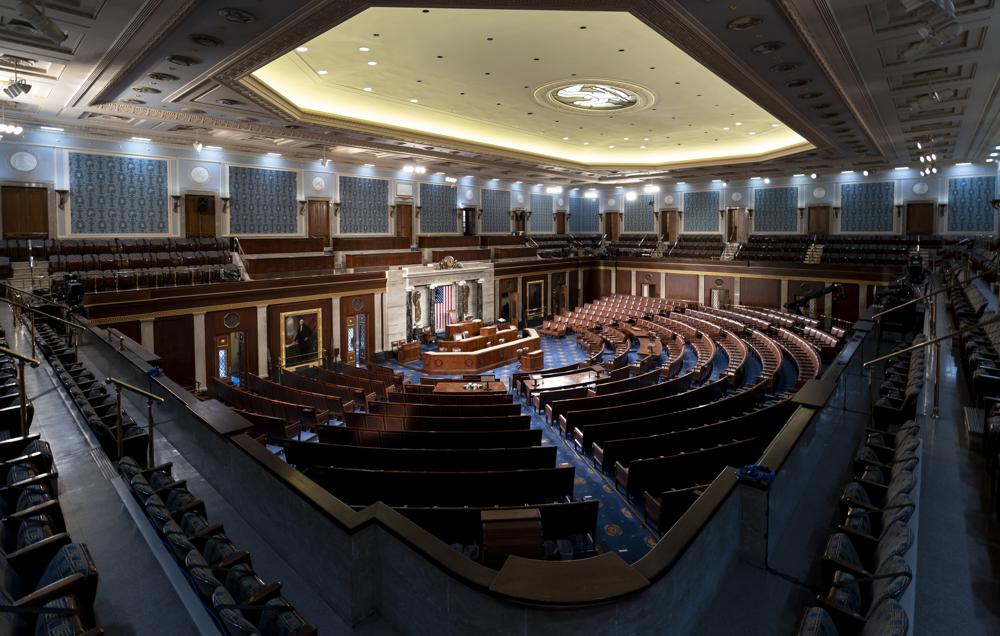
President Joe Biden will vow to make Vladimir Putin “pay a price” for Russia’s invasion of Ukraine in his first State of the Union address, rallying allies abroad while also outlining his plans at home to fight inflation and the fading but still dangerous coronavirus. In addition to recounting U.S. and allied economic sanctions against Russia, Biden planned to announce that the U.S. is following Canada and the European Union in banning Russian planes from its airspace in retaliation for the invasion of Ukraine, according to two people familiar with his remarks’ They spoke only on the condition of anonymity before the speech. Biden planned in his Tuesday night remarks to highlight the bravery of Ukrainian defenders and the resolve of a newly reinvigorated Western alliance that has worked to rearm the Ukrainian military and cripple Russia’s economy through sanctions. He was set to deliver an ominous warning that without consequences, Russian President Putin’s aggression wouldn’t be contained to Ukraine. “Throughout our history, we’ve learned this lesson – when dictators do not pay a price for their aggression, they cause more chaos,” Biden was to say, according to advance excerpts released by the White House. “They keep moving. And, the costs and threats to America and the world keep rising.” Even before the Russian invasion sent energy costs skyrocketing, prices for American families had been rising, and the COVID-19 pandemic continues to hurt families and the country’s economy. Biden planned to outline plans to address inflation by reinvesting in American manufacturing capacity, speeding supply chains, and reducing the burden of childcare and eldercare on workers. “We have a choice,” Biden was to say. “One way to fight inflation is to drive down wages and make Americans poorer. I have a better plan to fight inflation. Lower your costs, not your wages.” Set against disquiet at home and danger abroad, the White House had conceived Tuesday night’s speech as an opportunity to highlight the improving coronavirus outlook, rebrand Biden’s domestic policy priorities, and show a path to lower costs for families grappling with soaring inflation. But it has taken on new significance with last week’s Russian invasion of Ukraine and nuclear saber-rattling by Putin. In an interview with CNN and Reuters, Zelenskyy said he urged Biden to deliver a strong and “useful” message about Russia’s invasion. Ahead of the speech, the White House announced that Ukrainian Ambassador to the U.S. Oksana Markarova would join first lady Jill Biden in the galleries to watch Biden’s address. Biden will address a mask-optional crowd in the House chamber, one sign of the easing coronavirus threat. But he’ll also speak from within a newly fenced Capitol due to renewed security concerns after last year’s insurrection. Rising energy prices as a result of Russia’s war in Ukraine risk exacerbating inflation in the U.S., which is already at the highest level in 40 years, eating into people’s earnings and threatening the economic recovery from the pandemic. And while the geopolitical crisis in Eastern Europe may have helped to cool partisan tensions in Washington, it can’t erase the political and cultural discord that is casting doubt on Biden’s ability to deliver on his pledge to promote national unity. Biden is speaking to an American public that is frustrated with his performance. A February AP-NORC poll found that more people disapproved than approved of how Biden is handling his job, 55% to 44%. That’s down from a 60% favorable rating last July. White House officials acknowledge the mood of the country is “sour,” citing the lingering pandemic and inflation. Biden, in his speech, will highlight progress from a year ago — with the majority of the U.S. population now vaccinated and millions more people at work — but also acknowledge that the job is not yet done, a recognition of American discontent. Biden aides say they believe the national psyche is a “trailing indicator” that will improve with time. But time is running short for the president, who needs to salvage his first-term agenda to revive the political fortunes of his party before November’s midterm elections. House Republicans say the word “crisis” describes the state of the union under Biden and Democrats — from an energy policy that lets Russia sell oil abroad to challenges at home over jobs and immigration. “We’re going to push the president to do the right thing,” said House Majority Leader Kevin McCarthy. At least a half dozen lawmakers, including Reps. Jamie Raskin and Pete Aguilar, both members of the committee investigating last year’s Capitol riot, and Sen. Alex Padilla, D-Calif., had tested positive for COVID-19 and were not expected at the Capitol for the speech. Where his speech to Congress last year saw the rollout of a massive social spending package, Biden plans this year to repackage past proposals in search of achievable measures he hopes can win bipartisan support in a bitterly divided Congress before the elections. The president was to highlight investments in everything from internet broadband access to bridge construction from November’s $1.2 trillion bipartisan infrastructure law as an example of government reaching consensus and delivering change for the nation. He also planned to appeal to lawmakers to compromise on rival competitiveness bills that have passed the House and Senate; both meant to revitalize high-tech American manufacturing and supply chains in the face of growing geopolitical threats from China. The speech comes as progress on many of Biden’s other legislative priorities remains stalled on Capitol Hill after Democratic Sen. Joe Manchin scuttled the sweeping “Build Back Better” spending bill that Biden championed last fall. As part of his pitch to voters, Biden was to resurrect components of the legislation, but with a new emphasis on how proposals like extending the child tax credit and bringing down child care costs could bring relief to families as prices rise. He was also to outline how his climate change proposals would cut costs for lower- and middle-income families and create new jobs. Jen Psaki said Biden “will absolutely use the word inflation” in the speech but emphasized that he was
AP-NORC poll: Most in U.S. oppose major role in Russia strife

There’s little support among Americans for a major U.S. role in the Russia-Ukraine conflict, according to a new poll, even as President Joe Biden imposes new sanctions and threatens a stronger response that could provoke retaliation from Moscow. Biden has acknowledged a growing likelihood that war in Eastern Europe would affect Americans, though he has ruled out sending troops to Ukraine. Gas prices in the U.S. could rise in the short term. And Russian President Vladimir Putin has a range of tools he could use against the U.S., including cyberattacks hitting critical infrastructure and industries. “Defending freedom will have costs for us as well, here at home,” Biden said Tuesday. “We need to be honest about that.” Just 26% say the U.S. should have a major role in the conflict, according to a new poll from The Associated Press-NORC Center for Public Affairs Research. Fifty-two percent say a minor role; 20% say none at all. The findings are a reminder for Biden and fellow Democrats that while the crisis may consume Washington in the coming months, pocketbook issues are likely to be a bigger priority for voters heading into the midterm elections. A December AP-NORC poll showed that Americans are particularly focused on economic issues, including rising inflation. The Biden administration has argued that supporting Ukraine is a defense of fundamental American values and has made a concerted effort to declassify intelligence findings underscoring the dangers it sees for Ukraine and the wider European region. But the survey shows widespread public skepticism of the U.S. intelligence community. White House press secretary Jen Psaki on Wednesday noted that Americans may have different interpretations of a major U.S. role and reiterated that Biden would not send the U.S. military to Ukraine, though troops have deployed to nearby NATO member countries. “We make national security decisions based on what’s best for our country’s national security, not on the latest polling,” she said. Democrats are more likely than Republicans to think the U.S. should have a major role in the conflict, 32% to 22%. Overall, the poll shows 43% of Americans now approve of Biden’s handling of the U.S. relationship with Russia, a downtick from 49% in June of last year. Despite the clear reluctance about major involvement in the conflict, Americans are hardly looking at Russia through rose-colored glasses. The poll finds 53% say they’re very or extremely concerned that Russia’s influence around the world poses a threat to the U.S., an uptick from 45% in August 2021. Jennifer Rau, a 51-year-old mother of three adopted teenagers who lives on Chicago’s South Side, said she listens to local public radio for her world news. But in recent days, when the news turns to Russia and Ukraine, she has started to turn it off. “I’m so frustrated. It’s enough. We’re bombarded,” Rau said. “There are other stories in Chicago that need to be covered.” Rau is a political independent who voted for Biden. But she believes the U.S. gets involved in foreign wars to make money. She is more concerned about rising crime in Chicago, the prevalence of guns, and systemic racism that affects her three children, who are Hispanic. “I just feel like there’s a war going on in the United States, every day, in Chicago,” she said. “And it is really scary. And I feel like no one helps us.” Edward Eller, a 67-year-old retiree from Shady Valley, Tennessee, said the White House needs to focus on lowering oil prices. “They want to send millions of dollars of ours to stop a war that we have nothing to do with,” he said. “I’m sorry they’re involved in a mess, but it’s not our problem.” The poll was conducted Friday to Monday during a period of rapidly escalating tensions, culminating with Putin recognizing the independence of two separatist regions in eastern Ukraine, widely seen in the West as a step toward a wider war. Russian-backed separatists and Ukrainian forces have been locked since 2014 in fighting that’s killed 14,000 people. Russia has massed at least 150,000 troops on three sides of Ukraine and continues to establish bridges, camps, and logistics necessary for a protracted invasion. U.S. officials believe Putin could attack Ukraine at any time. A full-on war in Ukraine could result in thousands of deaths and huge numbers of refugees fleeing for the U.S. or elsewhere in Europe. The U.S. has imposed sanctions on Russian banks and oligarchs, with more measures possible this week. The White House has warned in increasingly strong words about a Russian invasion while trying to persuade Putin against launching one. It has declassified Russian troop positions and detailed allegations of “false-flag” plots that could set a pretext for a military attack on Ukraine. However, the poll shows there remains skepticism among Americans of the U.S. intelligence community. Only 23% said they had a “great deal of confidence” in intelligence agencies. Another 52% say they have some confidence and 24% have hardly any. U.S. Rep. Mike Quigley, an Illinois Democrat who serves on the House Intelligence Committee, says the intelligence he’s received on Ukraine “has been very, very good. Sadly, it’s been accurate.” But he often hears from constituents who are uninterested in Ukraine and more focused on health care and the coronavirus pandemic. Over time, Quigley said, he has developed comments about why Ukraine matters to the U.S.: its role as a strategic ally and a “sovereign democratic nation at Putin’s doorstep,” and how a new war could hit already disrupted technology supply chains that use exports from Russia and Ukraine. Among Russia’s biggest threats to Americans is its capability to wage cyberwarfare. Previous Russia-linked cyberattacks have cut off services at hospitals and breached the servers of American government agencies. A ransomware attack on Colonial Pipeline linked to a Russia-based hacking group temporarily shut down gas stations across the East Coast. And Russia was accused of interfering in both the 2016 and 2020 presidential elections. “I think it’s an incredibly difficult time to message because of everything else that’s topping the list of what Americans care about. It’s hard to bump COVID, inflation,
Under pressure to ease up, Joe Biden weighs new virus response

Facing growing pressure to ease up on pandemic restrictions, the White House insisted Wednesday it is making plans for a less-disruptive phase of the national virus response. But impatient states, including Democratic New York, made clear they aren’t waiting for Washington as public frustration grows. Gov. Kathy Hochul announced that New York will end its COVID-19 mandate requiring face coverings in most indoor public settings — but will keep it for schools. Illinois announced the same. Earlier this week, New Jersey, Connecticut, and Delaware all disclosed plans to join states that have lifted or never had mask requirements for their schools, and Massachusetts will follow suit at the end of the month. All but Massachusetts have governors who are Democrats, like President Joe Biden. Biden, who has long promised to follow to “follow the science” in confronting the pandemic, is hemmed in, waiting for fresh guidance from federal health officials, who so far still recommend that nearly all Americans wear masks in most indoor settings. Defending Biden, press secretary Jen Psaki acknowledged that while people are tired of masks and “we understand where the emotions of the country are,” the administration is following the advice of medical experts who rely on scientific evidence. “That doesn’t move at the speed of politics; it moves at the speed of data,” she said. Clearly feeling the pressure, the White House, for the first time, acknowledged movement in its planning, saying conversations have been underway privately to develop plans for guiding the country away from the emergency phase of the pandemic. Federal COVID-19 coordinator Jeff Zients said officials are consulting with state and local leaders and public health officials on potential next steps. But as governors and local officials press for clearer federal guidelines for easing or ending restrictions, states, cities, and school boards are adopting an awkward patchwork of policies that differ widely from one place to the next. “We are working on that guidance,” Centers for Disease Control and Prevention Director Dr. Rochelle Walensky said in a White House teleconference Wednesday. “As we’ve been encouraged by the current trends, we are not there yet.” The White House offered no timetable for the review or an indication of what it will recommend. And some critics say that’s not good enough. “The tragic thing is that these are governors that would probably have followed the White House’s guidance,” said Dr. Leana Wen, a former Baltimore health commissioner. “They wanted CDC input and asked for it, but without a clear timeline, at some point, they had to decide that they couldn’t wait any more. The fault is not theirs, but the CDC’s and by extension, President Biden’s, which, with each passing day, is making itself less and less relevant.” Asked whether Biden appears to be out of touch with the country, Psaki defended his caution. “As a federal government, we have the responsibility to rely on data on science, on the medical experts,” she said. Pressed on whether Americans should follow less-restrictive state or local rules or the stricter federal guidance, she repeated the White House’s daily counsel: “We would advise any American to follow the CDC guidelines.” New York’s Hochul and others aren’t waiting. They are ending or easing many broad mandates, though her state will keep masking rules in schools and health facilities. “Given the declining cases, given the declining hospitalizations, that is why we feel comfortable to lift this, in effect tomorrow,” Hochul said Wednesday. Even allies of the administration have argued that Biden should at least lay out a roadmap for moving back toward normalcy. He has been hesitant, aides say, in part because of the sting of his fleeting “declaration of independence” from the virus last summer, which proved premature in the face of the delta and then omicron strains. Now, though, cases and hospitalizations from COVID-19 have dropped markedly since they peaked earlier this year amid the spread of the highly transmissible omicron variant, and the vast majority of Americans are protected against the virus by effective vaccines and boosters. Still, more than 2,000 people infected with the virus die in the U.S. each day, and there is concern within the administration about letting up while deaths remain high. And Psaki noted that many Americans support continued mask-wearing. Some in the White House point to the consternation that was voiced in December after the CDC shortened the isolation time for Americans who test positive. While Biden and other administration officials emphasize that the threat from the virus is far diminished from a year ago, before the wide roll-out of vaccines and booster shots and the approval of rapid at-home tests and highly effective therapeutics, administration officials acknowledge that most federal guidelines have been slow to keep up. The CDC continues to recommend indoor mask-wearing in places of “substantial or high transmission” of the virus, which as of Wednesday was all of the U.S. but 14 rural counties. State and local leaders, nevertheless, have announced plans to ease virus restrictions in the coming weeks as omicron cases fall, citing the protections offered by vaccines as well as the increased availability of at-home testing kits and therapeutics for those who do catch the virus. Many of the restrictions eased last year, only to be reinstated as omicron swept the country. After more than a year of a top-down federally driven response, the emerging shift marks a return to the historical norm, where states have typically had the first say in how they handle public health emergencies. The CDC can advise them and issue general guidance for the nation, but in most situations, it cannot order them what to do. While the Biden administration has pushed back strongly against efforts by GOP governors to prohibit mask-wearing requirements, it is indicating that it will take a more flexible approach to jurisdictions that make their own choices. Policies lifting mask requirements “are going to have to be made at the local level” depending on case rates, Walensky said. Despite the encouraging reports in the Americas, Western Europe, and some
High court’s Alabama ruling sparks alarm over voting rights
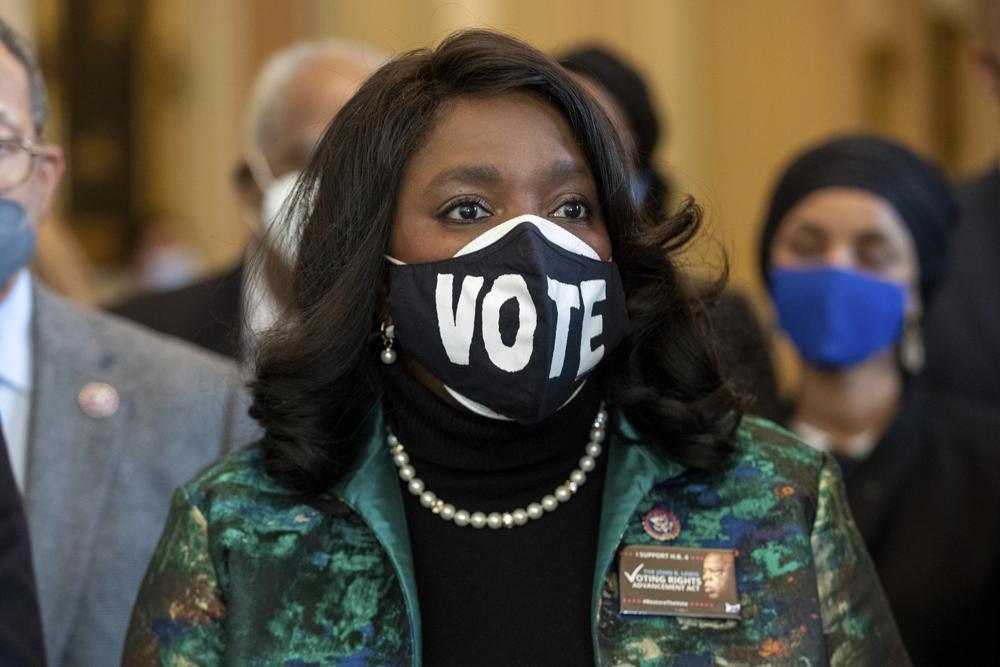
The Supreme Court’s decision to halt efforts to create a second mostly Black congressional district in Alabama for the 2022 election sparked fresh warnings Tuesday that the court is becoming too politicized, eroding the Voting Rights Act and reviving the need for Congress to intervene. The Supreme Court’s conservative majority put on hold a lower court ruling that Alabama must draw new congressional districts to increase Black voting power. Civil rights groups had argued that the state, with its “sordid record” of racial discrimination, drew new maps by “packing” Black voters into one single district and “cracking” Black voters from other districts in ways that dilute their electoral power. Black voters are 26% of Alabama’s electorate. In its 5-4 decision late Monday, the Supreme Court said it would review the case in full, a future legal showdown in the months to come that voting advocates fear could further gut the protections in the landmark Civil Rights-era law. It’s “the latest example of the Supreme Court hacking away at the protections of the voting rights act of 1965,” said Sen. Dick Durbin, D-Ill., chairman of the Judiciary Committee. “Congress must act. We must restore the Voting Rights Act.” The outcome all but ensures Alabama will continue to send mostly white Republicans to Washington after this fall’s midterm elections and applies new pressure on Congress to shore up voter protections after a broader elections bill collapsed last month. And the decision shows the growing power of the high court’s conservative majority as President Joe Biden is under his own pressures to name a liberal nominee to replace retiring Justice Stephen Breyer. Rep. Terri Sewell, the only Black representative from Alabama, said the court’s decision underscores the need for Congress to pass her bill, the John R. Lewis Voting Rights Advancement Act, to update and ensure the law’s historic protections. “Black Alabamians deserve nothing less,” Sewell said in a statement. The case out of Alabama is one of the most important legal tests of the new congressional maps stemming from the 2020 census count. It comes in the aftermath of court decisions that have widely been viewed as chiseling away at race-based protections of the Voting Rights Act. Alabama and other states with a known history of voting rights violations were no longer under federal oversight, or “preclearance,” from the Justice Department for changes to their election practices after the court, in its 2013 Shelby v. Holder decision, struck down the bill’s formula as outdated. As states nationwide adjust their congressional districts to fit population and demographic data, Alabama’s Republican-led Legislature drew up new maps last fall that were immediately challenged by civil rights groups on behalf of Black voters in the state. Late last month, a three-judge lower court, which includes two judges appointed by former President Donald Trump, had ruled that the state had probably violated the federal Voting Rights Act by diluting the political power of Black voters. This finding was rooted, in part, in the fact that the state did not create a second district in which Black voters made up a majority or close to it. Given that more than one person in four in Alabama is Black, the plaintiffs had argued the single Black district is far less than one person, one vote. “Black voters have less opportunity than other Alabamians to elect candidates of their choice to Congress,” the three-judge panel wrote in the 225-page ruling. The lower court gave the Alabama legislature until Friday to come up with a remedial plan. Late Monday, the Supreme Court, after an appeal from Alabama, issued a stay. Justices Brett Kavanaugh and Samuel Alito, part of the conservative majority, said the lower court’s order for a new map came too close to the 2022 election. Chief Justice John Roberts joined his three more liberal colleagues in dissent. “It’s just a really disturbing ruling,” said Sen. Cory Booker, D-N.J., a member of the Judiciary Committee, who called the Supreme Court’s decision “a setback to racial equity, to ideals of one person, one vote.” Rep. Joyce Beatty, D-Ohio, and the chair of the Congressional Black Caucus said the decision “hits at the guts of voting rights.” She told The Associated Press: “We’re afraid of what will happen from Alabama to Texas to Florida and even to the great state of Ohio.” White House Press Secretary Jen Psaki said the court decision exposes the need for Congress to legislate to protect voting rights. The erosion of those rights is “exactly what the Voting Rights Act is in place to prevent.” Critics went beyond assailing the decision at hand to assert that the court has become political. “I know the court likes to say it’s not partisan, that it’s apolitical, but this seems to be a very political decision,” said Democratic Sen. Chris Van Hollen of Maryland. Rep. Hakeem Jeffries, D-N.Y., tweeted that the court majority has “zero legitimacy.” Rep. Barbara Lee, D-Calif., tweeted that the court’s action was “Jim Crow 2.0.” Alabama Republicans welcomed the court’s decision. “It is great news,” said Rep. Mo Brooks, who is running for the GOP nomination for Senate. He called the lower court ruling an effort to “usurp” the decisions made by the state’s legislature. The justices will, at some later date, decide whether the map produced by the state violates the voting rights law, a case that could call into question “decades of this Court’s precedent” about Section 2 of the act, Justice Elena Kagan wrote in dissent. Section 2 prohibits racial and other discrimination in voting procedures. Voting advocates see the arguments ahead as a showdown over voting rights they say are being slowly but methodically altered by the Roberts court. The Supreme Court in the Shelby decision did away with the preclearance formula under Section 5 of the Voting Rights Act. And last summer, the conservative majority in Bronvich vs. the Democratic National Committee upheld voting limits in an Arizona case concerning early ballots that a lower court had found discriminatory under Section 2. With the Alabama case, the court
Ron DeSantis blasts FDA for halting drugs ineffective on omicron

Florida Gov. Ron DeSantis pushed Tuesday for coronavirus patients to continue receiving antibody treatments deemed ineffective against the omicron variant, vowing to fight White House health regulators in his latest feud with President Joe Biden. The Republican governor’s comments came a day after the U.S. Food and Drug Administration pulled its emergency authorization for the antibody drugs from Regeneron and Eli Lilly. DeSantis, who made the drugs a centerpiece of his virus response while resisting vaccine mandates and other safety measures, did not outline how he would fight the FDA decision and it is legally unclear how he would do so. His office did not immediately return an email seeking further clarification. The FDA has sole authority over drug regulation in the U.S. The FDA announcement was expected, as both drugmakers have said for weeks that the treatments are less able to target omicron because of its mutations. In updated drug labeling released Monday, the FDA said omicron appears 1,000-fold less vulnerable to Regeneron’s drug and nearly 3,000-fold less vulnerable to Lilly’s drug. DeSantis has risen to prominence within the Republican Party through his constant criticism of Biden and White House virus policy. The governor, who is running for reelection and considered to be eyeing a 2024 presidential run, has heavily promoted the monoclonal antibody treatments. At a news conference Tuesday, DeSantis referenced anecdotal cases in which people were helped by the monoclonal antibody treatments and said it was “reckless” to block the drugs. “People have a right to access these treatments, and to revoke it on this basis is just fundamentally wrong and we’re going to fight back,” DeSantis said at a news conference. Asked about DeSantis’ opposition to the FDA decision, White House press secretary Jen Psaki said, “Let’s just take a step back here to realize how crazy this is.” “They are still advocating for treatments that don’t work,” she said of DeSantis. A spokeswoman for the U.S. Department of Health and Human Services confirmed Tuesday that the U.S. government has halted shipments of the two antibodies. She added that the federal government continues to distribute a GlaxoSmithKline antibody and two antiviral pills that are effective against omicron. However, supplies of those drugs are limited. “The Administration is focused on making sure that, if an American gets sick with COVID-19, they get a treatment that actually works,” HHS’ Kirsten Allen said in a statement. Hours after the FDA announced its decision Monday, the Florida Department of Health said it would shutter all monoclonal antibody state sites until further notice. DeSantis, in a statement Monday night, warned of the repercussions to “Biden’s medical authoritarianism.” Federal officials said the FDA decision was supported by several independent studies, including a peer-reviewed paper published in the journal Nature last month. In that study, a consortium of European researchers tested the ability of several antibody drugs to neutralize a live sample of the virus, concluding that Lilly and Regeneron’s antibodies “were inactive against omicron.” The American Medical Association, the nation’s largest physician group, said it agreed with the FDA decision, issuing a statement that read: “Limiting the use of these treatments will help ensure patients receive the best available therapy.” The federal government in late December temporarily stopped distributing the drugs to states as omicron began to become the dominant coronavirus strain but resumed shipments after complaints from Republican governors, including DeSantis. The U.S. government has shipped enough doses of the two antibodies to treat more than 300,000 patients since early January. The DeSantis administration last week announced it was opening five new monoclonal antibody treatment sites, to “facilitate the distribution of life-saving therapeutics.” The FDA says omicron is responsible for more than 99% of U.S. infections, making it “highly unlikely” that the antibodies would be effective for people seeking treatment. The drugs are not a substitute for vaccination and are generally reserved for people who are the most vulnerable, including seniors, transplant recipients, and those with conditions like heart disease and diabetes. Republished with the permission of the Associated Press.
White House soft-launches COVID-19 test request website

The Biden administration on Tuesday quietly launched its website for Americans to request free at-home COVID-19 tests, a day before the site was scheduled to officially go online. The website, COVIDTests.gov, now includes a link for Americans to access an order form run by the U.S. Postal Service. People can order four at-home tests per residential address to be delivered by the Postal Service. It marks the latest step by President Joe Biden to address criticism of low inventory and long lines for testing during a nationwide surge in COVID-19 cases due to the omicron variant. White House press secretary Jen Psaki said the website was in “beta testing” and operating at a “limited capacity” ahead of its official launch. The website will officially launch mid-morning Wednesday, Psaki said. There were isolated reports Tuesday afternoon of issues relating to the website’s address verification tool erroneously enforcing the four-per-household cap on apartment buildings and other multi-unit dwellings, but it was not immediately clear how widespread the issue was. At points Tuesday, more than 750,000 people were accessing the website at the same time, according to public government tracking data, but it was not immediately known how many orders were placed. She added that the administration was anticipating a “bug or two,” but had IT experts from across the government working to get the site ready. Biden announced last month that the U.S. would purchase 500 million at-home tests to launch the program, and on Thursday, the president announced that he was doubling the order to 1 billion tests. But Americans shouldn’t expect a rapid turnaround on the orders, and they will have to plan ahead and request the tests well before they meet federal guidelines for when to use a test. The White House said “tests will typically ship within 7- 12 days of ordering” through USPS, which reports shipping times of 1-3 days for its first-class package service in the continental United States. Officials emphasized that the federal website is just one way for people to procure COVID-19 tests, and shortages of at-home test kits have shown signs of easing as more supply has hit the market. Since Saturday, private insurance companies have been required to cover the cost of at-home rapid tests, allowing Americans to be reimbursed for tests they purchase at pharmacies and online retailers. That covers up to eight tests per month. The technical bugs that embarrassed President Barack Obama’s administration with the 2013 rollout of the HealthCare.gov website should not be a problem for the COVID-19 test kit website in part because it is so much simpler, said Alex Howard, director of the Digital Democracy Project, an open government watchdog group. Howard said the new website is also simpler than the Vaccines.gov website – for finding nearby vaccine clinics and pharmacies – that was already successfully launched by the Biden administration last year. Howard said the task of requesting someone’s address is a straightforward one, especially when compared with the Obama-era health insurance website that involved shopping for different health plans and authenticating a secure transaction. The challenge of hosting a website application under high demand is also a “solved problem” in the private sector, he said. “My expectation is the U.S. Digital Service, and any vendors they work with will be able to pull this off,” he said. “It’s the least hard part of this.” Two tech companies that frequently work with the federal government – Microsoft and Accenture – on Tuesday referred questions about the website to the Postal Service. Amazon, a major cloud provider for U.S. agencies, didn’t respond to requests for comment. Howard said the trickiest part of the project is not the website but the physical distribution of kits. “I don’t recall the last time the federal government sent something like this to everyone that wasn’t a tax document,” he said. Likely challenges include multiple people ordering from the same apartment building address or how to handle people who try to game the system and order extra. “I would like my fellow Americans to be a more trustworthy lot,” said Howard, but given other debates over COVID-19 protocols and response, “that’s not going to fly very well.” Republished with the permission of the Associated Press.
Congress passes $770 billion defense bill, allows discharge over vaccine refusal

Congress passed a $770 billion defense bill Wednesday, authorizing a wide range of military spending for the next year. The Senate passed the bipartisan 2022 National Defense Authorization Act with an 89-10 vote, sending the legislation to President Joe Biden. The bill, which is passed annually in some form, includes a revamp of how the military deals with sexual assaults as well as a 2.7% pay increase for military members and employees at the Department of Defense. The bill also creates an “Afghanistan War Commission” to evaluate the U.S. military’s presence – and withdrawal from – that nation. “The passage of this year’s national defense bill bolsters our security, ensures our nation’s defenders can effectively confront adversaries like Communist China and Russia, and directly benefits Tennessee’s military and research communities,” said Rep. Marsha Blackburn, R-Tenn. The NDAA came after months of wrangling over the debt ceiling, funding for the government, and the infrastructure and “Build Back Better” spending bills. The legislation, which Biden is expected to sign, funds the gamut of military activity, from new equipment to salaries and more. The bill faced several points of contention, including when a contingent of Republicans fought to include language protecting U.S. service members who refuse to take the COVID vaccine. The head of the Department of Defense, Lloyd Austin, announced earlier this year that service members who refuse the vaccine will likely face discharge. After Republican efforts, the newly passed NDAA prevents them from receiving dishonorable discharges, but they can still be discharged. “In addition, this year’s NDAA includes a provision I fought for that removes the ability for the military to dishonorably discharge service members who choose not to receive the COVID-19 vaccine,” Sen. Ted Cruz, R-Texas, said in a statement. “As President Biden’s unlawful vaccine mandates are continually challenged, this reform prevents our brave servicemen and women from being punished like convicted criminals for simply making what they believe is the best medical decision for themselves,” he said. “I will continue to fight to ensure that service members who refuse the vaccine are not punished for their private healthcare choices,” Cruz added. A spokeswoman for the Air Force said Monday the branch had discharged 27 service members, reportedly for refusing the COVID vaccine. These discharges are the first with more expected. The Biden administration has defended the mandate for service members, arguing only a small percentage have refused. “My understanding is that 99 percent of the Air Force is in compliance. So, we’re talking about less than 1 percent, which – to us, the story is that it’s more than 99 percent who are in compliance,” White House Press Secretary Jen Psaki told reporters Tuesday. “I would also note – and they can give you more detail on this – but this is at the end of months of counseling and engagement with those not in compliance about what is required here.” Another controversial provision that did not make the final version of the bill was an effort to include women in selective service, otherwise known as the draft. “Democrats tried to use the NDAA to draft America’s daughters and force their radical social ideologies onto our troops,” Sen. Tom Cotton, R-Ark., said in a statement. “Thankfully, they failed, and this year’s defense bill largely does what it should: support and strengthen our troops.” By Casey Harper Republished with the permission of The Center Square.
Pushing COVID-19 boosters, Joe Biden says ‘we need to be ready’
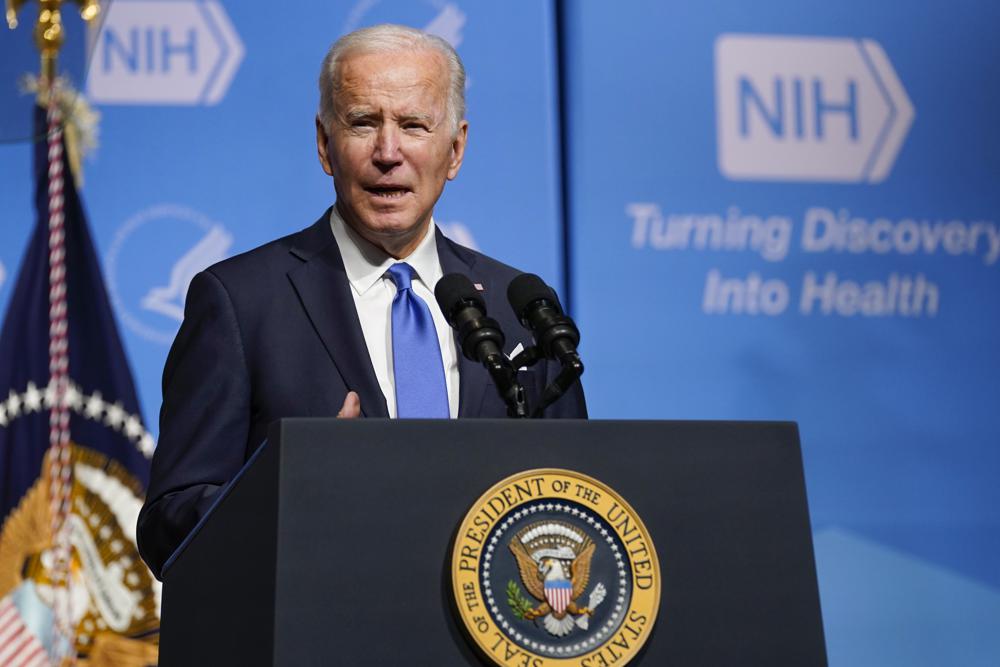
With rising numbers of COVID-19 cases predicted this winter, President Joe Biden on Thursday appealed for Americans to get their boosters and get behind his plan to tackle the new omicron variant through wider availability of vaccines and shots, but without new major restrictions on daily life. Biden wants to require private insurers to cover the cost of at-home COVID-19 tests, and he is tightening testing requirements for people entering the United States, regardless of their vaccination status. While some other countries are closing their borders or reinstituting lockdowns, the president said he would not at this time impose additional clampdowns beyond his recommendation that Americans wear masks indoors in public settings. “Experts say the COVID-19 cases will continue to rise in the weeks ahead this winter, so we need to be ready,” Biden said during a visit to the National Institutes of Health in suburban Maryland after a briefing with scientific advisers. He said his new strategy “doesn’t include shutdowns and lockdowns,” and he hoped for bipartisan backing. “My plan I’m announcing today pulls no punches in the fight against COVID-19, and it’s a plan that I think should unite us,” he Biden said. Legal challenges have held up Biden’s vaccination-or-testing requirement for workers at larger employers, and that’s led the president to urge businesses to impose their own mandates so companies can stay open without outbreaks. His administration has come to view widespread adoption of booster shots as its most effective tool for combating COVID-19 this winter. Medical experts say boosters provide enhanced and more enduring protection, including against new variants. Much remains unknown about the omicron variant, such as whether it is more contagious, makes people more seriously ill, and can thwart the vaccines. Officials said Thursday that a second case of the variant had been confirmed in the United States. About 100 million Americans are eligible for boosters under current U.S. policy, with more becoming eligible every day. Officials believe that persuading the vaccinated to get another dose will be easier than vaccinating the roughly 43 million adult Americans who haven’t gotten a shot. “Go get your booster now,” Biden said. Seniors are in the population most vulnerable to the virus, and the Centers for Medicare & Medicaid Services will send a notice to all 63 million Medicare beneficiaries encouraging them to get booster doses, the White House said. The AARP will work with the administration on education campaigns for seniors. So far, about 42 million Americans, about half of them seniors, have received a booster dose. The Centers for Disease Control and Prevention this week broadened its booster dose recommendation to cover all Americans at least age 18, starting six months after their second dose of the mRNA vaccines from Pfizer or Moderna. Biden said the CDC is developing new guidance for schools in an effort to reduce or eliminate current quarantine requirements for those not fully vaccinated and exposed to the virus. That could include “test-to-stay” policies, in which those considered close contacts can continue to go to school but wear masks and undergo serial testing in an effort to minimize learning loss and disruption. The rule that private insurers cover at-home testing is being drafted, and details remain to be worked out, officials said. People insured by Medicare and Medicaid would not be eligible, but the White House said as many as 150 million people with private insurance would see easier and cheaper access to the at-home tests. The administration said it is making 50 million COVID-19 tests free for older people and other vulnerable groups for pickup at senior centers and community sites. Beginning next week, Biden said, all travelers to the U.S., regardless of nationality or vaccination status, will need to provide proof of a negative COVID-19 test within one day of boarding flights. That compares with three days now for those who have been vaccinated. The White House has shelved tougher options such as requiring post-arrival testing or requiring quarantines upon arrival in the U.S. The White House has not yet acted to require domestic U.S. travelers to be vaccinated or get tested. Officials believe such a requirement would be mired in litigation. “We base our decisions on the advice of the health and medical experts, what’s going to be most effective and what we can implement,” press secretary Jen Psaki said Thursday. Biden is extending his directive requiring masks on airplanes and other public transit, which had been set to expire in January, through at least the middle of March, the White House said. The administration is informing states that it has more than 60 teams available to help them or their municipalities address surges in cases and public health shortages heading into the winter. Republished with the permission of the Associated Press.
White House holiday decor honors COVID-19 frontline workers

Holiday decorations unveiled Monday for Joe and Jill Biden’s first White House Christmas honor frontline workers who persevered during the COVID-19 pandemic. Nurses, doctors, teachers, grocery store workers, and others are recognized in this year’s gigantic Gingerbread White House, which was made into a 350-pound (158.76 kilograms) gingerbread village with the addition of a school and police, fire and gas stations as well as a hospital, a post office, a grocery store, and a warehouse to honor workers who stayed on the job. Fewer people are likely to see the decked-out mansion in person this year, with public tours still suspended because of the continuing threat from COVID-19. But videos, photos, and other details are available at WhiteHouse.gov/Holidays. “Gifts from the Heart” is the theme. In remarks thanking volunteers for decorating, the first lady explained the vision behind her theme, speaking of unity and her view that everyone comes together around faith, family and friendship, gratitude and service, and love for one’s community. “For all of our differences, we are united by what really matters,” she said. “Like points on a star, we come together at the heart. That is what I wanted to reflect in our White House this year. In each room, we tell a story of gifts from the heart.” The first lady, a longtime community college professor, invited Maryland second graders for Monday’s unveiling of the holiday decorations. They were inspired by people the president and first lady met while traveling around the country this year, according to the White House. Frontline workers are also represented in the iridescent doves and shooting stars that illuminate the East Colonnade hallway, “representing the peace and light brought to us by all the front-line workers and first responders during the pandemic,” the guidebook says. The COVID-19 pandemic has affected the White House holiday season in other ways, though it remained unclear how parties and receptions may be tweaked to compensate for it. White House press secretary Jen Psaki has said parties will be held, though they will be “different” from years past. Some indication will come Wednesday when the president and first lady and Vice President Kamala Harris and her husband, Doug Emhoff, light a menorah to celebrate Hanukkah. Emhoff, who is Jewish, helped light the National Menorah on the Ellipse on Sunday. Volunteers who decorated the White House came only from the surrounding area, instead of from all over the United States as in past years, because of COVID-19 concerns. The White House also wasn’t spared the supply shortages that many Americans are contending with. Some topiary trees took a little longer to arrive, said social secretary Carlos Elizondo. The other showstopper of holidays at the White House is the official Christmas tree, an 18-foot-tall (5.5-meter tall) Fraser fir that commands the Blue Room and is trimmed with white doves and ribbon bearing the names of all U.S. states and territories to celebrate peace and unity. More than 100 volunteers decorated the White House, including the Oval Office, while the Bidens spent Thanksgiving week in Nantucket, Massachusetts. They trimmed 41 Christmas trees and hung some 6,000 feet (2,000 yards) of ribbon and more than 10,000 ornaments. Twenty-five wreaths adorn the exterior of the White House, and nearly 79,000 lights illuminate the Christmas trees, garlands, wreaths, and other holiday displays. Christmas stockings for each of the Biden grandchildren — Naomi, Finnegan, Maisy, Natalie, Hunter, and baby Beau — hang from the fireplace mantel in the State Dining Room, which celebrates family, while two trees in that stately room are decorated with framed Biden family photos and photos of other first families during the holiday season. Many of the photos are personal favorites of Jill Biden, who picked them out of old family albums on trips home to Delaware, said Elizabeth Alexander, the first lady’s communications director. The decorations are the product of months of work by the first lady and her staff in the White House East Wing, starting as far back as June. A second grade class from Malcolm Elementary School in Waldorf, Maryland, was invited to the White House and bantered with PBS KIDS characters Martin and Chris Kratt from “Wild Kratts” and costumed characters Ms. Elaina, Daniel Tiger, Molly of Denali, Arthur, and Rosita from “Sesame Street.” The first lady then read her children’s book, “Don’t Forget, God Bless Our Troops.” “Let’s move on to happier things,” she said after stopping to ask the kids about their pets and one boy started talking about his dogs that had died. She invited a local National Guard family whose daughter was among the second graders to highlight the role the Guard has played in the U.S. response to COVID-19, and military families spending the holidays away from loved ones. Republished with the permission of the Associated Press.
Joe Biden signs $1T infrastructure deal with bipartisan crowd
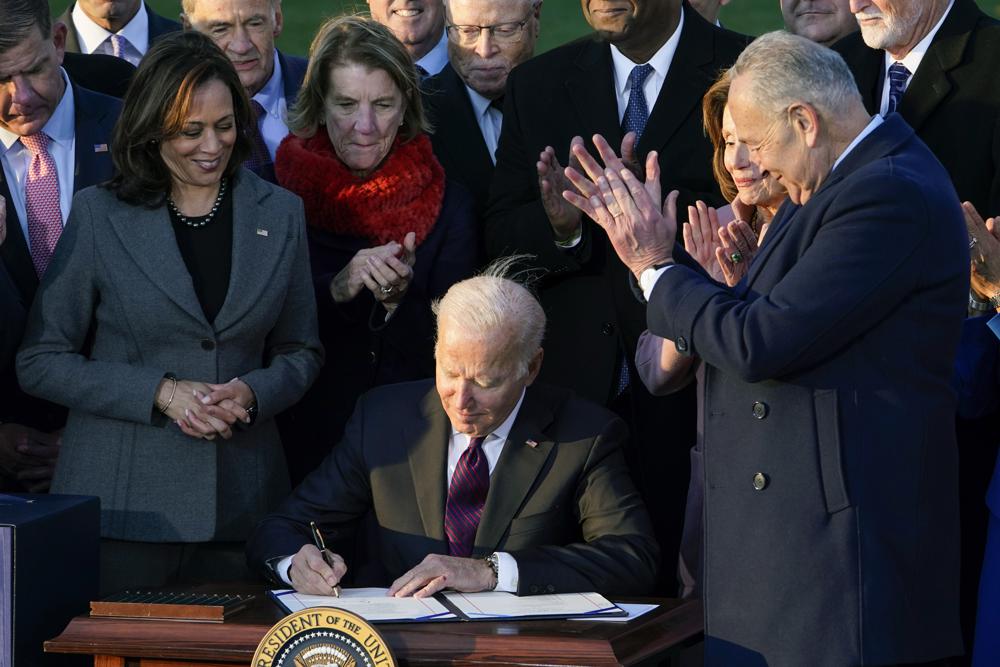
President Joe Biden signed his hard-fought $1 trillion infrastructure deal into law Monday before a bipartisan, celebratory crowd on the White House lawn, declaring that the new infusion of cash for roads, bridges, ports, and more is going to make life “change for the better” for the American people. But prospects are tougher for further bipartisanship ahead of the 2022 midterm elections as Biden pivots back to more difficult negotiations over his broader $1.85 trillion social spending package. The president hopes to use the infrastructure law to build back his popularity, which has taken a hit amid rising inflation and the inability to fully shake the public health and economic risks from COVID-19. “My message to the American people is this: America is moving again and your life is going to change for the better,” he said. With the bipartisan deal, the president had to choose between his promise of fostering national unity and a commitment to transformative change. The final measure whittled down much of his initial vision for infrastructure. Yet the administration hopes to sell the new law as a success that bridged partisan divides and will elevate the country with clean drinking water, high-speed internet, and a shift away from fossil fuels. “Folks, too often in Washington, the reason we didn’t get things done is because we insisted on getting everything we want. Everything,” Biden said. “With this law, we focused on getting things done. I ran for president because the only way to move our country forward in my view was through compromise and consensus.” Biden will get outside Washington to sell the plan more broadly in the coming days. He intends to go to New Hampshire on Tuesday to visit a bridge on the state’s “red list” for repair, and he will go to Detroit on Wednesday for a stop at General Motors’ electric vehicle assembly plant, while other officials also fan out across the country. The president went to the Port of Baltimore last week to highlight how the supply chain investments from the law could limit inflation and strengthen supply chains, a key concern of voters who are dealing with higher prices. “We see this as is an opportunity because we know that the president’s agenda is quite popular,” White House press secretary Jen Psaki said Monday before the signing. The outreach to voters can move “beyond the legislative process to talk about how this is going to help them. And we’re hoping that’s going to have an impact.” Biden held off on signing the hard-fought infrastructure deal after it passed on Nov. 5 until legislators would be back from a congressional recess and could join in a splashy bipartisan event. On Sunday night before the signing, the White House announced Mitch Landrieu, the former New Orleans mayor, would help manage and coordinate the implementation of the infrastructure spending. The gathering Monday on the White House lawn was uniquely upbeat with a brass band and peppy speeches, a contrast to the drama and tensions when the fate of the package was in doubt for several months. The speakers lauded the measure for creating jobs, combating inflation, and responding to the needs of voters. Ohio Sen. Rob Portman, a Republican who helped negotiate the package, celebrated Biden’s willingness to jettison much of his initial proposal to help bring GOP lawmakers on board. Portman even credited former President Donald Trump for raising awareness about infrastructure, even though the loser of the 2020 election voiced intense opposition to the ultimate agreement. “This bipartisan support for this bill comes because it makes sense for our constituents, but the approach from the center out should be the norm, not the exception,” Portman said. The signing included governors and mayors of both parties and labor and business leaders. In addition to House Speaker Nancy Pelosi and Senate Majority Leader Chuck Schumer, the guest list included Republicans such as Louisiana Sen. Bill Cassidy, Maine Sen. Susan Collins, New York Rep. Tom Reed, Alaska Rep. Don Young, and Maryland Gov. Larry Hogan. In order to achieve a bipartisan deal, the president had to cut back his initial ambition to spend $2.3 trillion on infrastructure by more than half. The bill that becomes law on Monday in reality includes about $550 billion in new spending over 10 years, since some of the expenditures in the package were already planned. The agreement ultimately got support from 19 Senate Republicans, including Senate GOP leader Mitch McConnell. Thirteen House Republicans also voted for the infrastructure bill. An angry Trump issued a statement attacking “Old Crow” McConnell and other Republicans for cooperating on “a terrible Democrat Socialist Infrastructure Plan.” McConnell said the country “desperately needs” the new infrastructure money, but he skipped Monday’s signing ceremony, telling WHAS radio in Louisville, Kentucky, that he had “other things” to do. Historians, economists, and engineers interviewed by The Associated Press welcomed Biden’s efforts. But they stressed that $1 trillion was not nearly enough to overcome the government’s failure for decades to maintain and upgrade the country’s infrastructure. The politics essentially forced a trade-off in terms of potential impact not just on the climate but on the ability to outpace the rest of the world this century and remain the dominant economic power. “We’ve got to be sober here about what our infrastructure gap is in terms of a level of investment and go into this eyes wide open, that this is not going to solve our infrastructure problems across the nation,” said David Van Slyke, dean of the Maxwell School of Citizenship and Public Affairs at Syracuse University. Biden also tried unsuccessfully to tie the infrastructure package to the passage of a broader package of $1.85 trillion in proposed spending on families, health care, and a shift to renewable energy that could help address climate change. That measure has yet to gain sufficient support from the narrow Democratic majorities in the Senate and House. Biden continues to work to appease Democratic skeptics of the broader package such as
Joe Biden urges bill over ‘finish line’ as Dems eye new surtax
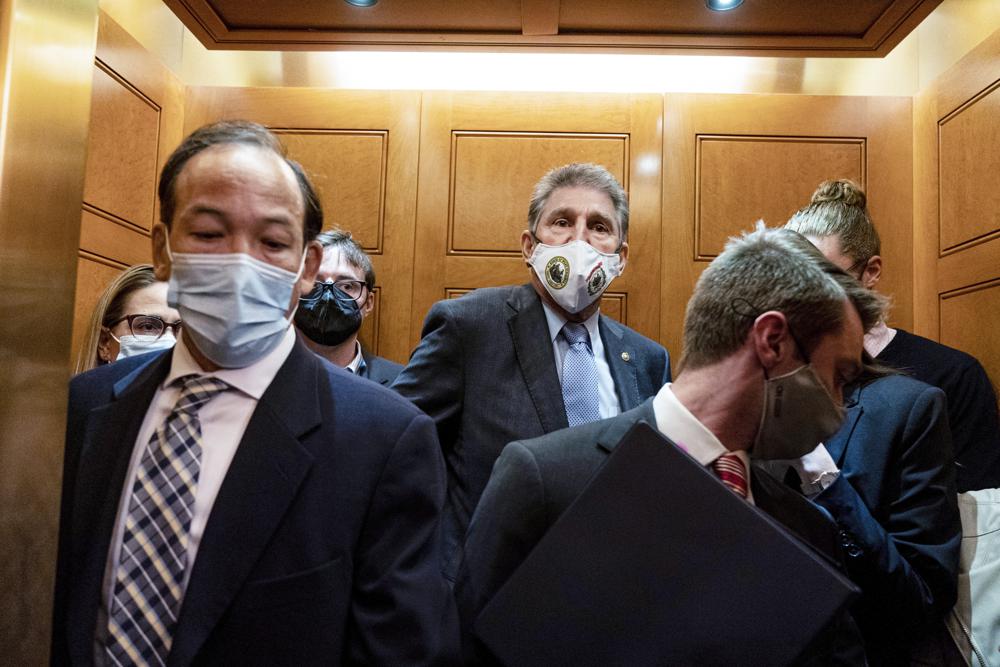
With his signature domestic initiative at stake, President Joe Biden is urging Democrats to wrap up talks and bring the social services and climate change bill “over the finish line” before he departs Thursday for global summits overseas. Top Democratic leaders are signaling a deal is within reach even though momentum fizzled and tempers flared late Wednesday after a billionaires’ tax and a paid family leave program fell out of the Democrats’ sweeping bill, mostly to satisfy a pivotal senator in the 50-50 Senate. But expanded health care programs, free pre-kindergarten, and some $500 billion to tackle climate change remain in the mix in what’s now at least a $1.75 trillion package. And Democrats are eyeing a new surcharge on the wealthy — 5% on incomes above $10 million and an additional 3% on those beyond $25 million — to help pay for it, according to a person who requested anonymity to discuss the private talks. “They’re all within our reach. Let’s bring these bills over the finish line.” Biden tweeted late Wednesday. Biden could yet visit Capitol Hill before traveling abroad, and House Democrats were set to meet in the morning. Besides pressing for important party priorities, the president was hoping to show foreign leaders the U.S. was getting things done under his administration. The administration is assessing the situation “hour by hour,” White House press secretary Jen Psaki said. It was a fast-moving day on Capitol Hill that started upbeat as House Speaker Nancy Pelosi declared that Democrats were in “pretty good shape.” But hopes quickly faded as Biden’s big proposal ran into stubborn new setbacks, chief among them how to pay for it all. A just-proposed tax on billionaires could be scrapped after Democratic Sen. Joe Manchin of West Virginia objected, according to a senior party aide, who requested anonymity to discuss the private talks. The billionaires’ tax proposal had been designed to win over another Democratic holdout, Sen. Kyrsten Sinema of Arizona, but Manchin panned it as unfairly targeting the wealthy, leaving Democrats at odds. “People in the stratosphere, rather than trying to penalize, we ought to be pleased that this country is able to produce the wealth,” Manchin told reporters. Manchin said he prefers a minimum 15% flat “patriotic tax” to ensure the wealthiest Americans don’t skip out on paying any taxes. Nevertheless, he said: “We need to move forward.” Next to fall was a proposed paid family leave program that was already being chiseled back from 12 to four weeks to satisfy Manchin. But with his objections, it was unlikely to be included in the bill, the person said. Sen. Kirsten Gillibrand, D-N.Y., had devised several new options for Manchin’s review and told reporters late in the evening, “It’s not over until it’s over.” Together, Manchin’s and Sinema’s objections packed a one-two punch, throwing Biden’s overall plan into flux, halving what had been a $3.5 trillion package, and infuriating colleagues along the way. In the evenly divided Senate, Biden needs all Democrats’ support with no votes to spare. White House officials met at the Capitol with Manchin and Sinema, two senators who now hold enormous power, essentially deciding whether or not Biden will be able to deliver on the Democrats’ major campaign promises. “Making progress,” Sinema said as she dashed into an elevator. A Sunday deadline loomed for approving a smaller, bipartisan roads-and-bridges infrastructure bill or risk allowing funds for routine transportation programs to expire. But that $1 trillion bill has been held up by progressive lawmakers who are refusing to give their support without the bigger Biden deal. Despite a series of deadlines, Democrats have been unable to close the deal among themselves, and Republicans overwhelmingly oppose the package. At best, Democrats could potentially reach a framework Thursday that could send Biden overseas with a deal in hand and unlock the process while the final details were sewn up. Applying pressure, Pelosi announced a Thursday committee hearing to spur the Biden package along toward a full House vote, though the timing remained uncertain. Democrats had hoped the unveiling of the billionaires tax Wednesday could help resolve the revenue side of the equation after Sinema rejected the party’s earlier idea of reversing Donald Trump-era tax breaks on corporations and the wealthy, those earning more than $400,000. The new billionaires’ proposal would tax the gains of those with more than $1 billion in assets or incomes of more than $100 million over three consecutive years — fewer than 800 people — requiring them to pay taxes on the gains of stocks and other tradeable assets, rather than waiting until holdings are sold. The billionaires’ tax rate would align with the capital gains rate, now 23.8%. Democrats have said it could raise $200 billion in revenue that could help fund Biden’s package over ten years. Republicans have derided the billionaires’ tax as “harebrained,” and some have suggested it would face a legal challenge. But Democratic Sen. Ron Wyden of Oregon, chairman of the Senate Finance Committee, insisted the billionaires tax remains on the table. “I’ve not heard a single United States senator — not one — get up and say, ‘Gee, I think it’s just fun that billionaires pay little or nothing for years on end,’” Wyden said. More likely in the mix was the companion proposal, a new 15% corporate minimum tax, as well as the new surtax being proposed on higher incomes above $10 million. Together they are designed to fulfill Biden’s desire for the wealthy and big business to pay their “fair share.” They also fit his promise that no new taxes hit those earning less than $400,000 a year, or $450,000 for couples. Biden wants his package fully paid for without piling on debt. Resolving the revenue side has been crucial, as lawmakers figure out how much money will be available to spend on the new health, child care, and climate change programs in Biden’s big plan. Among Democrats, Rep. Richard Neal of Massachusetts, the chairman of the Ways and Means Committee, said he told Wyden
Alabama lawmakers OK plan to build prisons with virus cash

Amid a national debate over the use of pandemic relief funds, Alabama lawmakers swiftly approved a plan Friday to tap $400 million from the American Rescue Plan to help build two super-size prisons, brushing off criticism from congressional Democrats that the money was not intended for such projects. The Alabama Legislature gave final approval to the $1.3 billion prison construction plan, and to a separate bill to steer $400 million of the state’s $2.1 billion from the rescue funds to pay for it. With legislative leaders standing behind her, Alabama Gov. Kay Ivey signed the bills into law soon afterward. The Republican called the construction plan “a major step forward” for the prison system, which faces various federal court orders and a lawsuit from the U.S. Department of Justice. “This is a pivotal moment for the trajectory of our state’s criminal justice system,” Ivey said. President Joe Biden’s sweeping $1.9 trillion COVID-19 rescue package was signed in March, providing a stream of funds to states and cities to recover from the coronavirus pandemic. Alabama’s plan to use almost 20% of its American Rescue funds for prison construction drew criticism from some congressional Democrats, including U.S. Rep. Terri Sewell of Alabama, who argued that was not the intent of the relief program. But state Republicans argued that the expenditure addresses a public safety need and is allowed under a provision to replace lost revenue and shore up state services. Republican Sen. Greg Albritton said the funds will “go a long way” to addressing the state’s longstanding problems in prisons. “This was the right thing for Alabama to do. We’ve got crumbling infrastructure. We’ve got people housed in places that are filthy. We’ve got individuals working in conditions that are unsafe,” Albritton said. The plan drew opposition from many Democrats in the House of Representatives but had minimal dissenting votes in the state Senate, where senators approved the use of the pandemic money in a 30-1 vote and the overall construction plan in a 29-2 vote. Democratic Rep. Juandalynn Givan of Birmingham, who voted against the bills in the House, said she hopes the federal government steps in and tells the state the expenditure is not allowed. “There are many needs here in the state of Alabama and there are many people who need these funds,” she said. “But they (Republicans) saw an opportunity to take the Biden money, that $400 million, because it was just like liquid water flowing through their hands and say, ‘OK, let’s jump on it,’” Givan said. U.S. House Judiciary Committee Chairman Jerrold Nadler of New York this week sent a letter to Treasury Department Secretary Janet Yellen asking her to “prevent the misuse of ARP funding by any state, including Alabama” to build prisons. Asked Wednesday about Alabama’s plan, White House press secretary Jen Psaki said, “I would be surprised if that was the intention of the funding.” Republican legislative leaders said they are comfortable they can legally use the funds because the American Rescue Plan, in addition to authorizing the dollars for economic and health care programs, says states can use the money to replace revenue lost during the pandemic to strengthen support for vital public services and help retain jobs. The U.S. Department of Justice has sued Alabama over a prison system “riddled with prisoner-on-prisoner and guard-on-prisoner violence.” The Justice Department noted in an earlier report that dilapidated facilities were a contributing factor to the unconstitutional conditions but wrote “new facilities alone will not resolve” the matter because of problems in culture, management deficiencies, corruption, violence, and other problems. The Alabama prison construction proposal calls for three new prisons — a prison in Elmore County with at least 4,000 beds and enhanced space for medical and mental health care needs; another prison with at least 4,000 beds in Escambia County and a women’s prison — as well as renovations to existing facilities. Six current facilities would close. The package of approved bills includes modest reform measures: The state will purchase a vacant private prison and use it to house parole violators — instead of sending them back to prison — and provide rehabilitation programs there to try to combat recidivism. Corrections Commissioner Jeff Dunn said the construction plan was both the “right thing to do” and would help the state “with respect to DOJ, with the other litigation.” Advocacy groups argued the state needed to take on broader reforms. “The Alabama Legislature has proved its determination to spend $400 million of American Rescue Plan funds to build two mega-prisons when we have one of the highest COVID death rates in the world,” said Katie Glenn, policy associate at the SPLC Action Fund, an arm of the Southern Poverty Law Center. “It won’t solve the problems plaguing the prison system, only decarceration can do that.” Republished with the permission of the Associated Press.
