
Case seeking to bar Donald Trump from 2024 ballot appealed to Colorado Supreme Court

Chase Woodruff, Alabama Reflector November 21, 2023 This story was originally published on Colorado Newsline. The widely anticipated next phase of a challenge to former President Donald Trump’s constitutional eligibility to seek office again began on Monday with separate appeals filed by Trump and the plaintiffs who brought the case to the Colorado Supreme Court. A Denver District Court judge ruled last week that Trump should be placed on Colorado’s March presidential primary ballot, rejecting a lawsuit filed by six Colorado voters who argue that the Republican frontrunner is disqualified from office under a Civil War-era insurrection clause. Although Judge Sarah B. Wallace ruled that Trump “engaged in insurrection” within the meaning of Section 3 of the 14th Amendment — which prohibits anyone who did so after taking an oath to support the Constitution from holding office again — she held that the clause does not apply to the presidency. Wallace’s order instructed Secretary of State Jena Griswold, a Democrat, to place Trump on the ballot when certifying the list of primary candidates on Jan. 5. The ruling drew an appeal first from Trump’s attorneys, who wrote that while they were satisfied with the outcome, Wallace’s opinion also contained “multiple grave jurisdictional and legal errors,” including her finding that Trump “incited an insurrection on Jan. 6, 2021.” “President Trump seeks review to ensure that if this Court takes up this case on appeal, it will consider the full scope of the constitutional, interpretive, and evidentiary issues,” Trump’s attorneys wrote to the Colorado Supreme Court, listing eleven different legal issues they want the state’s highest court to consider. The list of issues revives many of the arguments Trump’s team made during a five-day trial in district court earlier this month, including questioning the definitions of “insurrection” and “engaging” under Section 3, disputing the secretary of state’s authority to disqualify candidates under the clause and attempts to discredit the investigation into the Jan. 6 attack on the Capitol conducted by a select U.S. House of Representatives committee. Plaintiffs in the case, backed by the nonprofit Citizens for Responsibility and Ethics in Washington, filed their own appeal late on Monday, calling the finding that Section 3 does not apply to the presidency “nonsensical.” That theory was first put forward in 2021 by two conservative law professors, Josh Blackman and Seth Tillman, who argue that the section’s reference to “an officer of the United States” does not include the president. Gerard Magliocca, a scholar of 19th-century constitutional law, was called as an expert witness by the plaintiffs during this month’s trial and testified that the position taken by Blackman and Tillman “so far is in the minority” among academics who have studied the question. Echoing Magliocca, the plaintiffs’ appeal cited several pieces of historical evidence showing that Section 3, which was ratified in 1868 and aggressively enforced against ex-Confederates for a period of several years, was understood to apply to the president at the time. “Excluding the President and the Presidency from Section 3 would make no sense,” the plaintiffs wrote. “There would be no reason to prohibit insurrectionists from serving as mere presidential electors, and from holding every other office in the land, while allowing them to hold most the powerful and hence most dangerous office. Nor would there be any reason to allow insurrectionist former Presidents to hold office again, while excluding former low-level state officers.” Attempts to bar Trump from the ballot under the 14th Amendment have been rejected by courts in several other states, including Michigan and Minnesota. But CREW and its supporters have sought to portray Wallace’s ruling in Colorado as a victory as they continue to build their case against Trump’s eligibility across the country. “We always knew this case would end up before the Colorado Supreme Court, and have been preparing for that from the beginning,” Noah Bookbinder, CREW’s president, said in a press release Tuesday. “We are planning to build on the trial judge’s incredibly important ruling that Donald Trump engaged in insurrection, and we are ready to take this case as far as necessary to ensure that Donald Trump is removed from the ballot.” Colorado Newsline is part of States Newsroom, a network of news bureaus supported by grants and a coalition of donors as a 501c(3) public charity. Colorado Newsline maintains editorial independence. Follow Colorado Newsline on Facebook and Twitter. Alabama Reflector is part of States Newsroom, a network of news bureaus supported by grants and a coalition of donors as a 501c(3) public charity. Alabama Reflector maintains editorial independence. Follow Alabama Reflector on Facebook and Twitter.
Republicans set to push mail ballots, voting methods they previously blasted as recipes for fraud

After years of criticizing mail voting and so-called ballot harvesting as ripe for fraud, Republicans at the top of the party want to change course. They are poised to launch aggressive get-out-the-vote campaigns for 2024 that employ just those strategies, attempting to match the emphasis on early voting Democrats have used for years to lock in many of their supporters well ahead of Election Day. The goal is to persuade voters who support GOP candidates that early voting techniques are secure and to make sure they are able to return their ballots in time to be counted, thus putting less pressure on Election Day turnout efforts. It marks a notable shift from the party’s rhetoric since 2020 when then-President Donald Trump was routinely sowing doubt about mail voting and encouraging his voters to wait and vote in-person on Election Day. As recently as last year, Republican activists peddling the stolen election narrative were telling GOP voters who received mail ballots to hold onto them and turn them in at their polling place on Election Day rather than use mail or drop boxes. Now Trump is asking donors to chip in for his “ballot harvesting fund” – saying in a fundraising email, “Either we ballot harvest where we can, or you can say goodbye to America!” Republicans say the shift is needed to ensure GOP victories up and down the 2024 ballot, arguing they cannot afford to give Democrats any advantage. At the same time, they acknowledge skepticism from many of their own voters conditioned by false claims of widespread voter fraud from Trump and others. Across the country, Republican-controlled legislatures have acted against early voting — shortening windows for returning mail ballots, banning or limiting the use of drop boxes, and criminalizing third-party ballot collection. In announcing a “Bank Your Vote” initiative for 2024, Republican National Committee Chairwoman Ronna McDaniel said the party “has never said ‘don’t vote early,‘” but acknowledged the GOP will have to work to shift voters’ perceptions. “That certainly is a challenge if you have people in your ecosystem saying, ‘Don’t vote early or don’t vote by mail,’ and those cross messages do have an impact,” McDaniel told reporters Wednesday. “I don’t think you’re seeing that heading into 2024. I think you’re seeing all of us singing from the same songbook.” The nationwide GOP plan emphasizes “in-person early voting, absentee voting, and ballot harvesting where legal,” while also pledging “to fight against bad ballot harvesting laws.” Republicans use the term to describe when someone else returns a mailed ballot on behalf of another voter, especially third parties that gather multiple ballots. McDaniel emphasized she remains opposed to ballot collection, and she said the party would deploy an army of poll watchers and election monitors to reassure Republican voters that their ballots will be protected. “Do I think it’s the most secure way of voting? No,” McDaniel said. “But if it’s the law, we’re going to have to do it just like the Democrats are.” The challenge will be providing a consistent message that reassures GOP voters. The same day McDaniel announced her initiative, Republicans in Congress were holding a hearing considering legislation that, among other things, would ban ballot collection in the District of Columbia. GOP state lawmakers around the country have chipped away at advanced voting opportunities since 2020. Some state and local election Republicans have gone further, advocating for just a single day of voting. After the 2020 presidential election, the movie “2000 Mules” was a popular video that made various debunked claims about mail ballots, drop boxes, and ballot collection. Even the co-chair of the new GOP strategy, U. S. Rep. Byron Donalds, R-Fla., has been a critic. In November, he issued a call on social media to “End ballot harvesting.” Nonetheless, McDaniel noted that Republican presidential candidates, including Trump, have been talking about the importance of advance voting and ballot collection. Florida Gov. Ron DeSantis, a high-profile GOP contender, recently told a voter he planned to launch his own “ballot harvesting” effort, according to video posted online by a Washington Post reporter. DeSantis said he wasn’t going to “fight with one hand tied behind my back.” The Trump and DeSantis campaigns did not respond to messages seeking details about ballot collection plans. Florida is among the mostly Republican-led states that have sought to ban or limit the practice in recent years, despite the GOP’s reliance there on older, more conservative voters who prefer voting methods other than casting Election Day ballots. Since the 2020 election, lawmakers in 31 states have introduced 124 bills that would restrict third-party ballot returns, according to data collected by the Voting Rights Lab, which tracks voting-related legislation in the states. Of those, 14 bills in 11 states have been enacted. That includes one DeSantis himself signed that makes it a felony for an individual to collect more than two mail ballots other than the person’s own or one belonging to an immediate family member. While some states are silent on the issue, 31 states allow someone other than the voter to return a ballot on behalf of another voter. Nine limit how many ballots one person can return, according to the National Conference of State Legislatures. Many states limit ballot handling to a family member, household member, or caregiver. In California, efforts to lock in the early vote could be decisive next year in a string of U.S. House districts, most of them in the southern California suburbs, that are expected to play a pivotal role in determining control of the chamber. California is a Democratic stronghold, but Republicans retain pockets of strength across rural and small-town areas and the Central Valley farm belt, while the state’s suburban congressional districts have yielded many tight races in recent election cycles. As many as nine congressional seats are considered competitive, and several races will play out in districts won by President Joe Biden but where the seat is held by a Republican. Each of California’s 22 million registered voters is mailed a ballot one month before Election Day. “In any close election, the ability to capture absentee votes becomes extremely important, especially in a
Donald Trump admits he’s blocking postal cash to stop mail-in votes
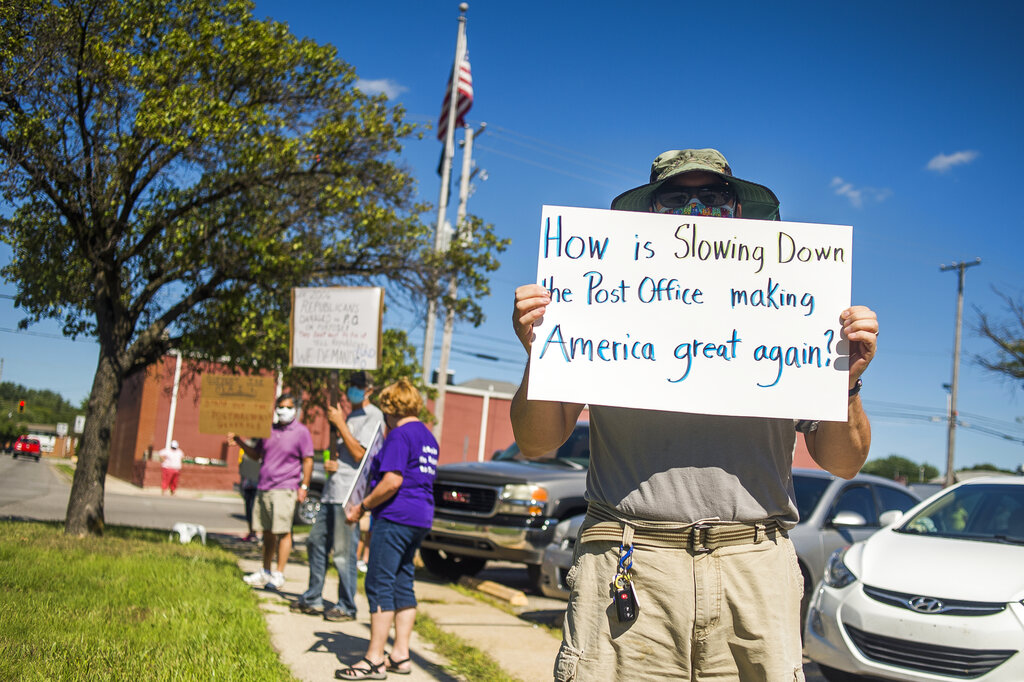
Trump’s statements, including the false claim that Democrats are seeking universal mail-in voting, come as he is searching for a strategy to gain an advantage in his November matchup against Joe Biden.
Public, election offices may be kept in the dark on hacks

If the FBI discovers that foreign hackers have infiltrated the networks of your county election office, you may not find out about it until after voting is over. And your governor and other state officials may be kept in the dark, too. There’s no federal law compelling state and local governments to share information when an electoral system is hacked. And a federal policy keeps details secret by shielding the identity of all cyber victims regardless of whether election systems are involved. Election officials are in a difficult spot: If someone else’s voting system is targeted, they want to know exactly what happened so they can protect their own system. Yet when their own systems are targeted, they may be cautious about disclosing details. They must balance the need for openness with worries over undermining any criminal investigation. And they want to avoid chaos or confusion, the kind of disruption that hackers want.The secrecy surrounding foreign hacks is not a hypothetical issue. The public still doesn’t know which Florida counties were breached by Russian agents in the 2016 election. Rick Scott, Florida’s governor in 2016 and now a U.S. senator, was not told at the time and didn’t learn most of the details until this year. And the threat to electoral systems is real. Federal officials believe Russian agents in 2016 searched for vulnerabilities within election systems in all 50 states. And the nation’s intelligence chiefs warn that Russia and other nations remain interested in interfering in U.S. elections. Meanwhile, experts worry the White House hasn’t highlighted the threat as President Donald Trump argues it’s OK for foreign countries to provide damaging information on his political rivals, a matter now the subject of an impeachment inquiry led by House Democrats. In general, it’s up to electoral agencies to disclose when they’ve been hacked. That, plus the federal policy protecting the identity of cyber victims, could mean that state election officials might not be told immediately if one of their local election offices experiences a breach. In addition, the whole situation could be considered classified as part of a federal investigation. At least two states — Colorado and Iowa — have implemented policies to compel local officials to notify the state about suspected breaches involving election systems. “Every American in this nation deserves to have a democracy they can believe in, and when there is not good communication on cyber incidents … it does create a lack of confidence in the system,” said Colorado Secretary of State Jena Griswold. “Luckily we have been able to work around the void of federal policy that has been leaving our nation in a precarious spot.” But Department of Homeland Security officials say privacy is needed to ensure that officials come forward and share valuable threat information, such as suspect IP addresses. Some election officials could be hesitant about public disclosures, concerned their agencies would be portrayed in a negative light. They could opt to handle any breach alone. That could create dangerous delays in sharing information, said Jeanette Manfra, assistant director for cybersecurity at Homeland Security’s new cyber agency. Homeland Security acts as the middleman between the intelligence community and the states. In general, communication and coordination on election security have improved in the last two years. “We’ve worked over the years to be able to declassify even more and to do it faster,” Manfra said. “It’s still not a perfect process.” Due to the criminal nature of cyber breaches, law enforcement officials may seek to withhold releasing certain information long after the incident. When Florida’s current governor, Ron DeSantis, was briefed this year on the 2016 cyber breaches, he said he signed an agreement preventing him from identifying the affected counties. The secrecy surrounding Florida helped spur bipartisan legislation that would compel reporting among federal, state and local officials and to voters potentially affected by a breach. Rep. Stephanie Murphy, a Florida Democrat, co-sponsor of the bill, said she believes voters are the victims, not the election office, and that not disclosing information about election-related breaches could undermine public confidence. In June, a majority of Americans expressed at least some concern that voting systems are vulnerable to hackers, according to a poll from The Associated Press-NORC Center for Public Affairs Research. “It’s hard for me to assess if what people are doing in response is sufficient when I don’t know the full scope of the problem,” Murphy said. “And I think that’s the same issue with voters: How can they feel comfortable or confident that this next election will be free and fair?” Yet election officials want to ensure they have a good understanding of what happened before going public so they don’t contribute to the confusion that the hackers may be trying to achieve. Cyber intrusions are inherently complicated, taking time to understand and contain. There is also a concern of inadvertently releasing information that could invite further compromises or undermine an investigation. “It is important to be as transparent as possible, but as with any crime, the full details of an investigation are not discussed,” said Paul Pate, Iowa’s Republican secretary of state. “It’s a balancing act that needs to be measured on a case-by-case basis.” In 2017, California election officials quickly disclosed the state had been notified by federal officials that its election systems were among those scanned by Russians the year before. Five days later, they had to correct the announcement after discovering the scans involved a non-election system. Secretary of State Alex Padilla, a Democrat, said it was an important lesson in making sure all the facts were there, especially considering the public is not familiar with cybersecurity terminology. In the summer of 2016, hackers accessed Illinois’ voter registration database, and officials moved fast to shut down the system and isolate the threat. State officials knew the move wouldn’t go unnoticed and felt it was important to notify the public. It became clear only later that Russian agents were involved, and the breach was part of an
