
Mike Rogers: Ukraine war and nuclear threats from Russia show “how valuable NATO cohesion is”

U.S. Representative Mike Rogers, the House Armed Services Committee Chairman, recently participated in a bipartisan briefing with NATO Secretary General Jens Stoltenberg. Following the briefing, Chairman Rogers said that “Stoltenberg assured me of NATO’s continued cooperation” to aid Ukraine in its efforts to thwart a Russian invasion. “NATO is the most successful alliance of modern times,” Rogers said. “The alliance stood together to defeat communism and win the Cold War, and our NATO allies stood with us after the September 11th terrorist attacks. Today, however, the alliance is being tested like never before. [Vladimir] Putin’s war in Ukraine and dangerous threats of nuclear first use against our allies and partners have proven how valuable NATO cohesion is,” Rogers stated. “Secretary General Stoltenberg assured me of NATO’s continued cooperation and support of our robust oversight efforts of aid for Ukraine. I thank the Secretary General for his leadership in supporting Ukraine, bringing Finland and Sweden into NATO, and increasing defense spending across the alliance. The Secretary General also highlighted the need for NATO to adapt to counter the threat posed by the Chinese Communist Party. For too long, Europe tried to engage Russia and became economically dependent on Vladimir Putin for cheap energy. We need to ensure European mistakes with Russia are not repeated with China.” The Chinese balloon that drifted across the United States last week until it was shot down has drawn international attention to China. That balloon was one of several balloons that the Chinese have launched over five continents. The balloons are widely believed to be gathering intelligence for the Chinese military. China has denied that and said that the balloons are civilian weather balloons. “The balloon over the United States confirms a pattern of Chinese behavior where we see that China has invested heavily in new capabilities, including different types of surveillance and intelligence platforms,” Stoltenberg said during a press conference in Washington with U.S. Secretary of State Antony Blinken. “We need to be aware of the constant risk of Chinese intelligence and step up what we do to protect ourselves and react in a prudent and responsible way.” “It is attempting to assert control over the South China Sea and threatening Taiwan, trying to take control of critical infrastructure, including in NATO countries, repressing its own citizens and trampling on human rights and deepening its strategic partnership with Moscow,” Stoltenberg continued. “So NATO allies have real concerns which we discuss today.” In the Russia v. Ukraine war, Putin has called up several hundred thousand reservists and is believed to be about to launch a massive offensive against the Ukrainians. Due to this threat, the U.S. and its NATO allies have pledged western tanks – including the M1A1 Abrams, Leopard 1s and 2s, and Challenger 2s – to aid the Ukrainians. “Ukrainians have proven extremely skilled and capable in operating the equipment, the weapons that NATO allies and partners has provided,” Stoltenberg told CNN. “I am absolutely certain that they will be able to do the same also with the main battle tanks from NATO allied countries, especially because many of them have a lot of experience already from the front lines operating Soviet-era armored vehicles and battle tanks. But, of course, that is a useful background when they start then training on modern NATO battle tanks. We have to remember that this is a war of aggression. President Putin invading another sovereign independent nation in Europe – Ukraine. Ukraine has a right of self-defense, and we have the right to support them in upholding that right; because if President Putin wins, it is challenging for Ukraine and dangerous for us.” Stoltenberg is the Prime Minister of Norway. Rogers was recently elected to his eleventh term representing Alabama’s Third Congressional District. To connect with the author of this story or to comment, email brandonmreporter@gmail.com.
West works to deepen sanctions after Vladimir Putin heightens threats
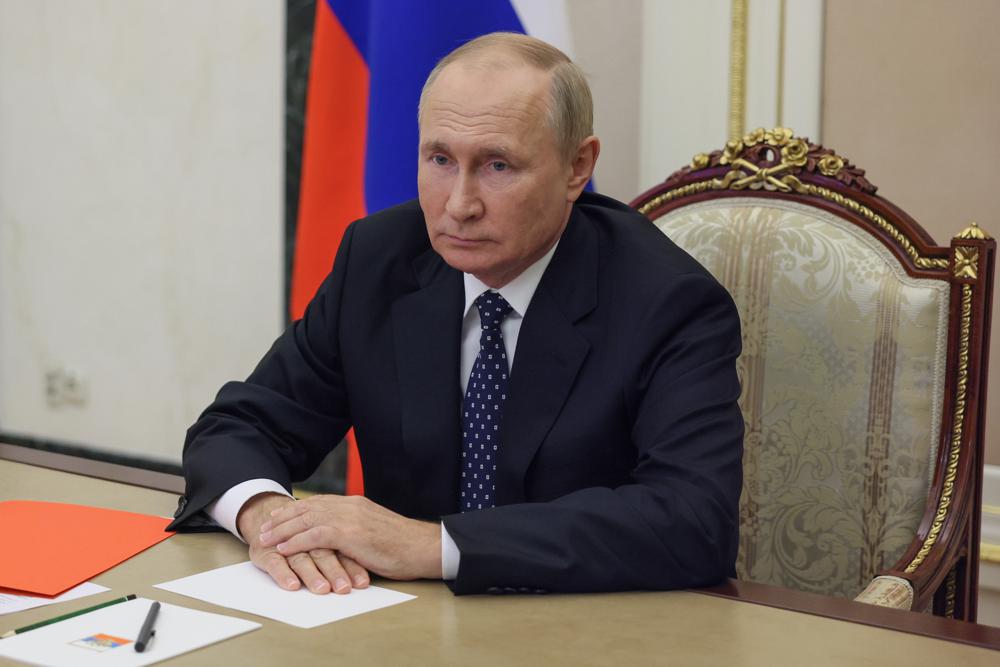
How do American leaders and their allies intend to respond if President Vladimir Putin seeks to escalate his way out of a bad situation on Ukraine’s battlefields and makes good on renewed threats of annexing territory or even using nuclear weapons? At least to start with, by trying to double down on the same tactics that have helped put Russia in a corner in Ukraine, U.S. and European leaders have made clear: more financial penalties and international isolation for Russia, more arms, and other backing for Ukraine. That won’t necessarily be easy. It’s been tough enough staying the current course of persuading all of dozens of allies to stick with sanctions and isolation for Putin and persuading more ambivalent countries to join in. Global financial and energy disruptions from Russia’s war in Ukraine already promise to make the coming winter a tough one for countries that have depended on Russia for their energy needs. And there’s no sign of U.S. or NATO officials matching Putin’s renewed nuclear threats with the same nuclear bluster, which in itself might raise the risks of escalating the conflict to an unimaginable level. Even if Putin should act on his nuclear threat, President Joe Biden and others point, without details, to an ascending scale of carefully calibrated responses based on how far Russia goes. To start with, “they’ll become more of a pariah in the world than they ever have been,” Biden told CBS’ “60 Minutes” just before Putin’s new wartime measures and renewed nuclear threat. “What they do will determine what response would occur,” Biden said on the nuclear side, adding that the U.S. responses, in that case, would be “consequential.” “I do not believe the United States would take an escalatory step” in the event of a one-off, limited nuclear detonation by Russia aimed at trying to scare Ukraine and its supporters off, said Rose Gottemoeller, former deputy NATO secretary-general and former U.S. undersecretary of state for arms control. “Certainly, it would not respond with nuclear weapons.” Putin this week pledged to use “all available means” to stave off any challenges as Russia moves to summarily claim more Ukrainian territory despite heavy losses on the battlefield to NATO-armed Ukrainian forces. In case NATO missed the point, another senior Russian political figure specified the next day that included nuclear weapons. Putin also mobilized Russian fighters to throw into the seven-month invasion of Ukraine and announced votes in parts of Ukraine that the West says are meant to provide political cover for illegally absorbing those regions into Russia. U.S. and European Union officials say new sanctions are in the works in response to Putin’s latest moves. “Russia, its political leadership, and all those involved in organizing these ‘referenda’ as well as in other violations of international law and international humanitarian law in Ukraine will be held accountable,” E.U. foreign policy chief Josep Borrell pledged this week on the sidelines of the U.N. General Assembly in New York. But political declarations are the easy part. It’s unclear what type of measures can be agreed upon, as the financial punishments against Russia are also increasingly inflicting pain on other European economies weighed down by high electricity and natural gas prices and spiraling inflation. Hungary has led resistance to sanctions that might hit supplies from Russia, but it isn’t alone in hesitating. New sanctions may come only after much debate and hand-wringing among the 27 E.U. member countries in the coming weeks, probably only after Russia has held its referendums. The last round of sanctions over Russia’s invasion of Ukraine was announced on May 4 but only agreed on four weeks later, as concerns over oil divided member countries. Rather than a new set of sanctions, a “maintenance and alignment” package was sealed in July, mostly to close loopholes on measures already agreed upon. Pressed by reporters in New York for details about what might be coming, Borrell said the sanctions would target “new areas of the Russian economy, especially — if I can be a little more concrete — the technological ones.” ADVERTISEMENT Ursula von der Leyen, who heads the E.U.’s executive branch — the European Commission — which has been responsible for drawing up most of the sanctions, also appeared resolute, but she was hardly more forthcoming. “We stand ready to impose further economic costs on Russia and on individuals and entities inside and outside of Russia who support (the war), politically or economically. Plus, we will propose additional export controls on civilian technology as Russia moves to a full war economy,” she told CNN. Beyond the economic sanctions, the E.U., since Russia’s February invasion of Ukraine, has slapped asset freezes and travel bans on more than 1,200 Russians, including Putin, Russia’s foreign minister, and other senior officials. Militarily, Secretary-General Jens Stoltenberg said this month that NATO is working with the defense industry to explore ways to boost arms production to better meet Ukraine’s needs and replenish the arsenals of allies who have been providing weapons and defense systems. “We saw that during the COVID crisis, the industry was able to ramp up production of vaccines, and now we need to have, to some extent, the same approach: ramp up quickly production of weapons and ammunition,” he told The Associated Press. The U.S., as a matter of policy maintains ambiguity about how it would respond to any use of nuclear weapons in the conflict. Such a use would return the world to nuclear war for the first time since the U.S. dropped bombs on Hiroshima and Nagasaki in 1945, and risk escalation on a scale the world has never seen. But U.S. officials’ public comments on the matter this month are in line with expectations from arms experts that Washington’s response would be a graduated one based on the gravity of Russia’s nuclear use. A one-off and comparatively limited Russian nuclear use would deepen Russia’s isolation internationally, but might not necessarily draw an immediate Western nuclear use in kind. It’s difficult to fathom Putin launching any central strategic nuclear strike at
Joe Biden pledges new Ukraine aid, warns Russia on chemical weapons

President Joe Biden and Western allies pledged new sanctions and humanitarian aid on Thursday in response to Vladimir Putin’s assault on Ukraine, but their offers fell short of the more robust military assistance that President Volodymyr Zelenskyy pleaded for in a pair of live-video appearances. Biden also announced the U.S. would welcome up to 100,000 Ukrainian refugees — though he said many probably prefer to stay closer to home — and provide an additional $1 billion in food, medicine, water, and other supplies. The Western leaders spent Thursday crafting next steps to counter Russia’s month-old invasion — and huddling over how they might respond should Putin deploy chemical, biological, or even a nuclear weapon. They met in a trio of emergency summits that had them shuttling across Brussels for back-to-back-to-back meetings of NATO, the Group of Seven industrialized nations, and the 27-member European Council. Biden, in an early evening news conference after the meetings, warned that a chemical attack by Russia “would trigger a response in kind.” “You’re asking whether NATO would cross. We’d make that decision at the time,” Biden said. However, a White House official said later that did not imply any shift in the U.S. position against direct military action in Ukraine. Biden and NATO allies have stressed that the U.S. and NATO would not put troops on the ground in Ukraine. The official was not authorized to comment publicly by name and spoke only on condition of anonymity. Zelenskyy, while thankful for the newly promised help, made clear to the Western allies he needed far more than they’re currently willing to give. “One percent of all your planes, one percent of all your tanks,” Zelenskyy asked members of the NATO alliance. “We can’t just buy those. When we will have all this, it will give us, just like you, 100% security.” Biden said more aid was on its way. But the Western leaders were treading carefully so as not to further escalate the conflict beyond the borders of Ukraine. “NATO has made a choice to support Ukraine in this war without going to war with Russia,” said French President Emmanuel Macron. “Therefore, we have decided to intensify our ongoing work to prevent any escalation and to get organized in case there is an escalation.” Poland and other eastern flank NATO countries are seeking clarity on how the U.S. and European nations can assist in dealing with their growing concerns about Russian aggression as well as the refugee crisis. More than 3.5 million refugees have fled Ukraine in recent weeks, including more than 2 million to Poland. Biden is to visit Rzeszów, Poland, on Friday, where energy and refugee issues are expected to be at the center of talks with President Andrzej Duda. He’ll get a briefing on humanitarian aid efforts to assist fleeing refugees and he’ll meet with U.S. troops from the 82nd Airborne Division who have been deployed in recent weeks to bolster NATO’s eastern flank. Billions of dollars of military hardware have already been provided to Ukraine. A U.S. official, who requested anonymity to discuss internal deliberations, said Western nations were discussing the possibility of providing anti-ship weapons amid concerns that Russia will launch amphibious assaults along the Black Sea coast. Biden said his top priority at Thursday’s meetings was to make certain that the West stayed on the same page in its response to Russian aggression against Ukraine. “The single most important thing is for us to stay unified,” he said. Finland announced Thursday it would send more military equipment to Ukraine, its second shipment in about three weeks. And Belgium announced it will add one billion euros to its defense budget in response to Russia’s invasion. At the same time, Washington will expand its sanctions on Russia, targeting members of the country’s parliament along with defense contractors. The U.S. said it will also work with other Western nations to ensure gold reserves held by Russia’s central bank are subject to existing sanctions. With Russia facing increasing international isolation, NATO Secretary-General Jens Stoltenberg also warned China against coming to Moscow’s rescue. He called on Beijing “to join the rest of the world and clearly condemn the brutal war against Ukraine and not support Russia.” But Stoltenberg, too, made clear that the West had a “responsibility to prevent this conflict from becoming a full-fledged war in Europe.” The possibility that Russia will use chemical or even nuclear weapons has been a grim topic of conversation in Brussels. Stoltenberg said that NATO leaders agreed Thursday to send equipment to Ukraine to help protect it against a chemical weapons attack. White House officials said that both the U.S. and NATO have been working on contingency planning should Russia deploy nonconventional weaponry. NATO has specially trained and equipped forces if there should be such an attack against a member nation’s population, territory, or forces. Ukraine is not a member. Stoltenberg said in an NBC News interview that if Russia deployed chemical weapons, that would make “an unpredictable, dangerous situation even more dangerous and even more unpredictable.” He declined to comment about how the alliance might respond. The White House National Security Council launched efforts days after the invasion through its “Tiger Team,” which is tasked with planning three months out, and a second strategy group working on a longer-term review of any geopolitical shift that may come, according to a senior administration official. The official was not authorized to comment publicly and spoke on the condition of anonymity. Both teams are conducting contingency planning for scenarios including Russia’s potential use of chemical or biological weapons, targeting of U.S. security convoys in the region, disruptions to global food supply chains, and the growing refugee crisis. Biden before departing for Europe on Wednesday said that the possibility of a chemical attack was a “real threat.” In addition, Kremlin spokesman Dmitry Peskov told CNN this week that Russia could consider using its nuclear weapons if it felt there were “an existential threat for our country.” Finland’s Prime Minister Sanna Marin on Thursday warned, “Russia is capable
Donald Trump lectures NATO members on cost sharing

The Latest on President Donald Trump’s first trip abroad (all times local): 4:48 p.m. President Donald Trump is lecturing members of the NATO alliance to pay their fair share on defense during a ceremony at NATO headquarters. Trump says NATO members must “finally contribute their fair share” and meet their obligations. The president has been urging NATO leaders to live up to a 2011 decision to increase spending on defense to 2 percent of gross domestic product by 2024. Trump says 23 of the 28 member nations are not paying what they should and he says it’s “not fair” to the people of the United States. He says many of these nations owe “massive” amounts of money from previous years. The president spoke as the other NATO leaders looked on. ___ 4:41 p.m. President Donald Trump is calling for a moment of silence for the victims of the Manchester concert attack. The president is speaking at a dedication ceremony for a new 9/11 memorial at NATO headquarters in Brussels. He says that “today is a day for both remembrance and resolve” and that the attack demonstrates “the depths of the evil we face with terrorism.” Trump has urged NATO members to spend more money on defense. ___ 4:37 p.m. President Donald Trump is attending a dedication service for two new memorials at NATO headquarters. Trump stood on as German Chancellor Angela Merkel and NATO Secretary-General Jens Stoltenberg unveiled two sections of the Berlin Wall that divided the German city until 1989. The pieces, standing together, form a monument that symbolizes the efforts to end the division of Europe. Trump and Stoltenberg are also unveiling a steel beam from the 107th floor of one of the World Trade Center towers that collapsed on Sept. 11, 2001. It’s a reminder of NATO’s commitment to its collective defense clause — so called Article 5. It has only ever been activated once, after 9/11. ___ 4:35 p.m. President Donald Trump is pledging to “get to the bottom” of leaks of sensitive information. In a written statement Thursday, Trump called recent leaks “deeply troubling.” He said he is asking the Justice Department and other agencies to “launch a complete review of this matter.” Trump adds that “if appropriate, the culprit should be prosecuted to the fullest extent of the law.” Trump’s comments come amid anger from Britain over intelligence leaks and a decision by Manchester police to withhold information from the United States about the investigation into this week’s bombing. British Prime Minister Theresa May has said she will make it clear to Trump that intelligence shared between law enforcement agencies “must remain secure.” ___ 4:20 p.m. President Donald Trump has arrived at NATO headquarters for an afternoon of meetings with fellow world leaders. Trump was greeted by NATO Secretary General Jens Stoltenberg at the organization’s new headquarters in Brussels. Stoltenberg visited the White House last month and touted NATO’s benefits at a joint news conference with Trump. Trump had previously questioned NATO’s relevance. ___ 4:15 p.m. President Donald Trump has done an about-face on NATO, the military alliance he once dismissed as ineffective. Trump says at a White House news conference with NATO Secretary-General Jens Stoltenberg that the organization is “no longer obsolete.” As a candidate, Trump said the 28-member organization had outlived its usefulness. Since taking office, he has expressed support for NATO but has reinforced his view that European members must meet a 2014 agreement for member countries to boost defense spending to 2 percent of gross domestic product within a decade. Just the U.S. and a handful of other countries are meeting the target. Trump says NATO countries will be more secure and the partnership strengthened if other countries pay their fair share and stop relying on the United States. He’s set to participate in a memorial dedication and dinner with other NATO member leaders. ___ 4:04 p.m. British Prime Minister Theresa May says she will press U.S. President Donald Trump on keeping shared intelligence confidential, after leaks from the investigation of the Manchester concert attack. Speaking to reporters upon arrival at a NATO summit in Brussels, May said that the U.S.-British defense and security partnership is built on trust. But she says, “part of that trust is knowing that intelligence can be shared confidently.” She said that when she sees Trump at the summit Thursday she will stress “that intelligence that is shared between law enforcement agencies must remain secure.” She said the Manchester attack shows why it’s important for the international community and NATO to do more about the fight against terrorism. ___ 3:59 p.m. President Donald Trump is on his way to NATO headquarters in Brussels for his first meeting with a group he criticized mercilessly during his campaign. Trump has rattled the group with musings about pulling out of the pact because other countries aren’t dedicating enough money to defense and called the alliance “obsolete.” But he’s softened his stance considerably since taking office in January. Trump is set to deliver remarks at the unveiling of memorials dedicated to the Berlin Wall and one that will serve as a reminder of NATO’s commitment to its collective defense clause — so called Article 5. It has only been activated once, after 9/11. He’ll also attend a working dinner with other member leaders. ___ 3:32 p.m. Several hundred protesters have gathered outside the NATO summit in Brussels to demonstrate against NATO and U.S. President Donald Trump. The group was tiny compared to the 10,000 demonstrators who came out Wednesday to protest Trump’s visit. But the summit won’t start until late afternoon, so the crowds could still swell. Security officials have cordoned off a large protest zone outside NATO headquarters. Protesters there are holding banners that say “NATO game over” and “peace.” At one point, some 50 demonstrators tried to block a road using banners. Stephanie Demblon of the “Agir pour la paix” pacifist group says Trump “makes people scared” and says he’s “shown over the past months that
Mike Pence tries to reassure anxious Europeans on U.S. support
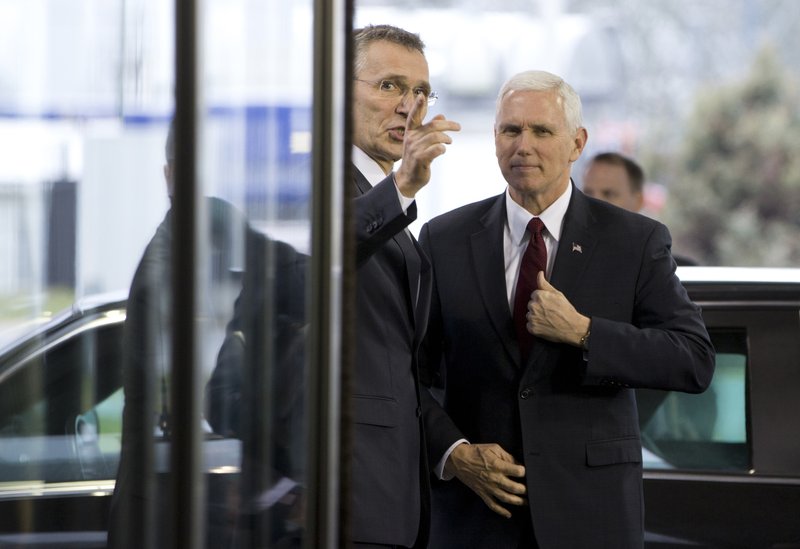
U.S. Vice President Mike Pence moved Monday to assuage European Union fears about the strength of Washington’s support for the union and its commitment to European security through the NATO military alliance. During meetings in Brussels, Pence said he was acting on behalf of President Donald Trump “to express the strong commitment of the United States to continued cooperation and partnership with the European Union.” “Whatever our differences, our two continents share the same heritage, the same values and above all the same purpose: to promote peace and prosperity through freedom, democracy and the rule of law,” he told reporters after talks with EU Council President Donald Tusk. Trump’s benevolence toward Russian President Vladimir Putin and campaign rhetoric that included branding NATO obsolete and vowing to undo a series of multinational trade deals has sparked anxiety in Europe. Trump was also supportive of Britain’s vote last year to leave the 28-nation EU, a withdrawal known as Brexit. And he has suggested that the EU itself could soon fall apart. Tusk, who chairs meetings of EU leaders, said he had been reassured after “open and frank talks” with Pence, but made clear that the bloc would watch closely to ensure the U.S. acts on its words of support. “I heard words which are promising for the future, words which explain a lot about the new approach in Washington,” Tusk said. He underlined that “too many new and sometimes surprising opinions have been voiced over this time about our relations — and our common security — for us to pretend that everything is as it used to be.” “We are counting, as always in the past, on the United States’ wholehearted and unequivocal — let me repeat, unequivocal — support for the idea of a united Europe,” Tusk said. “The world would be a decidedly worse place if Europe were not united.” He asserted: “The idea of NATO is not obsolete, just like the values which lie at its foundation are not obsolete.” Tusk added, “Both Europeans and Americans must simply practice what they preach.” After talks with NATO Secretary General Jens Stoltenberg across town, Pence reiterated the administration’s strong support for the alliance, but warned that Trump wants to see “real progress” by the end of the year on boosting defense spending. NATO leaders agreed in 2014 that alliance members needed to start spending at least 2 percent of their gross domestic product by 2024. Only five nations currently do so: the United States, Britain, Poland, Estonia and Greece. “The truth is many others, including some of our largest allies, still lack a clear and credible path to meet this minimum goal,” Pence said. Asked what the administration would do if allies failed to meet the defense spending target, Pence said, “I don’t know what the answer is to ‘or else,’ but I know that the patience of the American people will not endure forever.” Pence’s meetings in Brussels were aimed at assuring European leaders that his words reflected the views of Trump and would not easily be swept away at the whim of the U.S. president or undermined by statements issued on Twitter. Pence, as he did in an address Saturday at the Munich Security Conference, also said Trump would demand that Russia honor its commitments to end the fighting in Ukraine. “In the interest of peace and in the interest of innocent human lives, we hope and pray that this cease-fire takes hold,” he said. The vice president also noted the “heartbreaking” suicide bombings at the Brussels airport and subway system in March 2016, and said the U.S. would continue to collaborate with EU partners to address safety and combat terrorism. “The United States’ commitment to the European Union is steadfast and enduring,” he said. Republished with permission of The Associated Press.
Head of NATO talks to Donald Trump
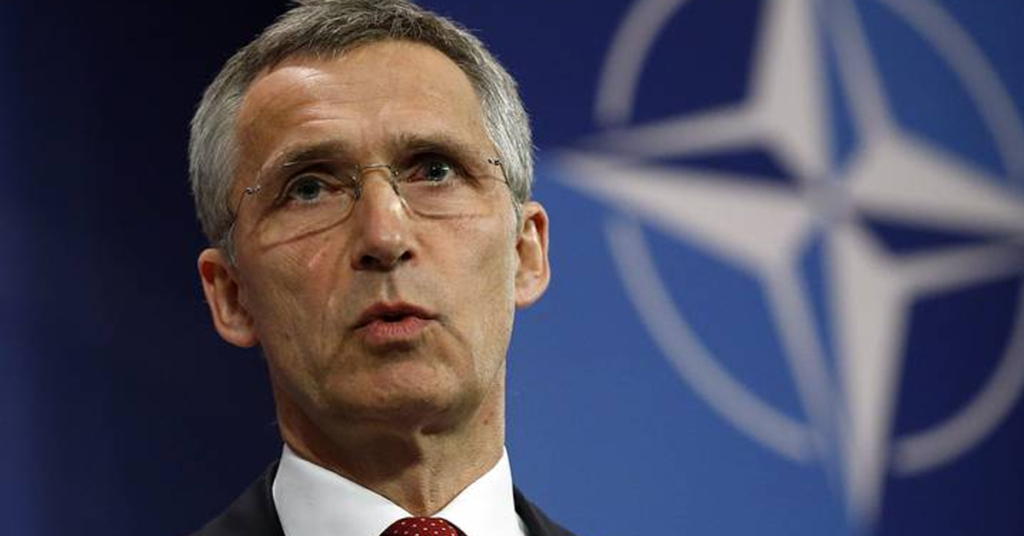
The Latest on President-elect Donald Trump‘s transition activities (all times EST): 2:15 p.m. — NATO says its secretary general, Jens Stoltenberg spoke with President-elect Donald Trump for the first time to congratulate the businessman on his election victory. The military alliance says both leaders agreed during a telephone call on Friday that progress has been made on making sure member countries are sharing the defense burden, but that there is more to do. NATO became a debated part of the presidential election after Trump suggested that the U.S. might abandon its NATO treaty commitments and pull out of the alliance if other countries don’t contribute more. The alliance statement says Stoltenberg looks forward to welcoming Trump to Brussels for next year’s NATO summit. 1:20 p.m. — Texas Sen. Ted Cruz says last week’s election could be called “the revenge of flyover country.” In his speech at the conservative Federalist Society Friday, the Republican senator said the “utter astonishment” of Democrats is a result of not listening to the American people. He said voices were crying, “leave us alone.” Cruz lost the GOP primary to President-elect Donald Trump, and didn’t endorse him until late in the race. Without mentioning Trump by name, Cruz said Republicans should move forward by being honest and trustworthy and remembering they serve a cause greater than themselves. When asked if he might be a candidate for the Supreme Court’s open seat, Cruz said “history is long and can take unexpected paths,” but he looks forward to continuing his time in the Senate. 12:40 p.m. — South Carolina Gov. Nikki Haley says Donald Trump won election as president by running against both political parties. Haley is telling conservative lawyers who are meeting in Washington Friday that Trump’s victory offers Republicans a chance to regain the public’s trust, but only if the party restrains spending and returns power to the states. Haley says voters rejected “the political class of all stripes, Republicans included.” She says now Republican control of the White House and Congress offers the party a rare opportunity, and that it’s important that Trump and Republican leaders in Congress take action quickly and “we don’t stop.” Haley acknowledges that she was not Trump’s “biggest cheerleader.” But she said she voted for him and was thrilled that he won. 12:30 p.m. — Among the people meeting with the president-elect this weekend: the man who marshalled more outside money than anyone else to help Donald Trump win the White House. Todd Ricketts, a co-owner of the Chicago Cubs, helped raise at least $66 million for outside groups called Future 45 and the 45 Committee – a nod the incoming 45th president. Ricketts is emblematic of what a topsy-turvy election it has been. Before helping Trump, Ricketts was part of a super PAC that spent more than any other trying to stop him from winning the Republican nomination. Ricketts lives in Chicago and is a small business owner and board member of TD Ameritrade, which his billionaire father founded. Trump’s team is turning its attention to economic positions in the administration, including the Department of Commerce. 11:55 a.m. — Donald Trump is stoking speculation about his future cabinet picks as he continues holding meetings behind closed doors. Trump aides say the president-elect will be meeting Saturday with retired Marine Corps Gen. James Mattis. Mattis is a potential contender to serve as Trump’s defense secretary. Trump is also meeting with Michelle Rhee and Betsy DeVos, two well-known education activists. Trump aides have cautioned that not everyone meeting with the president-elect is under consideration for an administration position. They say Trump is meeting with experts to hear their thoughts and advice. Also expected to sit down with Trump on Saturday are 2012 GOP nominee Mitt Romney, Chicago Cubs co-owner Todd Ricketts, anti-poverty advocate Bob Woodson, and restaurant executive Andy Puzder. 11:20 a.m. — A Democratic House member says attorney general nominee Jeff Sessions is the right pick “if you have nostalgia for the days when blacks kept quiet, gays were in the closet, immigrants were invisible and women stayed in the kitchen.” Rep. Luis Gutierrez, D-Ill., says no senator has fought harder “against the hopes and aspirations” of Latinos, immigrants and people of color. Gutierrez is a member of the House Judiciary Committee. While the Senate, not the House, will decide if Sessions should be confirmed, the comments by Gutierrez suggest the process will likely be contentious. Sen. Sessions, R-Ala., is one of the more conservative members of the Senate Judiciary Committee and has said the Justice Department’s Civil Rights Division should not be used as a “sword” to promote political agendas. The Senate denied him a federal judgeship in 1986 after he was accused of making racially charged remarks while U.S. attorney in Alabama. 10:50 a.m. — Senate Judiciary Chairman Charles Grassley says he is confident his panel would approve the nomination of Sen. Jeff Sessions as attorney general. Sessions would still face a vote by the full Senate, but a committee endorsement would be a critical first step. Grassley, a Republican from Iowa, says Sessions is a respected colleague who “has worked across the aisle on major legislation.” Grassley added that as a former U.S. attorney, Sessions has the right background. 10:40 a.m. — Mike Pompeo, a conservative Republican congressman from Kansas, says he accepts President-elect Donald Trump’s decision to nominate him to lead the CIA. In a statement on Friday, he said that while he has loved representing Kansans in Congress, the opportunity to lead a top U.S. intelligence agency is a call to service he can’t ignore. Pompeo still must be confirmed by the Senate. The 52-year-old was elected to Congress during the tea party wave of 2010. Pompeo has been a harsh critic of the Obama administration. He denounced the Iran deal, which granted Tehran sanctions relief for rolling back its nuclear weapons program, and was a member of the congressional committee that blasted Hillary Clinton over the attack on a U.S. diplomatic outpost in Libya.
