
Steve Flowers: 1962 governor’s race
It is hard to believe it has been 60 years since George Wallace’s first victorious race for governor. Let’s go down memory lane and reminisce about the 1962 governor’s race and Wallace’s classic inaugural victory. The 1962 governor’s race really began in 1958. The governor’s chair and the race for it was the big show in Alabama politics in that era. Being a U.S. Senator was secondary in Alabama politics. Governor is still probably the most important and glamorous political position, but it certainly was at that time. Television had not come into its own. Most Alabamians did not own a TV. There were no southern major league baseball teams to follow, such as the Atlanta Braves, who were still in Milwaukee at that time. The closest team was the St. Louis Cardinals, and they were miles away and not really in the south. The Grand Ole Opry was only on the radio on Saturday night. So, southerners had to include politics as a prime source of entertainment. That is why we had such colorful political characters. They were really our entertainers and, in some cases, real clowns. Thus, we had more entertaining politicians than the rest of the country. We had a legacy of Jimmy Davis and Huey Long in Louisiana, Bilbo in Mississippi, the Talmadges in Georgia, and the most colorful of all time was our very own 6’9” Big Jim Folsom. Big Jim was the most uninhibited, gregarious, fun-loving of them all. He traveled the state with his country band, the “Strawberry Pickers.” Alabamians thought Big Jim’s barefoot musical antics and down-home soaking the rich speeches spiced with country humor were better than the circus coming to town. Big Jim was first elected governor in 1946. He upset the Big Mules of Birmingham and the Big Planters of the Black Belt to become the first people’s governor in 50 years. All twelve Governors before him had been picked in the closed-door board rooms of Birmingham and had been well-heeled Big Mules or Big Planters and had gone out and given dull speeches and simply bought the election with corporate and large agricultural money. Big Jim went directly to the country people all over the state, and most people in Alabama at that time were rural or lived in small towns. He convinced them that he was their friend. He won their hearts. He became the youngest and most progressive Alabama Governor in history. He was the little man’s big friend. However, the governor could not succeed himself. It was one four year-term, and you were out. So Big Jim left after four years, 1946-1950. A quaint aristocrat named Gordon Persons became governor from 1950-1954, but Big Jim came storming back to win a landslide victory in 1954. He won without a runoff, despite the fact that most of the State’s big daily newspapers endorsed other people and predicted he would lose. He became only the second person to be elected to two terms. Bibb Graves had done it earlier in the century. Big Jim served his second term from 1954-1958, then waited out another four years and was running for his third term in 1962. He was legendary by this time and had almost unanimous name identification as simply “Big Jim,” but he was up against another populist and maybe even better politician, George Wallace. George Wallace had run his first race for governor in 1958 and lost to John Patterson. Patterson had beaten Wallace for two reasons. First was sympathy for Patterson resulting from his daddy’s assassination at the hands of the Phenix City mafia, but primarily because Patterson was the most ardent racist and segregationist. Patterson was the candidate of the Klan, and race was the issue in 1958. Wallace was considered the moderate, but Wallace woke up the day after the defeat and swore he would never be out-segged again. After George Wallace’s loss to John Patterson in 1958, Wallace worked tirelessly for the next four years, 1958-1962, while Patterson served his only term as governor. Wallace made sure he was the racist segregationist candidate in 1962. Race was the only issue in the 1962 Governor’s race. Wallace rode the race issue to his first victory as governor, defeating Big Jim Folsom and State Senator Ryan DeGraffenreid of Tuscaloosa. That 1962 race had an interesting, entertaining, and historical twist to it that I will share with you next week. Steve Flowers is Alabama’s leading political columnist. His weekly column appears in over 60 Alabama newspapers. He served 16 years in the state legislature. Steve may be reached at www.steveflowers.us.
Steve Flowers: TV still drives the vote
After the 1960 John F. Kennedy vs. Richard Nixon classic presidential contest, television became the medium for political campaigns. TV became the new campaign strategy in Alabama in 1962. George Wallace, Big Jim Folsom, and Ryan DeGraffenried used TV that year for the first time. Unfortunately for Big Jim Folsom, his use of TV was the demise of his storied political career. His appearance on a live 30-minute paid television show was one of the most colorful stories in Alabama politics. He came on TV drunk as Cooter Brown. That’s a story for another day. Wallace and Folsom were used to campaigning one-on-one and asking folks for their vote. They stumped and had rallies in every county and hamlet in the state. However, in the end, they succumbed to the politics of TV. It has not changed but has become more pronounced over the last 60 years. This 2022 campaign for our open senate seat is nothing more than a TV show. TV has become such an integral part of getting elected to a U.S. Senate Seat that it appears that what you do now is just raise money or, if you have a lot of your own money, spend your own money and buy and design effective TV ads. The day of actually campaigning appears to be over. The only candidate who made an effort to campaign in every county, shake hands and meet folks was Katie Britt. By the way, she is the only real Alabamian in the race. Katie Britt’s grassroots campaign organization is what propelled her to an incredible commanding lead heading into the June 21 runoff. It looked for a while in our U.S. Senate race that a real outsider, Mike Durant, would be in the June 21 runoff with Katie Britt. However, the original frontrunner, Mo Brooks, clawed back to claim second place. As a lifelong follower of Alabama politics, I long for and yearn for the day when state candidates actually get out and met and talked with Alabamians one on one. Not to sound too provincial or old-fashioned, I believe that a person who wants to be Alabama’s U. S. Senator ought to really know Alabama and the people of the state. They ought to at least know what’s important to folks in our state, from Mobile to Scottsboro and Dothan to Tuscaloosa. They ought to know the intricacies and nuances of places and what industries and federal dollars mean to their locales. They need to know how important military dollars are to Huntsville, Montgomery, and the Wiregrass and also how much agriculture means to rural Alabama. In short, they should know some folks in Alabama if they are going to be their U.S. Senator. With Katie Britt in the runoff, she has truly campaigned and not just been a phantom TV candidate who flew in from New Hampshire or Colorado and tried to buy our Senate Seat and run as a celebrity POW hero. If we want to elect someone to our U.S. Senate Seat who is a celebrity and knows nothing about how to be a U.S. Senator for Alabama, then we have some folks that are qualified and are real celebrities and real Alabamians. We have two who come to mind who are a lot more famous and would be better. They are real Alabamians. Allow me to suggest Lionel Richie and Randy Owen. Lionel Ritchie was born and raised in Tuskegee and spent the first 25 to 30 years of his life in Macon County before he became world-famous. Randy Owen, the legendary lead singer, and founder of the band Alabama has never left his home in Alabama. He is Alabama-born and bred. He still lives in DeKalb County, where he was born. He walks his land and takes care of his prized black angus cattle every day. These two guys are real, sure enough Alabama celebrities and would make a lot better Senator for Alabama than some semi-Alabamian. See you next week. Steve Flowers is Alabama’s leading political columnist. His weekly column appears in over 60 Alabama newspapers. He served 16 years in the state legislature. Steve may be reached at www.steveflowers.us.
Steve Flowers: We miss Shorty Price
The governor’s races of bygone years were a lot more fun and colorful than today. We would have 10 to 15 candidates. There would be three or four favorites, but we would have ten others that would make an effort to crisscross the state and have fun and cut up a little bit to garner publicity. The “also rans” could not afford the expensive country music stars from Nashville like the George Wallace, Big Jim Folsom, and Jimmy Faulkner frontrunners could to draw a crowd. This year’s gubernatorial race has not been interesting because a popular incumbent governor was running for reelection. However, Kay Ivey did attract eight opponents. However, only two, Lindy Blanchard and Tim James, really mounted a campaign. The six others seem to not do anything, and nobody really knew who they were. The six no-name candidates were Stacy Lee George, Dean Young, Dean Odle, Donald Trent Jones, Dave Thomas, and Lew Burdette. When Burdette qualified, he looked like he had the potential to be a viable candidate, but he seemed to never get out of the gate. If he was running a getting acquainted race, it was unsuccessful. He would probably have as much name identification as a baseball player from the 1960s, who had the same name. As a boy, I had a baseball card of Lou Burdette, who was a pretty good pitcher for the old Milwaukee Braves. Donald Trent Jones probably was hoping that folks would think he was the golf course developer for our famous state links. Dave Thomas was maybe hoping that voters would think he was the Wendy’s hamburgers founder. Today, what we need in the “also ran” category or what I call “run for the fun of it” candidates is another Shorty Price. Most of you do not remember Shorty Price. Ole Shorty was the King of run for the fun of it candidates. He ran for governor every time and really didn’t care how many votes he got. He just ran for the fun of it, and boy was he fun to watch and visit with. He brought new meaning to the word colorful. Shorty was a native of Barbour County, which by the way, is George Wallace’s home county. In fact, Wallace and Shorty grew up together as contemporaries around Clio. Shorty would campaign vehemently and viciously against George Wallace, his nemesis, probably because he was jealous of Wallace’s success as a politician. By the way, Barbour County is called the “Home of Governors” because it has had more governors than any other county in our state’s history. Shorty was maybe the most colorful political clown to ever appear on the Alabama political stage. He not only ran for governor every time, he also ran for numerous offices every time there was an election. That is how he would make his living. He would travel from town-to-town, mostly in southeast Alabama, and panhandle for contributions, and soon after collecting the few dollars that folks would give him, he would convert his campaign contributions into a purchase of a Budweiser beer. In fact, one of his campaign slogans was “Smoke Tampa Nugget cigars, drink Budweiser beer, and vote for Shorty Price.” In one of Shorty’s campaigns for governor, his campaign speech contained this line, “If elected governor, I will reduce the governor’s tenure from four years to two years. If you can’t steal enough to last you the rest of your life in two years, you ain’t got enough sense to have the office in the first place.” Shorty would use recycled campaign signs to save money. He would just change the name of the office he was running for that year. Ole Shorty usually got about two percent of the vote and usually finished last. He was really kind of proud of his usual last-place finish. Indeed, one time the venerable political columnist Bob Ingram mistakenly stated that Shorty finished 13th out of 14th in a particular governor’s race. Shorty blasted Ingram and said, “That’s a blasphemous lie. I finished 14th out of 14.” As stated, Shorty hated George Wallace. One year he was one of many candidates running against Wallace. Shorty coined the slogan, “Shorty, Shorty, he’s our man. George Wallace belongs in a garbage can.” None of these six “also ran” gubernatorial candidates were nearly as good as Shorty. I bet if Shorty were still alive and running today, he would have beaten all six of them. I wish ole Shorty were alive and running in this governor’s race. This governor’s race would have been a lot more fun to watch. See you next week. Steve Flowers is Alabama’s leading political columnist. His weekly column appears in over 60 Alabama newspapers. He served 16 years in the state legislature. Steve may be reached at www.steveflowers.us.
Steve Flowers: A Mo Brooks Story
Over the years, I have shared a lot of stories about Alabama’s colorful political figures. We have had some characters like Big Jim Folsom and George Wallace. Big Jim was gregarious and fun-loving. Wallace was a political genius and, without question, the most prolific politician in Alabama history. Both Wallace and Folsom used theatrics to get elected governor, but both were effective once elected to office. Ole Mo Brooks will make the history books as a colorful Alabama political character. However, unlike Wallace and Folsom, Mo will never be considered effective or important, but Mo Brooks is no fool. He knows what he is doing. He is a graduate of Duke and Alabama Law School. He has always been a right-wing ideologue. He truly believes in less government, even if that means cutting your district’s or state’s throat. He does not want to be an effective emissary for his people. He is proud of the title of being the least effective congressman in Alabama history. He believes his role is to be the most conservative person in the halls of the Capitol. Mo and I were freshman legislators together in 1982. Mo served one four-year term in the Alabama House and left in 1986. He was immediately recognized as a right-wing nut who was driven by an ideological agenda rather than being an effective legislator for his constituents. He was laughed at and ridiculed by the entire House and placed on the back row by the Speaker. They would recognize him occasionally, his first year to make a reactionary speech on an issue. However, after a while, the Speaker would not recognize him to talk. Prior to that, if we had a bill we wanted to pass, and we knew Mo might be for it, we would quietly go back to Mo’s desk in the far-right corner and say, “Mo, I would like for you to vote for my bill. However, please do not speak for it.” We knew his speaking for it would be detrimental to the bill’s passage. Having been relegated to not having any power, which he preferred, he decided to become the Czar of conservatism in the House. He made himself the appointed keeper of all the House members voting records and would rank us on our conservatism based on how we voted on legislative issues. Mo got a computer, which was a rare device in those days, and sat at his desk keeping track of our daily voting record and ranking us. You can imagine how that upset some of the old crusty legislators, some of whom had been around since the early George Wallace segregationist days. They figured that the word conservative meant voting against Civil Rights and integration. I was one of the few who would visit with Mo. I would go back to his desk and ask how he was doing with his list. Some of the old-timers would ask me what Mo and I talked about. You can only imagine the indignation they had towards the young nut from north Alabama when I told them he was keeping their voting record and ranking them on their conservatism. Ole Mo moved on to the Madison County Commission for a decade or so. They say that every vote during that time was five yes and one no. Guess who the “no” vote was. He has continued that same consistency of longing to be a loud voice in the wilderness of ineffectiveness during his 11 years in Congress. Recently a respected fellow member of our 1982 Freshman Legislative Class and I were visiting, and the subject of Mo’s race for the Senate came up. He said, “You know, I have never known anyone besides Mo Brooks who has served nearly two decades in a legislative-congressional capacity and never passed a bill nor ever accomplished anything.” However, my 1982 colleague and I were from the old school that believed you should look after your district first. My perception of today’s Republican primary voters is that there are a good many who prefer a total less government conservative senator. If you are looking for a true long-term proven conservative, then Mo Brooks is your man. See you next week. Steve Flowers is Alabama’s leading political columnist. His weekly column appears in over 60 Alabama newspapers. He served 16 years in the state legislature. Steve may be reached at: www.steveflowers.us.
Steve Flowers: Governor John Patterson’s first lesson
Governor John Patterson, who passed away earlier this year at 99, shared a funny story that occurred during the opening days of his administration. He entered the Governor’s office in January 1959 as the clean government, strict law enforcement governor. He followed Big Jim Folsom’s second administration, which had been less than perfect when it came to favoritism, nepotism, and corruption. Patterson was determined to run a clean ship. On his first day as governor, he called his cabinet in for a pep talk and told them to run their departments aboveboard and free of any semblance of favoritism. He dismissed them and told them to get to work running the state. He turned to his new public safety director, Floyd Mann, and asked him to stay behind. Floyd Mann was a well-respected man in Alabama politics. He had been chief of police in Opelika prior to Patterson appointing him head of the highway patrol. Mann and Patterson were lifelong friends. They had grown up and gone to school together in Tallapoosa County. Patterson looked at his friend and said, “Floyd, under no circumstances are we going to fix any tickets during my administration. Do you understand?” Mann went on his way to his first day as public safety director and supervisor of the highway patrol. That was about 11:00 a.m. About 2:30 in the afternoon, the new governor got a message that he had had a call from senior U.S. Senator Lister Hill. Within 30 minutes, he had a message that Senator John Sparkman had called as well as Congressmen George Andrews and Frank Boykin. He assumed that all our distinguished congressional delegates were calling to wish him well on his first day as governor. When he called these four very powerful Washington solons back, he learned that an equally powerful congressman from Missouri had been detained and indeed arrested in south Alabama. The congressman had been vacationing in Florida with his family and driving back to Missouri when he was caught speeding in Conecuh County. At that time, an out-of-state driver could not sign his own bond in Alabama, so the good congressman had been detained for more than three hours with his family waiting to locate a justice of the peace. The congressman was upset, to say the least. Hill and Sparkman were somewhat tactful with the new governor. They simply suggested that the speeder was a powerful and important member of Congress and that it would be helpful to them if Patterson could help their colleague get back on his way home to Missouri. Frank Boykin was more direct. He informed Patterson that this congressman chaired the committee that oversaw all the appropriations for waterways. He further explained that he and Senators Hill and Sparkman had been working diligently for years to get funding for the Tennessee-Tombigbee Waterway and the project was pending in this congressman’s committee at this time. Governor Patterson called Colonel Mann and said, “Floyd can you come over here a minute?” When Mann arrived in the governor’s office, Patterson told his buddy, “You know, Floyd, when I told you this morning not to fix any tickets? Well, we’ve had a change in policy.” The no-ticket-fixing policy of the Patterson Administration lasted four hours. Mann dispatched a trooper to not only release the congressman but to give him a trooper escort out of the state. Governor Patterson learned a lesson from that experience – never say never. He also should be given some credit for obtaining funding for the Tennessee-Tombigbee Waterway. A similar story was told to me by former congressman, Governor Kay Ivey’s Chief of Staff and recently crowned Chancellor of the University of South Alabama, Jo Bonner. He was a new congressman from Mobile-Baldwin. The district has had some illustrious congressmen, including Frank Boykin, Jack Edwards, Sonny Callahan, and Jo Bonner. Edwards, Callahan, and Bonner were all good friends, and they were headed to the famous annual Frank Boykin gathering in Washington County. It fell to the new congressman, Bonner, to drive. As they were heading back to Mobile, Bonner noticed a blue light in the rearview mirror. Callahan had already told Bonner he was driving too fast. A deputy sheriff pulled them over and looked in the window, and before he asked for Bonner’s driver’s license, he saw Sonny in the backseat and asked, “Sir, aren’t you Congressman Callahan?” Then looked next to Callahan and asked, “Aren’t you Congressman Edwards?” Callahan and Edwards assured the deputy that he was correct. Then they proceeded to tell the deputy that the driver and third member of this trio was a congressman and a new one and that the deputy should give him a ticket. See you next week. Steve Flowers is Alabama’s leading political columnist. His weekly column appears in over 60 Alabama newspapers. He served 16 years in the state legislature. Steve may be reached at www.steveflowers.us.
Steve Flowers: Birmingham’s political inside man
Historically, political power in the state has rested in the rural counties. Birmingham has been the home of the “Big Mules,” where the money that fueled the gubernatorial campaigns came from, but very few Birmingham politicians have ascended to governor or U.S. Senator. Counties like Barbour and Cullman have been where governors are bred, not imperial Jefferson. Indeed, the small-town boys that ran for governor would demagogue and make fun of and run against the “Big Mules” of the Magic City, especially the village of Mountain Brook. Therefore, the legendary kingmakers in the state were the probate judges in the rural counties throughout the Heart of Dixie. The giants of Alabama political lore, Big Jim Folsom and George Wallace, won their races in the rural counties. They would run against the “got rocks,” Big Mules and silk-stocking Mountain Brook and Over the Mountain elite, so it was not surprising that Wallace nor Big Jim ever carried Jefferson County. Business, not politics, prevailed in Jefferson County. Therefore, Birmingham did not yield as many inside political men as might be expected of the major city of the state. However, there has been one go-to political kingmaker in Birmingham in my generation. Joe Fuller has been the go-to man to see in the Magic City, especially in Republican primaries. Joe was proudly born and raised in Birmingham and knows the city like the back of his hand. Fuller has been a successful, independent insurance agent his entire career and has led the Alabama Independent Insurance Agents Association for decades. He began his civic political involvement in his 20’s through the legendary Birmingham Jaycees. He, like a good many of Birmingham’s civic and political leaders, cut their teeth in the Birmingham Jaycees. This group were the original founders of Birmingham’s Legion Field. The Birmingham Jaycees were the training ground for the leaders of the city. Some of Fuller’s contemporaries in the 1960s and early 70s were Fox DeFuniak, J. Mason Davis, David Wheeler, Julian Smith, George McMillan, and George Siebels. The Birmingham Jaycees became the springboard for George Siebels to be elected Mayor of Birmingham in 1965. Joe Fuller was instrumental in helping to orchestrate Siebel’s victory. Thus, began Joe Fuller’s reign as the kingmaker of Birmingham politics. Fuller would start candidates off in his stately home on top of a hill in the historic Redmont neighborhood in Birmingham. He would have a gathering of 20 to 30 at an elegant meal, which he primarily prepared. His first major horse he bet on was George McMillan. He helped George get elected to the legislature and then helped mastermind McMillan’s historical upset of state senator George Lewis Bailes. He then helped manage his successful run for Lt. Governor and then saw him almost beat George Wallace for Governor in 1974. It has been my honor and privilege to have known Joe for almost 40 years and have had the opportunity to be invited to his great political gatherings over those years. I have watched him as he helped launch the careers of Birmingham Congressman Spencer Bachus, who served in the legislature before serving in Congress 20 years. Joe was extremely close to legendary state representative John Hawkins. He has been a loyal supporter of iconic State Senator Jabo Waggoner over all of his almost five decades in the state legislature. Joe Fuller has been and was one of the early supporters of my great friend and legislative colleague, Mike Hill. Mike served three decades in the House from Shelby County and is now the State Banking Commissioner. Fuller has been close-to another longtime veteran state legislator, Jim Carnes. Jim has been at almost all of Joe’s political dinner parties as he helped launch the political careers of legislators Paul DeMarco, David Wheeler, and Dan Roberts. Joe was instrumental in the election of state senator Steve Windom as Lt. Governor. Joe’s house was Windom’s first stop. Joe was one of the founders of the renowned Mid-Alabama Republican Club, which meets monthly in Vestavia. It is a sought-after invitation to speak for all aspiring statewide Republican candidates, as are his dinner parties. The first place that Jeff Sessions came to when he first began his political career as Attorney General of Alabama was Joe Fuller’s home. Joe supported Jeff Sessions during his entire 20-year career in the United States Senate. Jeff will never forget it. A good many of Alabama’s political leaders have found their way to the home of “ole” Joe Fuller atop Red Mountain over the last 40 to 50 years. See you next week. Steve Flowers is Alabama’s leading political columnist. His weekly column appears in over 60 Alabama newspapers. He served 16 years in the state legislature. Steve may be reached at www.steveflowers.us.
Inside the Statehouse: Labor Day
“The most legendary political Labor Day Barbeques have been held in the Northwest corner of the state.”
Inside the Statehouse: The 1965 special succession session
Steve Flowers details the 1965 special succession session.
Inside the Statehouse: Legislative session begins this week. Legislator abolishes his own county.
Steve Flowers discusses the dangers of being a legislator.
Nancy Worley to face challenge for Democratic Party chair
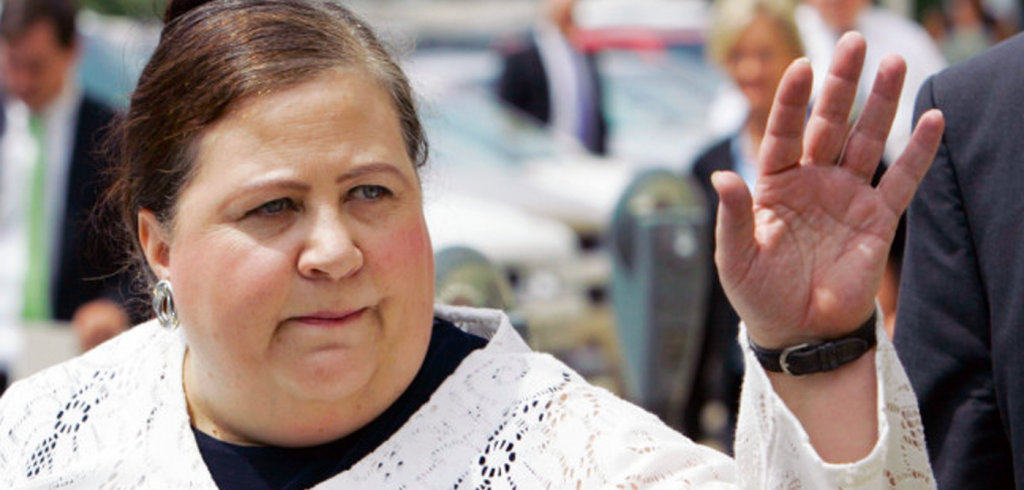
As Alabama Democrats head into what they hope will be a period of rebuilding, some are seeking new party leadership. The Alabama Democratic Party executive committee meets Saturday in Montgomery to elect a chairperson. Longtime chairwoman Nancy Worley will face a challenge from Montgomery attorney Peck Fox. Once dominant throughout the Deep South, Democrats had been obliterated from statewide office in Alabama until last year’s election of U.S. Sen. Doug Jones. Buoyed by Jones’ victory, Democrats are looking to the 2018 elections with newfound optimism. “I think it’s important that we have a party that has a functional infrastructure, the ability to raise funds, the ability to organize field operations to provide help and support to our candidates and county committees,” Fox said. “If we miss this window of opportunity, I don’t know when the next one will be.” Worley has served as the party’s chairwoman since 2013 and is seeking another term at the helm. “During the time I have served as chair of the Democratic Party, we have substantially reduced the party’s debt, fielded more candidates than we have had in decades, elected a Democratic U.S. Senator, held regular board meetings with financial reports at each, and reorganized some county parties,” Worley said in a statement. Both Worley and Fox are political veterans. Fox worked for the late Sen. Howell Heflin in Washington and for Lt. Gov. Jim Folsom. Worley is a former Alabama secretary of state and served as the party’s vice-chairwoman. Fox likely faces an uphill battle. Worley has been supported by Joe Reed, the longtime leader of the influential Alabama Democratic Conference. Reed also controls a substantial number of committee votes. Reed did not immediately return a telephone message seeking comment. However, House Minority Leader Anthony Daniels said Friday that, “now is the perfect time for a transition.” “On the heels of Doug Jones’ election and with the number of candidates running for office, more than any time before these candidates need a strong party, a stronger party,” Daniels said. The Democratic Party has been roiled by tension and criticism about its direction and finances in recent years. A reform group has sought to strengthen and diversify the party. In 2016, then-House Minority Leader Craig Ford penned a letter saying the party was on” life support” and urged Worley and Reed to step down. The party’s previous party chairman resigned in 2013 to create a new group to assist Democratic candidates. Republished with the permission of the Associated Press.
Steve Flowers: Dark horses emerge to follow legacy of ‘Luv Gov’
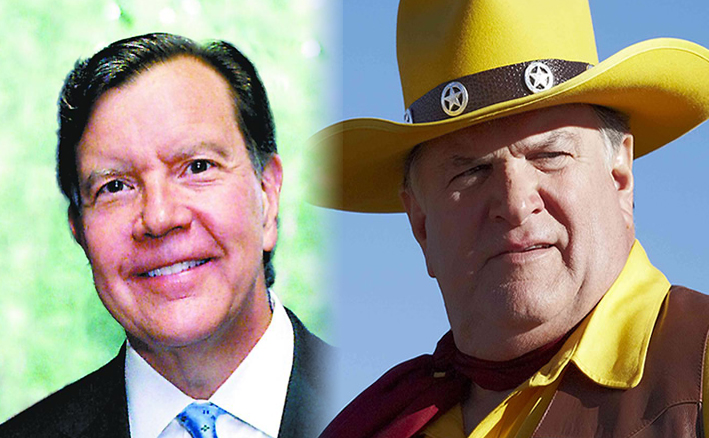
Well, folks, let’s put the final coup de grace to the Robert Bentley six-year Governor’s reign and move on. Ole Bentley was quite a story his last two years. He had become the ringleader of a circus and an infamous national cartoon character. The salacious and lurid details of his affair with Mrs. Rebekah Mason were a never-ending, titillating saga. The story, along with his picture, could aptly be a plot for a tabloid or a Soap Opera. I will actually be surprised if it does not make it to television or even the movies. Unfortunately, this story will be his legacy as governor. He has no public policy initiatives to tout for posterity. He will be known as the “Luv Gov.” Our last two governors may not have gone to jail like previous ones, but they garnered terrific nicknames for their exploits over their last year in office. Bob Riley spent his last year doing the bidding of the Indian Gambling syndicate and his cowboy and Indian escapades closing down all the non-Indian casinos earned him the nickname of “Bingo Bob.” Ole Bentley, who appeared to be the least likely person to play the part, became a sex-crazed philanderer. His and Rebekah’s sordid romance tapes sounded like the x-rated version of Barney Fife sweet talking Thelma Lou. Even the national media dubbed him the “Luv Gov.” Bentley never really showed any genuine remorse or contrition. Even when he read his prepared resignation speech, it did not seem heartfelt or sincere. They were just words wrapped in religion. He never seemed to apologize from the heart. He still seemed a little bit haughty. Having taught Sunday school for many years, one would have thought Bentley had taught some from the book of Proverbs. One of Solomon’s greatest proverbs says, “Pride goeth before a fall.” Early in the day of Bentley’s resignation, I was walking around the Capitol with rumors swirling that Bentley’s demise was imminent at any time. I was wishing the best for ole Bentley. I thought about ole Big Jim Folsom standing on the Capitol steps when the press would pound on him and ask him to resign. He would say to them, “Y’all ain’t gonna get old Big Jim to quit. When I was a boy, growing up in Coffee County my old pappy would make me get out of bed before daylight and go work in the fields chopping cotton and plowing behind a mule. I’d see a rain cloud come up and start praying for rain so I could quit for a while. My pappy would say, boy, it may cloud up but it ain’t gonna rain on Big Jim.” Well, bless his heart, it did rain on Bentley. He’s gone. Kay Ivey will serve out the remaining 19 months of his term. She may decide to run for a full term of her own as governor. As the incumbent governor, she would be a viable candidate. There is an ever-growing list of potential and probable horses that are gearing up for the 2018 gubernatorial derby. The list of viable candidates is at about a dozen. However, let me tell you again, like I have been telling you for years, Alabamians like to vote for a dark horse for governor – one who has not been around the political track. Let me give you the names of two very rich businessmen who could pull off a Fob James 1978-like coup. Jimmy Rane, known as “Yella Fella” from his ads of riding a horse and wearing a big yellow hat advertising his yellow lumber, started out and built Great Southern Wood out of Abbeville where he was born and raised and still calls home. Forbes magazine has his net worth at $600 million. Johnny Johns became CEO of Birmingham-based Protective Life at a young age. He built the company started by Colonel Rushton into one of the largest life insurance companies in the world. When an international corporation bought Protective several years ago, Johnny walked away with $300 million. He is known throughout Birmingham as one of the most civic-minded people in the Magic City. Either one of these two distinguished gentlemen could easily buy the governor’s office with their pocket change and they may be interested. See you next week. ___ Steve Flowers is Alabama’s leading political columnist. His weekly column appears in over 60 Alabama newspapers. He served 16 years in the state Legislature. Steve may be reached at www.steveflowers.us.
Steve Flowers: For 2018 governor’s derby, a cavalcade of characters
We are on the cusp of one of the best political years in modern political history in the Heart of Dixie. Prior to the 1970s, our constitution disallowed succession of office for our state constitutional offices. In other words, you could not run for two consecutive four-year terms. That is why George Wallace ran his wife in his place in 1966. George and Lurleen campaigned side-by-side. George would wink at the crowds still drawn to courthouse squares by a country band and say, “I’m going to be her No. 1 adviser.” By the way, she won in a landslide. She beat eight male opponents without a runoff, including two former governors, an agriculture commissioner, the sitting state attorney general and two powerful state senators. However, you could serve a four-year term and wait out four years and run for a second term. Only two men had done that in Alabama history. Prior to the constitutional change in the 1970s, Bibb Graves of Montgomery had done it early in the century and Big Jim Folsom did it in 1946 and again in 1954. Now that governors can succeed themselves, it has become common practice for governors to serve eight years rather than four. Thus, the 2018 governor’s race will be a once in an eight-year opportunity. Folks, we are in for one heck of a year and the bell rings June 6. Therefore, the horses will begin lining up over the next few months. It will be a great cavalcade of characters. The early favorite horse in the 2018 Derby is Roy Moore. The Chief Justice’s expulsion from the bench by the Judicial Inquiry Commission has propelled him to stratospheric levels in polling. Leading a horserace is a good analogy for Moore since he traditionally rides his horse to vote at his polling place in Gallant in rural Etowah County. Some of you may question Moore’s popularity, but the numbers are there in every poll. The JIC has made him a martyr. Alabama is a very religious state and being thrown out of office by an unaccountable commission for being against homosexual marriages is a pretty good issue to run on in the Bible Belt. Roy Moore is the wild card in the early 2018 jockeying. Most folks have him in the governor’s race. However, he has two other options. Attorney general or the U.S. Senate seat. He would probably win either of these posts. The governor’s office is another question. Historically, people do not think of him as governor. He lost miserably both times he ran, whereas he wins handily for a state judgeship. His best race is for attorney general or U.S. Senate. Twinkle Andress Cavanaugh has a free shot in 2018. She was just re-elected to a four-year term as Public Service Commission President. She is already out running for governor and sometimes the early bird gets the worm. State Agriculture Commissioner John McMillan is term-limited in that job that he has done well for eight years. He is well liked by everyone who knows him and is planning to run for governor. Young Boozer has also served his two-term eight-year limit as State Treasurer. He is a wild card and gives no hints as to what his future political plans are for 2018. Young is not a natural politician. He is an erudite Stanford-educated successful banker who was perfectly suited for the State Treasurer’s post and he has done an excellent job. Secretary of State John Merrill is probably the best retail politician in the state at this time. Lots of people have encouraged him to run. However, he is one of the few constitutional officeholders who can run for re-election in 2018. He will probably bide his time and run for re-election. State Senate President Pro Tem Del Marsh of Anniston is itching to pull the trigger on the governor’s race, but being a powerful state senator does not translate into statewide name identification. However, Marsh is said to be wealthy. If he were to spend $3 to $5 million of his own money, he could be a player. The very popular mayor of Huntsville, Tommy Battle, is seriously considering the race. If he joins the fray he could be a player. He would come out of the Tennessee Valley with a strong start. There are a lot of votes in North Alabama. We are in for a heck of a campaign year. I will keep you posted. See you next week. ___ Steve Flowers is Alabama’s leading political columnist. His weekly column appears in over 60 Alabama newspapers. He served 16 years in the state Legislature. Steve may be reached at www.steveflowers.us.
