
Richard Shelby awarded Aerospace Industry Association award
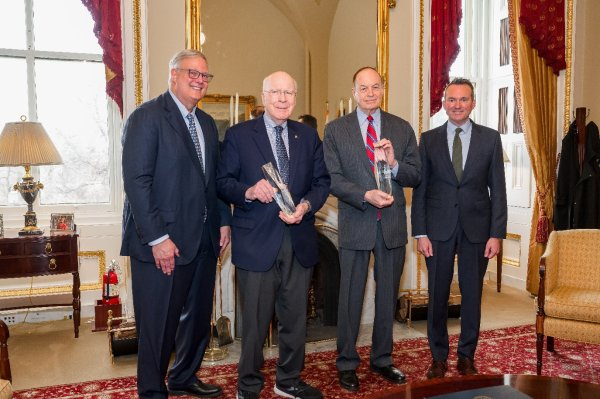
The Aerospace Industries Association (AIA) honored U.S. Senators Jim Inhofe (R-Oklahoma), Richard Shelby (R-Alabama), and Patrick Leahy (D-Vermont) with the “Wright Stuff Award” in recognition of their support of the aerospace and defense industry. “On behalf of the 2.1 million employees working in the aerospace and defense industry, it’s an honor to present our ‘Wright Stuff Award’ to Senators Jim Inhofe, Richard Shelby, and Patrick Leahy for their decades of bipartisan leadership and service,” AIA President & CEO Eric Fanning said. “Sens. Inhofe, Shelby, and Leahy will leave a legacy of unwavering support and dedication to investment in our military, our national security, and the U.S. defense industrial base that supports both.” “Thank you to the Aerospace Industries Association for presenting me with the Wright Stuff Award,” Sen. Shelby said. “This is a high honor. I am proud of what Senator Inhofe, Senator Leahy, and I have been able to accomplish in this space. The safety and security of our nation is paramount, which is why I have supported the aerospace and defense industry throughout my career. There is no wiser investment than that of our military.” The AIA praised Shelby for being a longtime advocate for the U.S. military and the manufacturing base that supports it. “Sen. Shelby’s role on the Senate Committee on Appropriations as both Chair and Vice Chair will continue to have a lasting impact on the military, NASA, and our civil aviation system,” the AIA said in a statement. “Sen. Shelby has served the state of Alabama in both chambers of Congress as well as in the state legislature. He was first elected to the U.S. Senate in 1986 and is currently in his sixth term.” For nearly three decades, Sens. Shelby and Leahy led congressional delegation trips to the Farnborough and Paris Air Shows, critical convening opportunities for industry, government partners, and thought leaders. “The Wright Stuff Award” was created in 2020. It is named after the inspiring Wright brothers, whose ideas and inventions ushered in the age of flight and, in turn, transformed the world. The award recognizes individuals who have made major and measurable contributions to the U.S. aerospace and defense industry. The aerospace and defense industries play a significant role in Alabama’s economy. Shelby is retiring at the end of this Congress. He is being replaced in the Senate by his former Chief of Staff, Katie Britt. Shelby has served in the U.S. Senate since 1987. He served in the U.S. House of Representatives representing Alabama’s Seventh Congressional District from 1979 to 1986 and in the Alabama Senate representing Tuscaloosa from 1970 to 1978. He is a graduate of the University of Alabama and the University of Alabama School of Law. To connect with the author of this story, or to comment, email brandonmreporter@gmail.com.
Democrats’ letter urges amendment to National Defense Authorization Act
Vetting human rights security cooperation programs is the focus of a letter sent to the House and Senate Armed Services Committees by a pair of Democrats. California Congresswoman Sara Jacobs, Maryland Senator Chris Van Hollen, and 13 other federal legislators are urging the committees to include their amendment that would require vetting of human rights in cooperation programs within the fiscal year 2023 National Defense Authorization Act conference pact. According to the letter sent to Chairman Jack Reed, D-RI; Chairman Adam Smith, D-WA; Ranking Member Jim Inhofe, R-OK; and Ranking Member Mike Rogers, R-AL, members are pushing for House-ratified provisions of the Upholding Human Rights Abroad Act that would, if enacted, close loopholes in the Leahy Laws that would “guarantee human rights vetting” of U.S. security assistance that would prevent taxpayer funds from aiding human rights abusers. “This provision would strengthen the U.S. commitment to human rights by increasing vetting measures to ensure that recipients of U.S. support have not committed human rights violations or violations of international humanitarian law,” the members wrote in the letter. “Consistent with the Department of Defense Leahy Law, this provision allows for the use of a national security waiver.” The members wrote that the provisions would give the flexibility that would “continue to address U.S. national security priorities” that would allow the State Department to “undertake this additional vetting.” “This provision would help prevent civilian harm, ensure partner compliance with human rights, and improve intended long-term outcomes toward good governance, rule of law, peace, and human rights promotion,” the members wrote. The letter was also signed by Senators Dick Durbin, D-Ill; Patrick Leahy, D-VT; and Richard Blumenthal, D-CT; and Representatives Jason Crow, D-CO; Chrissy Houlahan, D-PA; Tom Malinowski, D-NJ; Joaquin Castro, D-TX; Albio Sires, D-NJ; Dina Titus, D-NV; Ted Lieu, D-CA; Colin Allred, D-TX-32; Gerry Connolly, D-VA; and Dean Phillips, D-MN. Republished with the permission of The Center Square.
Donald Trump fires Mark Esper as Pentagon chief after election defeat

President Donald Trump fired Defense Secretary Mark Esper on Monday, an unprecedented move by a president struggling to accept election defeat and angry at a Pentagon leader he believes wasn’t loyal enough. The decision was widely expected as Trump had grown increasingly unhappy with Esper over the summer, including sharp differences between them over the use of the military during the civil unrest in June. But the move could unsettle international allies and Pentagon leadership and injects another element of uncertainty to a rocky transition period as Joe Biden prepares to assume the presidency. Presidents who win reelection often replace Cabinet members, but losing presidents have kept their Pentagon chiefs in place until Inauguration Day to preserve stability in the name of national security. Trump announced the news in a tweet, saying that “effective immediately” Christopher Miller, the director of the National Counterterrorism Center, will serve as acting secretary, sidestepping the department’s No.2-ranking official, Deputy Defense Secretary David Norquist. “Chris will do a GREAT job!” Trump tweeted. “Mark Esper has been terminated. I would like to thank him for his service.” In a letter to Trump, Esper referred to his efforts to keep the Pentagon apolitical — a resistance that often angered Trump. Esper said he served as defense secretary and Army secretary “in full faith to my sworn oath to support and defend the Constitution, and to safeguard the country and its interests while keeping the Department out of politics and abiding by the values Americans hold dear.” The Associated Press obtained a copy of the letter. Esper didn’t thank Trump, but he also didn’t openly criticize the president or his policies. He said he accepts Trump’s decision to replace him, adding, “I step aside knowing there is much we achieved at the Defense Department over the last eighteen months to protect the nation and improve the readiness, capabilities, and professionalism of the joint force, while fundamentally transforming and preparing the military for the future.” U.S. defense officials said Miller arrived at the Pentagon in the early afternoon to take over the job, and that White House chief of staff Mark Meadows informed Esper of the firing before Trump announced the move on Twitter. Esper and Miller were in the building at the same time for a while, but Esper left by the end of the day, said defense officials who spoke on condition of anonymity to discuss internal matters. Trump’s abrupt move to dump Esper triggers questions about what the president may try to do before he leaves office, including adjustments in troop presence overseas or other national security changes. More broadly, the U.S. military continued to operate as usual. U.S. officials said Gen. Mark Milley, chairman of the Joint Chiefs of Staff, met with Miller on Monday and also gathered the top military commanders and chiefs for a secure meeting. Officials said Miller’s message so far is that he won’t make immediate changes, and the department will stay the course. Military leaders, meanwhile, were calling top officials in their various geographic regions to assure them that the U.S. military is maintaining a stable presence around the world. In a separate message to the force, Esper expressed a twinge of disappointment, saying “I step aside knowing that there is much more we could accomplish together to advance America’s national security.” He said much was achieved, and “through thick and thin, however, we have always put People and Country first,” he said. Trump’s decision brings to five the number of men who have held the job of defense chief under Trump — either in an acting capacity or confirmed by the Senate. The move was quickly condemned by Democratic members of Congress. “Dismissing politically appointed national security leaders during a transition is a destabilizing move that will only embolden our adversaries and put our country at greater risk,” said Rep. Adam Smith, D-Wash., chairman of the House Armed Services Committee. “President Trump’s decision to fire Secretary Esper out of spite is not just childish, it’s also reckless.” Former military leaders weighed in. Jim Stavridis, a retired four-star Navy admiral, wrote on Twitter that, “Things are already unstable internationally, and this does not help.” Republicans praised Esper but largely avoided criticizing Trump. GOP Sen. Jim Inhofe, the Senate Armed Services Committee chairman, told reporters it was Trump’s decision and said, “I learned a long time ago I don’t tell the president not to do anything.” Biden has not said who he would appoint as defense chief, but is widely rumored to be considering naming the first woman to the post — Michele Flournoy. Flournoy has served multiple times in the Pentagon, starting in the 1990s and most recently as the undersecretary of defense for policy from 2009 to 2012. She is well known on Capitol Hill as a moderate Democrat and is regarded among U.S. allies and partners as a steady hand who favors strong U.S. military cooperation abroad. Miller most recently served as director of the National Counterterrorism Center and before that was a deputy assistant defense secretary and top adviser to Trump on counterterrorism issues. He spent more than 30 years in the military, including as an Army Green Beret, and was deployed multiple times to both Iraq and Afghanistan. After his retirement from the military, Miller worked as a defense contractor. Esper’s strained relationship with Trump came close to collapse last summer during civil unrest that triggered a debate within the administration over the proper role of the military in combating domestic unrest. Esper’s opposition to using active duty troops to help quell protests in Washington, D.C., infuriated Trump, and led to wide speculation that the defense chief was prepared to quit if faced with such an issue again. The tensions fueled rumors that Esper would be ousted if Trump won reelection. Presidents historically have put a high priority on stability at the Pentagon during political transitions. Since the creation of the Defense Department and the position of defense secretary in 1947, the only three presidents
Alabama’s only seat on TVA board in jeopardy by Jeff Sessions’ changing fortunes
Alabama is represented by only a single seat on the Tennessee Valley Authority board — Joe Ritch, a Huntsville attorney. But Ritch’s TVA board seat could be under fire by the election of Donald Trump and his pick for Attorney General, Sen. Jeff Sessions. Ritch, a Democrat nominated in 2013 by President Obama for a three-year term, is up for another term. Board members elected him chair, a position he currently holds. Lee Roop of Al.com notes that Ritch’s knowledge of North Alabama and strong leadership has earned him several local supporters, such as Huntsville Mayor Tommy Battle, Jackson County Commission Chair Matthew Hodges and Madison Mayor Paul Finley. “They cite thousands of new jobs brought to the region and nearly $1 billion in new business investment during his tenure,” Roop writes. Ritch was instrumental in helping Jackson County rebound from economic damage due to federal policies and court rulings, Hodges said. Hodges also cited Ritch’s help after federal policies reduced reliance on coal to power TVA plants, which led to the shuttering of Widow’s Creek coal-based power plant and subsequent loss of jobs; Ritch worked to lure a Google data center now operating in the same location. “They came and I feel like have made an incredible effort to turn things around, to work with us and help us to help ourselves,” Hodges told Al.com. “(Ritch) was chairman of the board at that time. It took an effort from a lot of folks at TVA to make that happen, but you had his leadership.” “He’s been a very valuable member of the (local economic) team,” Battle added. “He’s the only chair Alabama’s ever had, he’s kept power rates low, and it would be a win-win for the community to keep him there.” Both Finley and Battle, whose positions are non-partisan, agree that Ritch doesn’t favor a specific Alabama city or the state in general. But someone like him on the board helps keep industry leaders aware that commitments will be kept. As of now, the Senate is left with only a few weeks to decide if Ritch stays with the TVA. If he is not approved before Congress’ Christmas break, President-elect Trump will name a successor. The Senate Environment and Public Works Committee, chaired by Oklahoma Republican Jim Inhofe ,determines TVA board members; a committee which Sessions is a member. Senate rules allow senators to either approve – or block — presidential nominations from their respective states. The first time around, Sessions gave Ritch the thumbs-up. This time, he has not yet said he would. “We’ve been in a continual conversation with the (entire) Alabama delegation,” Battle told reporters. If Sessions becomes President Trump’s attorney general and a replacement for Ritch is chosen, Alabama’s new Republican Senator could have veto power. That is if Trump nominates another Alabamian, and Sessions’ replacement is named to the public works committee. Alabama is represented on the TVA by someone already approved by Sessions, Roop says local leaders hope it stays that way.
