
Voting rights marcher Della Simpson Maynor recalls being clubbed, hearing fatal gunshot during pivotal day of protests
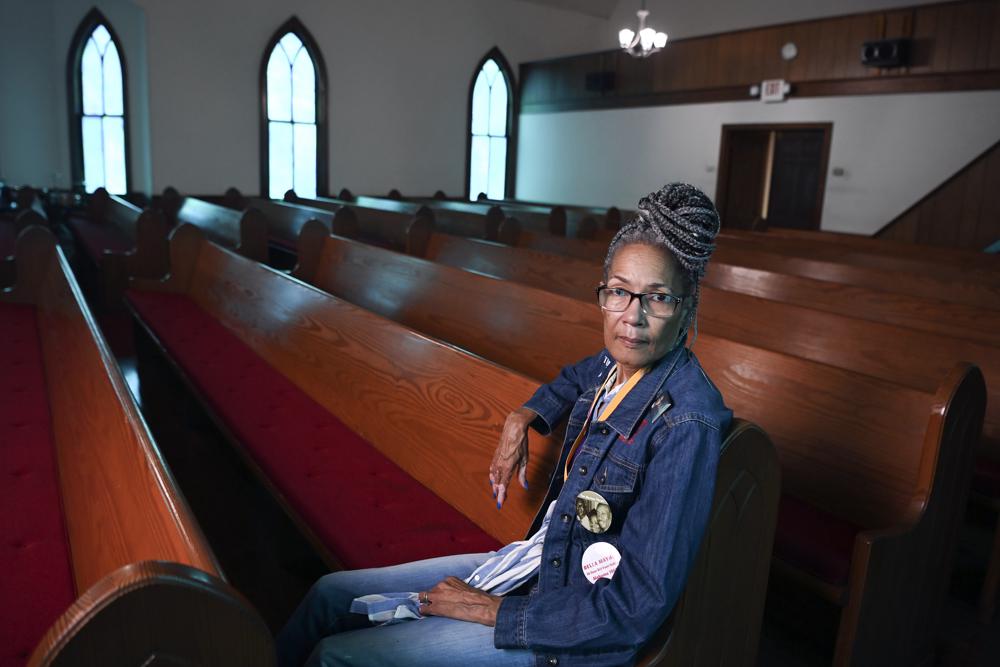
Della Simpson Maynor was just 14 when she marched for voting rights in her hometown of Marion, Alabama. Her most distinct memory of that evening is of the police attacking the demonstrators. She recalls one officer, on horseback, swinging at her head with a club. “I remember going up with my elbow, trying to protect my head,” she said, pointing to the place where the club cracked down on her arm. “They didn’t care who they hit — children, women. I remember a lady. She was pregnant.” VOTING RIGHTS ACT SERIES The Feb. 18, 1965, march ended with the shooting of a young activist and set in motion events that galvanized support for Congress passing the Voting Rights Act later that year. The group had gathered to walk from Zion Methodist Church to the nearby jail to protest the arrest of James Orange, a leader in the civil rights movement. There was a rumor that white people in the town planned to lynch Orange that night to send a message. Maynor had wiggled her way near the front of the line, but the group made it only a few hundred feet. “All of a sudden, there were police officers everywhere,” she said. “They just came out of the darkness.” She remembers seeing a minister kneeling to pray. “They told him to get up, unlawful assembly. You have to disperse. And, of course, he continued to pray. And that wasn’t good enough, so they hit him with that billy club,” she said. “I started to try to retreat, but it was too late because they had begun to rush us.” Maynor ran and crouched beside the church, where she was found and hit. She and others fled into Mack’s Café, a restaurant that was part of a Black business district — the businesses on the town square were for whites only. A police officer came in and ordered them to leave. Maynor then heard the sound of a gunshot. A local church deacon, Jimmie Lee Jackson, trying to protect his grandfather from police inside the cafe, was shot by a state trooper. He died eight days later. Jackson’s death became the catalyst for a march the next month in Selma, when the participants were attacked by police as they tried to cross the Edmund Pettus Bridge. The day became known as “Bloody Sunday,” and images of the violence galvanized support for the passage of the Voting Rights Act later that year. “It was after Jimmie’s death and all the attention that was brought to this area that they actually attempted to do something about the Voting Rights Act,” Maynor said. At the time, she thought the struggle was over because “we immediately started electing people of color to key positions in this town.” But while events in Alabama helped give birth to the Voting Rights Act, court cases originating in the state have led to its steady erosion over the years. A U.S. Supreme Court case arising from a suburban Alabama county ended the requirement for several states with a history of voting discrimination, mainly in the South, to get federal approval before changing election laws and procedures. This summer, the court is expected to rule on whether the Voting Rights Act will be reinforced or further eroded in another case out of Alabama. “I’ve seen a lot of change,” said Maynor, now 74. “But I’ve seen a lot of things exactly remain the same because the thinking hasn’t changed.” While circumstances are vastly different nearly 60 years after the Voting Rights Act became law, Maynor sees echoes of the past. As a child, she attended segregated schools, waiting in the morning to catch an old bus while white children, riding a new one, would ride past her shouting racial slurs. Today, white politicians are trying to put boundaries on how race and the civil rights era are taught in schools. The vast majority of people “that hold power and make the biggest decisions” in Alabama are white, she said. “There’s a struggle that’s always had to be fought,” Maynor said. “You always hope the things you’ve done will make a difference in the long run, but to see where we are in this country (it’s) pretty much the same place we were in 1965, and we’re fighting the same battle.” Republished with the permission of The Associated Press.
Black worker at Confederate site raises race complaint

Alabama welcomes visitors at the “First White House of the Confederacy,” a historic home next to the state Capitol where Confederate President Jefferson Davis lived with his family in the early months of the Civil War. The museum managed by the state’s Department of Finance says it hosts nearly 100,000 people a year, many of them school children on field trips to see such things as the “relic room” where Davis’ slippers and pocket watch are preserved. Near the gift shop, a framed article describes Davis as an American patriot who accomplished “one of the most amazing feats in history” by keeping the “north at bay for four long years.” Evelyn England, an African-American woman who worked for 12 years as a receptionist at the historic site, said some visitors, both Black and white, were surprised to see her there. “I’m in a unique position because whites don’t really want me here, and Blacks don’t want to come here,” England told The Associated Press. England, 62, retired this week from the $34,700 state job, and it wasn’t the friendliest of departures: State records show she was suspended for three days last month for refusing to sign a performance review, and she said she filed a racial discrimination complaint with the U.S. Equal Employment Opportunity Commission. A spokeswoman said the Department of Finance declined to comment on the personnel matter. After all those years working among the Davis family’s furniture and belongings, England wishes the museum would take a broader view of history. That slavery was a catalyst for the Civil War “is sort of stated around,” she said. “Tell it like it is. Just tell it like it is. This happened. This is what is known to have happened. Give it as absolute truth as you can….. Until that, you are painting a false narrative that this was a gala — no, there were some ugly things that happened,” she said. Explanatory displays at the museum, where the first Confederate flag still flies outside, mostly discuss the furnishings and how rooms were used, and make little to no mention of slavery, which Davis promoted as “a moral, a social and a political blessing.” The residence was salvaged over a century ago by The White House Association, a state-chartered women’s organization that still owns its contents and remains involved, even as Finance Department employees staff the site. The legislature mandated in a 1923 law that the state-owned building serve as a “reminder for all time of how pure and great were southern statesmen and southern valor.” It would be better, England believes, if the historic site was managed by the Department of Archives and History. The museum’s curator, Bob Wieland, said Friday that he would ask the board to respond to questions about how the museum is run, but he doesn’t think the museum depicts an overly rosy view of Davis. “Jefferson Davis has never been called great in the house. He was the president of the Confederate States of America. We would say no more, no less than that,” Wieland said. England, who would sometimes give tours, said guides only gave information such as the dates (February-May 1861) when Montgomery served as the Confederacy’s capital. The museum has made some changes over the years. She said there once was an area called a “shrine” to Davis. The gift shop stopped selling Confederate flags, except for stickers of the design that was used when the Confederate capital was in Montgomery. “They have taken steps. It might be baby steps,” she said. England, who lives in Marion, said she is a distant cousin of Jimmie Lee Jackson, a civil rights activist shot and killed by a state trooper in 1965. His death helped inspire the voting rights marches from Selma to Montgomery that led to passage of the Voting Rights Act. England was a young child at the time, but still recalls the commotion and pain. In conversations with visitors, England said she would sometimes use questions and humor to try to get them to see a different point of view. When one person maintained that secession was only about preserving states’ rights — a view that had long been taught to southerners as the root cause of the Civil War instead of slavery — she responded, “But did everyone have the same rights?” “You love the Confederacy for what you think it stood for: Your rights,” she would think. “What were they fighting about? Some would say states’ rights. I have a problem with your solution of states’ rights because all individuals in that state didn’t have the same rights.” One day, an older white woman said “Oh, the South will rise!” to no one in particular as she browsed in the gift shop, where the merchandise includes books, stickers of the first Confederate flag, and children’s toys including teddy bears in Confederate and Union uniforms. When the woman turned around to put more items on the counter, England asked her, “What are you rising from?” She said the woman didn’t reply. “If looks could kill I’d be a dead woman,” England said. But many interactions have been positive, she said, recalling good conversations, even with people who — a supervisor warned — could be prejudiced against her. She’s been “chewed out” by some African Americans for working there, she added. “It came at me from both sides,” she said. Many visitors — Black and white — found her race a point of curiosity. “How do you work here?” one white woman asked her. “Ma’am, if you pay every last one of my bills, I’ll quit today,” she jokingly replied. England hopes her presence helped open minds. “Just open up what you are thinking. That’s where the real change is going to occur, in your heart. You can take down monuments. But if what they are still harboring is there, at an inopportune time it will resurface.” Republished with the permission of the Associated Press.
