Wallace State Community College holds ribbon cutting at new Workforce Training Center
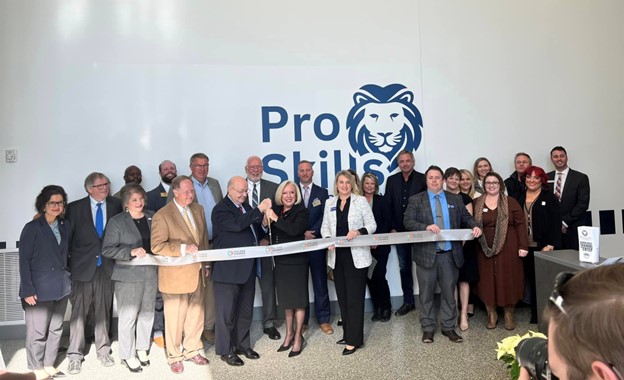
Wallace State Community College (WSCC) held a ribbon cutting on Wednesday for its new Workforce Training Center, which is located on the grounds of Rehau. The Workforce Training Center will provide facilities for training programs and services offered by the college’s Center for Career and Workforce Development. Initially, classes for phlebotomy, computer office training, fiber optics training, some manufacturing training, and a Skills for Success lab will be offered at the site. WSCC plans to offer classes for Certified Nursing Assistants and Medication Assistant Certification at the center soon. Alabama Community College System Chancellor Jimmy Baker, State Rep. Randall Shedd, Cullman Mayor Woody Jacobs, and Cullman Economic Development Agency Director Dale Greer were in attendance, as well as WSCC President Dr. Vicki Karolewics, Vice President for Advancement and Innovation Suzanne Harbin and industry partners Jeremy Sturdivant of the Jimmie Hale Mission, and Tracy Rushing of R.E. Garrison Trucking. Space will also be available for use by area businesses and industries that need facilities for employee training. Hardin said that the facility provides them with a central location to host classes and store materials and supplies for their programs. Through its Pro Skills Pathways program, the Center for Career and Workforce Development offers short-term training to earn credentials students can use to get a job, advance in their current job, or use as credit to articulate into a credit-bearing program at Wallace State. Economic developer Dr. Nicole Jones Wadsworth told Alabama Today, “Wallace State’s newest workforce training center at the Rehau campus will transform the lives of the people in Cullman and the surrounding area. Courses offered will equip graduates with in-demand skills that translate into jobs within a variety of trades. We applaud Wallace State for its continuous communication with industry partners and willingness to go the extra mile to serve our communities.” Registration for the Spring 2024 semester is underway, with classes beginning January 8 for regular and Mini Term I and March 6 for Mini Term II. Registration for Flex Start I courses will be held Jan. 13-19, with classes starting January 15, and registration for Flex Start II courses will be held Jan. 20-26, with classes beginning January 22. To register for classes, visit their website. The two-year college system has an enormously important role in training Alabama’s workforce. This expansion with the Workforce Training Center will help Wallace State perform in that role. To connect with the author of this story or to comment, email brandonmreporter@gmail.com.
Steve Flowers: The Alabama Community College System
Sometimes overlooked and often unsung, Alabama’s community and technical colleges are on a roll. It is time they get the recognition they deserve as workhorses for the state’s economy. There are 24 community and technical colleges in the state, located on 50 different campuses with over 130 service locations. This means every Alabamian reading these words is close to incredible education and training opportunities. The colleges offer over 300 degrees and certifications and award more than 30,000 credentials each year that show employers these students are serious about working. More than 155,000 students are served by Alabama’s community colleges, and 95% of students live in Alabama. What is more, 71% choose to stay in Alabama after completing their studies. These students and alumni add an amazing $6.6 billion to Alabama’s economy each year, according to a report from Lightcast, a national firm that analyzes labor markets. Nearly 99,000 jobs in Alabama are generated or supported by Alabama’s community colleges, their students, and alumni. To put it another way, that is one of every 27 jobs in the state. Under the leadership of Chancellor Jimmy Baker, who took the helm of the Alabama Community College System (ACCS) in 2017, innovative and transformational programs are in place that “build strong Alabama people who are willing to work and do what it takes to move the state forward,” as Baker puts it. Among the most impressive is the Innovation Center, a division of the ACCS that brings together the state’s community colleges, businesses, and industries. These partners deliver Skills for Success training for careers that employers say are most in demand but lack qualified Alabama workers to fill. By working together with Alabama businesses and industries, the ACCS Innovation Center ensures Skills for Success training is perfectly aligned with the jobs that employers say they need to fill right away. Since its launch a little more than a year ago, more than 2,700 Alabamians have benefitted from Skills for Success training. The appeal to trainees – other than getting the skills needed for an in-demand job – is the training is offered at no cost to them. It is free to trainees thanks to appropriations from the State Legislature and support from Gov. Kay Ivey, who has put a strong emphasis on workforce training. The Governor’s Success Plus initiative aims to add 500,000 Alabamians with postsecondary credentials to the state’s workforce by 2025. Rapid training from our community colleges will be key to reaching this important goal. It is incredible to think that every Alabamian has the opportunity to receive no-cost training and become credentialed for jobs as bulldozer operators, fiber optic technicians, truck drivers, and more, but that is the reality of today’s community college system in our state. Chancellor Baker has wisely built a workforce training program around the skills that employers say they need in their workers. As a result, many students can walk right out of training and immediately into jobs that are waiting for someone with their exact skillset. The training is essentially “customized” for Alabama employers in desperate need of workers. What is also innovative is how quickly Skills for Success training can be delivered. Part of each training course is offered online, with self-paced learning that can take place anywhere one can connect to the internet. Some have said they have completed the online training from their mobile phones over a few hours in the evening. When a trainee completes the online portion of the course, they then get hands-on training with qualified instructors at a nearby community college or some other regional location. The average Skills for Success course can be completed in as little as two or three weeks. Any Alabamian can sign up for no-cost training and, in less than a month, have a community college credential that shows employers they have the skills and qualifications to do the job. With Skills for Success training, they are “job-ready” on day one for jobs that are in high demand throughout the state, thanks to the forward-thinking leaders of the Alabama Community College System and the State Legislature. See you next week. Steve Flowers is Alabama’s leading political columnist. His weekly column appears in over 60 Alabama newspapers. Steve served 16 years in the state legislature. Steve may be reached at www.steveflowers.us.
Steve Flowers: Marshall County and Enterprise emerging as Alabama political breeding grounds
Over the years, certain counties in Alabama have bred an inordinate number of governors and state political leaders. The three most prominent enclaves historically have been Tuscaloosa, Barbour, and Cullman. In the earlier years of statehood, Tuscaloosa was the most heralded county. They have continued, intermittently, throughout the years. The most prominent senator in Alabama history, Richard Shelby, who retired after 36 years in the Senate, calls Tuscaloosa home. Indeed, the state capital was in Tuscaloosa one time in the early years. They have had a fairly recent governor in Dr. Robert Bentley. Barbour County is called the “Home of Governors,” and for a good reason. They have had more governors than any county in state history. This sparsely populated Black Belt county has had six governors hail from there. George Wallace is, of course, the most prominent Barbour County Governor, but they also have Chauncy Sparks, John Gill Shorter, William Jelks, Braxton Bragg Comer, and Jere Beasley. Barbour County and Tuscaloosa both claim Lurleen Wallace. She was born and raised in Northport in Tuscaloosa County but married George Wallace and moved to Barbour County. This split county claim of governors also applies to legendary Governor James “Big Jim” Folsom. Big Jim was born and raised in Coffee County near Elba but moved to Cullman as a young man. So, Cullman gets bragging rights since he lived in Cullman when he was first elected in 1946. Cullman has indeed come on strong in the past few decades. They have had two governors in recent years, Jim Folsom Jr. and Guy Hunt. Today, we have two counties emerging as hotbeds for breeding state political leaders. Coffee County is percolating with political success. More particularly the growing City of Enterprise. Our new U.S. Senator, Katie Boyd Britt, was born and raised in Enterprise. She is only 40. The Congressman from the second district, Barry Moore, is from Enterprise although Dothan, Montgomery, and Elmore County have more population in that Congressional District. Moore is only 56. A rising popular star in the State House of Representatives, Rhett Marquis, 48, is from the Boll Weevil City. Enterprise is the home of the new state senator from that southeast Alabama hub. Josh Carnley just took the seat of retiring legend Jimmy Holley, thus keeping that seat in Coffee County. Carnley is a Coffee County farmer and insurance broker. Enterprise has a very good Mayor in William “Bill” Cooper. He has been in city politics for a good while. Coffee County also dominates all the judicial posts in this circuit. All three circuit judges hail from Coffee County in Enterprise. Sonny Reagan, Jeff Kelley, and Shannon Clark are all relatively young. The new District Attorney, James Tarbox, is very young. Jimmy Baker, who is Chancellor of the Alabama Community College System, hails from Coffee County and lives in Enterprise. Enterprise has always laid claim to Ft. Rucker, which has been the impetus of their growth, but they are emerging as a political powerhouse. The other county that is set to be called an Alabama political spawning ground powerhouse is Marshall County. They currently have a cadre of the state’s most powerful and promising Alabama leaders. The most prominent is 41-year-old Lt. Governor Will Ainsworth, who may be our next governor. State Senator Clay Scofield of Marshall County is only 42 and is Majority Leader of the State Senate. Attorney General Steve Marshall, 57, is in his second term as Attorney General. It is rare that two of the state’s highest-ranking officials, Will Ainsworth and Steve Marshall, are both from the same county. There are two rising stars in the Alabama House of Representatives from Marshall County. Young Wes Kitchens, an emerging leader in the House, is from Marshall. Also, the youngest member of the House of Representatives, Brock Colvin, has just been elected at the ripe old age of 26 and is catching people’s eyes on Goat Hill. Enterprise and Marshall County are emerging as new political breeding grounds for Alabama politicians. See you next week. Steve Flowers is Alabama’s leading political columnist. His weekly column appears in over 60 Alabama newspapers. He served 16 years in the state legislature. Steve may be reached at www.steveflowers.us.
Lawmakers seek probe of leader changes at Bishop State

Mobile area legislators are seeking an investigation into the state’s constant leadership changes at Bishop State Community College, including the dismissal of the school’s latest interim president. The 10 lawmakers, including both Democrats and Republicans, sent a letter Monday to Alabama Gov. Kay Ivey, who serves as president of the Alabama Community College System Board of Trustees, seeking an investigation. The historically Black community college has had five interim or permanent leaders since 2015, they said. “There is an obvious problem causing the constant changes in leadership. therefore, we strongly call for an investigation into the changes,” they wrote. The lawmakers expressed concerned about the recent dismissal of Interim President Lawrence Brandyburg. They said the school had seen a number of successes under Brandyburg, including the opening of a manufacturing center and an agreement with Airbus to train aircraft assemblers. “We have grave concerns about micromanagement and leadership changes that will hamper the community’s efforts to rebuild confidence in Bishop State. This community has supported efforts to rebuild the integrity and foundation of Bishop State Community College. Therefore, it is troubling to witness the recent barrage of leaders that have been at the helm of this historically black community college,” they wrote. Alabama Community College System Chancellor Jimmy Baker appointed Charles Jones as acting president of the community college on Friday. A new presidential search is currently underway. News outlets report that some of the lawmakers also held a news conference outside the school on Monday. They asked Baker and the system’s board of trustees to provide information. Republished with the permission of The Associated Press.
Alabama community college tuition increasing $10 per credit hour

Alabama community colleges will be raising tuition and fees starting this fall. The Alabama Community College System (ACCS) board of trustees on Wednesday unanimously approved a $10-per-credit-hour increase, scheduled to go into effect for the 2018-2019 school year. The increase will bring the average cost of tuition and fees up to $153 per credit hour. “As we move forward, making significant changes and looking to the future of the community college system, there are a number of things we need to address: safety, technology, facilities,” said System Chancellor Jimmy Baker. More than 80,000 students are enrolled within the state’s two-year college system, and the increase is expected to generate approximately $14 million. ACCS officials says half of the increased revenue will be divided among the 25 community and technical colleges across the state, and the other half will be used for general statewide college support. Last year, ACCS increased tuition 1.4 percent.
Longtime educator Jimmy Baker appointed chancellor of Alabama’s community college system

The Alabama Community College System board of trustees voted Wednesday to appoint interim chancellor Jimmy H. Baker as the official chancellor, effective April 1. “As we searched for a permanent replacement, we realized we could never find a chancellor who would be more experienced or prepared than Jimmy Baker,” board vice president Al Thompson said. Baker, who has served as acting chancellor for more than six months, will replace Mark Heinrich who officially submit his resignation last month following a long-term illness kept him away from the job. “Jimmy Baker has done a tremendous job of leading the system during the chancellor’s absence and has been far more than a place-holder,” Thompson added. Baker began his K-12 education career as a teacher and coach at Daleville High School. He quickly moved up in the ranks in education administration, first being named superintendent in Daleville, later becoming superintendent for Coffee County, and then assistant superintendent for finance at the state Department of Education. Baker served as state finance director from 1995 to 1999 under former Gov. Fob James. Baker has a wide array of experience, with responsibilities that have included: that included purchasing, contracting, information technology, insurance and bonds, overseeing budgets and financial reports for the state education office, local school systems and the community college system. Baker was one of seven applicants the board reviewed for the position. “Jimmy Baker understands the important work of community colleges from virtually every angle – from administering the schools and teaching the students, to hiring them when they graduate,” said Milton Davis, a member of the board of trustees who chaired the personnel committee that led the chancellor search. “He brings a unique perspective, and he knows that ultimately the work of our community colleges is about ensuring the success of our students, the success of our businesses, and the success of our state. Baker became chief of staff at the community college system in January 2016 and was named acting chancellor in August, after Heinrich developed severe complications from shingles. “I am honored to be in this position,” Baker said in a news release. “Alabama has no greater asset than its community college system, and we are uniquely positioned to ensure our students have the skills they need to meet their goals. While we will continually adapt and upgrade our programs, our basic mission remains the same. We want to provide our students opportunities for success, whether they want to work toward a four-year degree, to get a good job, or to upgrade their skills.”
Jimmy Baker appointed acting chancellor of Alabama’s two-year college system
Jimmy Baker has been appointed acting chancellor of the Alabama Community College System. Baker’s promotion from chief of staff to chancellor is only temporary and comes in the wake of Chancellor Mark Heinrich‘s request for a leave of absence to be treated for shingles. “My prognosis for a full recovery is yet to be determined and no time frame for my return can currently be medically determined,” Heinrich wrote in the letter Tuesday. “At this time, the combination of the medication therapy and the symptoms of this severe health condition have simply rendered me incapable of performing my duties and responsibilities as chancellor.” The state’s two-year system’s board of trustees approved the leave request and promotion during a meeting at John C. Calhoun Community College in Tanner on Wednesday. “During his absence, and through these weeks, there have been so many situations that have come up this week that are too important not to be handled properly by the office of the system,” said board of trustees’ vice president Al Thompson. “We hope this will be short term, but I think it’s very necessary to provide proper leadership.”