
Conservatives hold rally and prayer service in front of the Alabama State Capital
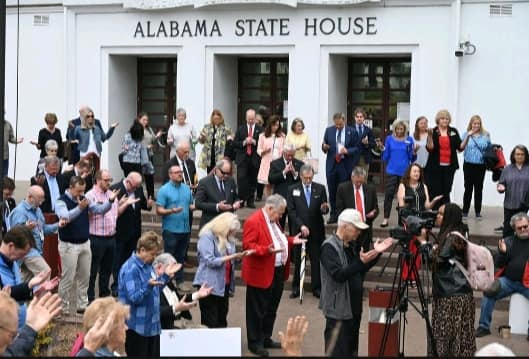
On Thursday, a variety of conservative groups held a prayer service and rally for their issues in front of the Alabama Statehouse. The Alabama Citizens Action Program (ALCAP) and Alabama Eagle Forum held a prayer service and followed that with a rally by the Campaign for Common Sense. The welcome-back rally urged legislators to advance a socially conservative agenda in the 2023 Alabama Regular Legislative Session that began on Tuesday. ALCAP President and CEO and talk radio host Greg Davis said on Facebook, “We had a blessed time of prayer in Montgomery at the Statehouse steps yesterday with ALCAP – Alabama Citizens Action Program. I encourage all Christians to include those who serve us thru Government on your prayer lists and then truly lift them up to God!” Several speakers urged the Legislators to jettison the unpopular Common Core educational standards – renamed the Alabama College and Career Ready Standards by the state school board. The Rev. John Killian said that the state will not succeed educationally while Common Core remains in place. The Campaign for Common Sense Director Lou Campenosi said, “We have been coming here for 13 years, and still nothing has been done.” Campenosi said that the state of Alabama had gone from 20th in educational performance to 52nd in state educational rankings since switching to the Alabama College and Career Ready Standards. The Director of Alabama Eagle Forum, Becky Gerritson, told Alabama Today that State Sen. Larry Stutts and State Rep. Susan Dubose will introduce legislation in each House to prevent pregnant women from being able to obtain medical marijuana – which will become legal in Alabama by the end of the year. Gerritson said that the group would also support a bill to expand school choice for families across Alabama – the Universal School Choice Act. State Auditor Andrew Sorrell advocated for legislation to give his office powers similar to that of other state auditors. Sorrell said that he had been criticized as being “too conservative,” but in the recent November general election, it was he who won by the largest margin showing that true conservatives can win. Sorrell said that Florida Governor Ron DeSantis governed as a conservative and was rewarded with an easy re-election. State Rep. Ernie Yarbrough vowed to support the school choice bill. Former ALCAP Director Joe Godfrey said on Facebook, “Glad to have been a part of the ALCAP Prayer Rally led by Greg Davis.” Stephanie Durnin with the Healthcare Freedom group advocated for passage of the Healthcare Freedom Act. The controversial legislation would prevent employers from being able to require employees to be vaccinated. Durnin said that some workers who refused to get the vaccine are required to submit frequent COVID-19 tests. Durnin said that this was unfair and unjust. Healthcare Freedom wrote on Facebook, “We expect our legislators to pass the #neveragain legislation called the Alabama Health Freedom Act (AHFA) this session. We need your help to make this happen. Here’s your first CALL TO ACTION to kick off this legislative session right…” Other speakers included: former State Auditor Jim Zeigler, 1819 news podcaster Bryan Dawson, Jarman Leatherwood, Angela Shepard, Jackie Connell, Dr. Rick Lance, and others. To connect with the author of this story or to comment, email brandonmreporter@gmail.com.
Alabama House committee advances lottery bill

An Alabama legislative committee advanced a lottery proposal Thursday as proponents try to get the issue before voters for the first time since 1999. The House Tourism and Economic Development Committee approved the proposed constitutional amendment and related enabling legislation. The bills now move to the full House of Representatives. Alabama is one of five states without a state lottery. Republican Rep. Chip Brown, the bill’s sponsor, said it is the top issue he and other lawmakers get asked about in their districts. He said many Alabamians now drive across state lines to buy tickets. “The people of Alabama have been playing the lottery for years. We’ve just been playing it in other states. So it’s time we kept that money in-state and helped out the children of the state of Alabama,” Brown told reporters. The measure faces a short window to win final approval with just seven meeting days remaining in the legislative session. Brown said he hoped for a vote in the final week of March when lawmakers return from spring break. House Speaker Mac McCutcheon said he first wants assurances that supporters have the needed 63 votes for passage before bogging down one of the final legislative days with the lengthy debate. He asked members to spend spring break talking with constituents and colleagues to determine the level of support. “We’ve got to see where the votes are,” McCutcheon said. Lottery proceeds would be used primarily to provide scholarships to help families pay a portion of tuition at two and four-year colleges. The two-year scholarships would be capped at $2,500 or less. The amount of the four-year scholarships would be determined based on lottery proceeds and the number of eligible recipients. The Legislative Services Agency estimated a lottery would generate $198 million to $285 million annually after paying prizes and expenses. Rep. Neil Rafferty, a Democrat from Birmingham, told Brown he wanted to make sure low-income families are receiving an equitable share of the benefits from lottery proceeds. “It is usually not wealthy people that are participating in the lottery. If we are going to do the lottery, we ought to do it right, and I would want equity in that,” Rafferty said. The committee approval came after a brief public hearing in which two opponents spoke against the proposal. Joe Godfrey, executive director of the Alabama Citizens Action Program, told the committee lottery benefits will be fueled by tickets bought by low-income Alabamians. “Wealthy people don’t buy lottery tickets. This is coming out of the pockets of the poor,” Godfrey said. If approved by three-fifths of lawmakers, the lottery proposal would go before voters in November. The House lottery bill advanced as a separate proposal that would allow a lottery and eight casinos with table games has so far stalled in the Alabama Senate amid longstanding divisions over which sites and entities would hold the casino licenses. Alabama is just one of five states — along with Nevada, Utah, Alaska, and Hawaii — without a state lottery. State voters in 1999 rejected a lottery proposed by then-Gov. Don Siegelman. Since then, efforts to create a state lottery or allow casinos have failed under a fatal mix of conservative opposition to legalized gambling and turf wars over who could operate lucrative electronic gambling machines. “We’ve been talking about this ever since 1999. It’s time for the citizens of this state to decide whether they want a lottery or not,” Rep. Berry Forte, a Democrat from Eufaula, said during the committee debate. Republished with the permission of the Associated Press.
House committee approves two bills to loosen Alabama alcohol restrictions

The House Committee on Economic Development and Tourism approved two measures Thursday aimed at loosening alcohol restrictions in the state. SB219 from Sen. William Beasley (D-Clayton) would allow state and retail liquor stores to conduct liquor and wine tastings on premise. The measure would allow 10 percent of stores to do so in the first year and eventually move up to 28 percent within three years. The bill allows for two quarter-ounce tastings of liquor and four one-ounce tastings of wine. Joe Godfrey, Executive Director of the Alabama Citizens Action Program, was on hand to oppose the legislation, urging lawmakers to make it more difficult to get alcohol. “Alcohol is an addictive and mind-altering drug,” Godfrey said. “It destroys homes, it destroys families.” Gina Dearborn, who represented the Distilled Spirits Council, was in favor of the measure. Dearborn noted that 40 states already allow such tastings, and Alabama’s laws would be stricter than most – tastings must begin before 6 p.m. and manufacturers would oversee the tastings at no cost to consumers or retailers. The committee gave the legislation a favorable report by a unanimous vote. HB325 from Rep. James Buskey (D-Mobile) addressed a specific issue concerning Lake Patti Sue in Slocomb. The 160-acre property straddles a wet and dry county and the owner is hoping to sell alcohol at the recreational spot. Buskey’s legislation would allow him to do so, even on portions that sit within the dry county. The bill would make the lake a “commercial development district” and have no bearing on the parts of the county outside of the property. Similar bills have already passed. Again Godfrey objected, asking whether such a move is constitutional. “You’re imposing something on people who have not voted to go wet,” Godfrey said. “We keep inching and, eventually, the plan is for the whole state to be wet. I don’t believe that’s fair to the citizens of that dry county.” Rep. Tommy Hanes (R-Scottsboro), who lives in a dry county, concurred with Godfrey’s reasoning. “It goes against your people if they don’t want it to be wet,” Hanes said. The bill was given a favorable report with Hanes the only one to vote against it.
Alabama gambling bill prompts passionate testimony

Gambling foes and proponents squared off over whether a lottery and casinos would bring jobs and revenue, or corruption and vice. The Alabama Senate Tourism and Marketing Committee held a public hearing Tuesday on the bill to authorize a state lottery and casinos at four dog tracks. Senate President Pro Tem Del Marsh, who is sponsoring the bill, says gambling has to be an option on the table for the state budget crisis. Gambling opponent Joe Godfrey argued gambling would be a tax on the poor. Others argued Macon County had been devastated by the closure of VictoryLand bingo casino. Testimony also illustrated the developing turf war. Speakers from the Wiregrass asked to have a fifth casino located there. Marsh delayed a vote, saying he wants changes to the bill. Republished with permission of The Associated Press.
Committee votes to let adoption agencies refuse gay couples

A House Committee voted Wednesday for a bill that would allow private adoption agencies to turn away gay couples on religious grounds. The House State Government Committee approved the bill, which now moves to the House floor. The bill would not allow groups to be forced to participate in adoptions and foster care placements that violate their religious beliefs. It would prohibit the state from refusing to license, or contract with, agencies and children’s homes that refuse the services on religious grounds. Supporters said it is needed to protect faith-affiliated adoption agencies such as children’s homes linked with the Baptist and Catholic churches. “This would protect them so they would not be required to place children in homes when it violates their religious convictions,” said Joe Godfrey, executive director of the interdenominational Alabama Citizens Action Program and a supporter of the bill. Godfrey said a Catholic adoption agency in another state had to close rather than participate in a state requirement to let gay couples adopt. The bill called the “Alabama Child Care Provider Inclusion Act” is one of several religious freedom bills being taken up across the country as state gay marriage bans have fallen to federal court rulings. Similar adoption bills were debated in Michigan and Florida. The bill does not specifically mention homosexuality, but proponents said it is in anticipation of legalized same-sex marriage. The U.S. Supreme Court will hear arguments next week on whether gays and lesbians have a right to marry nationwide. Susan Watson, executive director of the American Civil Liberties Union of Alabama, said the bill would legalize adoption discrimination — against a broad range of people — in the name of religion. “It’s like saying, ‘I don’t want to serve somebody black because I don’t like the way they look.’ It’s the same thing with this bill,” Rep. John Rogers, a Birmingham Democrat, said. Republished with permission of The Associated Press.
