
Jim Zeigler: Jimmy Carter as President vs. as ex-President
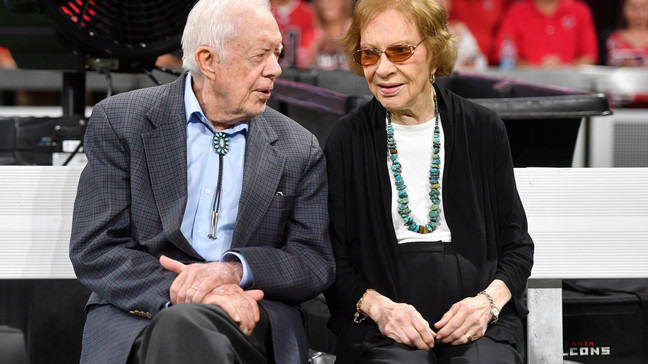
After several hospital stays, former President Jimmy Carter has entered hospice care at his home in Plains, Georgia. Hospice is often (but not always) comfort care as a person is dying. Carter, 98, is an example of a person whom I can disagree with politically while liking and admiring him as a human – and in Carter’s case, as a Christian and Bible teacher. In the divisive world we live in, it has become rare for us to be able to think, “I disagree with him politically, but he is a fine person and does a lot of good.” My impression of Carter as President was – weakness. He was weak in responding to the radical Islamicists. He was weak in protecting Americans taken hostage. The radical Islamicists sensed his weakness. They kept American hostages imprisoned until the day Carter left office. As Ronald Reagan was being inaugurated as President to follow Carter, our hostages were being released. And he gave away the Panama Canal. As an ex-President, Carter did a world of good. He was a leader – and a pretty good carpenter – in Habitat for Humanity. Hundreds of formerly homeless are now in homes built in part by Jimmy and Rosalynn Carter. While an ex-President, he taught his popular Sunday School class in Plains, Georgia, for over 40 years. Jimmy Carter and wife Rosalynn (pronounced rose-a-lynn) were a model for marital integrity. They were married in 1946 – 76 years of marriage. Wow. Jimmy Carter is the longest-living former President. Historians will likely say that Jimmy Carter did more as a former President than any except former President John Quincy Adams, who served in Congress for years until his dying day. Please be in prayer for President Carter, his wife, his family, and all who have loved him in his long life on this earth. He lived an abundant life. Jim Zeigler is the retired State Auditor of Alabama.
Nancy Pelosi to step aside from Dem leadership, remain in Congress

House Speaker Nancy Pelosi said Thursday that she will not seek a leadership position in the new Congress, making way for a new generation to steer the party after Democrats lost control of the House to Republicans in the midterm elections. Pelosi announced in a spirited speech on the House floor that she will step aside after leading Democrats for nearly 20 years and in the aftermath of the brutal attack on her husband, Paul, last month in their San Francisco home. The California Democrat, who rose to become the nation’s only woman to wield the speaker’s gavel, said she would remain in Congress as the representative from San Francisco, a position she has held for 35 years when the new Congress convenes in January. “I will not seek reelection to Democratic leadership in the next Congress,” she said. “For me, the hour has come for a new generation to lead the Democratic caucus that I so deeply respect.” Now, she said, “we must move boldly into the future.” Pelosi received a standing ovation after her remarks, and lawmakers and guests, one by one, went up to offer her hugs, many taking selfies of a moment in history. President Joe Biden spoke with Pelosi in the morning and congratulated her on her historic tenure as speaker of the House. “History will note she is the most consequential Speaker of the House of Representatives in our history,” Biden said in a statement, noting her ability to win unity from her caucus and her “absolute dignity.” It’s an unusual choice for a party leader to stay on after withdrawing from congressional leadership, but Pelosi has long defied convention in pursuing power in Washington. In an interview with reporters after her announcement, Pelosi said she won’t endorse anyone in the race to succeed her, and she won’t sit on any committees as a rank-and-file lawmaker. She said the attack on her husband “made me think again about staying.” But in the end, after the election, she decided to step down. “I quite frankly, personally, have been ready to leave for a while,” she said. “Because there are things I want to do. I like to dance, I like to sing. There’s a life out there, right?” During her remarks on the House floor, Pelosi recapped her career, from seeing the Capitol the first time as a young girl with her father — a former congressman and mayor — to serving as speaker alongside U.S. presidents and doing “the people’s work.” “Every day, I am in awe of the majestic miracle that is American democracy,” she said. Democrats cheered Pelosi as she arrived in the chamber at noon. On short notice, lawmakers filled the House, at least on the Democratic side, and Senate Majority Leader Chuck Schumer joined. He later joined a throng of lawmakers and hugged and kissed Pelosi on the cheek. The Speaker’s Gallery filled with Pelosi staff and guests. Some Republicans, including some newly elected members, also attended, though House Republican Leader Kevin McCarthy, who’s seeking the speakership in the new Congress, did not, telling reporters afterward that he was “busy, unfortunately.” Earlier, Pelosi noted in a statement after The Associated Press called control of the chamber that, in the next Congress, House Democrats will have “strong leverage over a scant Republican majority.” Pelosi was twice elected to the speakership and has led Democrats through consequential moments, including the passage of the Affordable Care Act with President Barack Obama and the impeachments of President Donald Trump. Her decision Thursday paves the way for House Democratic leadership elections next month when Democrats reorganize as the minority party for the new Congress. Pelosi’s leadership team, with Majority Leader Steny Hoyer of Maryland and Democratic Whip James Clyburn of South Carolina, has long moved as a triumvirate. All now in their 80s, the three House Democratic leaders have faced restless colleagues eager for them to step aside and allow a new generation to take charge. Hoyer said after Pelosi’s remarks that “it is the time for a new generation of leaders” and that he will also step down from leadership but stay in Congress. Clyburn, the highest-ranking Black American in Congress, has said he expects to stay in Congress next year and hopes to remain at the leadership table. Democratic Reps. Hakeem Jeffries of New York, Katherine Clark of Massachusetts, and Pete Aguilar of California have similarly moved as a trio, all working toward becoming the next generation of leaders. Jeffries could make history if he enters the race to become the nation’s first Black speaker of the House. After Pelosi spoke, Clyburn released a statement saying he looks forward “to doing whatever I can to assist our new generation of Democratic Leaders, which I hope to be Hakeem Jeffries, Katherine Clark, and Pete Aguilar.” One idea circulating on Capitol Hill was that Pelosi and the others could emerge as emeritus leaders as they pass the baton to new Democrats. First elected in 1987, Pelosi has been a pivotal figure in American politics, long ridiculed by Republicans as a San Francisco liberal while steadily rising as a skilled legislator and fundraising powerhouse. Her own Democratic colleagues have intermittently appreciated but also feared her powerful brand of leadership. Pelosi first became speaker in 2007, saying she had cracked the “marble ceiling” after Democrats swept to power in the 2006 midterm elections in a backlash to then-President George W. Bush and the wars in Iraq and Afghanistan. When she was poised in 2018 to return as speaker in the Trump era, she vowed: “to show the power of the gavel.” Pelosi has repeatedly withstood leadership challenges over the years and had suggested in 2018 she would serve four more years as leader. But she had not discussed those plans more recently. Typically unsentimental, Pelosi let show a rare moment of emotion on the eve of the midterm elections as she held back tears discussing the grave assault on her husband of nearly 60 years. Paul Pelosi suffered a fractured skull after an intruder broke into their home
Will Sellers: In defense of the Electoral College

This article originally appeared in City Journal. I came of age politically with the 1968 presidential election. Alabama governor George Wallace was running as an independent against Richard Nixon and Hubert Humphrey. My parents were Nixon supporters, and I, their five-year-old son, hopped on the Nixon bandwagon with gusto. The dinnertime conversations in the month preceding the election were all about whether Wallace’s third-party candidacy could work. This all fascinated me, so I asked my mother to let me watch her vote on Election Day. She agreed, but to my dismay, when I joined her in the voting booth, I did not see Nixon, Humphrey, or Wallace listed on the ballot. This made no sense to me; I thought we were here to vote for Richard Nixon? My mother then explained that we didn’t vote for the presidential candidate directly. Instead, we voted for men and women called presidential electors. These people were well-regarded and appointed for the special privilege of casting the deciding votes in presidential elections. This system seemed out of place to me, because in every other election the candidates were listed by name on the ballot. Why not for president? Why should my mother vote for nine people, who would then vote later for president, instead of voting directly for the president? This was my first encounter with the Electoral College. It would not be my last. The first electoral college was a medieval construct dating back at least to the twelfth century, when specific princes were chosen to elect the Holy Roman Emperor. They were influential noblemen, who, because of the importance of their respective kingdoms, were given the hereditary title of “elector.” After the death of the emperor, they met, much like the College of Cardinals, to choose a successor. Whether this idea influenced the deliberations of the Constitutional Convention is speculation, but, like most of the other aspects of the Constitution, the mechanics of the new government were based on historical facets of self-government. The new American nation was built on traditions of representative government expressed in the English parliamentary system, the organization of Protestant church government, and the colonial experience with various local governments in the New World. Important questions necessarily arose during the Constitutional Convention concerning the process of electing the president. How exactly would a president be chosen, and to whom or what would he owe allegiance? Some advocated for election to take place in the House of Representatives, or in the Senate, or even in the several states. The obvious problem with these proposals is that they would create an axis between the president and the electing body. If the states elected the president, then the larger, wealthier, and more populous states would receive greater attention and more favorable treatment by the executive branch than would the smaller, less populous states. A similar imbalance of power would occur were the president chosen by the House or the Senate. Thus, the mechanics of electing the chief executive required balancing various interests to give the executive branch the requisite independence from other political bodies, while maintaining co-equality. According to the chosen scheme, each state would appoint “electors” based on the number of House and Senate members comprising the state’s congressional delegation. These electors were appointed for the sole purpose of electing the president, and a simple majority of their votes would decide the election. This created another means by which the spheres of Congress and the federal government were balanced and divided from that of the states. The Constitutional Convention viewed electors as not necessarily aligned with a faction, but as citizens of honesty, integrity, and political acumen. Originally, electors voted for two people; the person with the most electoral votes became president, and the runner-up became vice-president. Flaws in this system became evident with the presidential election of 1796, when John Adams was elected as president and his archrival, if not nemesis, Thomas Jefferson, was elected vice president. Four years later, Jefferson and Aaron Burr received the same number of electoral votes—neither had the required majority. This unworkable situation was remedied by the 12th Amendment to the Constitution, which prescribed that electors would separately vote for a president and vice president on the same ballot. Later, state legislatures, as they were constitutionally permitted and as the two-party system grew, allowed electors to run as proxies for the presidential and vice-presidential party nominee. For at least the first 100 years, the system worked well, and, other than the 12th Amendment, no major attempts were made to alter the process of electing the president and vice president. Several times, the election was submitted to the House of Representatives after the electors failed to achieve a majority vote for president. For example, in 1824, the election was submitted to the House, where power plays resulted in the election of John Quincy Adams, though Andrew Jackson won significantly more of the popular and the electoral vote. Rutherford B. Hayes, a Republican, lost the 1876 popular vote to Samuel Tilden, a Democrat, but became president because he had prevailed in the electoral vote, though voter fraud in some jurisdictions seemed certain. Many Democratic candidates running for federal office embraced the idea of abolishing the Electoral College, not least Sam Rayburn, who, in his first congressional election in 1912, advocated electing the president by popular vote. If there was any momentum for this aspect of the Progressive movement, it lost steam as other, more critical issues advanced. Today, the constitutional method for electing the president is under siege. The result of the 2016 election—with Donald Trump winning the presidency despite losing the popular vote—led pundits and politicians to call for the presidential election to be based on the popular, not electoral, vote. But lamenting results that saw two presidents in recent memory fail to win the popular vote obscures the effect that abolishing the Electoral College would have on a national campaign. A presidential campaign aimed at achieving a popular vote majority would completely ignore
Darryl Paulson: Voters don’t understand or like the Electoral College

Here are a few basic facts about the electoral-college system. First, very few voters understand how it works. Second, most voters hate the system. Third, the system is almost impossible to change. Those who drafted the Constitution had little trust in democracy. James Madison, in The Federalist Papers, wrote that unfettered majorities tend toward “tyranny.” John Adams, signer of the Declaration of Independence and second President, noted that “Democracy never lasts long. It soon wastes, exhausts, and murders itself. There never was a democracy that did not commit suicide.” Reflecting their distrust of democracy, the drafters of the Constitution wanted to create a process where the president would be indirectly selected. Direct election was rejected because they believed that most voters were incapable of making a wise choice. Voters would likely vote for a well-known person, especially one from a voter’s home state. A Committee of Eleven was appointed and they recommended a compromise where each state would appoint presidential electors equal to the number of representatives and senators. The electors would cast a vote for president and vice president. The candidate with the most votes would be president and the candidate with the second highest vote would be vice president. The compromise was accepted and Alexander Hamilton described the electoral-college plan “if the manner of it be not perfect, it is at least excellent.” The compromise worked until the 1800 presidential election when electors cast an equal number of votes for Thomas Jefferson, who the Anti-Federalists wanted to be president and Aaron Burr, who they wanted as vice president. After 36 ballots, the House selected Jefferson as president. The 12th Amendment, adopted in 1804, separated the electoral vote for president and vice president. There is little doubt that Americans hate the Electoral College system and prefer the direct election of the president. The system has allowed the election of four presidents who lost the popular vote, but won the electoral vote. In 1824, Andrew Jackson won the popular vote, but lost when the House selected John Quincy Adams. In 1876, Samuel Tilden won the popular vote by a quarter million votes, but lost the electoral vote to Republican Rutherford B. Hayes. In 1888, Grover Cleveland received more popular votes but lost to Republican Benjamin Harrison. Finally, in 2000, Democrat Al Gore won the popular vote, but lost the election when Florida’s electoral votes were awarded to George W. Bush. Another complaint about the electoral college is that the winner-take-all feature does not reflect the popular will. A candidate with a plurality of the popular vote would win all of a state’s electoral votes in a three or four person race. Critics contend that the system discourages candidates from campaigning in states that they are sure to win or lose. No sense wasting time and money campaigning in those states. Instead, all of the attention is focused on a half-dozen competitive states like Florida and Ohio. If no candidate gets a majority of the electoral votes (270), the election is thrown into the House of Representatives. Each state, regardless of population, gets one vote. The least populated state has one vote; the most populated state gets one vote. If a state delegation’s vote is equally split, they get no vote until the deadlock is broken. Although reforms of the system have been pushed, the likelihood of reform is small. Small states, which have disproportionate power under the plan, are not likely to give up that power to support direct election. Supporters of direct election argue that it is the most democratic, which is precisely why the drafters of the Constitution dismissed it. Supporters also argue that it would force candidates to conduct national campaigns since every vote would matter. Critics of direct election argue that it would create gridlock in close elections. Imagine having to review over 100 million votes in a close election to see if they should be counted or dismissed. Would voters have confidence if a candidate won by a few thousand votes? What does the electoral-college system tell us about 2016. Hillary Clinton is a flawed candidate seeking a third consecutive win for Democrats, something that is difficult to do. However, we know that Republicans are not happy with either Donald Trump or Ted Cruz. The possibility of a contested convention further muddies Republican chances. A look at the electoral-college maps shows that Democrats usually win fewer states than Republicans, but they win the states with large numbers of electoral votes. While the electoral-college map of America looks overwhelmingly red, it is likely the Republicans will end up feeling blue. Larry Sabato, of the University of Virginia, projects that in a Clinton-Trump election, Clinton is likely to win 347 electoral votes to Trump’s 191. If so, an easy Clinton victory means there will be no pressure to reform the electoral-college system. *** Darryl Paulson is Professor Emeritus of Government at USF St. Petersburg.
