
A Georgia trial arguing redistricting harmed Black voters could decide control of a U.S. House seat
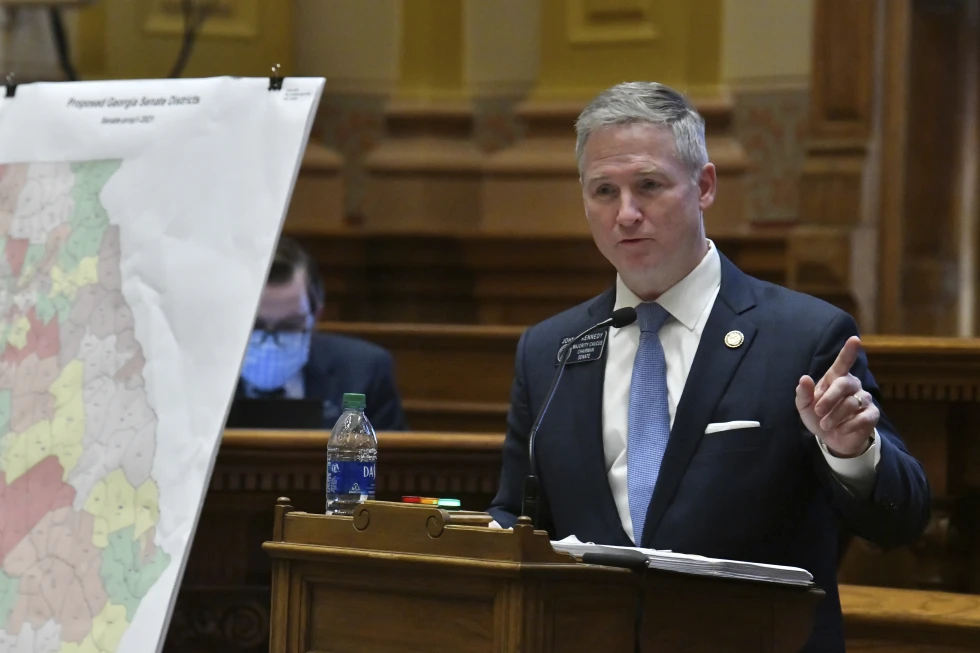
Democrats could gain a seat in the U.S. House and multiple seats in Georgia’s Legislature, if a judge rules Republicans drew maps illegally weakening Black voters’ power. The trial beginning Tuesday is part of a wave of litigation progressing after the U.S. Supreme Court earlier this year stood behind its interpretation of the Voting Rights Act, rejecting Alabama’s challenge to the law. The Voting Rights Act says voting district lines can’t result in discriminatory effects against minority voters, who must be allowed a chance to elect candidates of their choosing. Court cases challenging district lines drawn after the 2020 Census could shape 2024 congressional elections in states beyond Alabama and Georgia, including Florida, Louisiana, South Carolina, and Texas. Taken as a whole, those cases could affect the narrow hold Republicans have on the U.S. House. In Georgia, U.S. District Judge Steve Jones is hearing what is expected to be a two-week case without a jury. If he rules against the state, he is likely to order Georgia’s Republican-controlled General Assembly to redraw districts to comply with the law. The trial yokes together three different cases, meaning Jones could rule for the challengers in some instances and not others. Jones already ruled in March 2022 that some parts of Georgia’s redistricting plans probably violate federal law. He allowed the new congressional and state legislative maps to be used for 2022’s elections, finding changes close to elections would have been too disruptive. Charles Bullock, a University of Georgia political scientist who studies redistricting, said he expects Jones to side with the plaintiffs. “He found the plaintiffs had proven the elements of a Section 2 violation at that point,” Bullock said of the earlier ruling. The plaintiffs challenging the districts argue there is room to draw another Black-majority congressional seat on the west side of metro Atlanta, as well as three more majority-Black state Senate districts and five additional majority-Black state house districts in various parts of the state. They point to Georgia’s addition of a half million Black residents from 2010 to 2020, nearly half of all population growth. “Despite these striking demographic changes, the enacted congressional plan fails to reflect the growth in Georgia’s Black population,” the plaintiffs challenging Georgia’s congressional map wrote in a summary of their case filed with the court. The state, though, argues the plaintiffs haven’t proved voters act the way they do because of race, arguing partisanship is a stronger motivator. Defense attorneys, for example, point to the role of partisanship in the original election of Democratic U.S. Rep. Lucy McBath in 2018. McBath, who is Black, first won office in a district with a small Black population. Lawmakers then redrew lines to make the district significantly more Republican, leading McBath to jump to and win reelection in a different district. The state also argues plaintiffs would rely so much on race to draw districts that it would be illegal. “That’s a defense you can offer is what the plaintiffs want would require putting considerations of race above everything else,” Bullock said. But Kareem Crayton, senior director for voting and representation at New York University’s Brennan Center for Justice, said Georgia’s claims that lawmakers didn’t consider race in drawing lines, only partisanship, should lead to questions about whether they considered if the lines discriminated. “It sounds like, so far, the state is saying, ‘We don’t talk about race at all.’ But then, is there a story to be told about?” Crayton said. “What does it mean to have a significant portion of your state that has not been able to access power?” Republicans held an 8-6 majority in Georgia’s U.S. House delegation in 2020, but majority-GOP state lawmakers redrew lines to eliminate one of those Democratic seats, boosting their majority to 9-5. If the plaintiffs win, the balance could revert to 8-6 Republicans. However, lawmakers also could try to convert McBath’s current seat into a majority Black seat. The GOP currently holds a 102-78 majority in the state House and a 33-23 majority in the state Senate. While a plaintiff’s victory is unlikely to flip control in either chamber, additional Black-majority districts in the Senate and House could elect Democrats who would narrow Republican margins. Republished with the permission of The Associated Press.
Supreme Court voting rights ruling stuns minority voters, who hope it expands their representation
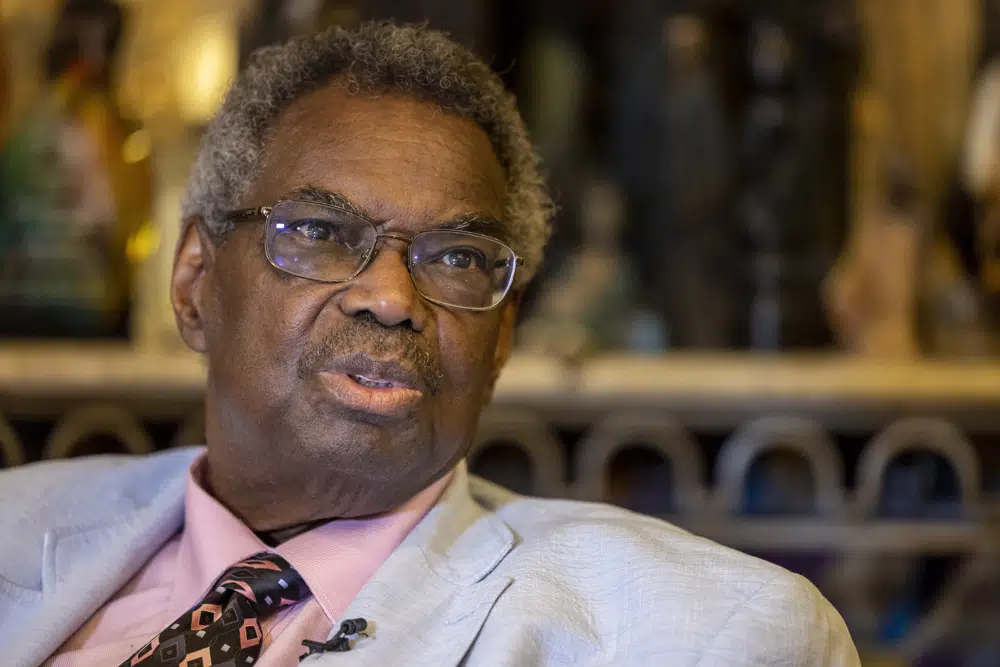
This week’s Supreme Court decision ordering Alabama to redraw its congressional districts was seen by many minority lawmakers and voting rights activists as a stunning victory with the potential to become a major stepping stone for undoing political maps that dilute the strength of communities of color. Hank Sanders, a former Alabama state lawmaker who has long been politically active in the state, knew there would be a decision since the court heard arguments in the case last fall. He was not anticipating being happy with the outcome, given that previous rulings of the conservative-leaning court had essentially gutted some of its most important provisions. “I was afraid they were going to go ahead and wipe out section 2,” he said, referring to the part of the Voting Rights Act at stake in the Alabama case. He was at his law office Thursday in Selma, scene of one of the most pivotal moments in the Civil Rights Movement, when news of the 5-4 ruling in favor of Alabama’s Black voters was announced. “It was a surprise that was good for my day,” he said. How the decision will affect similar lawsuits against political maps drawn in other states is unclear, although voting rights groups say the ruling provides firm guidance for lower courts to follow. The court majority found that Alabama concentrated Black voters in one district, while spreading them out among the others to make it much more difficult to elect more than one candidate of their choice. Alabama’s Black population is large enough and geographically compact enough to create a second district, the judges found. Just one of its seven congressional districts is majority Black, in a state where more than one in four residents is Black. Similar maps have been drawn in other states, primarily by Republican-controlled legislatures. Kareem Crayton, the Brennan Center’s senior director for voting and representation, called the court’s decision “a welcome surprise” and said challenges to the maps in Louisiana and Georgia were the most similar to the Alabama case. While it was considering the Alabama case, the Supreme Court had placed a hold on a lower court ruling in Louisiana allowing creation of a second majority-Black district. That’s now likely to be lifted. A federal judge last year also ruled that some of Georgia’s U.S. House and state legislative districts likely violated the Voting Rights Act, but he had allowed the districts to be used in the 2022 elections because it was too close to the election to redraw them. Maps in all three states could have to be redrawn for the 2024 elections. Louisiana Gov. John Bel Edwards, a Democrat, said in a statement that the court’s action reaffirmed his own belief that Louisiana’s map, which was drawn by the Republican-controlled Legislature, violated the law. “As I said when I vetoed it, Louisiana’s current congressional map violates the Voting Rights Act,” he said. “Louisiana’s voting population is one-third Black. We know that in compliance with the principles of the Voting Rights Act, Louisiana can have a congressional map where two of our six districts are majority Black.” Rep. Troy Carter, a Black Democrat representing Louisiana’s lone district that is majority Black, said the Legislature should immediately convene to draw a second majority-minority district. “This Supreme Court ruling is a win not just for Alabamians but for Louisianans as well,” Carter said in an emailed statement. “Rarely do we get a second chance to get things right — now Louisiana can.” In Georgia, Bishop Reginald Jackson, a plaintiff in one of the lawsuits challenging the state’s congressional map, said he was ecstatic when he heard the news about the ruling and hopes it will boost their case. He said he became involved in the lawsuit amid concerns that the state’s Black population had increased while the number of Black congressional representatives had decreased with the last round of redistricting. “So how could you have less Black representation when you have more Blacks moving into the state than before?” said Jackson, who presides over 534 African Methodist Episcopal churches in Georgia with over 90,000 parishioners The Alabama case, along with pending lawsuits in Georgia and Louisiana, means Black voters will likely have an opportunity to elect candidates in three additional districts, said Marina Jenkins, executive director of the National Redistricting Foundation, one of the organizations that has spearheaded voting rights challenges in the states. She said litigation in Texas by other plaintiff groups could mean additional seats there where minority voters “have the opportunity to elect candidates of their choice that don’t exist now.” Texas state Rep. Victoria Neave Criado, a Democrat who chairs the Mexican American Legislative Caucus, said the case was a “major win for voting rights.” She said following recent decisions by the current court in other areas she considers fundamental, such as last year’s overturning of the constitutional right to abortion, she was concerned about the direction the justices would take with voting rights and was relieved to see Thursday’s outcome. “As we are seeing the Latino community rise in many ways, we want to ensure that Latino power is translated into Latino political power,” Neave Criado said. Latinos and whites share an equal proportion of the Texas population, about 40% each, according to 2022 Census figures. Nina Perales, vice-president of litigation with the Mexican American Legal Defense and Educational Fund, said the ruling closes the door on Texas using arguments similar to those made by Alabama as the cases there go forward. Perales leads the litigation for a similar case out of Texas, which is based on the redistricting maps created in 2021. In addition to the Voting Rights Act challenge to Texas’ congressional districts, similar section 2 claims have been brought against numerous voting districts used for state legislatures and local governments around the country. Attorney Mark Gaber argued a case this week alleging Washington’s state legislative districts diluted the voting strength of Hispanic residents and will be arguing a similar case next week involving Native Americans and North Dakota’s state legislative districts. He thinks Thursday’s ruling will strengthen the case. In Alabama, the question
