
Raphael Warnock, Hershel Walker pivot to overtime in Georgia Senate contest
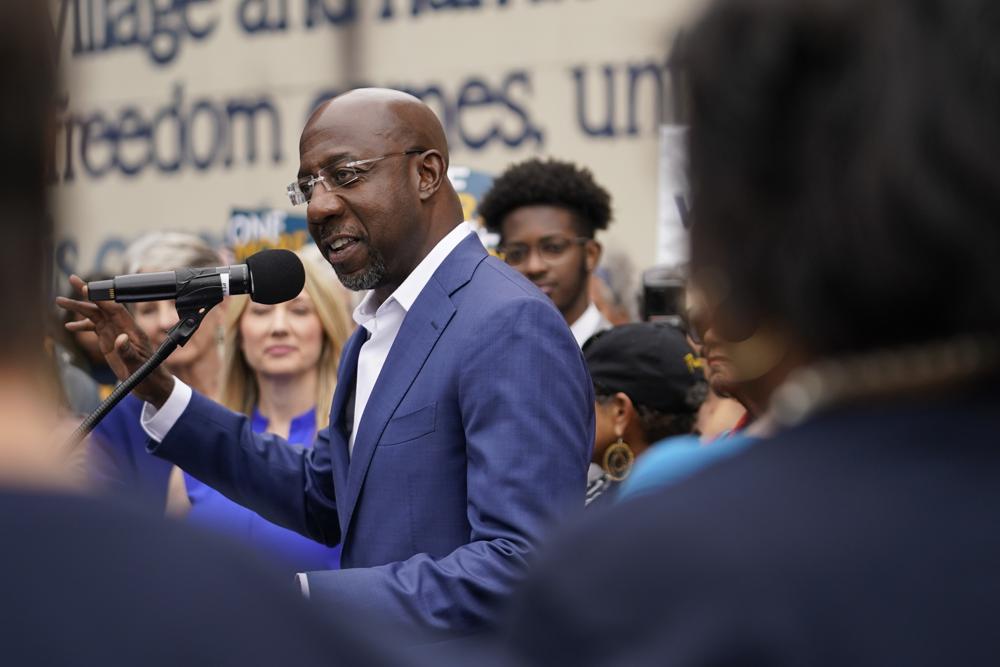
Democratic Sen. Raphael Warnock and Republican challenger Herschel Walker pivoted to a decisive extra round of their Senate race Thursday, while party leaders and donors around the country geared up for a four-week campaign blitz that could determine control of the chamber for the next two years. With votes still being counted in Senate contests in Arizona and Nevada, the single December 6 runoff in Georgia could either decide majority control — as did the state’s twin runoffs in 2021 — or further pad one party’s advantage. But neither Republicans nor Democrats were waiting for the Western states’ results to begin scrambling for big money. The Democrats’ Senate campaign arm announced early plans for a $7 million investment in field operations, a sum certain to be dwarfed by what both parties’ various committees will eventually spend on the airwaves. Top Republicans in Washington began huddling with donors, urging their continued support after the party nationwide fell short of expectations in Tuesday’s midterm elections. Former President Donald Trump, who has endorsed Walker, sent out fundraising pitches based on the runoff. The White House offered assurances that President Joe Biden would do whatever was best to help Warnock — even if that means keeping his distance. Warnock sidestepped the national implications Thursday, going directly at Walker and characterizing the former football star as unqualified and unfit for the office. “This race is about competence, and it’s about character,” Warnock said in his first public appearance since his election night party. He went on to detail Walker’s exaggerations of his business and professional achievements and allegations of violence against women, including Walker’s first wife. And he called Walker, who is making his first bid for public office, “manifestly uninformed” on public policy. “The choice between me and Herschel Walker is clear,” Warnock said. “Some things in life are complicated. This ain’t one of them. This is not a math test.” Walker was scheduled to host his first runoff campaign rally later Thursday in the northern reaches of metro Atlanta, key territory for Republicans in Georgia. Warnock’s searing indictment of Walker stands in contrast to the more muted arguments the senator offered for much of the fall, when he focused on his own record in Washington, especially deals with Republicans on infrastructure and provisions in Democratic bills to cap insulin and other drug costs for Medicare recipients. Both approaches, his advisers say, are aimed at independents and moderate Republicans who are critical in a state that, until recently, was dominated by the GOP at all levels of government. Tuesday’s election results appeared to validate Warnock’s strategy and show Walker’s vulnerability after sustained scrutiny of his past, including allegations from two former girlfriends that he encouraged and paid for their abortions despite calling for a national ban on the procedure as a political candidate. Walker led Warnock by about 35,000 votes out of more than 3.9 million cast but failed to clear the 50% threshold needed to avoid a runoff. More critically for Walker, he ran well behind nearly every other GOP nominee for statewide office, including Gov. Brian Kemp, who got about 200,000 more votes on his way to winning a second term. Walker’s vote shares trailed Trump’s 2020 marks across the state, in rural areas, suburban counties, and metro centers — and Trump still lost the state to Biden by a razor-thin margin. Republicans have acknowledged Walker’s flaws throughout the campaign but have argued Warnock remains vulnerable because of broad voter dissatisfaction with generally high inflation and the direction of the country under Democratic control of the White House and Capitol Hill. Dan Eberhart, a GOP donor, called Walker “damaged goods,” saying the contest has to be about who’s running Washington, not just a Georgia senator. “You are voting for Chuck Schumer or Mitch McConnell” to lead the Senate, Eberhart said. Walker, who dismisses the focus on his past as “foolishness,” has fully embraced a nationalized attack on his opponent. “Raphael Warnock represents Joe Biden, not the people of Georgia,” he says at every campaign stop. Stephen Lawson, who is leading the 34N22 political action committee in support of Walker’s bid, said the same. “That’s still the message: Elect a check on Joe Biden,” said Lawson, whose PAC features Walker’s jersey number as a running back for the University of Georgia and later pro football. Lawson said his PAC will focus on three pools of voters: the GOP base that stuck with Walker, the 200,000 Kemp voters who didn’t, and the 350,000 voters who backed Trump two years ago but didn’t return to the polls for the January 2021 runoffs that Democrats won. The anti-Biden message, he said, can reach all three groups. Warnock, for his part, tacitly acknowledges that his party affiliation may be his biggest liability, even as Democrats exceeded expectations Tuesday by winning enough to potentially hold their Senate majority and limit Republicans to a slim House majority, at best. From the start of his campaign, Warnock has distanced himself from Biden, at least in his campaign speeches and television advertising. The senator alludes to his 2021 runoff victory alongside fellow Georgia Democratic Sen. Jon Ossoff and links it to Democratic accomplishments, from the COVID-19 pandemic relief package to the confirmation of Supreme Court Justice Ketanji Brown Jackson as the first Black woman on the nation’s highest judicial body. Biden’s approval ratings nationally hover in the low 40s and are even lower in Georgia. White House communications director Kate Bedingfield said it was up to Warnock to decide what is best for his campaign. “The president will do whatever is helpful to Sen. Warnock, whether that’s campaigning with him, whether that’s raising money,” she said Thursday on CNN. “Whatever Sen. Warnock would like, the president will do.” But regardless of either candidate’s difficulty navigating his liabilities, one thing is certain: A full-scale national fight is underway. “There’s going to be plenty of money,” said Eberhart. “It’s the only game in town, so everyone will still be there.” Republished with the permission of The Associated Press.
Bipartisan deal near on trimmed $10 billion COVID bill

Lawmakers moved to the brink Thursday of shaking hands on a scaled-back bipartisan compromise providing a fresh $10 billion to combat COVID-19, a deal that could set up final congressional approval next week. The price tag was down from an earlier $15.6 billion agreement between the two parties that collapsed weeks ago after House Democrats rejected cutting unused pandemic aid to states to help pay for it. President Joe Biden requested $22.5 billion in early March. With leaders hoping to move the package through Congress quickly, the lowered cost seemed to reflect both parties’ calculations that agreeing soon to additional savings would be too hard. The effort, which would finance steps like vaccines, treatments, and tests, comes as Biden and other Democrats have warned the government is running out of money to counter the pandemic. At the same time, the more transmissible omicron variant BA.2 has been spreading quickly in the U.S. and abroad. “We’ve reached an agreement in principle on all the spending and all of the offsets,” Sen. Mitt Romney of Utah, the lead Republican bargainer, told reporters, using Washington-speak for savings. “It’s entirely balanced by offsets.” Senate Majority Leader Chuck Schumer, D-N.Y., and others were more circumspect. “We are getting close to a final agreement that would garner bipartisan support,” Schumer said on the Senate floor. He said lawmakers were still finalizing the bill’s components and language and awaiting a cost estimate from the nonpartisan Congressional Budget Office. Sen. Patty Murray, D-Wash., chair of the Senate health committee and another bargainer, said, “I’m hoping,” when asked about Romney’s assessment. Once clinched, an agreement would represent a semblance of bipartisan cooperation in battling the pandemic that dissolved a year ago, when a far larger, $1.9 trillion measure proposed by the new president cleared Congress with only Democratic votes. That bill was laden with spending to help struggling families, businesses, and communities, while this one would be aimed exclusively at public health. Many Republicans have been willing to go along with the new expenditures but have insisted on paying for them with unspent funds from previous bills Congress has enacted to address the pandemic. Half the new measure’s $10 billion would be used for treatments, said Sen. Roy Blunt, R-Mo., who has helped negotiate the agreement. He said top federal health officials would be given wide discretion on spending the rest of it, but it would include research and other steps for battling the disease, which has killed around 975,000 Americans and millions across the world. Romney and others said savings the two parties had agreed to for the new bill would not include the cuts in state assistance that House Democrats opposed. He said some unused funds would be culled from another pandemic program that gives state and local governments funds for grants to local businesses. Blunt said both sides had also agreed to savings that include pulling back an unspent $2.2 billion for aiding entertainment venues closed during the pandemic and more than $2 billion still available for assisting aviation manufacturing. Romney said the $10 billion might include $1 billion for vaccines, treatments, and other support for countries overseas. Blunt said that figure seemed unresolved. One-third of the earlier $15.6 billion measure had been slated to go abroad. The lowered figure for assisting other countries encountered opposition in the House, where some Democrats wanted to boost the figure. Epidemiologists have cited the need to vaccinate more people around the world and reduce the virus’ opportunities for spinning off new variants. “It’s a problem,” House Speaker Nancy Pelosi, D-Calif., told reporters. “It’s a shame.” Kate Bedingfield, White House communications director, said officials were “very hopeful” an agreement would be reached and prodded lawmakers to include funds to help other countries cope with the disease. “We’re not going to be able to put this pandemic behind us until we stop the spread and proliferation of new variants globally,” Bedingfield said. Leaders hope Congress can approve the legislation before lawmakers leave for a spring recess after next week. Republicans have leverage in the Democratic-controlled, 50-50 Senate because 60 votes are needed to pass most major bills. Romney and Blunt both said they believed a finalized package they described would attract significantly more than the 10 GOP votes needed. Since the pandemic began, Congress has approved more than $5 trillion to address the economic and health crises it produced. Only a small fraction of that has been for public health programs like vaccines. In an interview earlier Thursday with Punchbowl News, Senate Republican Leader Mitch McConnell, R-Ky., said the measure’s price tag seemed to have fallen to $10 billion because Democrats weren’t agreeing to additional savings. Minutes later, Schumer took to the Senate floor and mentioned no figures but suggested its size could fall. “I’m pleading with my Republican colleagues, join us,” Schumer said. “We want more than you do, but we have to get something done. We have to get something done.” Asked if he thought an agreement could be reached before lawmakers’ recess, McConnell said, “We’ll see. Hope so.” Republished with the permission of the Associated Press.
White House: Intel shows Vladimir Putin misled by advisers on Ukraine

U.S. intelligence officials have determined that Russian President Vladimir Putin is being misinformed by advisers about his military’s poor performance in Ukraine, according to the White House. The advisers are scared to tell him the truth, the intel says. The findings, recently declassified, indicate that Putin is aware of the situation on information coming to him and there now is persistent tension between him and senior Russian military officials. The U.S. believes Putin is being misled not only about his military’s performance but also “how the Russian economy is being crippled by sanctions because, again, his senior advisers are too afraid to tell him the truth,” White House communications director Kate Bedingfield said Wednesday. Earlier, President Joe Biden said in an exchange with reporters that he could not comment on the intelligence. The administration is hopeful that divulging the finding could help prod Putin to reconsider his options in Ukraine, according to a U.S. official. The official was not authorized to comment and spoke on the condition of anonymity. The war has ground to a bloody stalemate in much of the country, with heavy casualties and Russian troop morale sinking as Ukrainian forces and volunteers put up an unexpectedly stout defense. But the publicity could also risk further isolating Putin, who U.S. officials have said seems at least in part driven by a desire to win back Russian prestige lost by the fall of the Soviet Union. “What it does is underscore that this has been a strategic blunder for Russia,” Bedingfield said of the intelligence finding. “But I’m not going to characterize how … Vladimir Putin might be thinking about this.” Meanwhile, Biden told Ukrainian President Volodymyr Zelenskyy during a 55-minute call that an additional $500 million in direct aid for Ukraine was on its way. It’s the latest burst in American assistance as the Russian invasion grinds on. Asked about the latest intelligence, Secretary of State Antony Blinken suggested that a dynamic within the Kremlin exists where advisers are unwilling to speak to Putin with candor. “One of the Achilles’ heels of autocracies is that you don’t have people in those systems that speak truth to power or have the ability to speak truth to power, and I think that’s what we’re seeing in Russia,” Blinken told reporters during a stop in Algeria on Wednesday. The unidentified official did not detail underlying evidence for how U.S. intelligence made its determination. The intelligence community has concluded that Putin was unaware that his military had been using and losing conscripts in Ukraine. They also have determined he is not fully aware of the extent to which the Russian economy is being damaged by economic sanctions imposed by the U.S. and allies. The findings demonstrate a “clear breakdown in the flow of accurate information” to Putin and show that Putin’s senior advisers are “afraid to tell him the truth,” the official said. Biden notified Zelenskyy about the latest tranche of assistance during a call in which the leaders also reviewed security aid already delivered to Ukraine and the effects that weaponry has had on the war, according to the White House. Zelesnkyy has pressed the Biden administration and other Western allies to provide Ukraine with military jets, something that the U.S. and other NATO countries have thus far been unwilling to accommodate out of concern it could lead to Russia broadening the war beyond Ukraine’s borders. Prior to Wednesday’s announcement of $500 million in aid, the Biden administration had sent Ukraine about $2 billion in humanitarian and security assistance since the start of the war last month. Congress approved $13.6 billion that Congress approved earlier this month as part of a broader spending bill. Bedingfield said the latest round of financial assistance could be used by the Ukrainian government “to bolster its economy and pay for budgetary expenses,” including government salaries and maintaining services. Ukraine’s presidential website says Zelenskyy told Biden: “We need peace, and it will be achieved only when we have a strong position on the battlefield. Our morale is firm, there is enough determination, but we need your immediate support.” Zelenskyy, in a Twitter posting, said that he also spoke to Biden about new sanctions against Russia. Bedingfield said the administration is looking at options to expand and deepen current sanctions. The new intelligence came after the White House on Tuesday expressed skepticism about Russia’s public announcement that it would dial back operations near Kyiv in an effort to increase trust in ongoing talks between Ukrainian and Russian officials in Turkey. Russian forces pounded areas around Ukraine’s capital and another city overnight, regional leaders said Wednesday. The Pentagon said Wednesday that over the past 24 hours, it had seen some Russian troops in the areas around Kyiv moving north toward or into Belarus. Pentagon press secretary John Kirby said in interviews with CNN and Fox Business that the U.S. does not view this as a withdrawal but as an attempt by Russia to resupply, refit, and then reposition the troops. Putin has long been seen outside Russia as insular and surrounded by officials who don’t always tell him the truth. U.S. officials have said publicly they believe that the limited flow of information –- possibly exacerbated by Putin’s heightened isolation during the COVID-19 pandemic -– may have given the Russian president unrealistic views of how quickly he could overrun Ukraine. The Biden administration, before the war, launched an unprecedented effort to publicize what it believed were Putin’s invasion plans, drawing on intelligence findings. While Russia still invaded, the White House was widely credited with drawing attention to Ukraine and pushing initially reluctant allies to back tough sanctions that have hammered the Russian economy. But underscoring the limits of intelligence, the U.S. also underestimated Ukraine’s will to fight before the invasion, said Lt. Gen. Scott Berrier, head of the Defense Intelligence Agency, in recent testimony before Congress. Republished with the permission of the Associated Press.
White House taps populist message as Joe Biden pushes $3.5T plan
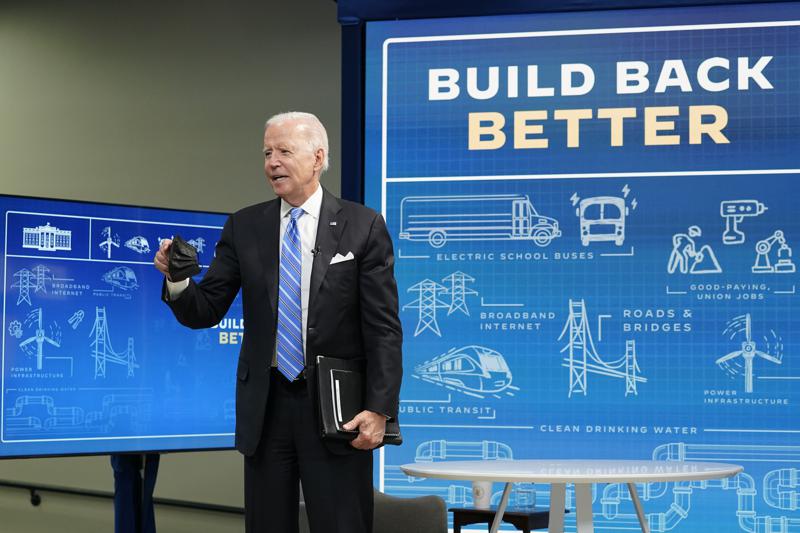
The White House is preparing an urgent and populist message for selling President Joe Biden’s $3.5 trillion “build back better” agenda, even as House committee leaders begin churning out pieces of the forthcoming measure. In a memo being sent Tuesday to Capitol Hill and obtained by The Associated Press, the administration warns there is no time to waste in passing the package of corporate tax hikes and domestic initiatives by the end of the month. “We face a fundamental choice in America right now as we rebuild our economy: this time, will everyone get in on the deal?” the memo says. “The time is now. We have to meet the needs in front of us. Not tomorrow, not months from now, not next year. Right now.” The urgent appeal comes at a crucial time, with House and Senate Democrats hoping to assemble the package by a self-imposed Sept. 15 deadline. It also comes as Biden seeks to refocus on his core campaign promises after a brutal summer, punctuated by spiking COVID-19 cases and the deadly evacuations and withdrawal from Afghanistan. Illustrating Democrats’ ambition as well as the challenges they face, House Ways and Means Chairman Richard Neal released part of his panel’s portion of the bill Tuesday. The Massachusetts Democrat proposed creating a new paid family and medical leave program for workers that is more generous than Biden’s own plan and expanding Medicare to provide dental, vision, and hearing benefits. But Neal also did not immediately unveil tax boosts on the rich and corporations that Democrats say will pay for much of the measure’s cost, saving that for coming days. The tax increases are likely to be among the most contentious items in the package, with some moderate Democrats facing tough reelection fights wary of them. But they are crucial if the party wants to support its claim that those tax boosts and other savings will pay for the entire measure, which they say will cost $3.5 trillion over 10 years. Neal and Senate Finance Committee Chairman Ron Wyden, D-Ore., are trying to resolve differences over some items in hopes the measure the House ultimately approves will largely face smooth sailing in the Senate, said Democrats who spoke on condition of anonymity to describe the legislation’s status. The bill will need the support of virtually every Democrat to clear the closely divided Congress. The Ways and Means panel has jurisdiction over the biggest chunk of the overall bill, and its members plan to begin voting on their piece of the plan on Thursday and Friday. “This is our historic opportunity to support working families and ensure our economy is stronger, more inclusive, and more resilient for generations to come,” Neal said in a statement. Republicans say Neal’s measure will end up raising taxes on people earning under $400,000, which Biden and Democrats have said will not happen. “They’re hiding the ball,” said J.P. Freire, the panel’s GOP spokesman. The committee’s proposal will pay for up to 12 weeks of paid family and medical leave for workers, beginning in 2023, including for higher earners. Biden’s plan would be phased in over the decade. Neal’s proposal would also phase in Medicare coverage for vision benefits starting in 2022, hearing in 2023, and dental in 2028. Missing in the details, he released Tuesday was a proposal to lower the Medicare eligibility age to 60, which has been considered unlikely to be included because it is expensive. It includes increased spending for child care, long-term care facilities, better benefits for workers laid off due to imports, and training health care workers. It would also require many employers to automatically enroll workers in savings arrangements like IRAs or 401(k) plans. Inside the White House, September is seen as a crucial month to make gains on Biden’s agenda. In speeches and travel, the president is expected to take a more aggressively populist tone as he rallies support for the plan. Congressional approval is not guaranteed as Democrats work to fundamentally reorder aspects of the U.S. economy and its governmental support systems. Democrats are already preparing for an onslaught of attacks over what Republicans call Biden’s big tax and spending plans, as the GOP tries to wrest control of Congress by winning House and Senate seats in next year’s midterm elections. In framing the arguments ahead as a choice, the White House is showing congressional Democrats one way the administration plans to counter those Republican attacks. “Republicans who oppose the Build Back Better agenda have chosen whose side they are on, too,” said the memo from White House Communications Director Kate Bedingfield to House Democratic communicators. “The Build Back Better agenda is about tackling those challenges and leveling the playing field to ensure the wealthiest and corporations pay their fair share and working families get a fighting chance to succeed and prosper in this country,” the memo said. Republished with the permission of the Associated Press.
Joe Biden chooses an all-female senior White House press team
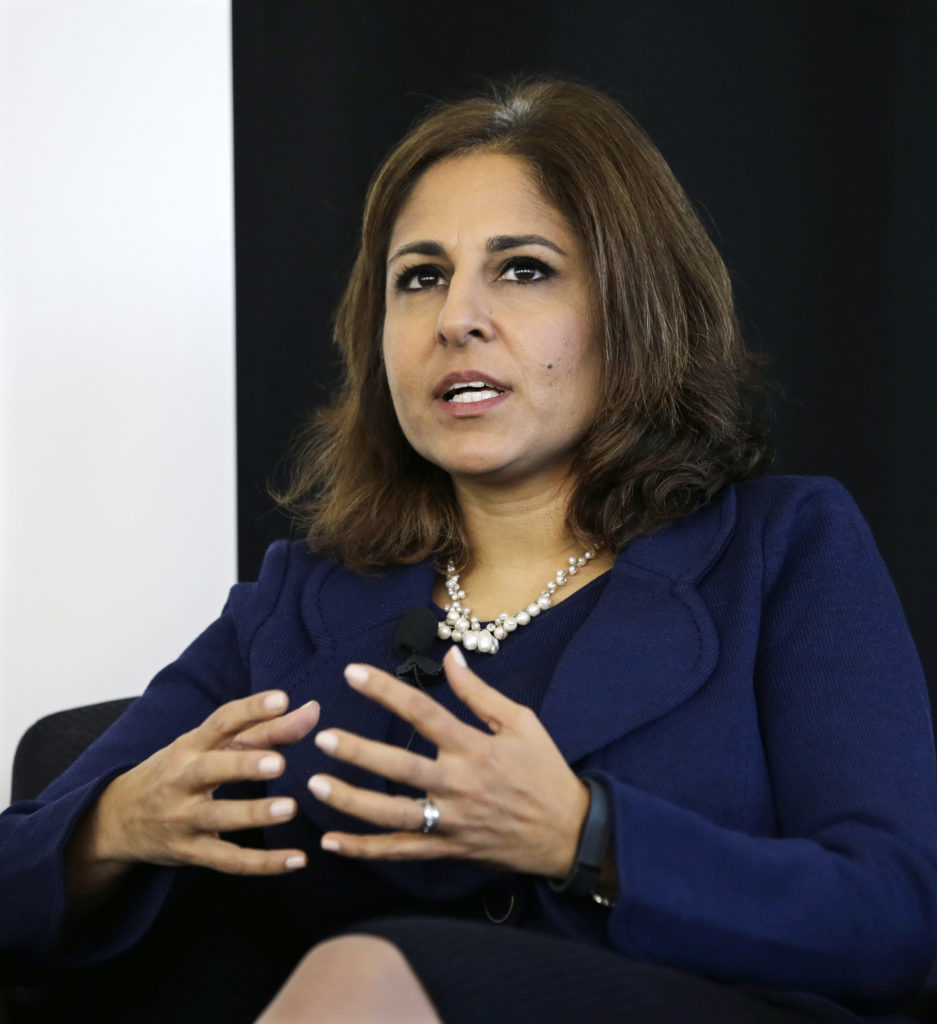
President-elect Joe Biden will have an all-female senior communications team at his White House, reflecting his stated desire to build out a diverse White House team as well as what’s expected to be a return to a more traditional press operation. Biden campaign communications director Kate Bedingfield will serve as Biden’s White House communications director. Jen Psaki, a longtime Democratic spokeswoman, will be his press secretary. In a different area of the White House operation, Biden plans to name Neera Tanden, the president and CEO of the liberal think tank Center for American Progress, as director of the Office of Management and Budget, according to a person familiar with the transition process granted anonymity to speak freely about internal deliberations. Four of the seven top communications roles at the White House will be filled by women of color, and it’s the first time the entire senior White House communications team will be entirely female. President Donald Trump upended the ways in which his administration communicated with the press. In contrast with administrations past, Trump’s communications team held few press briefings, and those that did occur were often combative affairs riddled with inaccuracies and falsehoods. Trump himself sometimes served as his own press secretary, taking questions from the media, and he often bypassed the White House press corps entirely by dialing into his favorite Fox News shows. In a statement announcing the White House communications team, Biden said: “Communicating directly and truthfully to the American people is one of the most important duties of a President, and this team will be entrusted with the tremendous responsibility of connecting the American people to the White House.” He added: “These qualified, experienced communicators bring diverse perspectives to their work and a shared commitment to building this country back better.” Bedingfield, Psaki and Tanden are all veterans of the Obama administration. Bedingfield served as communications director for Biden while he was vice president; Psaki was a White House communications director and a spokesperson at the State Department; and Tanden served as a senior adviser to Health and Human Services Secretary Kathleen Sebelius and helped craft the Affordable Care Act. Others joining the White House communications staff are: — Karine Jean Pierre, who was Vice President-elect Kamala Harris’ chief of staff, will serve as a principal deputy press secretary for the president-elect. She’s another Obama administration alum, having served as a regional political director for the White House office of political affairs. — Pili Tobar, who was communications director for coalitions on Biden’s campaign, will be his deputy White House communications director. She most recently was deputy director for America’s Voice, an immigration reform advocacy group, and was a press staffer for Senate Minority Leader Chuck Schumer, D-N.Y. Three Biden campaign senior advisers are being appointed to top communications roles: — Ashley Etienne, a former communications director for House Speaker Nancy Pelosi, will serve as Harris’ communications director. — Symone Sanders, another senior adviser on the Biden campaign, will be Harris’ senior adviser and chief spokesperson. — Elizabeth Alexander, who served as the former vice president’s press secretary and his communications director while he was a U.S. senator from Delaware, will serve as Jill Biden’s communications director. After his campaign went virtual due to the coronavirus pandemic, Biden faced some of his own criticism for not being accessible to reporters. But near the end of the campaign, he answered questions from the press more frequently, and his transition team has held weekly briefings since he was elected president. The choice of a number of Obama administration veterans — many with deep relationships with the Washington press corps — also suggests a return to a more congenial relationship with the press. As head of the OMB, Tanden would be responsible for preparing Biden’s budget submission and would command several hundred budget analysts, economists and policy advisers with deep knowledge of the inner workings of the government. Her choice may mollify progressives, who have been putting pressure on Biden to show his commitment to progressive priorities with his early staff appointments. She was chosen over more moderate voices with roots in the party’s anti-deficit wing such as Bruce Reed, who was staff director of President Barack Obama’s 2010 deficit commission, which proposed a set of politically painful recommendations that were never acted upon. Republished with the permission of the Associated Press.
Mike Pence urges in-person school this fall
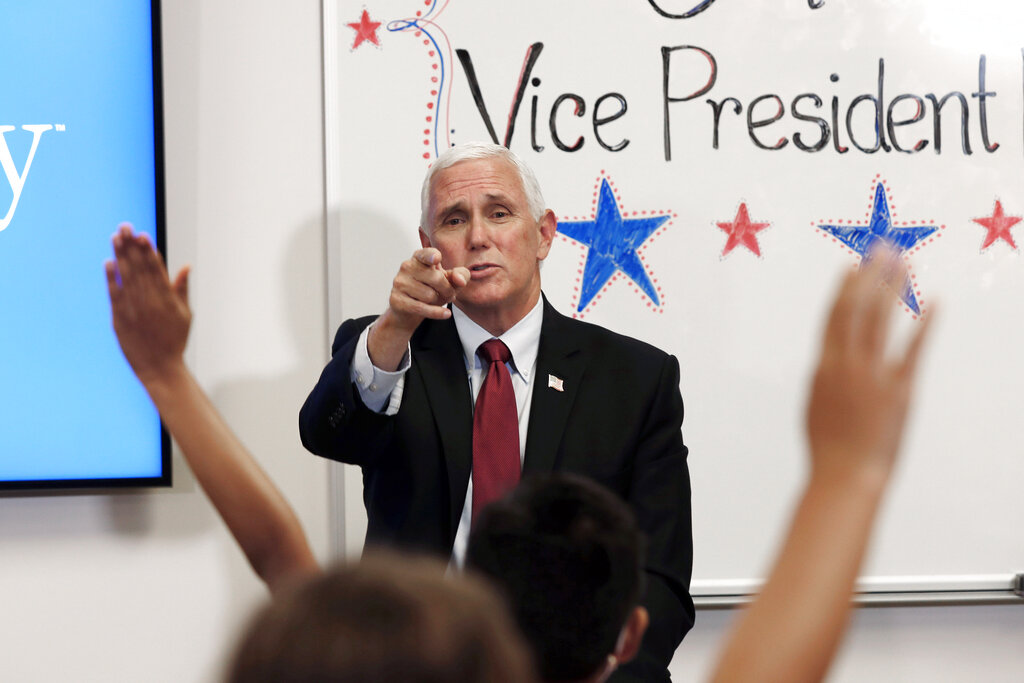
Education Secretary Bety Devos also announced $180 million in grants on Wednesday.
Donald Trump, Joe Biden spoke by phone about coronavirus outbreak
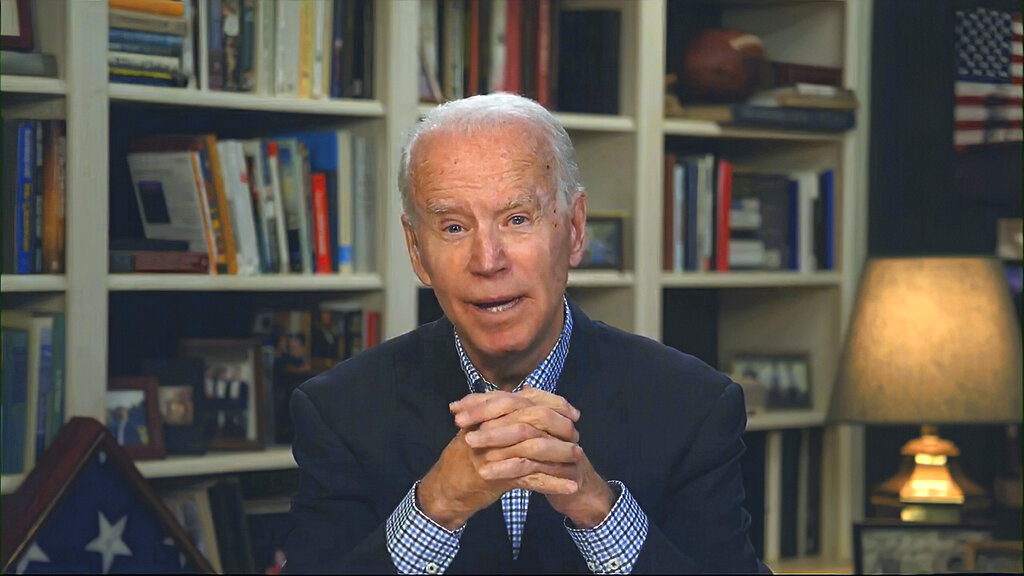
The president said he and Biden agreed not to share the details of their conversation.
