Kay Ivey gets a ‘D’ in report card stacking up U.S. governors’ fiscal policies
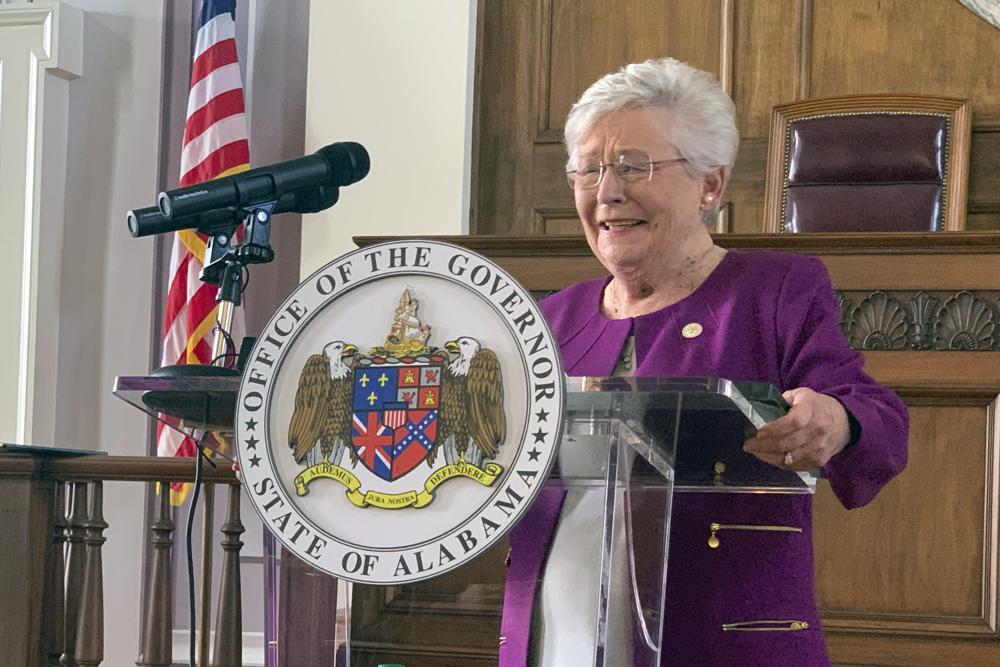
Gov. Kay Ivey’s years-long support of an increased gas tax in Alabama landed her in the bottom tier of a new report grading states’ top-level leaders on their fiscal policies. The Cato Institute, a public policy organization focused on limited government, recently released its 2022 Fiscal Policy Report Card on America’s Governors. Co-authors Chris Edwards and Ilana Blumsack gave Ivey, who is seeking a second full term in office this fall, a score of “D.” In their analysis of Ivey’s fiscal performance throughout her first full term in office, Edwards and Blumsack elaborated on why they gave the governor a low score. “Running for a full term in office in 2018, Ivey said she opposed tax increases,” Edwards and Blumsack wrote. “Nonetheless, she has raised some taxes, including the gas tax by 10 cents per gallon in 2019 and an assessment on nursing home facilities in 2020.” In their report, the authors did note some of Ivey’s more recent tax-cutting overtures in her run-up to reelection and against the backdrop of inflation. “Ivey switched direction recently and approved modest tax cuts, including raising the standard deduction, exempting $6,000 of retirement income from taxes, increasing an adoption credit, and exempting small businesses from the business privilege tax,” Edwards and Blumsack wrote. Early this year, during the most recent legislative session, Ivey also touted her support of House Bill 231, which she signed into law in February. “I am proud to sign this needed tax relief into law so that money will return directly into the hands of hardworking Alabamians,” Ivey said in the news release. Ivey’s support of a gas tax, and her denial of cutting it back this spring, has been a source of criticism since she first signed the legislation into law in 2019. Proceeds from portions of the increased gas tax have been poured into Ivey’s 2019 Rebuild Alabama Act, which required the state’s Department of Transportation to annually allocate $10 million from excised gas taxes. “Since becoming governor, with the support of Rebuild Alabama, we have embarked on more than 1,500 new road and bridge projects worth more than $5 billion,” Ivey said in March. “We certainly have more work in front of us, and I am proud to continue those efforts today.” While the Cato Institute’s newest report did not have a clear-cut partisan divide in the granular state-by-state rankings, there was a prevailing theme. The top-performing governors in this year’s report were Republican, while the lowest-scoring leaders were Democrats. “The results are data-driven. They account for tax and spending actions that affect short-term budgets in the states,” Edwards and Blumsack said of their methodology. “But they do not account for longer-term or structural changes that governors may make, such as reforms to state pension plans.” Five governors, all Republican, received an “A” in this year’s Cato Institute report: Doug Ducey of Arizona; Brad Little of Idaho; Kim Reynolds of Iowa; Pete Ricketts of Nebraska; and Chris Sununu of New Hampshire. On the bottom end, eight Democrat governors received an “F” in the Cato Institute’s analysis of their fiscal policies: Kate Brown of Oregon; Jay Inslee of Washington; Phil Murphy of New Jersey; Gavin Newsom of California; J.B. Pritzker of Illinois; Tim Walz of Minnesota; Gretchen Whitmer of Michigan; and Tom Wolf of Pennsylvania. Republished with the permission of The Center Square.
Senators: Allow feds to keep guns from people deemed threat

Senators from both parties are proposing to let federal courts keep guns away from people who show warning signs of violence in response to the deadly school shooting in Florida. South Carolina Republican Sen. Lindsey Graham and Connecticut Democrat Richard Blumenthal said Thursday their bill is a common-sense proposal to save lives. At a news conference, Graham said the government encourages people who see something suspicious to “say something” to authorities. He asked, “Isn’t it incumbent on government to do something” to prevent gun violence? The bill is modeled on state “red flag laws” that let officials take guns away from people who are judged to pose an imminent danger to themselves or others. A federal law would fill gaps in state laws, Graham said, noting that only a handful of states allow gun-violence restraining orders. “Guns and shooters cross borders,” Blumenthal said. “That’s why a federal solution is important.” A federal red-flag law “will save lives,” he said. Police and the FBI received numerous warnings about the accused Florida shooter but did not move to take away his guns. Graham and Blumenthal said they were motivated not just by the Feb. 14 shooting that killed 17 people in Parkland, Florida, but also by high-profile shootings in their home states — a 2015 massacre at a Charleston, South Carolina, church that killed nine people and a 2012 shooting that killed 20 school children and six adults in Newtown, Connecticut. “I’m 62 years old. I’m tired of going home and telling people we just can’t do anything,” Graham said. Blumenthal said he is frequently asked in Connecticut why Congress can’t stop dangerous people from having guns. “An aroused and outraged public” will be able to overcome opposition from the National Rifle Association and other gun-rights groups, he said. Oregon Gov. Kate Brown signed a law this week prohibiting domestic abusers and people under restraining orders from owning firearms. Florida lawmakers, meantime, have approved a bill would let law enforcement officers petition a court for a risk protection order for individuals that show signs of harming themselves or others. Republican Gov. Rick Scott has not said whether he’ll sign it. Florida Sens. Marco Rubio and Bill Nelson have introduced a bipartisan bill to encourage states to adopt red-flag laws, with federal grants conditioned on meeting a series of requirements. Rubio is a Republican, and Nelson is a Democrat. Republished with the permission of the Associated Press.