
Legislature passes bill allowing social workers to diagnose mental illness

On Tuesday, the Alabama Senate State voted 32 to 0 to pass legislation allowing certain highly trained social workers to diagnose mental illnesses. The bill had already passed the House of Representatives 104 to 1. House Bill 56 (HB56) is sponsored by State Representative Frances Holk-Jones. It was carried in the Senate by State Senator Linda Coleman-Madison. HB56 has already passed the House 104 to 1. Sen. Coleman-Madison said, “It gives me great pleasure to present this bill.” “There is a limited number of social workers in our state,” Coleman-Madison said. “This will expand their scope of practice.” “We need social workers in the state,” Coleman-Madison said. “I am very supportive of the bill,” Sen. Will Barfoot said. “My Aunt is in the Social Worker Hall of Fame.” Barfoot said that his daughter is in her final year of college to be a social worker. “There is a huge need for social workers in our state: geriatric, veterans, in the schools, and working with mental health,” Barfoot explained. Sen. Dan Roberts said, “I congratulate you for working on this bill.” Rep. Holk-Jones explained to the Senate State Governmental Affairs Committee that “Alabama is currently the only state that does not allow” these highly trained social workers to diagnose mental illness. “We are losing these social workers to other states,” Holk-Jones said. “This allows people to get diagnosed and treatment without traveling to see a medical professional.” Sen. Coleman-Madison sponsored the Senate version of the bill, SB109, which had already passed the Senate. SB109 likely will remain in committee as the House version has already passed both Houses. The legislation expands the scope of practice of a licensed independent clinical social worker, including the authority to diagnose and develop treatment plans. “The scope of practice does not include the diagnosis, treatment, or provision of advice to a client for problems or complaints relating to conditions outside the boundaries of the practice of social work.” The legislation states that no individual may engage in the independent clinical practice of social work unless they satisfy all of the following: (1) Licensed is licensed under this chapter as a licensed independent clinical social worker; and. (2) Has a doctorate or master’s degree from a school of social work approved, accredited, or in candidacy granted by the Council on Social Work Education; and. (3) Has had two years of full-time or three years of part-time postgraduate experience under appropriate supervision in the specified social work method or four years of full-time or five years of part-time postgraduate experience under appropriate supervision in the specialty in which the applicant will practice. (4) Has passed an examination prepared by the board for this purpose; except that prior to the time that an examination is prepared by the board for this purpose, no person individual who otherwise meets the requirements of this section will be prohibited from engaging in the private independent practice of social work; and. (5) Has been issued by mail a certified letter of certification stating his or her qualification for private independent practice by the board; and. (6) Has paid an initial certification fee set by the board. “The terms diagnose and treatment, whether considered in isolation or in conjunction with the rules of the board, may not be construed to permit the performance of any act which a licensed clinical social worker is not educated or trained to perform including, but not limited to, any of the following: (1) Administering and interpreting psychological tests or intellectual, neuropsychological, personality, or projective instruments. (2) Admitting any individual to a hospital for treatment of any condition that is outside the boundaries of the practice of social work, as provided in subsection (b). (3) Treating any individual in a hospital setting without medical supervision. (4) Prescribing medicinal drugs. (5) Authorizing clinical laboratory procedures or radiological procedures. (6) Using electroconvulsive therapy. The state of Alabama has a significant shortage of mental health professionals. Coleman-Madison said, “I am carrying this for Rep. Holk-Jones. I think this is her first bill.” Since HB56 has been passed in both Houses in the same form, the legislation now goes to Gov. Kay Ivey for her consideration. Tuesday was day 14 of the 2023 Alabama Regular Legislative Session. To connect with the author of this story or to comment, email brandonmreporter@gmail.com.
Steve Flowers: Alabama has a host of outstanding political leaders under 45
It may appear to you and most casual observers of Alabama politics that our Alabama elected officials are old. That observation is accurate when you observe our current leaders in the highest offices. The governor’s office has been held by mature folks in recent years. Our current Governor, Kay Ivey, is 78 and has been the object of national media humor for appearing to be a pistol-toting great-grandmother. Dr. Robert Bentley, her predecessor, was in his 70’s, but he may have been sprier than he appeared. Bob Riley was no spring chicken while governor at age 65, although he looked younger. Our iconic senator, Richard Shelby, retired in January at 88 after a record-breaking 36 years in the U.S. Senate. Our new Senior Senator, Tommy Tuberville, is 68. This was not always the case in the Heart of Dixie. In the period from 1930 through 1970, we elected the youngest political leaders in the nation, beginning with our legendary tandem of United States Senators Lister Hill and John Sparkman, who served together close to 30 years. Lister Hill was elected to Congress from Montgomery in 1923 at age 29 and was elected to the U.S. Senate at age 44. John Sparkman was elected to the U.S. Senate in 1946 at 46 after serving as the Congressman for the Tennessee Valley. If you think Hill and Sparkman were young when they went to Washington, you have not seen anything like the governors we elected from 1946 -1966. James E. “Big Jim” Folsom was 38 when he was elected in 1946. John Patterson was 37 when he was elected in 1958. Patterson was referred to as the “Boy Governor.” When George Wallace was elected to his first term in 1962, he was only 43. When his wife Lurleen Wallace was elected in 1966, she was 40. She died in office of cancer less than two years later at 41. Lurleen Wallace was succeeded by Lt. Governor Albert Brewer, who had been Speaker of the Alabama House at 34, Lt. Governor at 38, and was 39 when he became governor. Bill Baxley was the youngest Attorney General in America when he was elected Attorney General of Alabama at 29 years old in 1970. He had been a 25-year-old District Attorney in Houston and Henry Counties. Baxley still practices law in Birmingham at 81. Well, folks, a cursory look at our current top elected officials may appear old. However, we have a generation of young political leaders arriving on the scene in Alabama. We already have superstars on the horizon and already on the scene who are under 45. Our new United States Senator, Katie Britt, is only 40 years old. She has the ability and youthfulness to be one of Alabama’s greatest senators. She has gotten to the Senate at a younger age than Hill, Sparkman, or Shelby. Marshall County has become the hotbed and breeding ground for the next generations of Alabama political leaders. This beautiful pristine lake area of North Alabama lays claim to Lt. Governor Will Ainsworth, age 41, State Senate Majority leader Clay Scofield, age 42, and State Representative Wes Kitchens, who is 35 and is Vice Chairman of the House Republican Caucus. Andrew Sorrell, the newly elected State Auditor, is only 37. He has a bright future. The brightest star in the Democratic ranks is Huntsville State Representative Anthony Daniels. At age 40, Daniels is a superstar. He is in his third term in the House from Huntsville. He is the Minority Leader in the House. This gentleman is also a successful high-tech businessman in Rocket City. There are several other stars under 45 in the Alabama House of Representatives besides Daniels and Kitchens, including Kyle South of Fayette, Matt Simpson of Daphne, Joe Lovvorn of Auburn, Ben Robbins of Sylacauga, Scott Stadthagen of Madison, Corey Harbison of Cullman, and very young newcomers James Lomax of Huntsville and Brock Colvin of Albertville. Joining the affable and accomplished 42-year-old Senate Majority Leader, Clay Scofield in the powerful State Senate in the under 45 superstar group are Senator Chris Elliott, 42, of Baldwin, Senator Andrew Jones, 38, of Cherokee, and newly elected Senator Josh Carnley from Coffee County who is 44. Alabama has a host of under 45 political leaders. See you next week. Steve Flowers is Alabama’s leading political columnist. His weekly column is seen in over 60 Alabama newspapers. Steve served 16 years in the legislature. He may be reached at: www.steveflowers.us.
Kay Ivey fires Early Childhood Education Secretary Barbara Cooper
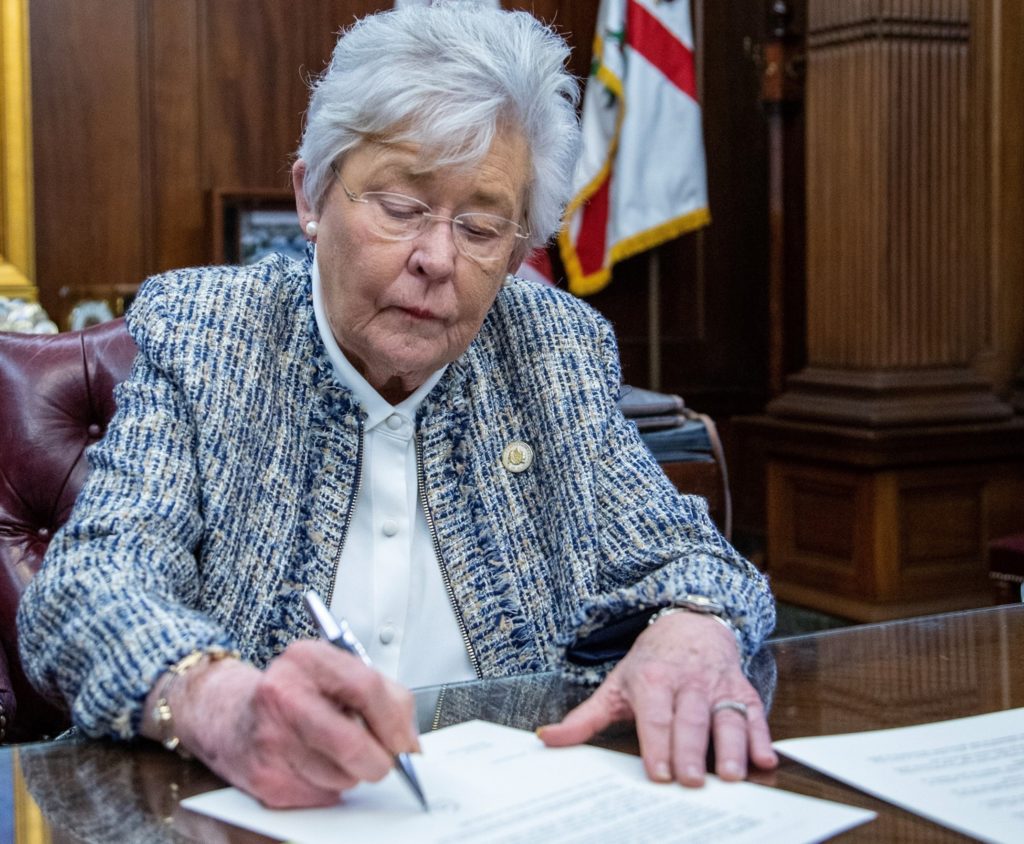
On Friday, Alabama Governor Kay Ivey announced that she has removed Barbara Cooper from her position as the Secretary of the Alabama Department of Early Childhood Education (ADECE). Cooper submitted her resignation after it was discovered that ADECE was promoting “woke” concepts to the teachers of the state’s four-year-olds. The Ivey administration learned that there was a pre-K teacher’s resource book with radical content being distributed across the state. After this was confirmed, Ivey demanded that Cooper issue a memo denouncing the text and removing it from use in Alabama’s pre-K program. Cooper refused and instead offered her resignation. Gov. Ivey accepted her resignation. “The education of Alabama’s children is my top priority as governor, and there is absolutely no room to distract or take away from this mission. Let me be crystal clear,” Ivey said in a statement. “Woke concepts that have zero to do with a proper education and that are divisive at the core have no place in Alabama classrooms at any age level, let alone with our youngest learners. We want our children to be focused on the fundamentals, such as reading and math.” “Alabama’s First Class Pre-K is the best in the country, and those children are at too critical of a juncture in their educational journeys and development to get it wrong,” Ivey continued. “I remain confident in the wonderful teachers we have in pre-K classrooms around our state and in the necessity of our children receiving a strong start to their educational journeys in our First Class Pre-K program. I thank Dr. Cooper for her service, but I believe it is best we continue this historically strong program on its forward trajectory under new leadership.” Ivey said that the content is simply not in line with what the Ivey Administration or the people of Alabama stand for or believe. Ivey stated that she strongly believes that woke concepts have no place at any level of education in Alabama and should not be taken away from the overall mission of improving educational outcomes for students. The resource book told the four-year-old kindergarten teachers that there are “larger systemic forces that perpetuate systems of White privilege” and that “the United States is built on systemic and structural racism.” The resource book also instructed the K4 teachers to instruct the four-year-olds that “LGBTQIA+ need to hear and see messages that promote equality, dignity, and worth.” The glossary includes equally disturbing concepts to the Ivey Administration. Ivey said that her administration and the people of Alabama in no way, shape, or form believe should be used to influence school children, let alone four-year-olds. Ivey said that for as long as she is governor, Alabama will be focused on ensuring our students are receiving a quality education and that she does not stand for these concepts. Cooper was appointed to the position in July 2020. Dr. Jan Hume will serve as the interim secretary of the ADECE while Governor Ivey decides on a permanent secretary to lead the department in the immediate future. The legislature is considering legislation by Rep. Ed Oliver that would ban state agencies from teaching and promoting divisive concepts. The Alabama Department of Early Childhood Education is a cabinet-level agency that answers directly to the ADECE Secretary, who is appointed by the Governor and is not under the direct supervision of the State School Board – even though many of the pre-K classrooms are in Alabama elementary schools. Gov. Ivey has made expanding the state’s First Class Pre-K classrooms to improve access for four-year-olds across the state a high priority of her administration. To connect with the author of this story or to comment, email brandonmreporter@gmail.com.
House passes legislation requiring first graders to go to kindergarten or pass skills competency test

On Tuesday, the Alabama House of Representatives voted in favor of legislation requiring all incoming first graders to have either attended kindergarten or pass a test proving that they have the competency to enter first grade. Children who fail the test will be forced to attend kindergarten rather than first grade with their peers. House Bill 43 (HB43) is sponsored by State Representative Pebblin Warren, who has carried this legislation for the last few years. “I am back again. I am back with the kindergarten bill again,” Warren said. “This bill is what is referred to as a First Grade readiness bill.” “This issue has become a really important issue in the State of Alabama,” Warren said. “It is a tragedy that we would let a child reach third grade without being able to read competently.” “This bill does not make kindergarten mandatory,” Warren continued. “A child can attend kindergarten or may be in homeschooling, private schooling, or religious schooling. As long as they demonstrate competence, they can enter into first grade.” Rep. Mary Moore asked, “Will this make it mandatory?” Warren answered, “It does not make it mandatory, but the child must pass a skills competency test to be admitted into first grade.” “If their parents aren’t education-oriented, that is the group that is always going to be behind,” Moore said. “We need to make K-4 and K-5 mandatory instead of leaving that up to the parents.” “I agree,” Warren said. “It should be mandatory, but this is a process. This is our beginning step to making it mandatory.” “What I want to see is Alabama’s ranking improved,” Warren said. “It is that foundation that is going to build the foundation of Alabama.” “We need to go back to K to 8,” Moore said. “They get to sixth grade, and they have been left behind, and they just look for that crack to get out without even going to go to high school.” “We are not giving up. We are going to continue fighting,” Warren said. “I have prayed to God, asking him what I can do to get this bill passed.” “I think unless we are going back to a time where a three-year-old goes to pre-K, we need to get that four-year-old in K4,” said Rep. Kyle South. The House voted to adopt the substitute version of the bill that Warren had prepared in the Education Policy Committee in a 92 to 7 vote. Rep. Phillip Pettus said, “I would like to see us mandate kindergarten.” “If this goes through, let’s come back next time and mandate kindergarten,” Warren said. Rep. Danny Garrett said, “The synopsis says that this mandates kindergarten. A lot of people in my district do not want to be mandated kindergarten.” There was some discussion on whether or not a parent could enroll the child in first grade even if they did not pass the skills competency test that will be required for children who did not have kindergarten before first grade. Rep. Terri Collins stated, “I have an actual amendment that spells it out that if they are not ready for first grade that the child shall enroll in kindergarten.” “This is mainly those children who have never been in any kind of organized program before,” Collins explained. “They do not know their numbers. They do not know their letters. They are not ready for first grade.” “Legally, you have to go to school as a six-year-old,” Collins stated. “This amendment says that if that child comes to school as a six-year-old and is not prepared to start in first grade, then they will be enrolled in kindergarten. It will be the best thing for the child at that point.” Rep. Barbara Drummond asked, “Will the parent have the option of placing them in the first grade?” “No, they will start at the most appropriate place,” Collins answered. “This is a friendly amendment,” Warren said. Collins explained that the Alabama State Department of Education would write the first-grade readiness test. The House voted to adopt the Collins Amendment 92 to 5. The House voted to pass HB43 in a vote of 87 to 12. This is the fourth year that Warren carried similar legislation. It has not passed the Senate in the past. Governor Kay Ivey endorsed the bill in her State of the State speech. It has been referred to the Senate Education Policy Committee. Tuesday will be day 14 of the 2023 Alabama Regular Legislative Session. The Alabama Constitution of 1901 limits the legislature to no more than 30 legislative days in the regular session. To connect with the author of this story or to comment, email brandonmreporter@gmail.com.
Alabama’s unemployment plummets to 2.3%

Of those Alabamians formally in the workforce – i.e., they have a job or are looking for work – just 2.3% meet the government definition of being unemployed. Alabama Governor Kay Ivey announced Friday that the state had set a new all-time record low unemployment last month. Alabama’s preliminary seasonally adjusted March unemployment rate of just 2.3% is a new record low, down from February’s rate of 2.5%. It is also below March 2022’s rate of 2.5%. Just 53,053 people in the state met the official definition of unemployed in March. This is down considerably from the 56,166 unemployed in February and the 58,074 counted as unemployed in March 2022. That is the lowest number of people counted as unemployed in state history. “We’re almost a quarter into 2023, and we are already seeing record-breaking success when it comes to Alabama’s economy,” said Governor Ivey. “We have been enjoying a period of low unemployment, high wages, and high jobs count for some time now, and I believe that even greater economic achievements are on their way. We will not back down on our commitment to continue bringing quality, high-paying jobs to Alabama.” Gov. Ivey has credited her administration’s aggressive recruiting of new industries to the state by offering economic incentives. On Thursday, Gov. Ivey doubled down on this strategy by signing legislation extending the Alabama Jobs Act, the Growing Alabama Jobs Act, and adding additional incentives to the state economic planner toolbox. “I am proud the Alabama Legislature has officially passed all four bills in The Game Plan package – my plan for our state’s continued economic success,” Ivey said in a statement. “I commend both the Senate and House for their incredible work on this timely legislation that will, no doubt, be transformative for our state and, more importantly, for our families. We are creating stability for our economy and are going to keep Alabama winning for many years to come.” The state experienced growth of 54,100 jobs in the past 12 months, with the most significant gains occurring in the manufacturing sector (+10,400), the professional and business services sector (+8,700), and the private education and health services sector (+7,500), among others. Extremely low unemployment and a growing economy pressures employers to pay more wages to recruit and retain workers. Classical economists cite full employment as being between 4 and 5%. At that level, most competent people can find a job, and employers are not under pressure to bid up the cost of labor to get workers leading to inflation across the economy. “Additionally, we’re continuing to see positive increases in our wages, meaning more money in Alabamians’ pockets,” said Alabama Department of Labor Secretary Fitzgerald Washington. “This month, we reached one of our highest average weekly wages in history.” Total private wages increased by $30.12/weekly over the year to $1,008.61 in January, marking the third-highest weekly wages in state history. The counties with the lowest unemployment rates are Shelby County at 1.8%, Morgan County at 2.0%, and Marshall, Madison, Limestone, and Cullman Counties at 2.1%. The counties with the highest unemployment rates are Wilcox County at 8.8%, Clarke County at 5.9%, and Dallas County at 5.4%. The major cities with the lowest unemployment rates are Homewood at 1.6%, Madison at 1.7%, and Alabaster, Trussville, and Vestavia Hills at 1.8%. The major cities with the highest unemployment rates are Selma at 6.4%, Prichard at 5.2%, and Bessemer at 4.2%. The size of the workforce in March increased to 2,289,759 persons. That is up from 2,287,334 in February and up from 2,286,491 in March of 2022. There were some negatives in the report, though. Even though wages have risen, Alabama’s labor force participation rate has dropped over the last 12 months. The seasonally adjusted labor force participation rate of Alabamians 16 years old and older in March was just 56.7%. That is unchanged from February and down from 57.1% just 12 months ago. The state’s 2.3% unemployment rate is well below the national average of 3.5%, but the state’s labor force participation rate of 56.7% trails the national average of 62.6%. How to lure more able-bodied but not working Alabamians off the sidelines and back into the workforce has perplexed employers and state leaders alike. To connect with the author of this story or to comment, email brandonmreporter@gmail.com.
House expected to vote on a $3 billion general fund budget

On Wednesday, the Alabama House Ways and Means General Fund advanced the largest state general fund (SGF) budget in history. The over $3 billion 2024 budget the House will reportedly consider on Tuesday is $15 million more than Governor Kay Ivey requested and $169 million more than the current fiscal year 2023 budget, the previous biggest SGF budget in the history of the state of Alabama. There are several minor changes between the Governor’s request and the House Committee substitute. In 2022, the Legislature passed, and Gov. Ivey signed controversial legislation that ended the pistol permit requirement. The Sheriffs said that doing so would devastate their pistol permit revenues. As a result, the Legislature agreed to create a $5 million fund to compensate the sheriffs. The governor kept that $5 million in her budget request. The Committee raised that amount to $7.5 million. Gov. Ivey cut funds from the Department of Tourism. The Committee restored those funds and gave the Department a substantial increase – a difference of $1,375,000. She eliminated a $50,000 appropriation for the MOWA Band of Indians. The House restored that line item. Gov. Ivey’s budget added nearly $10 million to the budget request for the Department of Mental Health. The House Committee added another $4,450,000 to Mental Health. They also added an additional $400,000 to the Department of Human Resources. The governor completely eliminated a $1,200,000 appropriation for a Huntsville Hospital Health System – workforce development schools for in-demand health professionals. The House restored that funding and added $500,000 to it. The State Auditor will receive $1,150,819 – $45,000 more than governor’s request. This is a substantial increase from the 2023 budget appropriation of $975,000. The House raised the governor’s request for the Alabama Forestry Commission by $325,000. They raised the request for the Alabama Department of Economic and Community Affairs $2,415,000. They also added $400,000 for crime victims, $300,000 for district attorneys, and $550,000 for the Department of Agriculture and Industries. In this budget, the state will spend $661,732,404 on the Department of Corrections. This is an increase from 2023 of $58,798,327 (9.75 percent). This does not include $30,000,000 in a separate line item for debt service for the – Correctional Institution Finance Authority. There is also a separate $11,977,500 line item in the budget for feeding prisoners. That did not get an increase in the FY2024 budget. Additionally, there is a conditional $40 million appropriation for Correctional Capital Improvements that will only be paid if conditions are met. The Judicial branch will receive $196,415,909 in 2024 – a modest increase from $192,653,808 in 2023. That is just a 1.95% increase. Given inflation and a state employee pay raise, that means no money for new judges – something that Chief Justice Tom Parker has said is needed for years. The Alabama Department of Environmental Management is getting a considerable boost from the 2023 budget. ADEM’s budget has increased from $12,327,927 to $24,482,935. The Department of Public Health is also receiving a big boost – increasing from $75,990,897 in FY2023 to $111,772,076 in 2024, including $1,760,000 more than the Governor requested. The Department of Human Resources is increasing from $107,408,581 to $121,805,400, including $400,000 more than the Governor requested. The Alabama Law Enforcement Agency is seeing its budget increase from $82,532,287 in 2023 to $112,112,287 in 2024. The Alabama Medicaid Agency budget will increase from $793,531,700 in 2023 to $862,999,999 in 2024. The Alabama Medical Cannabis Commission is receiving a budget cut from $3,525,047 in FY2023 to $2,525,047 in FY2024, but the Commission should start to see revenue from the new 9 percent tax on medical cannabis sold in the state of Alabama. Persons with a demonstrable medical need will be able to obtain a recommendation for Alabama-grown medical marijuana products late in the current calendar year. The Department of Mental Health sees a substantial increase, from $193,994,548 in FY2023 to $209,441,459 n FY2024, including $4,450,000 more than the Governor requested. The Military Department is receiving an increase from $8,542,605 in FY2023 to $9,527,505 in FY2024. The 2024 budget also creates a new $2,000,000 line item for the Military Department – Armory Commission separate from the Military Department. The Department of Senior Services is receiving an increase from $82,557,013 in FY2023 to $87,532,998 in FY2024. The Department of Veteran Affairs is receiving a budget increase from its FY2023 appropriation of $2,441,643 to $3,199,737 in FY2024. This includes $250,000 more than Gov. Ivey requested. The Department of Youth Services saw its budget increase from $6,704,537 in FY2023 to $7,204,537 in FY2024. There is a $14,500,000 increase in the cost of living adjustments for state employees. There is also a new $50 million line item for inflationary increases for state agencies and $5.6 million for the State Employees Insurance Board. There will be no one-time bonus in 2024 for retired state employees. That saves the state $4.8 million. There is a conditional appropriation of $3.5 million for the State Port Authority. The Grant Total SGF increased from $2,855,137,387 in FY2023 to $3,024,167,948, including $15,045,000 more than Gov. Ivey requested. Many agencies, including the Legislative Branch, were either level-funded or received modest percent increases in the House Ways and Means Committee’s proposed budget. Alabama has a very archaic budgeting system where over 90 percent of revenues are earmarked to specific agencies. Education is in a separate budget altogether. Many agencies have line items in both budgets, and agencies like the Department of Transportation and the Secretary of State’s office don’t even have line items in the two budgets. Most agencies have their own revenues, which go directly to them and not to the budgets, including approximately $14 billion in federal matching funds and federal appropriations. The full House of Representatives will consider the Committee’s recommendation when it meets on Tuesday. If it passes the House, the SGF will go to the Senate Finance and Taxation General Fund Committee for their consideration. The House will also consider a separate supplemental appropriation for FY2023. The 2024 fiscal year begins on October 1. To connect with the author
Gov. Kay Ivey signs ‘The Game Plan’ legislation
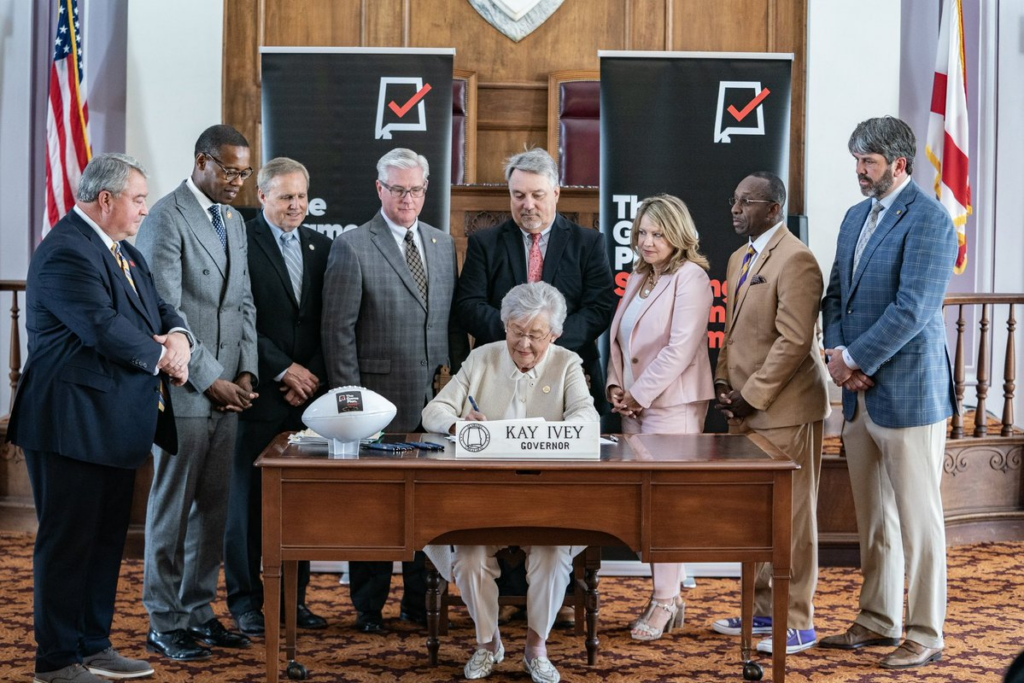
On Thursday, Alabama Gov. Kay Ivey signed a package of four bills to extend and expand the economic incentive tools available to state financial planners. The Alabama Legislature passed the package of bills on Thursday morning, promising that the four “Game Plan” bills are the “plays” Alabama needed to call to have a bright future. “I am proud the Alabama Legislature has officially passed all four bills in The Game Plan package – my plan for our state’s continued economic success,” Ivey said in a statement. “I commend both the Senate and House for their incredible work on this timely legislation that will, no doubt, be transformative for our state and, more importantly, for our families. We are creating stability for our economy and are going to keep Alabama winning for many years to come.” “The Game Plan will give Alabama’s team the tools it needs to extend our winning record in economic development and help us unleash a new wave of growth and innovation across the state,” said Gov. Ivey. “From our rural areas to our big cities, this is going to benefit every corner of Alabama.” Senate President Pro Temp Greg Reed said that passage of the package was a victory for the state and its future. “The Game Plan is a multi-pronged approach to strengthen Alabama’s economy from all angles,” said Reed. “The four ‘plays’ are effective pieces of legislation that will help Alabama’s local communities thrive by attracting high-quality employers, creating jobs, and stimulating economic growth.” Speaker of the House Nathaniel Ledbetter said that the package would benefit Alabamians by better positioning the state to compete for the best jobs in the country. “Industries across the nation and globe are trying to come here because of our great employees, our low taxes, and our unbeatable quality of life,” said Ledbetter. “We want to make sure that, from a competition standpoint, we have the tools needed to bring companies here and keep them here.” Greg Canfield is the Secretary of the Alabama Department of Commerce. “The Game Plan will serve as our next-generation strategic economic development framework as we work to build a more dynamic economy for Alabama and its citizens,” said Secretary Canfield. “Neighboring states are aggressively escalating their economic development activities, and this will allow us to keep winning the projects that trigger lasting impacts.” The Alabama Big 10 Mayors praised the passage of the economic development Incentives bills. Passing the economic incentives legislation was item number one on the Alabama Big 10 Mayors’ 2023 legislative agenda. “These incentives programs are critically important to our cities and the entire state of Alabama,” the Alabama Big 10 Mayors said in a joint statement. “For our cities to be successful, we need to have the tools to attract new industry, businesses, and high-quality jobs. These bills give Alabama the ability to not just remain competitive, but also increase our ability to attract the world-class businesses and developments that improve the quality of life across our state.” “We thank Governor Kay Ivey, legislative leadership and their members, the Department of Commerce, and the many stakeholders who worked tirelessly to make this happen. We were proud to support this package of bills, and we look forward to seeing the impact that these incentives programs will have on each of Alabama’s ten largest cities.” The Mayors representing Alabama’s ten biggest cities work together to address the state’s most important issues and make Alabama a safer, better place for all its residents to live. The Alabama Big 10 Mayors include Auburn Mayor Ron Anders, Birmingham Mayor Randall Woodfin, Decatur Mayor Tab Bowling, Dothan Mayor Mark Saliba, Hoover Mayor Frank Brocato, Huntsville Mayor Tommy Battle, Madison Mayor Paul Finley, Mobile Mayor Sandy Stimpson, Montgomery Mayor Steven Reed, and Tuscaloosa Mayor Walt Maddox. The Game Plan includes four bills — or “plays” — focusing on economic development issues such as incentives, site development, small business support, and transparency. Play 1: The Enhancing Alabama’s Economic Progress Act renews the Alabama Jobs Act and the Growing Alabama program and extends their sunset dates to 2028 while adding strategic enhancements to increase their effectiveness. The Jobs Act is the state’s primary incentives platform, while Growing Alabama primarily speeds development of shovel-ready sites. Play 2: The Site Evaluation and Economic Development Strategy Act (SEEDS) will allow the State Industrial Development Authority to accelerate the development of industry-ready sites at a time when available sites are scarce, and other states are expanding their site programs. Play 3: The Innovation and Small Business Act aims to supercharge growth in Alabama’s innovation economy and support underrepresented businesses and enterprises in rural areas, transforming the state into a hub for technology and innovation. Play 4: The Enhancing Transparency Act will amend the Jobs Act to require the Alabama Department of Commerce to publish certain incentivized project information on its website. Transparency around important information related to companies receiving incentives will serve a valid public service and increase confidence in the process. Critics of the idea of economic incentives to lure industry and projects argue that it is corporate welfare and picking winners and losers, but there were no critics in the Alabama Legislature as the plan sailed through both Houses. To connect with the author of this story or to comment, email brandonmreporter@gmail.com.
House Speaker Nathaniel Ledbetter is optimistic about cutting grocery tax

On Tuesday, Speaker of the House Nathaniel Ledbetter said that he was “optimistic” about passing a grocery tax cut in the current legislative session. Currently, the State of Alabama taxes groceries at a rate of four percent. Alabama is one of only a handful of states that charges a sales tax on foodstuffs. The state had over $3 billion in surpluses that rolled over from fiscal year 2022 to fiscal year 2023 on October 1. Most of that is in the education trust fund (ETF)) that rolled over from fiscal year 2022 to fiscal year 2023 on October 1. Before the session, there was talk of giving a one-time tax rebate to every income taxpayer. Governor Kay Ivey included that proposal in her State of the State address in March. Ledbetter said that the leadership has been polling members and the public on tax cuts versus a tax rebate, and the consensus of the Republican Caucus is to do tax cuts. “We asked them (House members) rebates or tax cuts, and they said tax cuts,” Ledbetter said. “We have moved in that direction.” A recent poll by the Alabama Republican Party showed that voters preferred cutting the grocery tax from 82 percent to 18 percent. “I like Lieutenant Governor [Will] Ainsworth’s plan,” Ledbetter said. “I think we have got to be cautious. What we are talking about spending is going to take a big chunk from the ETF,” Ledbetter said. “We need to be conservative with our spending.” The legislature will consider the state general fund (SGF) budget in the next few legislative days. The education trust fund budget (ETF) should be coming out of committee in the Senate within the next two weeks. “I am optimistic,” Ledbetter said of cutting the grocery tax. Ledbetter said that the House is looking at Sen. Arthur Orr’s bill that phases out the grocery tax over time. “It is very possible that we are going to see some changes,” Ledbetter said. Ledbetter warned that there have been “billions and billions of dollars dumped into Alabama by the federal government.” The Speaker expressed concern about what state revenues will look like once those federal COVID relief dollars work their way out of the systems and tax receipts come down in the future. “We have got to be cautious,” Ledbetter warned. A reporter asked Ledbetter when a decision would be made on whether or not to pass a grocery tax cut. “Within the next 15 legislative days,” Ledbetter responded. Most Alabamians pay between 7 and 11 percent sales taxes on groceries. The state tax is only 4 percent. The rest is county, municipal, and/or school district taxes. If the state legislature repeals its grocery tax, those remaining local taxes on food will remain in place. The Alabama Legislature is meeting on Wednesday for the 12th legislative day of the 2023 Alabama Regular Legislative Session. To connect with the author of this story or to comment, email brandonmreporter@gmail.com.
Speaker says that Alabama will not pass recreational marijuana in the next four years

Alabama will have medicinal cannabis being sold as soon as the end of the year, but there are no plans to consider passing recreational cannabis in this session or even in the next four years. That was the message Speaker of the House Nathaniel Ledbetter told reporters following Tuesday’s legislative day. A reporter asked Ledbetter if the state would consider passing recreational marijuana. “That won’t come for years,” Ledbetter said. “That won’t come for the next four years….because the Speaker won’t let it on the floor.” In 2021 the Alabama Legislature passed – and Alabama Governor Kay Ivey signed – medical cannabis legislation. The legislation created the Alabama Medical Cannabis Commission (AMCC). The AMCC was tasked with writing rules for creating a limited Alabama-only medical cannabis industry. The Commission is formally considering applications from 90 firms and individuals who hope to become licensed Alabama medical cannabis growers, transporters, processors, dispensers, or integrators. The Alabama statute is highly restrictive, but there have been calls from some conservative groups to make that even more restrictive. Some conservative groups want to introduce legislation requiring women of childbearing age to obtain a negative pregnancy test before filling their monthly doctor-recommended medical cannabis order. That legislation is expected to be filed this week. There have also been calls for some in the industry to go in and tweak the 2021 legislation to allow more permits to be awarded or more medical conditions to be included as being treatable by medical cannabis. Ledbetter said he expects the Legislature to “tweak” the statute. Ledbetter did not say what tweaks he thought were likely. Thursday will be the fourth annual lobbying day for the Alabama Cannabis Coalition. The group will meet in Room #429 of the Alabama State House. They will host guest speakers and discuss the current decriminalization legislation, SB42, sponsored for the fourth year by Alabama State Senator Bobby Singleton, and HB13, aka “Cite and Release,” sponsored by Alabama House Rep. Chris England. The group favors both decriminalization of marijuana offenses and the legalization of marijuana, including home growing and the legalization of recreational marijuana. Tuesday was day 11 of the 2023 Alabama Regular Session. The regular legislative session is limited by the Alabama Constitution of 1901 to no more than thirty legislative days during a regular session. To connect with the author of this story or to comment, email brandonmreporter@gmail.com.
Governor Kay Ivey signs legislation to give patients the right to receive visitors
On Tuesday, Alabama Governor Kay Ivey signed legislation into law that protects the rights of hospital and nursing home patients to receive visitors. “The ability to visit a cherished loved one, whether in a hospital or nursing home, should be a fundamental right,” Ivey stated. However, all over the country, during the pandemic, many family members, caregivers, and even clergy were denied access to visit and provide emotional support to patients in healthcare facilities. Such restrictions defy the norms of a caring society, and I was pleased to sign this legislation to signal that in Alabama, we support our patients having this fundamental right.” Senate Bill 113 (SB113) is sponsored by State Sen. Garlan Gudger. It was carried in the House by Rep. Debbie Wood. Senate Bill 113 requires healthcare facilities to adopt specific visitation policies. The bill provides that patients have a right to visitation and can designate an essential caregiver. It also guarantees that the caregiver has visitation rights. “I supported that bill,” said Speaker of the House Nathaniel Ledbetter. “It is only fair.” Thousands of Alabamians have died without their loved ones present since COVID restrictions began in 2020. “I would hate to know that I couldn’t visit my loved one,” Ledbetter said. Rep. Wood explained that patients could change their caregivers while in the hospital. For example, one adult child could be the designated caregiver on one day and their sibling on the next. Wood also said the bill prohibits a healthcare facility from requiring visitors to show proof of vaccination. They are also prohibited from banning consensual physical contact between visitors and patients. The Alabama Department of Public Health (ADPH) will be tasked with requiring healthcare facilities to provide visitation policies to the Department of Public Health. That visitation policy cannot be more restrictive than the policy that the hospital has for its staff. ADPH will develop a mechanism for complaints to be lodged and will have a page on its website that explains the visitation rights law. SB113 also provides for certain immunity from liability. A doctor may, in certain circumstances, exempt a psychiatric care facility from the visitation requirement. The bill is named after Harold Sachs – the longtime Chief of Staff of the Alabama Republican Party. Sachs was diagnosed with COVID-19 and pneumonia in late 2020. His condition deteriorated quickly, and after a few weeks, he passed away. Sachs’ family – like many Alabama families- were not allowed to visit Harold in the COVID-19 ward. The Sachs family for their efforts in getting the bill passed. The bill also was amended to include the name Ann Roberts in the title. Ann Roberts was the wife of State Sen. Dan Roberts. She lost a long battle with COVID-19 in 2021. SB113 passed the Alabama House of Representatives 100 to 1. SB113 has already passed the Senate on a 33 to 0 vote. Wednesday will be the 12th legislative day of the 2023 Alabama Regular Legislative Session. The Alabama Constitution limits the legislature to no more than thirty legislative days in a regular session. To connect with the author of this story or to comment, email brandonmreporter@gmail.com.
Shooting at Dadeville birthday party kills 4 people, wounds 28

Alabama law enforcement officers Sunday were imploring people to come forward with information about a shooting that killed four people and injured 28 others during a teenager’s birthday party. Among those killed was a high school senior who planned to play college football and was celebrating his sister’s 16th birthday. The shooting erupted Saturday night at a dance studio in downtown Dadeville. During two news conferences Sunday, Sgt. Jeremy Burkett of the Alabama Law Enforcement Agency did not take questions. He did not say if a suspect was in custody or if investigators knew about any motivation. He did not provide the names of those killed. “We’ve got to have information from the community,” Burkett said during a Sunday evening news conference. Philstavious “Phil” Dowdell, a Dadeville High School senior who had committed to Jacksonville State University, was celebrating at his sister Alexis’ party before he was shot to death, his grandmother Annette Allen told The Montgomery Advertiser. “He was a very, very humble child. Never messed with anybody. Always had a smile on his face,” Allen told the newspaper, calling it “a million-dollar smile.” Dowdell’s mother was among those hurt in the shooting. “Everybody’s grieving,” Allen said. Burkett said the shooting occurred about 10:30 p.m. Saturday. “There were four lives tragically lost in this incident,” he said. The shootings rocked the city of 3,200 residents, which is about 57 miles (92 kilometers) northeast of Montgomery, Alabama. Pastor Jason Whetstone, who leads the Christian Faith Fellowship, said the granddaughter of one of his church members was shot in the foot and underwent surgery Sunday. “All of our hearts are hurting right now. We’re just trying to pull together to find strength and comfort,” Whetstone said before an interfaith vigil in the parking lot of First Baptist Church. “We are a loving community,” he said. “We’re pulling together in every aspect to comfort each and every one of these children, the teachers, all of the community.” Dadeville’s compact downtown is centered around a courthouse square with one- and two-story brick buildings. The town’s busiest commercial district is a few blocks north of the square, off a bustling four-lane highway that runs between Birmingham and Auburn. Dadeville is close to Lake Martin, a popular recreational area. Investigators on Sunday continued filing in and out of the Mahogany Masterpiece dance studio, denoted by a banner hanging on the outside of a one-story brick building just off the square. Less than a block away, the American and Alabama flags were lowered to half staff outside the Tallapoosa County Courthouse. Dadeville Mayor Frank Goodman said he was in bed asleep when a council member called him just before 11 p.m. Saturday. He said he went to Lake Martin Community Hospital in Dadeville, where some of the people who had been shot were taken. “It was chaotic,” Goodman said. “There were people running around. They were crying and screaming. There were police cars everywhere, there were ambulances everywhere. People were trying to find out about their loved ones. That was a scene, where we never had anything like this happen in our city before.” Pastor Ben Hayes, who serves as chaplain for the Dadeville Police Department and for the local high school football team, said most of the victims are teenagers. Dowdell was within weeks of graduation and faced a bright future, Hayes told The Associated Press. “He was a strong competitor on the field,” Hayes said. “You didn’t want to try to tackle him or get tackled by him. But when he came off the field, he was one of the nicest young men that you could ever meet, very respectful and well-respected by his peers.” Hayes said worried families swarmed the local hospital Saturday night, trying to find the condition of their children. He said serious crime is rare in Dadeville, and the small city is “sad, traumatized, in shock.” Jacksonville State football coach Rich Rodriguez said in a statement Sunday: “Our thoughts and prayers are with the family of Philstavious Dowdell and the other victims of the senseless tragedy last night. He was a great young man with a bright future.” Dowdell also recently won medals at a high school track meet at Troy University. Counseling will be available for students at Tallapoosa County schools Monday, said the school district superintendent, Raymond C. Porter. “This morning, I grieve with the people of Dadeville and my fellow Alabamians. Violent crime has NO place in our state, and we are staying closely updated by law enforcement as details emerge,” Alabama Gov. Kay Ivey said on social media. President Joe Biden was briefed on the shooting, the White House said, adding that it is closely monitoring the situation and has been in touch with local officials and law enforcement to offer support. “What has our nation come to when children cannot attend a birthday party without fear? When parents have to worry every time their kids walk out the door to school, to the movie theater, or to the park?” Biden said in a statement Sunday. “Guns are the leading killer of children in America, and the numbers are rising – not declining. This is outrageous and unacceptable.” Biden called on Congress to “require safe storage of firearms, require background checks for all gun sales, eliminate gun manufacturers’ immunity from liability, and ban assault weapons and high-capacity magazines.” The mayor said Dowdell was “a great young man.” He also said he is concerned about those wounded and psychologically traumatized by the shooting. “We are praying for them,” Goodman said. “We ask God, if it’s his will, to bring them back to their parents safe, so they can mend.” Goodman said guns and violence are not a frequent presence in Dadeville. He said trying to control guns would prove as futile as trying to control illegal drugs. Dadeville High School had 485 students in grades 6-12 in 2022, according to Alabama state data. It serves Dadeville and nearby parts of Tallapoosa County. Like the rest of Dadeville,
Alabama legislature advances Governor’s “Gameplan” economic incentives package
On Thursday, both the Alabama House of Representatives and the Senate voted in favor of portions of Alabama Governor Kay Ivey’s “Game Plan” legislative package. “The Game Plan will position Alabama for a new era of vigorous growth, allowing us to continue our record-breaking economic development success while providing new levels of support for the state’s innovation economy,” said Gov. Ivey. “This package will benefit all Alabamians, those living in both urban centers and rural areas, and ensure our citizens are ready for high-paying careers.” “The Game Plan — our plan for Alabama’s continued economic success — had great momentum today in the Alabama Legislature,” Ivey wrote on Twitter. “I commend both the Senate and House for their work on this package of bills and look forward to their final passage. Let’s keep Alabama winning!” The House passed four-game plan bills on Thursday, while the Senate passed two more. The legislation from each now has to be considered by the second House. House Bill 257 (HB257) is sponsored by State Rep. Danny Garrett. HB257 creates the Alabama Site Development Fund. This legislation authorizes the State Industrial Development Authority to make site assessment grants and site development grants to private companies. The bill also provides for the criteria that must be met for grant approval, including changes to criteria based on economic conditions. It limits the funding that may be received by any site under the grant program. HB257 passed the House 105 to 0. HB257 has been referred to the Senate Fiscal Responsibility and Economic Development Committee, which is chaired by Sen. Garlan Gudger. Senate Bill 165 is sponsored by State Sen. Arthur Orr. It also addresses the creation of the Alabama Site Development Fund. SB165 appears to be the Senate version of HB257. SB165 passed the Senate by a vote of 30 to 0. The legislation has been referred to the House Ways and Means Education Committee – which Garrett chairs. House Bill 241 (HB241) is also sponsored by Garrett. HB241 extends the Alabama Jobs Act sunset date to July 31, 2028. It also increases the annualized cap on outstanding Alabama Jobs Act incentives by $25 million yearly for five up to $475 million. The bill increases the investment tax credit transfer time to provide that the first five years of the investment credit may be transferred by the incentivized company and applied by another person or company under the Alabama Jobs Act. It also extends the Growing Alabama Act sunset date to July 31, 2028, while increasing the annual cap on funding approved pursuant to the Growing Alabama Act incrementally to $35 million. The legislation transfers certain programs from the Growing Alabama Act to Innovate Alabama and creates the Sweet Home Alabama Tourism Investment Act. The Alabama Tourism Department is tasked with developing standards for the review and approval of certified tourism destination projects. HB247 passed the House 105 to 0. It has been referred to the Senate Finance and Taxation Education Committee, which Sen. Orr chairs. Senate Bill 151 (SB151) is sponsored by Sen. Garlan Gudger. SB151 would amend existing law on economic development to authorize the Joint Legislative Advisory Committee on Economic Development to conduct an economic incentive evaluation. It would also require the Department of Commerce to publish certain information regarding economic development incentives awarded under the Alabama Jobs Act. SB151 Passed the Senate 30 to 0. The legislation has been referred to the House Ways and Means Education Committee. House Bill 247 is sponsored by House Minority Leader Anthony Daniels. Under existing law, the Alabama Innovation Corporation is a public corporation created to support, financially and otherwise, growth in technology, innovation, and entrepreneurship sectors in the state. HB247 would change that to Innovate Alabama. Under existing law, the Alabama Innovation Corporation is also authorized to make Small Business Innovation Research and Small Business Technology Transfer Research matching grants to certain entities. To receive a grant, the entity must make its primary place of business in Alabama. The location of residency of one top executive must be in Alabama, and 75 percent of its employees must reside in Alabama for five years. This bill would add a one-year time frame for making Alabama the principal place of business, requiring the majority of top executives to reside in Alabama and a majority of employees to live in Alabama as a condition for receiving a grant. This bill would create the Innovating Alabama tax credit program to allow certain economic development organizations that create, operate, or support certain programs relating to technology accelerators and underrepresented companies to claim specified tax credits. This bill would also exempt working groups, task forces, and subcommittees of the Alabama Innovation Corporation from the Alabama Open Meetings Act. HB247 passed the Alabama House of Representatives 105 to 0. The bill has been referred to the Senate Finance and Taxation Education Committee. House Bill 240 is sponsored by State Rep. Cynthia Almond. HB240 requires the Alabama Department of Commerce to publish on its website certain information about economic development incentives awarded under the Alabama Jobs Act. It provides transparency to the awarding of incentives. HB240 passed the Alabama House of Representatives 105 to 0. It has been referred to the Senate Fiscal Responsibility and Economic Development Committee. Following passage of the six bills in their respective Houses of origin, Speaker of the House Nathaniel Ledbetter posted on Twitter. “The state’s economy is stronger than at any other time in our history, and we have an abundance of long-lasting, good-paying jobs,” Ledbetter said. “But while our state has already achieved remarkable milestones, Alabama is on the cusp of transforming its economy for generations.” “Growing Alabama’s economy through increased incentives and industry expansion is imperative to keeping our state the best place to live and work for its citizens,” Ledbetter added. “The Legislature is working for you, and we look forward to building on our progress.” As of Thursday, 542 bills have been filed in the 2023 Alabama Regular Legislative Session. Tuesday will be day 11 of the regular session. The Alabama Constitution limits the Legislature to no more
