
Steve Flowers: Girls State has had a profound effect on current state leaders
The Alabama Boys State and Girls State programs have been the spawning ground for Alabama political leaders for generations. It is a marvelous civic contribution that the American Legion has sponsored for almost a century in our state. The prominence that Boys State has played is immense. However, Girls State may very well be eclipsing the boys in this generation, given the amazing array of women who are currently leading our state. Governor Kay Ivey was a young high school leader growing up in Wilcox County in the early 1960s. Kay was selected for Girls State and had a week there that left an indelible impression on her. She went on to Auburn, where she was a student leader. For over 40 years, Kay Ivey has come back to Girls State every year as a counselor, advisor, and speaker. She is devoted to Girls State. Dr. Cathy Johnson Randall has been one of the state’s most respected leaders for 50 years. She was the most outstanding student at the University of Alabama when I arrived in 1970. She graduated undergraduate and got her doctorate from the Capstone. In her early career years, she was an administrator at the University of Alabama. She has been a premier businesswoman and philanthropist and Tuscaloosa Civic leader in her adult life. As a teenager, Cathy was a Girls Stater, to say the least. She was elected Governor of Girls State. She then went on to Washington and was elected President of Girls Nation. Furthermore, her daughter Kate was elected Governor of Girls State like her mother, and – get this – Kate was also President of Girls Nation. Cathy’s late husband and Kate’s father, Pettus Randall, was Governor of Alabama Boys State. It is doubtful any family in America, much less Alabama, will ever match that family lineage. Cathy Randall and Kay Ivey took a young lady from Enterprise under their wings when she arrived at Girls State. That student leader was one Katie Boyd. Katie became Governor of Girls State. She then went on to the University of Alabama and pledged Cathy Randall’s sorority, Chi Omega. Katie was elected Student Government President at Alabama, then married Crimson Tide Football star, Wesley Britt. Last year Katie Boyd Britt was elected as our United States Senator at the ripe old age of 40. The list of Girls Staters that are current state leaders does not end with Governor Ivey, Senator Britt, and Dr. Randall. Supreme Court Justice Kelli Wise was a Girls Stater, as well as past Justice Lyn Stuart. Federal District Judge Anna Manasco is a Girls State alumnus from around the same era as Kelli Wise. Mary Margaret Carroll from Ozark, who is one of the state’s top lobbyists, was a Girls Stater with Katie Britt and a Chi Omega with Katie at Alabama. She was also President of the SGA at the University of Alabama. Liz Filmore, Kay Ivey’s Chief of Staff, got her start at Girls State. Many of these women have bonded through the Girls State program. Especially Kay Ivey, Cathy Randall, and Katie Britt. They are like sisters. The fourth sister in this close-knit group is Lee Sellers of Montgomery. Lee grew up in Montgomery and has lived there all of her life. She was a prominent Girls State leader as a teenager. She became Executive Director of Alabama Girls State 21 years ago. She and her husband, Supreme Court Justice Will Sellers, are some of Kay Ivey’s closest friends. Lee is the glue that keeps this band of Girls State Alumni together. Lee will more than likely bring this group of state leaders back to welcome this year’s group of teenage Girls State leaders when they arrive next week to Troy University for the 81st meeting of Alabama Girls State. There will probably be a future senator or governor in attendance. Our current governor, Kay Ivey, is the first elected female Republican governor of Alabama. She will not be the last female to be elected governor of our state. In the future, my prediction is that there will be mostly female governors and presidents in future years. It is a fact that the majority of college enrollees and graduates are female. The reason most future governors and presidents, and probably Supreme Court justices, will be women is because currently 60% of law school graduates are females, and this is expected to grow to 70% in the next decade. See You next week. Steve Flowers is Alabama’s leading political columnist. His weekly column appears in over 60 Alabama newspapers. He served 16 years in the state legislature. Steve may be reached at: www.steveflowers.us.
Steve Flowers: Women in Alabama politics
It is hard to imagine that it was only a little over 100 years ago that women were given the right to vote in the United States. The 19th Amendment to the Constitution, giving women full suffrage, was finally ratified in 1920. In recent decades, many folks have lamented that there are very few women in elected office in Alabama, especially in the legislature. We do indeed have a low percentage of female legislators, most particularly in the Republican ranks. We have some high-profile female statewide officeholders. Governor Kay Ivey, PSC President Twinkle Cavanaugh, and Supreme Court Justices Kelli Wise and Sarah Stewart, to name a few. Some of the more progressive states have ridiculed our lack of female political participants. However, history will reveal that we in Alabama were electing women to statewide offices many years before other so-called progressive states. In fact, women dominated the offices of Secretary of State, State Treasurer, and State Auditor for several decades during the 1960s and 1970s. My first observations of Alabama politics were watching women swap out the State Treasurer and Secretary of State posts every four years. In fact, these constitutional offices were considered women offices. In 1944, Governor Chauncey Sparks appointed Sybil Pool as Secretary of State. Two years later, in 1946, Pool won the office overwhelmingly and became the first woman in Alabama history to be elected to a statewide office. In that 1946 race, Pool carried 63 out of 67 counties. Four years later, in her victorious run for State Treasurer, she received the largest vote in state history. In 1954, she was elected to the first of four terms on the Public Service Commission. Prior to Pool’s first statewide victory, she had served in the legislature for two terms from her native Marengo County. She was only the second woman elected to the Alabama Legislature, in addition to being the first woman elected statewide. All-in-all, her political career included eight years as Secretary of State, four years as State Treasurer, and 16 years on the State Public Service Commission. Sibyl Pool was way ahead of her time, and she opened the political door for women to walk through in Alabama. Mary Texas Hurt Garner of Scottsboro was a lawyer by profession and an Assistant Attorney General before being elected Secretary of State in 1954. She then went on to become State Auditor in 1958. She was elected State Treasurer in 1962. Annie Laura Gunter held several prominent cabinet positions in the Wallace Administration. Afterward, Gunter was elected State Treasurer of Alabama in 1978 and served eight years in that important state office. Melba Till Allen was one of 10 children who grew up modestly on an Alabama farm. She rose to be elected as State Auditor and then was elected State Treasurer for two terms. Mabel Amos and Agnes Baggett were household names in Alabama for decades. Agnes Baggett was probably the most prominent and profiled female officeholder in state history after Sybil Pool. She served as Secretary of State from 1951-1955. She was then elected State Auditor in 1955, State Treasurer in 1959, and returned to Secretary of State in 1963. In 1967, she was elected again as State Treasurer and served eight years in this post. She finished out her career as Secretary of State, thus capping a career that made history. She served 28 consecutive years as an elected statewide officeholder, making her one of the most celebrated elected officials in Alabama history. Mabel Amos was one of the most beloved and revered women in state politics. She had an amazing career as the recording secretary for six governors, including Frank Dixon, Chauncey Sparks, James Folsom, Gordon Persons, John Patterson, and George Wallace. There is no telling what secrets and political deals Ms. Mabel knew of during this unbelievable 30-year reign inside the governor’s office. She was elected Secretary of State in 1966 and served eight years in that office. She was a native of Conecuh County and never married. Therefore, she had no direct heirs. When she died, she had a sizeable estate, primarily of family land. Because she had no children, the beloved lady left her estate with instructions that her money should be used for deserving Alabama female students who otherwise would not be able to attend Alabama colleges. See you next week. Steve Flowers is Alabama’s leading political columnist. His weekly column appears in over 60 Alabama newspapers. He served 16 years in the state legislature. Steve may be reached at www.steveflowers.us.
Alabama extends time for executions, ends automatic review
Alabama has changed death penalty procedures to give the prison system more time to carry out executions — a move that comes after a string of troubled lethal injections in the state — and also eliminated an automatic review for trial errors in death penalty cases. Alabama Gov. Kay Ivey’s office called the time window change a “win for justice,” and supporters said the appeal change would ease the burden on the court system. But a noted death penalty lawyer said the changes end a crucial avenue of review and increase the likelihood of “more cruelty and potential torture.” The Alabama Supreme Court announced the changes to appellate procedure last Friday. At Ivey’s request, the court abolished the previous one-day time frame to carry out a death sentence. Instead, the governor will set a window of time for the execution. A divided court in a 6-3 decision also eliminated an automatic “plain error review” where the Alabama Court of Criminal Appeals automatically reviews death penalty cases for a clear error at trial even though the defense lawyer did not object. Justices said judges on the appeals court may undertake the review but are no longer required to do so. “I think the combination of these two rules increases the likelihood that we’re going to see more wrongful convictions, more unjust sentences, and more cruelty and potential torture,” said Bryan Stevenson, founder of the non-profit Equal Justice Initiative. Stevenson said that nearly 40% of the reversals in Alabama death penalty cases have come under the plain error review. He said the rule has been in place since the death penalty was reinstated in Alabama in 1976, and its repeal is “shocking.” Justice Jay Mitchell wrote in a concurring opinion that the change will relieve the court’s burden, so they are no longer required to “scour the record in search of such errors, nor will it be compelled to analyze claims of error.” He said lawyers for death row inmates can present the issues in other appeals. “Plain-error review requires already overloaded appellate courts to spend hundreds, if not thousands, of hours per case scrutinizing trial-court records for possible errors and then explaining why those errors are (or are not) reversible,” Mitchell wrote. However, two justices who are former members of the Court of Criminal Appeals dissented in the decision. Justice Kelli Wise wrote that she could not support a complete repeal despite the time required. “In these cases, the defendants’ very lives are at stake, and I believe that such cases are entitled to heightened review on direct appeal,” Wise wrote. The court also granted Ivey’s request to expand the amount of time that Alabama has to carry out an execution. Ivey asked for the change after announcing a “top-to-bottom” review of execution procedures. The review came after an unprecedented third failed lethal injection in the state following problems with intravenous lines and late-running appeals. Death warrants issued by the Supreme Court had been limited to a single day, resulting in a midnight deadline to get the execution underway. Now, after the court issues a death warrant, the governor will set a time window to carry out the execution. Justices left it up to the governor to decide how long that time window will be. “I view this as a win for justice. As we initially interpret the order, it secures an extended time frame, which was a primary request of the governor’s,” Ivey spokeswoman Gina Maiola said in an email. She said the governor’s staff will review the order with the prison system. Stevenson says while other states give longer than a day, no state allows a governor that kind of power. He said it would allow already problematic executions to go on for longer. The state in November called off the execution of Kenneth Eugene Smith, which was the state’s second such instance of being unable to put an inmate to death in the preceding two months and its third since 2018. The state completed an execution in July, but only after a three-hour delay caused at least partly by the same problem with starting an IV line. Republished with the permission of The Associated Press.
Steve Flowers: Inauguration day
The Inauguration of our Alabama Constitutional officials was Monday. Our state constitution calls for the Inauguration to be held on the third Monday in January. As you would expect, and as Almanac suggests, it is usually a cold day. Over the years, I have had countless folks harken back to their high school band experiences of marching in the Inaugural Parade, especially ladies who had been majorettes. They had to march and twirl a baton in 20-degree weather with skimpy, legless, bathing suit style attire. It left them with a lasting indelible memory of an Alabama Gubernatorial Inauguration. Mind you, I was not there, but every old-timer who has talked politics with me over the years and who have seen a good many inaugurations, will remark that the January 1963 George Wallace’s initial inauguration as governor was the coldest. There was a lot of frostbite that day. However, the inaugural address from George C. Wallace was hot and heavy. That was the day that Wallace threw down the gauntlet and declared, “Segregation today, segregation tomorrow, and segregation forever.” That was exactly 60 years ago. A lot has changed since that day. It was during the Wallace era that the Civil Rights movement changed the political landscape of the nation and especially in the south. Wallace was an integral part of that historical era. He watched it all unfold from his Goat Hill office overlooking Dexter Avenue, and he was the reason for a lot of the bloodshed. Every time I see an inauguration on the Capitol steps, I reminisce about the history that has been made in that block of Dexter Avenue in Montgomery. The men who wrote Alabama’s overtly racist 1901 Constitution and the crowd that howled in defiance as Wallace made his 1963 declaration would marvel at the change and diversity of today’s Alabama. It is poetic and ironic that this year’s Inauguration Day, January 16, 2023, was on the same day as Martin Luther King Day, a state and national holiday. Kay Ivey grew up in the heart of the Wallace Era in Wilcox County. She cut her political teeth campaigning for the Wallaces. She was especially involved with Lurleen Wallace’s 1966 governor’s race when she was a student at Auburn University. After Auburn, she worked for a while in Banking and teaching in Mobile. She began her Montgomery career as the reading clerk in the Alabama House of Representatives under the tutelage of Speaker Joe McCorquodale. Black Belters, like McCorquodale, controlled the House and the Senate. Kay Ivey’s melodious, pronounced Black Belt accent drew folks’ attention to her reading even the most mundane legalese for hours on end. She later became associated with the Alabama Commission on Higher Education. As their Public Relations and Governmental Affairs Director, she learned the legislative process. She entered the political arena in 2002 when she was elected State Treasurer. She served eight years in that post. She was then elected Lt. Governor in 2010 and reelected in 2014. In the middle of her second term, she became Governor after Dr. Robert Bentley vacated the governor’s office. She served out the last 18 months of his term and was elected in her own right as Governor of Alabama in 2018. She was reelected, overwhelmingly, last year. If Kay Ivey finishes out this four-year term, she will have been Governor of Alabama longer than anyone else besides George C. Wallace. She is the first woman to be elected as a Republican. She is the second female governor, the first being her idol, Lurleen Wallace, 56 years ago. Also inaugurated with Governor Kay Ivey were Lt. Governor Will Ainsworth, Attorney General Steve Marshall, State Treasurer Young Boozer, Agriculture Commissioner Rick Pate, Secretary of State Wes Allen, and State Auditor Andrew Sorrell. Jeremy Oden and Chip Beeker were sworn in for four-year terms on the Public Service Commission. Two Supreme Court Justices, Kelli Wise and Greg Cook, were sworn in for six-year terms in a special investiture last Friday. Justice Kelli Wise was sworn in for her third term. She has served 12 years on the Supreme Court and was on the State Court of Criminal Appeals for a decade prior to being elected to the high court. Justice Greg Cook was sworn in for his initial term on the high tribunal. He is a well-qualified and conservative jurist who will fit in well on the Supreme Court. It was a big day in Alabama politics. See you next week. Steve Flowers is Alabama’s leading political columnist. His weekly column appears in over 60 Alabama newspapers. He served 16 years in the state legislature. Steve may be reached at www.steveflowers.us.
Greg Cook joins the Alabama Supreme Court
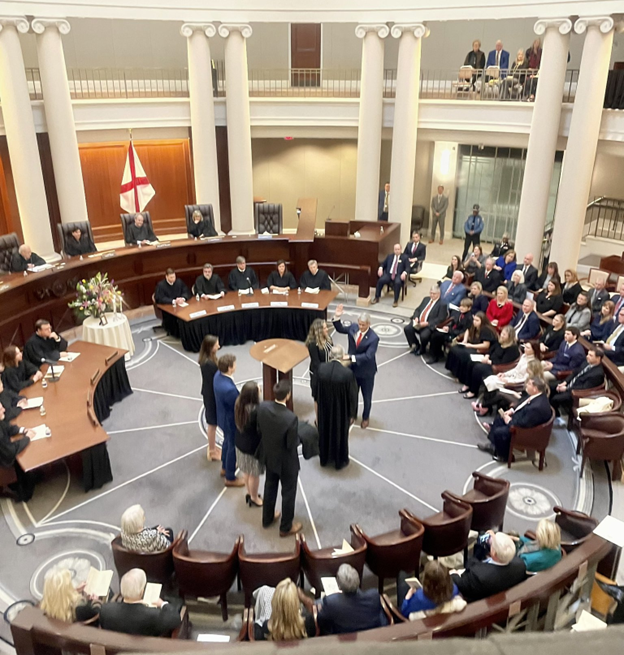
The Alabama Supreme Court held an Investiture and Oath of Office ceremony on Friday to welcome newly-elected Justice Greg Cook and re-elected Justice Kelli Wise. The Justices took their oaths of office in the Supreme Court Courtroom. “Yesterday was my investiture for the Alabama Supreme Court,” Cook said on Facebook. “I was overwhelmed by the many, many people who attended, for the thousands and thousands who supported me, and by the responsibility of this office. The Church service beforehand was so powerful and I am so thankful for St. John’s Episcopal and Donna Johnson and my pastor David Eldridge. I admit that I cried. I know that I owe God the glory for this opportunity. I am also so thankful to the many, many people at the Supreme Court (and Allison Skinner) who made the investiture so special. A special thanks to Justice Champ Lyons for swearing me in and to Attorney General Steve Marshall for presenting my commission. I have so much to be thankful.” Justice Cook was elected in November 2022 to fill the seat of Justice Michael F. Bolin, who retired last week after 18 years of service on the Supreme Court. Justice Wise was re-elected to her third term, having served on the Court since 2010. Chief Justice Tom Parker presided over the investiture ceremony. “We welcome our new colleague Justice Greg Cook to our Court, and we welcome back Justice Wise,” Parker said. “We thank them both for their past service in the legal and judicial community, and confidently pray and believe that their future service will honor the Lord, the law, and the trust that the people of Alabama have placed in them.” “I wish Mike all the best in his retirement from the bench, although I expect he will stay active in service to his beloved State and Jefferson County,” Parker continued. “Mike and I joined this Court at the same time in 2005, so it will not be the same here without his formidable presence and voice on the Supreme Court. I thank him for his decades of service and for his friendship.” Justice Cook formally took office and joined the Supreme Court on Tuesday. Alabama is one of the few states in the country that have partisan elected judges. All the Justices on the Alabama Supreme Court are Republicans. Similarly, all the Judges on the Alabama Court of Criminal Appeals and the Alabama Court of Civil Appeals are also Republicans. To connect with the author of this story, or to comment, email brandonmreporter@gmail.com.
Steve Flowers: Women rule in Alabama politics
For many years, Alabama has been ridiculed in national publications for having fewer women in political leadership positions than others assumed to be progressive states. States like Colorado, New York, and California were lauded for having an inordinate number of females in public office. Well, folks, take a cursory look around at Alabama’s political landscape, and it is a new day in the Heart of Dixie, and unlike the above-mentioned liberal states, our slate of women leaders are conservative Republicans. Our top two most powerful leaders in the state are Governor Kay Ivey and U.S. Senator Katie Britt. If you include PSC President Twinkle Cavanaugh into the mix, then the three most powerful and popular political leaders in the Heart of Dixie are women Republicans. You can eat your heart out, Colorado. This day did not just happen. These three women have been on the scene and the horizon for a while and arose the old-fashioned way by rising through and within the system to get to the top of the class. Kay Ivey was a student leader at Auburn. She spent a decade or more working with the legislature as the lobbyist for the Alabama Commission on Higher Education; then ran for and was elected State Treasurer and served eight years. She then was elected Lt. Governor, where she served for six years. She has been governor now for almost six years. Twinkle Cavanaugh has been on a leadership track since her high school years in Montgomery. She became Chairman of the Alabama Republican Party at a young age and has been President of the Public Service Commission for over a decade. She is the hardest working political figure in office in Alabama with a hardcore grassroots organization. Katie Britt also won our U.S. Senate seat the old-fashioned way. She worked hard and built a statewide grassroots organization that will hold her in good stead for years to come. All three of these ladies are conservative yet rational and reasonable leaders. They are exemplary of Southern grace, yet decisive, disciplined, and dignified. They are people we can be proud of and excellent role models. All three are Alabama born and bred and know the folks of Alabama. All three are closely aligned with and have proudly been supported by Alabama’s premier and most powerful and respected political organization, the Alabama Farmers Federation (Alfa). Currently, two of the most prominent jurists on the Alabama State Supreme Court are females. Justices Kelli Wise and Sarah Stewart grace the Court. I can see our Supreme Court in Alabama, as well as the United States Supreme Court, being majority female in future years. The majority of law students and graduates throughout the country are female. Women will dominate this profession in the next decade, if not already. The State Senate has two very prominent female leaders. The most powerful and proficient is veteran Mobile State Senator Vivian Figures. Senator April Weaver from Bibb/Shelby is on a fast track in the Alabama Senate. Another sign of women taking their rightful place in the Alabama Legislature is the takeover of Republican House Seats in the Shelby and Baldwin County Republican suburban districts. There were five new Republican women in these two Republican bastions that all took seats previously held by older men. Susan Dubose and Leigh Hulsey will be joining three females from Baldwin County. All three of the Baldwin County GOP seats will be held by female Republicans, including Jennifer Fidler, Donna Givens, and Frances Holk-Jones. Representative Cynthia Almond (R-Tuscaloosa), a relative newcomer, is a star on the horizon. Three of the most prominent leaders in the House of Representatives are women. Representative Margie Wilcox of Mobile is in a leadership position. Representative Ginny Shaver of Cherokee County works extensively on family and adoption issues. Representative Terri Collins of Morgan County is the education guru in the Alabama House. Speaking of education, our Alabama State Board is currently made up of eight female members and only one man. This eight-to-one female majority really becomes nine-to-one because Governor Kay Ivey serves as ex-officiate Chairman of the Board of Education. So, folks, as you can see, women rule in Alabama politics, and my guess is that this trend will not diminish in years to come. See you next week. Steve Flowers is Alabama’s leading political columnist. His weekly column appears in over 60 Alabama newspapers. He served 16 years in the state legislature. Steve may be reached at www.steveflowers.us.
Alabama Republicans dominate statewide races
As expected, Alabama Republicans won every statewide race. Kay Ivey was easily re-elected, and political newcomer Katie Britt will be the next U.S. Senator from Alabama. Republican incumbents Lieutenant Governor Will Ainsworth, Attorney General Steve Marshall, Commissioner of Agriculture and Industries Rick Pate, and Treasurer Young Boozer were easily re-elected. Republican State Representatives Wes Allen and Andrew Sorrell won the open Secretary of State and Auditor races. Republicans also held their supermajorities in both Houses of the Legislature and won the open State Supreme Court Justice race. Ivey won by an even larger percentage than in 2018 in 2022. Ivey had 69.9% of the vote as of press time. Yolanda Flowers’ 29.2% performance was the worst performance by a Democratic nominee in memory. Ivey improved her percentage victory by over 10% (69.9% versus 59.5%) of the vote; but actually had fewer votes than four years ago – 944,845 in 2022 versus 1,022,457 in 2018. Ivey’s two landslide victories makes her the most popular Republican governor in state history. Yolanda Flowers only received only 411,269 votes, whereas Walt Maddox received 694,495 votes. Ivey is the first Republican woman to serve as Governor of Alabama. She was already the longest-serving woman governor in state history and the first woman in state history to be re-elected as governor. Ivey won the 2022 election for governor, the 2018 election for governor, the 2014 election for Lieutenant Governor, the 2010 election for Lieutenant Governor, the 2006 election for State Treasurer, and the 2002 election for State Treasurer. This unprecedented run makes Ivey the most successful woman politician in the history of Alabama. Ivey, age 78, is also the oldest governor in the state’s history. Election night was hugely disappointing for Libertarians. While they did get ballot access for the first time since 2022, none of their candidates were able to get close to the 20% threshold needed to give the party ballot access in 2024 – even in statewide races where no Democrat even qualified. Gaining ballot access cost the Libertarian Party over $240,000 to get the necessary number of ballot access signatures to be on the ballot. If the party is going to be on the ballot in 2024, they will have to go through the ballot signature process. Libertarian candidate for Governor – Dr. Jimmy Blake, only received 45,825 votes (3.2%). It is unclear where Blake’s voters came from, disgruntled Republicans or Democrats who did not support Flowers. It was not a good night for write-in gubernatorial candidates. Dean Odle and Jared Budlong, representing the far right and far left respectively, received just 9,401 votes (0.67%). Since those votes will not be individually counted, so there is no way to know how many of those votes were Odle’s, Budlong’s, or someone else entirely. In the Senate race, Britt received 940,048 votes (66.6%). Democrat Dr. Will Boyd received 435,428 votes (30.87%). Libertarian John Sophocleus received 32,790 votes (2.32%). 2,454 Alabamians wrote in someone else. Britt is the first woman to win a U.S. Senate race in Alabama. In the Lieutenant Governor’s race, incumbent Lt. Gov. Will Ainsworth won in a landslide. Ainsworth had 955,372 votes (83.69%). Libertarian Ruth Page-Nelson had 178,069 votes (15.60%) – far short of the 20% Libertarians needed to guarantee them ballot access in 2024. 8,066 Alabamians (0.71%) wrote in someone else. Incumbent Attorney General Steve Marshall coasted to re-election, receiving 953,284 votes (67.91%) versus 449,193 votes (32%) for Democrat Wendell Major. Major received more votes than any Democrat running statewide. In the Secretary of State’s race, Republican Wes Allen won 923,206 votes (65.9%). Democrat Pamela Lafitte got 435,558 (31.1%), and Libertarian Matt Shelby received 41,480 votes (3%). In the Commissioner of Agriculture and Industries race, incumbent Republican Rick Pate cruised to victory 944,021 (84.3%) over Libertarian Jason Clark 169,869 (15%). In the State Treasurer races, Republican incumbent Young Boozer trounced Libertarian Scott Hammond with 944,792 votes (83.75%) to 174,472 votes (15.47%). For State Auditor, Republican Andrew Sorrell won 947,719 votes (84.4%), while Libertarian Leigh Lachine had 166,243 votes (14.81%). For Alabama Supreme Court Place 5, political newcomer Republican Greg Cook won 941,059 votes (67.42%), while Democrat Anita Kelly received 453,518 votes (32.49%). Incumbent Republican Alabama Supreme Court Place 6 Kelli Wise was unopposed winning re-election 995,688 votes (97.51%). For Public Service Commission Place 1, Republican incumbent Jeremy Oden defeated Libertarian Ron Bishop 934,987 (83.73%) to 172,733 (15.47%). For Public Service Commission Place 2, incumbent Republican Chip Beeker received 929,248 votes (83.18%), while Laura Lane had 179,302 votes. Lane received more votes than any other Libertarian, but her 16.1% was still far below the 20% threshold that the Libertarians needed statewide. The Alabama Republican Party also retained its supermajorities in both Houses of the Legislature. Democrats flipped one Alabama House seat in Montgomery County (Charlotte Meadows), while Republicans flipped one Democratic seat in the Wiregrass (Dexter Grimsley). These numbers are all unofficial results from the Alabama Secretary of State’s office. To connect with the author of this story, or to comment, email brandonmreporter@gmail.com.
Steve Flowers: Incumbency prevails in secondary constitutional offices
Incumbency is a potent, powerful, inherent advantage in politics. That fact is playing out to the nines in this year’s Alabama secondary constitutional and down ballot races. Several of the constitutional office incumbents do not have Republican or Democratic opposition. Of course, having a Democratic opponent is the same as not having an opponent in a statewide race in Alabama. A Democrat cannot win in a statewide contest in the Heart of Dixie. Lt. Governor Will Ainsworth will be elected to a second four-year term without opposition. He will be waiting in the wings to follow Kay Ivey as Governor. Agriculture Commissioner Rick Pate will be reelected without opposition. He has done a good job in this important state post. State Treasurer Young Boozer is running unopposed for another four-year term. He does an excellent job and is uniquely qualified for the Treasurer’s job. State Supreme Court Justice Kelli Wise is running for reelection unopposed. Kelli is popular and is a good jurist. She is home free for six more years on the state’s high tribunal. Attorney General Steve Marshall has token opposition in his run for reelection. One Republican and one Democrat qualified against Marshall. However, he will coast to reelection. There are two seats up for election on the Alabama Public Service Commission. There are three seats on this regulatory panel. The President of the PSC runs in a presidential year. Twinkle Cavanaugh is President and pretty much runs the ship. The two incumbents are Jeremy Oden and Chip Beeker. Oden has two unknown Republican opponents. Beeker has two opponents in the GOP Primary. One has some name identification, who has run before. Beeker and Oden will probably win reelection. There are only three hotly contested and interesting secondary statewide races. That is because these three posts are open without an incumbent on the scene. Popular Supreme Court Justice Mike Bolin, the former Probate Judge of Jefferson County, is term-limited by an antiquated law that prohibits a judge from running for the court after age 70. There are two qualified candidates seeking to follow Judge Bolin. Birmingham Defense Attorney Greg Cook is facing Anniston Circuit Judge Debra Jones. Cook appears to be the favorite to win. It is apparent that the business community in the state is backing Cook. He has also been endorsed by the Alabama Farmers Federation. The latest campaign finance reports reveal Cook has $552,000 to spend compared to Jones’s $15,000. The State Auditors position is open. Jim Ziegler has served his eight-year stint. This will be an interesting three-man race for this benign position. Former Mobile State Representative and State Senator Rusty Glover is facing Muscle Shoals State Representative Andrew Sorrell and Jefferson County Pastor Stan Cooke. All three are getting out and working the state. The race to succeed John Merrill as Secretary of State will be a good race. Merrill is term-limited after eight years. State Auditor Jim Ziegler is wanting to move next door in the Capitol and become Secretary of State. Because of his name identification advantage, Ziegler will be favored to win the race. However, he will get a significant challenge from State Representative Wes Allen. Young Wes Allen has been running for over a year and has a good many significant endorsements, including Alfa. He has an impressive resume having served a decade as Probate Judge of Pike County and four years as a State Representative. He also has two home bases. He has lived and served in office in Troy in Southeast Alabama and was born and raised in Tuscaloosa, where his father, Gerald Allen, has been a long-time State Senator. Ed Packard, who has run the Elections Division of the Secretary of State’s office for decades, is also running. He is very well qualified. The aforementioned current Secretary of State, John Merrill, is not seeking any elective office in 2022, even though he is still relatively young. I have said this before, and it holds true today, Merrill is currently the best and most prolific retail politician in the state and one of the best I have seen in Alabama. He has a real grassroots organization in Alabama. He is literally everywhere. Even though he is not on the ballot running this year, he is outworking every candidate mentioned in this column. You have not heard the last of John Merrill. See you next week. Steve Flowers is Alabama’s leading political columnist. His weekly column appears in over 60 Alabama Newspapers. He served 16 years in the state legislature. Steve may be reached at www.steveflowers.us.
Steve Flowers: We lost some good ones in 2021
As has been my custom for 18 years, I like for my yearend column to be a remembrance of Alabama political figures who have passed away during the year. We lost some good ones this year. We lost our oldest past governor, John Patterson in June. Governor Patterson passed away at age 99 at his ancestral home in rural Tallapoosa County surrounded by his family. Patterson was Governor from 1959-1963. He defeated George Wallace in the 1958 Governor’s Race, which featured a field of 14 candidates. He is the only man to beat George Wallace in a governor’s race. Patterson was Attorney General of Alabama prior to being elected Governor. He subsequently was appointed to the Court of Criminal Appeals by Wallace and was reelected numerous times and retired as a Judge of the Alabama Court of Appeals. He was a treasure trove of Alabama political history. He was Governor during a turbulent time in Alabama history. Former Alabama Attorney General Jimmy Evans died in February at 81. Evans was a native of Montgomery and was Montgomery County District Attorney prior to being elected Attorney General. Retired Alfa lobbyist Milton Parsons passed away in March at 91. Milton was renowned on Goat Hill as a straight arrow and straight shooter. He was an honest, trustworthy, Christian gentleman. He was Alfa’s chief lobbyist for 50 years. He was a devoted family man and devout Christian. Former Troy mayor, Jimmy Lunsford died in May at 78. He was mayor of Troy for 30 years. Economic development was his forte. He was a tremendous steward of the city’s finances. He left Troy in good shape financially. Former Mobile congressman Sonny Callahan passed away at 88 in late June. He was one of a long line of popular and effective congressmen from the first district. The list includes Frank Boykin, Jack Edwards, Jo Bonner, Bradley Byrne, and Sonny. Congressman Callahan served 10 terms in the U.S. House of Representatives. Prior to his two decades in Congress, he served in the Alabama House of Representatives and then six years in the State Senate. He was successful in the trucking business in conjunction with his legislative and congressional career. State Representative Thad McClammy of Montgomery passed away at 79 in August. McClammy represented parts of Montgomery County for 27 years. I had the privilege to serve with Thad in the legislature. He was a real gentleman. His word was as good as gold. He had a tremendous turnout for his funeral. State Senator Kirk Hatcher did a fabulous job singing two favorite hymns. Former State Legislator and longtime Geneva County Probate Judge Harold Wise died in August at 96 years old. He lived an amazing and colorful life. He was a loved and respected Geneva County political figure. He was the uncle to Supreme Court Justice Kelli Wise. Kelli adored him. He was her mentor. She says he sparked her love of politics and her desire to have a career in public service. Retired Winston-Marion County Circuit Judge Bobby Aderholt passed away in September at 85. He was a 50-year public servant, as well as lay minister. People say he probably married or buried half the folks in and around Haleyville and that part of Northwest Alabama. There was a tremendous turnout for his funeral. He was revered. State Senator Greg Reed sang at his funeral. Judge Aderholt was the father of our senior congressman, Robert Aderholt who is completing his 25th year in Congress. Former State Senator Jim Preuitt of Talladega died in September at 86. He was also a State Representative and Probate Judge of Talladega County. He was a successful businessman and family man. We lost some good ones this year. Happy New Year! Steve Flowers is Alabama’s leading political columnist. His weekly column appears in over 60 Alabama Newspapers. Steve served 16 years in the state legislature. Steve may be reached at www.steveflowers.us.
Steve Flowers: 2022 elections six months away
Believe it or not, we are six months away from the 2022 elections. All statewide offices will be decided in the May 24, 2022, Republican Primary. Winning the Republican Primary is tantamount to election in the Heart of Dixie. Therefore, garnering the endorsement of the most conservative group in the state is vitally important towards an election. That group is the Alabama Farmers Federation or commonly known as Alfa. The Farm PAC Alfa endorsement is the gold standard for conservatism, and it is the ticket to election in Alabama. The Alabama Farmers Federation is governed by county federation leaders in each of the state’s 67 counties, and the word leaders should be emphasized. The leaders of each county federation are respected men who have been born and raised in their community. Many have owned farmland for generations, are respected agribusinessmen, deacons in their churches, and board members of their local banks. In other words, they are centers of influence, and their words and recommendations extend well beyond their agricultural base. To win the Alfa endorsement, statewide candidates have to go see each of the county federation members in all 67 counties. There are over 100,000 actual farmers in the state that vote the Alfa endorsed ballot right down the line. There are also affiliated agribusiness groups that toe the Alfa line. In addition, there are over 100,000 insurance policyholders throughout the state who have their car and homeowners’ insurance with Alfa, and they see the Farm PAC endorsement and usually follow it because they have contributed to Farm PAC. Additionally, a good many Alabamians will see their friends and neighbors with an Alfa ballot and ask them who Alfa has endorsed in certain races. Then they will vote that way because they know Alfa has vetted the candidates and chosen the most conservative ones. The Alfa endorsements for the May 24, 2022 elections were decided on September 28, 2021. These endorsements will be decisive. Katie Britt won the endorsement for the open U.S. Senate race, which will be the marquee race next year. She got it the old-fashioned way. She worked for it. She got out and visited and got to know almost every farmers federation member in the state. This endorsement will probably propel her to victory. Governor Kay Ivey received the endorsement. She has been the darling of Alfa her entire career. The Farm PAC endorsement was critical in allowing her to win the governorship without a runoff four years ago. They have been with her from the get-go when she was State Treasurer two terms and Lt. Governor two terms. Will Ainsworth received the Alfa endorsement for reelection as Lt. Governor. This endorsement is the reason he upset Twinkle Cavanaugh in their race four years ago. Alfa was the reason he won that race and has made his political career. Incumbent Attorney General Steve Marshall has been endorsed by Alfa because he has proven to be a real conservative. Rick Pate has won the Alfa endorsement for a second term as Agriculture Commissioner. He had the endorsement four years ago, and it helped him win. Folks are really interested in who Alfa endorses for Agriculture Commissioner. Incumbent PSC Commissioners Chip Beeker and Jeremy Oden received the coveted Alfa nod. One of the most critical endorsements Alfa made was selecting Greg Cook for the Alabama Supreme Court seat of retiring Judge Mike Bolin. This endorsement of Greg Cook is pivotal. It proves that he is the conservative pro-business candidate for the Supreme Court. It will probably assure his victory. Popular incumbent Supreme Court Justice Kelli Wise got the endorsement even though she may be unopposed. Three candidates for secondary constitutional offices received the endorsement of Alfa and will be instrumental in their elections are Wes Allen for Secretary of State, Young Boozer for State Treasurer, and Rusty Glover for State Auditor. Glover’s getting the endorsement is that race is pivotal, as is Wes Allen’s in the Secretary of State. Alfa has endorsed all of the incumbent Republican Congressmen, including Jerry Carl, Barry Moore, Mike Rogers, Robert Aderholt, and Gary Palmer. They have endorsed Dale Strong in the open 5th district congressional race. He appears to be the favorite. All of Alfa’s statewide endorsements are Republicans. That makes sense because every statewide officeholder in the state is a Republican. If you made me bet, I would wager that all of the above-mentioned Alfa endorsed candidates will win next year. We will see in about six months. See you next week. Steve Flowers is Alabama’s leading political columnist. His column appears in over 60 Alabama newspapers. He served 16 years in the state legislature. Steve may be reached at www.steveflowers.us.
FarmPAC announces 2022 political endorsements

FarmPAC, the political arm of the Alabama Farmers Federation’s (ALFA), has announced its endorsements for the upcoming primary elections for 2022. ALFA president and CEO Jimmy Parnell explained that the endorsements came after months of study and consideration of all candidates who went before the federation. Parnell stated, “These candidates have invested time in getting to know our county leaders. They’ve spent time on our farms and attended meetings where they heard about the issues and concerns important to Federation members. At the same time, our county leaders have studied the candidates and decided these individuals have the knowledge, experience, and determination to help lead our state and nation in the right direction.” The following candidates have earned the official endorsement of FarmPAC: • Katie Britt — U.S. Senate• Jerry Carl — U.S. House of Representatives, District 1• Barry Moore — U.S. House of Representatives, District 2• Mike Rogers — U.S. House of Representatives, District 3• Robert Aderholt — U.S. House of Representatives, District 4• Dale Strong — U.S. House of Representatives, District 5• Gary Palmer — U.S. House of Representatives, District 6• Terri Sewell — U.S. House of Representatives, District 7• Kay Ivey — Governor• Will Ainsworth — Lieutenant Governor• Steve Marshall — Attorney General• Wes Allen — Secretary of State• Young Boozer — Treasurer• Rusty Glover — Auditor• Rick Pate — Commissioner of Agriculture and Industries• Greg Cook — Alabama Supreme Court, Place 5• Kelli Wise — Alabama Supreme Court, Place 6• Jeremy Oden — Public Service Commission, Place 1• Chip Beeker — Public Service Commission, Place 2• Tracie West — Alabama State Board of Education, District 2• Yvette Richardson — Alabama State Board of Education, District 4• Cynthia McCarty — Alabama State Board of Education, District 6• Wayne Reynolds — Alabama State Board of Education, District 8 Endorsements approved at Tuesday’s meeting will carry through to the general election. Additionally, the federation stated they would announce their endorsements for state legislature at a later date. FarmPAC Chairman Steve Dunn of Conecuh County said the Federation encourages voters to study the issues and candidates prior to the election. Dunn stated, “It’s important for Alabama voters to be engaged in the electoral process,” said Dunn. “We encourage members to exercise their right to vote, regardless of their political preference, and to consider these FarmPAC endorsements when they go to the polls.”
Steve Flowers: Who are the nine people who sit on our state Supreme Court?
This week allow me to share with you a sketch of the men and women who sit on our State Supreme Court. These nine Justices are all Republican, all conservative on both social and business issues. All are very devout in their faith and very connected to their church and their family. Chief Justice Tom Parker has been on the State Supreme Court since 2005. He was born and raised in Montgomery and went to Dartmouth College and Vanderbilt Law School. Chief Justice Parker and his wife the former Dottie James of Auburn have been married 39 years. Dottie was a supervisor of the governor’s mansion during the Fob James administration. They are Methodist. Justice Jay Mitchell is the most personable and definitely the tallest member of the Supreme Court. Jay was a star basketball player at Birmingham Southern where he graduated Phi Beta Kappa. He is imminently qualified for the Supreme Court having graduated from the University of Virginia Law School and had a sterling career with a Birmingham Law firm prior to being overwhelmingly elected to the high tribunal in 2018. Justice Mitchell and his wife, Elizabeth Mitchell, have four children. They reside in Homewood and are members of the Church of the Highlands. Justice Tommy Bryan is a popular and conservative member of the high court. Tommy was born on a family farm in Crenshaw County. He served on the Court of Civil Appeals and was an assistant attorney general prior to being elected to the Supreme Court in 2012. Justice Bryan and his wife, Pamela Bryan, are very active members of the First Baptist Church of Montgomery where he is a Deacon, Sunday School teacher, and sings in the choir. He and Pam are very close and have raised two fine children. Justice William “Will” Sellers, like Justice Parker, is a Montgomery native, as is Will’s outstanding wife, Lee Grant Sellers. Justice Sellers and Lee have been married 33 years and have three adult children and are active members of Trinity Presbyterian Church of Montgomery. Will was a prominent Tax Attorney prior to going on the court. He is a graduate of the University of Alabama Law School and has a New York University tax degree. Justice Brad Mendheim was a Circuit Judge in Houston County prior to going on the Supreme Court. He was born and raised in Dothan and is one of the most respected young men to have come out of his hometown. He is a graduate of Auburn University and Cumberland School of Law. He and his wife of 24 years, Michelle Mendheim, are very active members of the First Baptist Church of Dothan and they have three fine sons. Justice Greg Shaw epitomizes a judge both professionally and personally. He is said to be the hardest working member of the Court and takes his role seriously and is well above reproach. He has an outstanding wife, Samantha “Sam” Shaw, who has also had a sterling career in politics. She was overwhelmingly elected State Auditor twice, serving eight years. Greg and Sam live on a farm about an hour from Montgomery. They have two outstanding sons and are members of the Auburn United Methodist Church. Justice Shaw graduated from Auburn and Samford’s Cumberland School of Law. Justice Sarah Stewart is a longtime Mobilian and was a Mobile Circuit Judge prior to going on the Court. She is a very respected jurist and a graduate of Vanderbilt Law School. She and her husband, Craig Stewart, have two children and are Methodists. Justice Mike Bolin is one of the finest men I have ever known. Mike was a stellar and popular Probate Judge in Jefferson County prior to his service on the Supreme Court. He is a graduate of Samford University and a graduate of Cumberland School of Law. Justice Bolin and his wife, Rosemary Bolin, have one daughter. They attend St. Peter the Apostle Church in Hoover. Unfortunately, Judge Bolin cannot run for reelection next year. He will be over 70 and is term limited under state law. However, last but not least, Justice Kelli Wise is well below 70 and can and will run for reelection next year and she will win. She is a very popular member of the high court. Kelli served several terms on the Court of Criminal Appeals before matriculating to the Supreme Court. Justice Wise and her husband, former District Court Judge Arthur Ray, have one daughter and are members of the St. James United Methodist Church. Kelli is a Wiregrass native up for reelection next year in 2022. See you next week. Steve Flowers is Alabama’s leading political columnist. His weekly column appears in over 60 Alabama newspapers. He served 16 years in the state legislature. Steve may be reached at www.steveflowers.us.
