
25 Republican governors call on Biden to prioritize U.S. oil and gas production

North Dakota can produce enough crude oil to offset dependence on Russian imports, but the Biden administration is prohibiting it from doing so, the state’s governor and U.S. senators argue. North Dakota Gov. Doug Burgum and 24 Republican governors have called on President Joe Biden to prioritize U.S. oil and gas production and restore American energy independence. They did so as crude oil hit $120 a barrel and is expected to surpass $200 a barrel, causing gas prices, and everything that depends on gasoline for transport, to skyrocket. The market went into a correction on Monday, after the U.S. already entered into a 40-year inflationary high. Both are expected to push the U.S. toward a volatile recession. This was totally avoidable, Burgum said. “From the unsecured southern border to the underutilized oil fields of North Dakota, President Biden’s misguided policies continue to put U.S. citizens at risk and hold America back,” he said. “The Biden administration has again failed to meet its obligation to hold a federal oil lease sale, [which] is further proof that this administration isn’t serious about U.S. energy security. The President needs to reverse his anti-oil policies and unleash American energy production to protect U.S. consumers and return our nation to a position where we can sell energy to our friends and allies instead of importing it from adversaries like Russia.” The Biden administration argues that its restrictions on oil and gas production are necessary to combat climate change and that there are enough untapped permits for drilling on federal land that the industry could increase production if it wanted to. North Dakota produces more than 1.13 million barrels of crude a day and 2,990,340 MCF (thousand cubic feet) of natural gas a day. Crude oil production from North Dakota alone would easily offset the imports from Russia, the governor argues. In Biden’s first year in office, he halted and restricted oil and gas leases on federal lands, stopped construction of the Keystone Pipeline, and redirected U.S. policy to import more oil from Organization of the Petroleum Exporting Countries and Russia (OPEC+) instead of bolstering American oil and gas exploration and production. While U.S. production on federal lands was stifled in 2021, the U.S. imported 8.47 million barrels per day of crude oil and refined products, of which 672,000 barrels per day (8%) came from Russia, according to the U.S. Energy Information Agency. The U.S. also imported 6.10 million barrels per day of crude oil, of which 199,000 barrels per day (3%) came from Russia. The U.S. has been importing about 473,000 barrels per day of refined products from Russia, Andrew Lipow of Houston-based Lipow Oil Associates LLC, told The Center Square in an email. Of this, 354,000 barrels a day are unfished oils, which means they need to be upgraded in refineries in the U.S. – mostly on the Gulf Coast because the Russian refineries aren’t unable to upgrade them. The U.S. also imports 697,000 barrels a day of gasoline blendstocks, of which 50,000 barrels a day (7%) came from Russia, Lipow said. This mainly goes to states on the East Coast. The U.S. also imports 287,000 barrels a day of distillate, of which 23,000 barrels a day (8%) come from Russia. This also mainly goes to states on the East Coast, he said. The 25 governors in their joint statement to Biden called on him “to reverse his policies and restore America’s energy independence for our citizens as well as our allies abroad. “By removing his bans on new oil and gas development on federal lands, building the Keystone XL pipeline, and reinstating regulatory reforms to streamline energy permitting, we can protect our national energy security and sell to our friends rather than buy from our enemies – specifically Russia.” Governors from Alabama, Alaska, Arkansas, Arizona, Florida, Georgia, Idaho, Indiana, Iowa, Maryland, Mississippi, Missouri, Montana, Nebraska, New Hampshire, North Dakota, Oklahoma, South Carolina, South Dakota, Tennessee, Texas, Utah, Virginia, West Virginia, and Wyoming signed the letter. North Dakota’s two Republican U.S. senators, John Hoeven and Kevin Cramer, along with seven other cosponsors, also introduced the American Energy Independence from Russia Act in the U.S. Senate. The bill would require the Biden administration to submit an energy independence plan to Congress within 30 days that provides an energy security evaluation and risk assessment and plans to leverage America’s oil and gas resources. It would authorize the construction and operation of the Keystone XL pipeline, which Biden shut down when he entered office, and remove regulatory hurdles to increase liquefied natural gas exports. It also would prohibit any presidential moratoria on new federal leases and require the U.S. Department of Interior to hold a minimum of four oil and natural gas lease sales in fiscal year 2022 in each state that has federal land available for leasing. It also would prohibit the U.S. Energy Department Secretary from drawing down the Strategic Petroleum Reserve until the Secretary of the Interior issues a plan to increase oil and gas production on federal lands and waters. Republished with the permission of The Center Square.
Disputed Keystone Pipeline project focus of court hearing
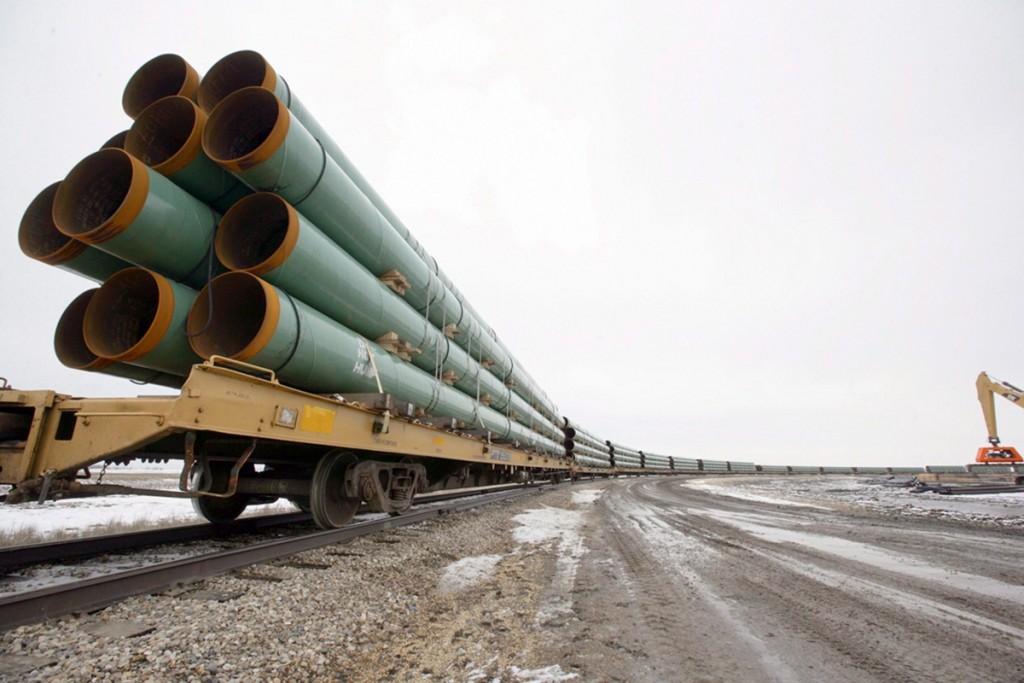
Attorneys for the Trump administration were due in a Montana courtroom Thursday to defend the disputed Keystone XL oil sands pipeline against environmental groups that want to derail the project. The 1,179-mile (1,800-kilometer) line proposed by TransCanada Corporation was rejected in 2015 by former President Barack Obama because of its potential to exacerbate climate change. President Donald Trump revived the project soon after taking office last year, citing its potential to create jobs and advance energy independence. Environmentalists and Native Americans who sued to stop the line have asked U.S. District Judge Brian Morris to overturn its approval by the State Department. They and others, including landowners, are worried about spills that could foul groundwater and the line’s impacts to their property rights. But U.S. government attorneys assert that Trump’s change in course from Obama’s focus on climate change reflects a legitimate shift in policy, not an arbitrary rejection of previous studies of the project. “While the importance of climate change was considered, the interests of energy security and economic development outweighed those concerns,” the attorneys recently wrote. Morris previously rejected a bid by the administration to dismiss the suit on the grounds that Trump had constitutional authority over the pipeline as a matter of national security. Keystone XL would cost an estimated $8 billion. It would begin in Alberta and transport up to 830,000 barrels a day of crude through Montana and South Dakota to Nebraska, where it would connect with lines to carry oil to Gulf Coast refineries. Federal approval is required because the route crosses an international border. TransCanada, based in Calgary, said in court submissions that the line would operate safely and help reduce U.S. reliance on crude from the Middle East and other regions. The project is facing a separate legal challenge in Nebraska, where landowners have filed a lawsuit challenging the Nebraska Public Service Commission’s decision to approve a route through the state. Republished with permission from the Associated Press.
Breaking Keystone silence, Hillary Clinton says she opposes pipeline
Whether it was by coincidence or not, Hillary Rodham Clinton picked a fortuitous time to announce that she opposes the Keystone XL pipeline. The longstanding criticism of Clinton’s reluctance to say where she stands on allowing the pipeline project to go forward was buried in the headlines by arrival of Pope Francis for his first visit to the United States. The next day, the pope’s call to action on climate change fit with Clinton’s reasons for opposing the pipeline. And it sets her up well for a few days of fundraising later this week in the San Francisco Bay area, where she was likely to face questions about her dithering among donors who are generally supportive of environmental causes. The Democratic presidential candidate said Tuesday that she had concluded the ongoing debate over whether the pipeline should be built had hindered a larger effort to curb global warming. “I think it is imperative that we look at the Keystone pipeline as what I believe it is – a distraction from the important work we have to do to combat climate change,” Clinton said in Des Moines, Iowa. “And unfortunately, from my perspective, one that interferes with our ability to move forward to deal with all the other issues. Therefore I oppose it.” Environmentalists have warned that the extraction and transport of oil risks setting back the fight against man-made climate change. Big business argues that the Canada-to-Gulf of Mexico project would create valuable jobs. On the presidential campaign trail, the debate over the pipeline has turned into a high-stakes fight for support and campaign cash as Clinton battles real and potential challenges. Opposing the pipeline puts her in line with rival Sen. Bernie Sanders, a favorite of the Democratic party’s left wing. Clinton’s opposition also sets out a marker as Vice President Joe Biden considers challenging her for the Democratic presidential nomination. Signs quickly surfaced that Clinton’s announcement was paying off for her. Tom Steyer, a California-based environmentalist and top Democratic donor, quickly credited Clinton for joining with “thousands of Americans calling on President Barack Obama to reject the Keystone XL pipeline in favor of building an American economy powered by clean energy.” On Wednesday morning, the pontiff joined Obama at the White House and made an urgent call to address climate change, warning it “can no longer be left to a future generation.” To be certain, Clinton’s unwillingness to offer a position had irritated liberals and environmentalists, and many winced when she said at a July town meeting in New Hampshire that if it was still undecided “when I become president, I will answer your question.” Clinton had said in 2010 that she was “inclined” to support the pipeline but had avoided taking a position after leaving the State Department in 2013. In recent weeks, Clinton expressed impatience over the Obama administration’s drawn-out deliberations and said last week in New Hampshire she was putting the White House “on notice” that she would soon announce her decision. Her campaign said the White House was briefed on Clinton’s position prior to her comments and she privately made her opposition known in discussions with labor officials in recent weeks. The announcement could set the boundaries for the environmental debate in next year’s presidential election. Republican candidates like former Florida Gov. Jeb Bush said on Twitter that Clinton’s decision proves she “favors environmental extremists over U.S. jobs.” Reince Priebus, the chairman of the Republican National Committee, meanwhile, said Clinton was being “blatantly dishonest” when she said her role at the State Department had prevented her from taking a position and said it was driven by concern about Biden joining the Democratic primary field. Clinton said in a posting on Medium on Wednesday that she would seek to modernize the U.S.’s energy infrastructure and develop new partnerships with Canada and Mexico to fight climate change in North America. She reiterated interest in creating an infrastructure bank to unleash investments in clean energy and said she would strengthen pipeline safety regulations and work to replace the country’s oldest pipes and riskiest train cars. “American energy policy is about more than a single pipeline to transport Canada’s dirtiest fuel across our country. It’s about building our future,” Clinton wrote. Republished with permission of the Associated Press.
