
Disputed Keystone Pipeline project focus of court hearing
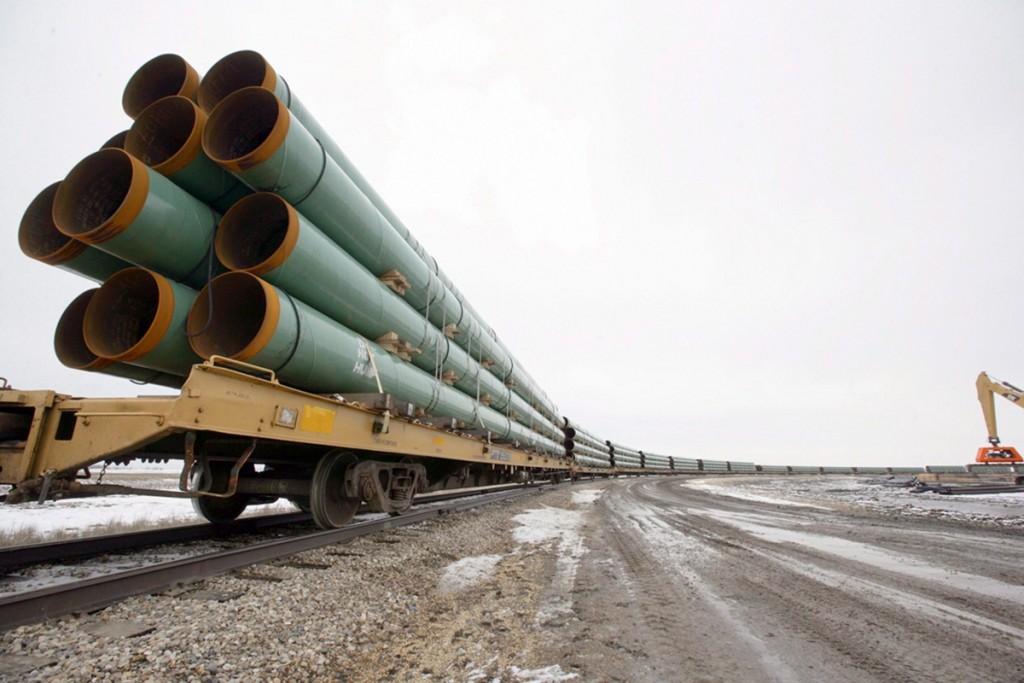
Attorneys for the Trump administration were due in a Montana courtroom Thursday to defend the disputed Keystone XL oil sands pipeline against environmental groups that want to derail the project. The 1,179-mile (1,800-kilometer) line proposed by TransCanada Corporation was rejected in 2015 by former President Barack Obama because of its potential to exacerbate climate change. President Donald Trump revived the project soon after taking office last year, citing its potential to create jobs and advance energy independence. Environmentalists and Native Americans who sued to stop the line have asked U.S. District Judge Brian Morris to overturn its approval by the State Department. They and others, including landowners, are worried about spills that could foul groundwater and the line’s impacts to their property rights. But U.S. government attorneys assert that Trump’s change in course from Obama’s focus on climate change reflects a legitimate shift in policy, not an arbitrary rejection of previous studies of the project. “While the importance of climate change was considered, the interests of energy security and economic development outweighed those concerns,” the attorneys recently wrote. Morris previously rejected a bid by the administration to dismiss the suit on the grounds that Trump had constitutional authority over the pipeline as a matter of national security. Keystone XL would cost an estimated $8 billion. It would begin in Alberta and transport up to 830,000 barrels a day of crude through Montana and South Dakota to Nebraska, where it would connect with lines to carry oil to Gulf Coast refineries. Federal approval is required because the route crosses an international border. TransCanada, based in Calgary, said in court submissions that the line would operate safely and help reduce U.S. reliance on crude from the Middle East and other regions. The project is facing a separate legal challenge in Nebraska, where landowners have filed a lawsuit challenging the Nebraska Public Service Commission’s decision to approve a route through the state. Republished with permission from the Associated Press.
Keystone XL survived politics but economics could kill it
The proposed Keystone XL pipeline survived nine years of protests, lawsuits and political wrangling that saw the Obama administration reject it and President Donald Trump revive it, but now the project faces the possibility of death by economics. Low oil prices and the high cost of extracting Canadian crude from oil sands are casting new doubts on Keystone XL as executives with the Canadian company that wants to build it face the final regulatory hurdle next week in Nebraska. The pipeline proposed in 2008 has faced dozens of state and federal delays, many of them prompted by environmental groups who ultimately persuaded President Barack Obama to deny federal approval in November 2015. President Donald Trump resuscitated the project in March, declaring that Calgary-based TransCanada would create “an incredible pipeline.” After all that, a TransCanada executive raised eyebrows in the energy industry last week when he suggested that the pipeline developer doesn’t know whether it will move forward with the project. Paul Miller, an executive vice president who is overseeing the project, told an investor call that company officials won’t decide until late November or early December whether to start construction. “We’ll make an assessment of the commercial support and the regulatory approvals at that time,” Miller said in the conference call Friday with investors. The company has invited customers to bid for long-term contracts to ship oil on the pipeline. The bidding will run through September. An energy expert said the project has been delayed so long it may no longer make economic sense. “Frankly, in the current price climate, it’s probably not going to be a going venture unless there’s a massive improvement in technology” for processing Canadian crude, said Charles Mason, a University of Wyoming professor of petroleum and gas economics. Crude oil was trading at around $49.50 a barrel on Wednesday, down from highs of more than $100 in 2014. The 1,179-mile pipeline would transport oil from tar sands deposits in Alberta, Canada, across Montana and South Dakota to Nebraska, where it would connect with existing pipelines that feed Texas Gulf Coast refineries. South Dakota and Montana regulators have approved the project, although there are legal challenges pending in both states. Only Nebraska has yet to give regulatory approval. The rest of the route for the oil to the Gulf would travel an existing pipeline in the network. Mason said the biggest economic problem is that synthetic crude from the Canadian deposits is considered a lower-value product because it tends to be heavier, and thus more expensive to refine into gasoline and jet fuel. It’s also more expensive to extract than other oils. Producers have also found other ways to ship oil, primarily by train, and many are reluctant to sign long-term contracts with a pipeline that wouldn’t go into operation for several more years, said Jeff Share, editor of the Houston-based Pipeline & Gas Journal, a leading industry publication. Given the difficulties, Share said TransCanada has probably a “50-50” chance of completing the project. The five-member Nebraska Public Service Commission is supposed to decide by Nov. 23 whether the project serves the public’s interests, based on evidence presented by attorneys in a formal legal proceeding beginning Monday and a series of public hearings held over the last few months. The elected commission is comprised of four Republicans and one Democrat. Environmental opposition to the project has persisted in Nebraska, where opponents say the pipeline would pass through the Sandhills, an ecologically fragile region of grass-covered sand dunes, and would cross the land of farmers and ranchers who don’t want it. Nebraska law enforcement authorities already have had discussions with their counterparts in North Dakota about how that state handled widespread protests during construction of the Dakota Access Pipeline near the Standing Rock Indiana Reservation, said Cody Thomas, a Nebraska State Patrol spokesman. Protesters led by Native American tribes and environmental groups flocked to North Dakota last summer to rally against the Dakota Access Pipeline, and some camped out in bitter cold through early this year, prompting the state to send a large law enforcement contingent that sometimes skirmished with protesters. The pipeline was ultimately completed but legal challenges remain. Pipeline opponents in Nebraska said they are wary of TransCanada’s recent statements and don’t believe the company will surrender without a fight. “We can’t let our guard down,” said Jim Carlson, a farmer near Silver Creek, Nebraska, who grows corn on the pipeline’s proposed route. “We’ve got to continue to be vigilant and proactive. TransCanada could be doing things just to throw us off.” Carlson said TransCanada has offered him $307,000 since the company first contacted him in 2013, but he refuses to sign an easement agreement to grant access to his land. To highlight his opposition, Carlson is installing solar panels on his land directly in the path of the proposed pipeline. If the Nebraska commission approves the route, TransCanada can initiate legal proceedings under eminent domain to gain access to the land of holdout property owners. TransCanada has secured agreement with roughly 90 percent of Nebraska landowners along the route. The company said that if it decides to go ahead with the project, it would need six to nine months to start doing some of the staging of the construction crews followed by two years of construction. Republished with permission of The Associated Press.
Donald Trump approves Keystone XL, calling it ‘great day’ for jobs

President Donald Trump declared it a “great day for American jobs” on Friday as he formally green-lighted the Keystone XL pipeline, clearing the way for the $8 billion project to finally be completed. In a reversal of the Obama administration’s earlier decision, the Trump administration issued a presidential permit enabling Calgary-based TransCanada to build the pipeline. Appearing alongside TransCanada’s CEO in the Oval Office, Trump called it part of a “new era of American energy policy” that he said would lower costs, reduce reliance on foreign oil and create thousands of U.S. jobs. “It’s going to be an incredible pipeline,” Trump said. “Greatest technology known to man or woman and, frankly, we’re very proud of it.” He said TransCanada could now build Keystone “with efficiency and with speed” and said the federal government was working out final details “as we speak.” The decision caps a years-long fight between environmental groups and energy industry advocates over the pipeline’s fate that became a proxy battle over global warming. It marks one of the biggest steps taken to date by the Trump administration to prioritize economic development over environmental concerns. The State Department, responsible for reviewing the project because it crosses an international border, determined that building it serves U.S. national interests. That conclusion followed a review of environmental, economic and diplomatic factors, the department said. It wasn’t immediately clear what, if anything, had changed since the State Department reached the opposite conclusion two years ago, other than the election of a new administration. President Donald Trump planned to address Keystone during an announcement on Friday morning, White House spokesman Sean Spicer said on Twitter. TransCanada, which first applied for a presidential permit in 2008, called the decision a “significant milestone.” “We greatly appreciate President Trump’s administration for reviewing and approving this important initiative,” said TransCanada CEO Russ Girling. “We look forward to working with them as we continue to invest in and strengthen North America’s energy infrastructure.” But Greenpeace, one of the pipeline’s most vocal opponents, said it sent a signal to the world that the U.S. is “moving backwards” on climate and energy, and pledged to keep fighting it nonetheless. “Keystone was stopped once before, and it will be stopped again,” said Annie Leonard, the group’s U.S. director. The 1,700-mile (2,735 kilometers) pipeline, as envisioned, would carry oil from tar sands in Alberta, Canada, to refineries along the Texas Gulf Coast, passing through Montana, South Dakota, Nebraska, Kansas and Oklahoma. The pipeline would move roughly 800,000 barrels of oil per day, more than one-fifth of the oil Canada exports to the U.S. Portions of Keystone have already been built. Completing it required a permit to cross from Canada into the U.S. Yet even with a presidential permit, the pipeline still faces obstacles – most notably the route, which is still being heavily litigated in the states. Native American tribes and landowners have joined environmental groups in opposing the pipeline. TransCanada said Friday it would continue engaging with “neighbors throughout Nebraska, Montana and South Dakota to obtain the necessary permits and approvals to advance this project to construction.” In an unusual twist, the presidential permit was signed by Tom Shannon, a career diplomat serving in a senior State Department role, rather than by Secretary of State Rex Tillerson. The former CEO of oil company Exxon Mobil recused himself after protests from environmental groups who said it would be a conflict of interest for Tillerson to decide the pipeline’s fate. Canadian Natural Resource Minister Jim Carr said the Canadian government is pleased with the decision. Ninety-seven percent of Canada’s oil exports go to the U.S. “Nothing is more essential to the American economy than access to a secure and reliable source of energy. Canada is that source,” Carr said. Oil industry advocates say the pipeline will improve U.S. energy security and create jobs, although how many is widely disputed. Calgary-based TransCanada has promised as many as 13,000 construction jobs — 6,500 a year over two years — although the State Department previously estimated a far smaller number. The pipeline’s opponents contend the jobs will be minimal and short-lived, and say the pipeline won’t help the U.S. with energy needs because the oil is destined for export. A Trump presidential directive also required new or expanded pipelines to be built with American steel “to the maximum extent possible.” However, TransCanada has said Keystone won’t be built with U.S. steel. The company has already acquired the steel, much of it from Canada and Mexico, and the White House has acknowledged it’s too difficult to impose conditions on a pipeline already under construction. Environmental groups also say the pipeline will encourage the use of carbon-heavy tar sands oil which contributes more to global warming than cleaner sources of energy. President Barack Obama reached the same conclusion in 2015 after a negative recommendation from then-Secretary of State John Kerry. TransCanada first applied for a permit in 2008. Years of politicking, legal wrangling and disputes over the pipeline’s route preceded Obama’s decision to nix the project. The Obama administration argued the pipeline would undercut U.S. efforts to clinch a global climate change deal that was reached weeks later in Paris. The Trump administration has dropped fighting climate change as a priority and left open the possibility of pulling out of the Paris deal. Republished with permission of The Associated Press.
Sean Spicer cites ‘studies’ to back Donald Trump voter claim
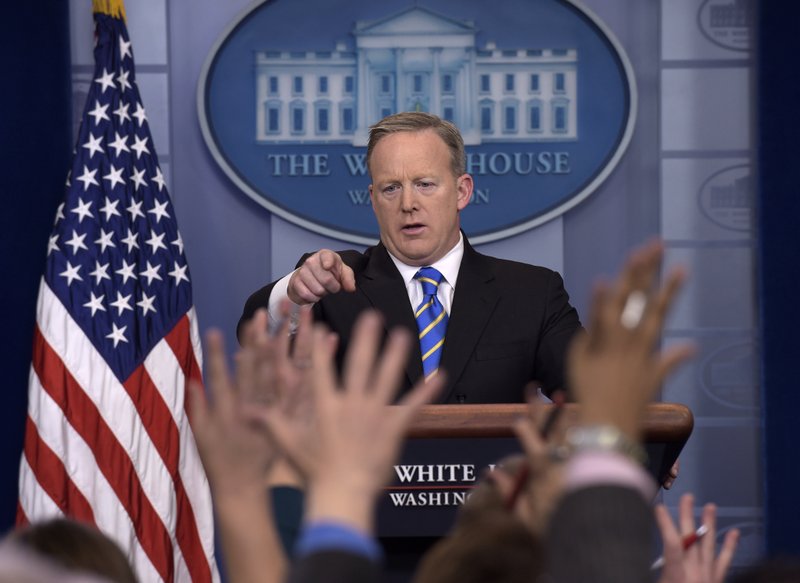
The Latest on President Donald Trump (all times local): 2 p.m. A spokesman says President Donald Trump’s belief that there were millions of illegal votes cast in the November election is based on “studies and evidence.” But spokesman Sean Spicer did not provide examples of that evidence. Trump first made the false claim during the transition. He reiterated the statement in a meeting Monday night with lawmakers, blaming illegal ballots for his loss of the popular vote. Spicer says Trump “continues to maintain that belief.” There has been no evidence to support the claims that there was widespread voter fraud in the election. Spicer’s only attempt to support Trump’s assertion was to point a 2008 Pew Research survey that showed a need to update voter registration systems. __ 1:55 p.m. An Agriculture Department research agency has banned the release of news releases, photos and other material to the public. In a memo to employees at USDA’s Agricultural Research Service, chief of staff Sharon Drumm said the agency would immediately cease releasing any “public-facing” documents. “This includes, but is not limited to, news releases, photos, fact sheets, news feeds, and social media content,” read the email memo obtained by The Associated Press. A statement released by ARS spokesman Christopher Bentley said the agency “values and is committed to maintaining the free flow of information between our scientists and the American public as we strive to find solutions to agricultural problems affecting America.” The statement said some material would still be available on the agency’s website. Buzzfeed News first reported the memo. __ 1:50 p.m. The White House says President Donald Trump has accepted House Speaker Paul Ryan‘s invitation to address a joint session of Congress on Feb. 28. Ryan announced the invitation on Tuesday and informed reporters after a meeting with House Republicans. Ryan had met with Trump Monday night at the White House. Trump also met with Republican and Democratic congressional leaders on Monday. Trump was meeting Tuesday at the White House with top Senate leaders. The speech will be Trump’s first to Congress. He was sworn into office on Friday. __ 12:45 p.m. The Trump administration has instituted a media blackout at the Environmental Protection Agency and barred staff from awarding any new contracts or grants. Emails sent to EPA staff since President Donald Trump’s inauguration on Friday and reviewed by The Associated Press detailed the specific prohibitions banning press releases, blog updates or posts to the agency’s social media accounts. The Trump administration has also ordered a “temporary suspension” of all new business activities at the department, including issuing task orders or work assignments to EPA contractors. The orders are expected to have a significant and immediate impact on EPA activities nationwide. The EPA did not respond to phone calls and emails requesting comment Monday or Tuesday. ___ 12:25 p.m. President Donald Trump is hanging up some new art in the White House press area — and it’s none too subtle. The panoramic photo shows the crowds gathered near the U.S. Capitol for Trump’s inauguration on Friday. It’s a nod to the ongoing interest the president has in making it clear that his event was well-attended. Trump tweeted: “A photo delivered yesterday that will be displayed in the upper/lower press hall. Thank you Abbas!” For emphasis, the official Twitter account of the president retweeted the @realDonaldTrump message. The photo was taken by Washington-area photographer Abbas Shirmohammadi, and it notes the wrong date — Jan. 21, although it does appear to depict the correct event. Trump and press secretary Sean Spicer have taken pains to play up the crowd size, sometimes exaggerating the number in attendance. They’ve excoriated the media for what they said is an effort to downplay enthusiasm for Trump’s inauguration. __ 11:50 a.m. President Donald Trump has taken steps to streamline the permitting process for manufacturing. He also wants pipelines to be made in the U.S. and an expedited process for environmental reviews and approvals. The steps came as Trump signed executive actions to advance construction of the Keystone XL and Dakota Access oil pipelines. Former President Barack Obama blocked construction in late 2015 of the Keystone line from Canada to the U.S. Meanwhile, the Army Corps of Engineers is studying alternative routes for the Dakota Access pipeline. Trump describes the regulatory process as a “tangled up mess.” He says if the answer is no, it should be a quick no. If the answer is yes, Trump says “let’s start building.” ___ 11:35 a.m. President Donald Trump says he will announce his pick to fill the vacant Supreme Court seat sometime next week. Trump told reporters in the Oval Office on Tuesday that he’ll be “making my decision this week” and “we’ll be announcing it next week.” “We have some outstanding candidates,” the president said. “And we’ll pick a truly great Supreme Court justice.” The Supreme Court has only had eight justices since Justice Antonin Scalia died last year. President Barack Obama nominated a replacement but Republicans in the Senate refused to bring the choice up for a vote. During his campaign, Trump publicly identified nearly two dozen candidates for the vacancy. __ 11:25 a.m. President Donald Trump has signed executive actions to advance the construction of the Keystone XL and Dakota Access oil pipelines. Trump tells reporters in the Oval Office that the moves on the pipelines will be subject to the terms and conditions being renegotiated by the U.S. President Barack Obama killed the proposed Keystone XL pipeline in late 2015, saying it would hurt American efforts to reach a global climate change deal. The pipeline would run from Canada to U.S. refineries in the Gulf Coast. The U.S. government needs to approve the pipeline because it crossed the border. The Army decided last year to explore alternate routes for the Dakota pipeline after the Standing Rock Sioux tribe and its supporters said the pipeline threatened drinking water and Native American cultural sites. __ 10:50 a.m. FBI Director James Comey is staying in his
Barack Obama oil pipeline rules face uncertain future under Donald Trump
President Barack Obama‘s administration is expected to push through long-delayed safety measures for the nation’s sprawling network of oil pipelines in its final days, despite resistance from industry and concern that incoming president Donald Trump may scuttle them. The measures are aimed at preventing increasingly frequent accidents such as a 176,000-gallon spill that fouled a North Dakota creek earlier this month. Thousands more accidents over the past decade caused $2.5 billion in damages nationwide and dumped almost 38 million gallons of fuels. Fights over pipelines have intensified in recent years, illustrated by the dispute over TransCanada’s Keystone XL plan and efforts by American Indians to stop the Dakota Access Pipeline from crossing beneath the Missouri River near the Standing Rock Sioux Reservation. The U.S. Department of Transportation proposal covers roughly 200,000 miles of lines that crisscross the country and carry crude, gasoline and other hazardous liquids. Environmental and safety advocates have criticized the agency’s commitment to tightening oversight of that network after a key safety feature – automatic valves that quickly shut down ruptured lines – was omitted from a draft rule published in 2015. Further revisions sought by the petroleum industry could make the rule largely ineffective, said Carl Weimer with the Pipeline Safety Trust. But keeping the proposal intact would expose it to a legal challenge or reversal by a Republican-controlled Congress and Trump, an enthusiastic advocate for fossil fuels whose administration would enforce the new safety provisions, Weimer added. “We already viewed it as an incremental step. If they water it down at all or extend the timelines, it’s going to be an even smaller step,” he said. Regulators began crafting the new rule after a 2010 Michigan pipeline break released almost 1 million gallons of crude into the Kalamazoo River. It’s languished amid industry criticisms, interventions from Congress and the bureaucratic inertia of the federal regulatory process. A recent boom in domestic drilling saw accident rates for pipelines increase by roughly a third. The number of hazardous liquid pipeline accidents in the U.S. increased from 350 in 2010 to 462 in 2015. The Transportation Department proposal calls for tougher inspection and repair criteria, leak detection systems on more lines and other measures to cut risk. Companies also would be required to inspect lines after flooding or other extreme events, a provision adopted after a 2011 ExxonMobil pipeline break spilled 63,000 gallons of crude into Montana’s Yellowstone River. It’s currently under review by the White House Office of Management and Budget. Final adoption is anticipated in late December, said Allie Aguilera, government affairs director of the Transportation Department’s Pipeline and Hazardous Materials Safety Administration. Industry representatives argue it would cost companies $600 million a year and almost $5 billion over the next decade. That’s almost 30 times the government’s estimate of $22.5 million annually. Association of Oil Pipe Lines Vice President John Stoody said the rule would force pipeline owners to immediately repair lines with microscopic cracks or traces of corrosion. Currently, the industry is allowed to monitor smaller defects and schedule repairs later. “It has the potential to distract us away from higher-priority safety issues,” Stoody said of the more stringent repair criteria. Advocates say the rule is particularly important for rural areas. Current regulations apply primarily to lines in “high consequence areas” with large populations or environmentally sensitive features such as drinking water supplies. Lines outside those areas are not required to be inspected with mechanical devices known as “pipeline pigs,” which travel inside lines looking for flaws. “This is the first time (the Department of Transportation) is saying you have to inspect them” using the devices, Weimer said. The Bellingham, Washington-based safety trust was formed after three children were killed when a gasoline pipeline broke in 1999, leaking fuel for 1½ hours before it exploded. The recent 176,000-gallon pipeline spill near Belfield, North Dakota occurred outside a high consequence area. Federal investigators said Wednesday that a leak detection system on the Belle Fourche Pipeline Co. line had failed to detect any problems before a rancher discovered the spill on Dec. 5. The company was ordered by the Transportation Department to make improvements to that detection system before re-starting the line. It’s unclear how long it had been leaking. The oil travelled 4½ miles down a tributary of the Little Missouri River, investigators said. About 76,000 gallons had been recovered as of Tuesday, according to company spokeswoman Wendy Owen. A third-party vendor had used a pipeline pig to inspect the line in April. The results were being reviewed to make sure the company repaired any flaws that were found, investigators said. The 6-inch line can carry up to 1 million gallons of crude daily. Belle Fourche is a subsidiary of True Companies of Casper, Wyoming, which has a lengthy history of accidents including a January 2015 spill into the Yellowstone River. Belle Fourche is a member of the American Petroleum Institute, which acknowledged it has been seeking revisions to the administration’s safety proposal but declined to specify the changes it wants. In a 65-page cost-benefit analysis, the petroleum institute chided federal officials for underestimating the costs and amount of work needed for companies to comply. The group described the rule as a “significant expansion of regulatory oversight.” Minimal federal oversight of pipelines in rural areas has left officials in some states overwhelmed with the task of policing the industry. Pressured by landowners, farmers and environmentalists, North Dakota will put a state rule into effect Jan. 1 to increase inspections of smaller pipelines known as gathering lines. The federal proposal requires only that companies document spills from the lines. Kevin Pranis, a spokesman for the Laborers District Council of Minnesota and North Dakota, which represents some workers building the four-state, $3.8 billion Dakota Access Pipeline, said his group welcomes “sensible” regulation for the industry. “The pipeline industry is under scrutiny like never before,” Pranis said. Republished with permission of the Associated Press.
Breaking Keystone silence, Hillary Clinton says she opposes pipeline
Whether it was by coincidence or not, Hillary Rodham Clinton picked a fortuitous time to announce that she opposes the Keystone XL pipeline. The longstanding criticism of Clinton’s reluctance to say where she stands on allowing the pipeline project to go forward was buried in the headlines by arrival of Pope Francis for his first visit to the United States. The next day, the pope’s call to action on climate change fit with Clinton’s reasons for opposing the pipeline. And it sets her up well for a few days of fundraising later this week in the San Francisco Bay area, where she was likely to face questions about her dithering among donors who are generally supportive of environmental causes. The Democratic presidential candidate said Tuesday that she had concluded the ongoing debate over whether the pipeline should be built had hindered a larger effort to curb global warming. “I think it is imperative that we look at the Keystone pipeline as what I believe it is – a distraction from the important work we have to do to combat climate change,” Clinton said in Des Moines, Iowa. “And unfortunately, from my perspective, one that interferes with our ability to move forward to deal with all the other issues. Therefore I oppose it.” Environmentalists have warned that the extraction and transport of oil risks setting back the fight against man-made climate change. Big business argues that the Canada-to-Gulf of Mexico project would create valuable jobs. On the presidential campaign trail, the debate over the pipeline has turned into a high-stakes fight for support and campaign cash as Clinton battles real and potential challenges. Opposing the pipeline puts her in line with rival Sen. Bernie Sanders, a favorite of the Democratic party’s left wing. Clinton’s opposition also sets out a marker as Vice President Joe Biden considers challenging her for the Democratic presidential nomination. Signs quickly surfaced that Clinton’s announcement was paying off for her. Tom Steyer, a California-based environmentalist and top Democratic donor, quickly credited Clinton for joining with “thousands of Americans calling on President Barack Obama to reject the Keystone XL pipeline in favor of building an American economy powered by clean energy.” On Wednesday morning, the pontiff joined Obama at the White House and made an urgent call to address climate change, warning it “can no longer be left to a future generation.” To be certain, Clinton’s unwillingness to offer a position had irritated liberals and environmentalists, and many winced when she said at a July town meeting in New Hampshire that if it was still undecided “when I become president, I will answer your question.” Clinton had said in 2010 that she was “inclined” to support the pipeline but had avoided taking a position after leaving the State Department in 2013. In recent weeks, Clinton expressed impatience over the Obama administration’s drawn-out deliberations and said last week in New Hampshire she was putting the White House “on notice” that she would soon announce her decision. Her campaign said the White House was briefed on Clinton’s position prior to her comments and she privately made her opposition known in discussions with labor officials in recent weeks. The announcement could set the boundaries for the environmental debate in next year’s presidential election. Republican candidates like former Florida Gov. Jeb Bush said on Twitter that Clinton’s decision proves she “favors environmental extremists over U.S. jobs.” Reince Priebus, the chairman of the Republican National Committee, meanwhile, said Clinton was being “blatantly dishonest” when she said her role at the State Department had prevented her from taking a position and said it was driven by concern about Biden joining the Democratic primary field. Clinton said in a posting on Medium on Wednesday that she would seek to modernize the U.S.’s energy infrastructure and develop new partnerships with Canada and Mexico to fight climate change in North America. She reiterated interest in creating an infrastructure bank to unleash investments in clean energy and said she would strengthen pipeline safety regulations and work to replace the country’s oldest pipes and riskiest train cars. “American energy policy is about more than a single pipeline to transport Canada’s dirtiest fuel across our country. It’s about building our future,” Clinton wrote. Republished with permission of the Associated Press.
Presidential Primary Brief: 463 days until Election Day
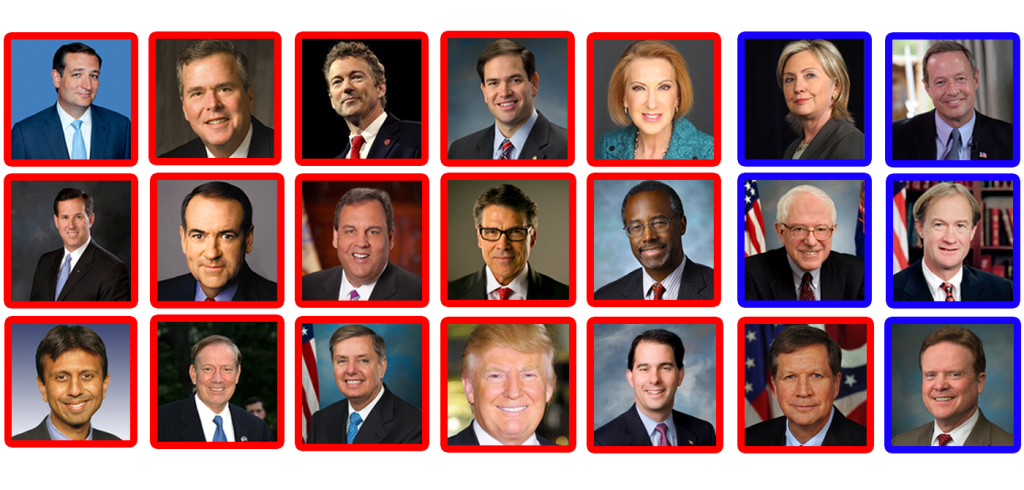
209 days until AL Presidential Primary 463 days until Election Day Convention Dates: Republican July 18-21 2016, Democratic July 25-28 2016 Weekly Headlines: Donald Trump leads Jeb Bush in Florida Hillary Clinton to Congress: End the Cuban trade embargo 6 key 2016 developments you missed this weekend Press Clips: A third of all 2016 campaign cash has come from about 60 donations (Chicago Tribune 8/1/15) It took Ted Cruz three months to raise $10 million for his campaign for president, a springtime sprint of $1,000-‐per-‐plate dinners, hundreds of handshakes and a stream of emails asking supporters to chip in a few bucks. One check, from one donor, topped those results. New York hedge fund magnate Robert Mercer’s $11 million gift to a group backing the Texas Republican’s White House bid put him atop a tiny group of millionaires and billionaires whose contributions already dwarf those made by the tens of thousands of people who have given to their favorite presidential candidate. Fox lowers threshold for early debate (Politico 7/28/15) Fox News is opening its 5 p.m. debate to all the announced Republican candidates who fail to make the cut for the Aug. 6 prime-‐time event, removing a requirement that participants reach at least 1 percent in polling. The change amounts to an insurance policy for candidates who were in danger of being disqualified from the vital first debate based on low polls – Carly Fiorina, former New York Gov. George Pataki and Sen. Lindsey Graham (R-‐ S.C.). Tom Steyer unfazed by Hillary Clinton’s silence on Keystone (Politico 7/29/15) Tom Steyer’s hard green line is turning soft when it comes to Hillary Clinton. The billionaire climate activist has spent more than $100 million of his personal fortune to support green-‐minded candidates and ballot initiatives in the past Tie years, ruffling the Washington establishment while threatening to torpedo even fellow Democrats who don’t hew the line on controversies like the Keystone XL oil pipeline. But he declined repeatedly Tuesday to criticize Clinton, who still refuses to take a stand on Keystone, and whose just-‐ released initial climate proposal is notably short on specifics about issues like fracking and Arctic drilling. There’s something about Bernie (The Atlantic 7/29/15) There’s no way this man could be president, right? Just look at him: rumpled and scowling, baldpate topped by an entropic nimbus of white hair. Just listen to him: ranting, in his gravelly Brooklyn accent, about socialism. Socialism! And yet here we are: In the biggest surprise of the race for the Democratic presidential nomination, this thoroughly implausible man, Bernie Sanders, is a sensation. He is drawing enormous crowds—11,000 in Phoenix, 8,000 in Dallas, 2,500 in Council Bluffs, Iowa—the largest turnout of any candidate from any party in the first-‐to-‐vote primary state. He has raised $15 million in mostly small donations, to Hillary Clinton’s $45 million—and unlike her, he did it without holding a single fundraiser. Right sees 2016 as chance to take over Supreme Court, reverse marriage equality (Huffington Post 7/30/15) Right-‐wing leaders have spent the past month denouncing as illegitimate and tyrannical the Supreme Court’s June 26 decision that declared state laws banning same-‐sex couples from getting married to be unconstitutional. In addition to waging a campaign of resistance to the ruling, right-‐wing activists are looking toward the 2016 presidential elections as a chance to pack the Court with far-‐right justices who will overturn the decision. Journalist Paul Waldman argued recently that 2016 will be a Supreme Court election because right-‐ wing voters will be motivated by anger over their losses on marriage and health care, even though “the Roberts Court has given conservatives an enormous amount to be happy about” -‐-‐ gutting the Voting Rights Act and giving corporations and zillionaires the right to spend as much as they want to influence elections, and much more. Presidential Polls: How to avoid getting fooled (New York Times 7/30/15) Polls with surprising or novel results can be irresistible to journalists and the public alike. It’s newsworthy if public attitudes seem to have changed in some unexpected way. As a result, these findings tend to attract the most public attention and media coverage. Unfortunately, they are the most likely to be spurious. What looks like a shift in public opinion is often just random statistical variation. First, all polls should come with an associated margin of error or some other estimate of uncertainty. Take it seriously. With the sample sizes conventionally used in polling, changes in support of one or two percentage points can’t be distinguished from random variation. Second, given the number of polls that are conducted, outliers are likely to be common. Approximately one in 20 polls of President Obama’s approval rating, for instance, will produce a statistically significant change from the last estimate even if nothing changed.
Bernie Sanders rallies supporters in nationwide simulcast
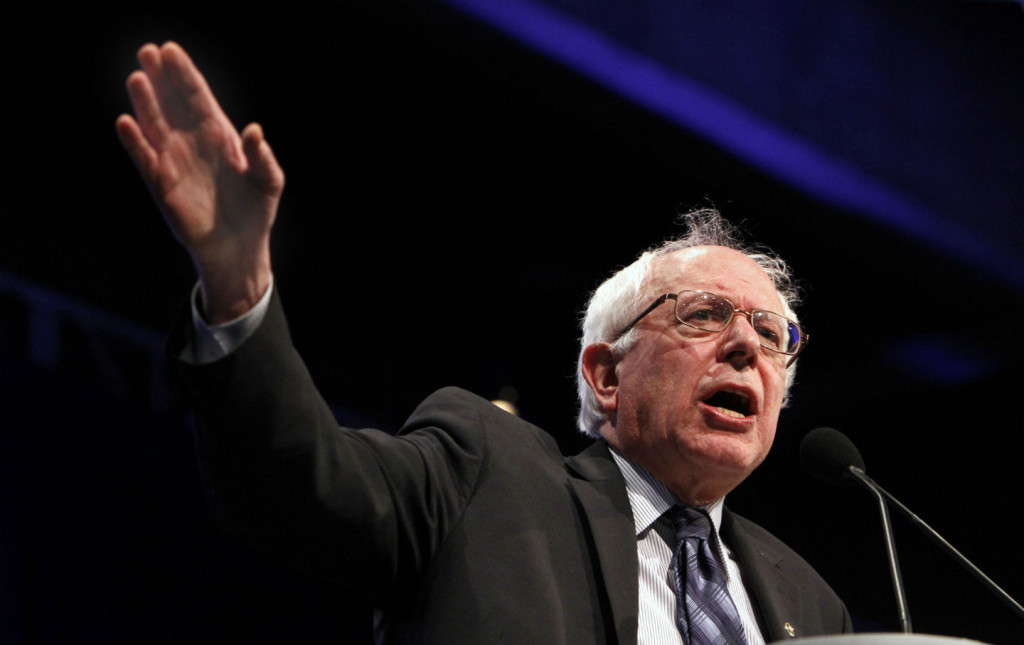
Vermont Sen. Bernie Sanders called on supporters to spark a “political revolution” for his candidacy on Wednesday night, offering a rallying cry of “enough is enough” on a video simulcast to events across the country. “The American people are saying loudly and clearly: Enough is enough,” he said, standing before a bank of video cameras set up in a crowded Washington apartment. “Our government belongs to all of us and not just a handful of billionaires.” The Sanders campaign said more than 105,000 backers attended 3,500 meetings in homes, coffee shops, union halls and town squares, an effort to spread the message of his insurgent bid for the Democratic presidential nomination. As supporters sipped “Bernie Palomas,” a Vermont maple syrup cocktail mixed by the event’s host, Sanders made an impassioned argument for building a single-payer health system, tackling income inequality, eliminating student debt, addressing institutional racism, expanding family leave and raising a “starvation minimum wage.” “Bernie Sanders alone as president of the United States is not going to solve all these problems,” he said, reading off a yellow legal pad with handwritten notes. “But when we stand together there is nothing, nothing, nothing that we cannot accomplish.” Sanders has ridden the populist wave surging through the Democratic party, attracting large crowds to rallies across the country with his unapologetically liberal message. In recent weeks, he has seized on Hillary Rodham Clinton‘s refusal to say whether she backs the Keystone XL pipeline and the Trans-Pacific Partnership — both opposed by key segments of the Democratic base. While Clinton remains the front-runner in the primary race, the Wednesday night event was intended as a show of strength for Sanders’ candidacy. His campaign is trying to emulate the model used by President Barack Obama, who mobilized supporters against Clinton in the 2008 primary through an expansive organizing effort focused on networks of personal contacts. Larry Cohen, a former president of the Communications Workers of America, encouraged backers to volunteer for the campaign — and sign up others to make calls, knock on doors and contribute. “We’re part of a historic moment but our job is to build a historic movement,” he told the cameras. “Solidarity.” Sanders’ unexpectedly strong showing has not gone unnoticed by Clinton’s team. Her aides have signaled that they consider Sanders to be a legitimate challenger who will be running for the long haul, noting the $15.2 million he’s raised, largely from small donors, in the first three months of the race. They believe he will find a measure of support in Iowa, where the caucus system typically turns out the most passionate voters, and New Hampshire, given Sanders’ many years representing neighboring Vermont in Congress. The Washington meeting struck a sharp contrast with Clinton’s carefully stage-managed events. Host Manisha Sharma said she stayed awake until 2 a.m. cleaning the one-bedroom apartment, carefully storing odds and ends in cardboard organic milk boxes from Costco tucked into a wooden bookshelf. Beers were piled into a kitchen sink and a card table set up next to a small bathroom served as a bar. After Sanders spoke Sharma presented him with a poster featuring a photo of Mahatma Gandhi‘s Salt March, the first major act in his campaign against British rule of India. “First they ignore you, then they laugh at you, then they fight you, then you win,” she told him, quoting Gandhi. “That’s what you’ll do.” Republished with permission of The Associated Press.
Quiet on Keystone, Hillary Clinton faces sharper attacks from rivals
Hillary Rodham Clinton dodged questions Tuesday about her positions on trade and the Keystone XL pipeline, telling a New Hampshire voter that if the future of the project opposed by environmentalists remains “undecided when I become president, I will answer your question.” Sensing an opportunity, Clinton’s rivals for the Democratic presidential nomination escalated their critique of the party’s front-runner. “It is hard for me to imagine how you can be serious about climate change and not oppose the Keystone pipeline,” Vermont Sen. Bernie Sanders told The Associated Press. A day after laying out a sweeping plan to foster renewable energy and combat climate change, Clinton stuck with her refusal to say where she stands on the $8 billion pipeline. Environmental groups vigorously oppose the project, which would transport oil from Canada’s tar sands to refineries on the Gulf of Mexico, arguing it would contribute to global warming. “My assessment is that it is not appropriate or fair for me to prejudge in a public area what Secretary (of State John) Kerry and President (Barack) Obama eventually have to decide,” Clinton said. “I will not do it. I’m sorry if people want me to.” The former secretary of state also declined during a town hall-style meeting in the early voting state to take a firm position on the Trans-Pacific Partnership, noting her early work to lay the groundwork for the trade deal that labor unions and liberals oppose. Clinton’s aides argue her work at the State Department is a major asset for her candidacy, even if it prevents her from taking positions on certain topics – such as Keystone and the Pacific trade deal – that are closely watched by the Democratic base. “Having the experience of being a former Secretary of State distinguishes her and her candidacy, but it comes with responsibilities that at times can limit her,” said Jennifer Palmieri, communications director for the Clinton campaign. “We know that the experience is well worth whatever price she may pay politically.” As Clinton told New Hampshire voters in a steamy elementary school auditorium on Tuesday: “I’m in a very different position than any other candidate. I was there.” But refusal to say definitively where she stands on those two issues has frustrated liberals and fed into Republican attacks on her trustworthiness. The Republican National Committee quickly seized on Clinton’s remarks, blasting out a statement saying her refusal to express a clear view are “making it abundantly clear she’ll say or do anything to get elected.” Clinton’s refusal to take a position has also given rivals such as Sanders and former Maryland Gov. Martin O’Malley an opportunity to sharpen their case against the heavy favorite for the Democratic nomination. O’Malley, who has struggled to gain traction against Clinton and Sanders, offered perhaps his most stinging criticism of Clinton’s economic agenda to date in an interview with New Hampshire television station NH1 that aired late Monday. The former Maryland governor said Clinton’s “closeness to Wall Street is well-known and genuinely held. But it’s a difference of opinion that she and I have. I believe our federal government should protect our common good and Main Street from being worked over by recklessness on Wall Street. She does not.” O’Malley has pressed the Democratic field to support reinstating the law that separated the business of commercial and investment banking, which was repealed during President Bill Clinton‘s administration. Sanders does, but Clinton has yet to take a firm position on doing so and said the issue is more complicated than a single piece of banking legislation. Asked Tuesday by reporters in Washington how he distinguishes himself from Clinton, Sanders pointed to his voting record in Congress and what he described as a “virtually 100 percent voting record for the AFL-CIO.” “To me, politics is not hard. It’s which side are you on,” Sanders said after a speech to the International Association of Sheet Metal, Air, Rail and Transportation Workers. “I don’t sit around debating: `Gee, am I going to take Wall Street money? Am I going to vote for Wall Street? Or am I going to vote with working people?’ “That’s not where I come from,” Sanders said. “I vote with working people. That’s who I am.” Sanders said in an interview with the AP that Clinton’s recent climate change proposal didn’t go far enough to curb global warming, adding that Keystone amounted to a litmus test for any candidate seeking to champion the environment. Bruce Blodgett, a software architect from Amherst, New Hampshire, pressed Clinton to give a “yes” or “no” answer on Keystone at her town hall in Nashua. Clinton, who declined to take a position on Keystone after leaving the State Department in 2013, responded that it wouldn’t “be right” for her to “second guess” the administration, which is currently weighing whether to approve the project. “If it’s undecided, when I become president I will answer your question,” she said, offering a smile. Her remarks were met with silence by the sweaty crowd. Republished with permission of The Associated Press.
