
Donald Trump approves Keystone XL, calling it ‘great day’ for jobs

President Donald Trump declared it a “great day for American jobs” on Friday as he formally green-lighted the Keystone XL pipeline, clearing the way for the $8 billion project to finally be completed. In a reversal of the Obama administration’s earlier decision, the Trump administration issued a presidential permit enabling Calgary-based TransCanada to build the pipeline. Appearing alongside TransCanada’s CEO in the Oval Office, Trump called it part of a “new era of American energy policy” that he said would lower costs, reduce reliance on foreign oil and create thousands of U.S. jobs. “It’s going to be an incredible pipeline,” Trump said. “Greatest technology known to man or woman and, frankly, we’re very proud of it.” He said TransCanada could now build Keystone “with efficiency and with speed” and said the federal government was working out final details “as we speak.” The decision caps a years-long fight between environmental groups and energy industry advocates over the pipeline’s fate that became a proxy battle over global warming. It marks one of the biggest steps taken to date by the Trump administration to prioritize economic development over environmental concerns. The State Department, responsible for reviewing the project because it crosses an international border, determined that building it serves U.S. national interests. That conclusion followed a review of environmental, economic and diplomatic factors, the department said. It wasn’t immediately clear what, if anything, had changed since the State Department reached the opposite conclusion two years ago, other than the election of a new administration. President Donald Trump planned to address Keystone during an announcement on Friday morning, White House spokesman Sean Spicer said on Twitter. TransCanada, which first applied for a presidential permit in 2008, called the decision a “significant milestone.” “We greatly appreciate President Trump’s administration for reviewing and approving this important initiative,” said TransCanada CEO Russ Girling. “We look forward to working with them as we continue to invest in and strengthen North America’s energy infrastructure.” But Greenpeace, one of the pipeline’s most vocal opponents, said it sent a signal to the world that the U.S. is “moving backwards” on climate and energy, and pledged to keep fighting it nonetheless. “Keystone was stopped once before, and it will be stopped again,” said Annie Leonard, the group’s U.S. director. The 1,700-mile (2,735 kilometers) pipeline, as envisioned, would carry oil from tar sands in Alberta, Canada, to refineries along the Texas Gulf Coast, passing through Montana, South Dakota, Nebraska, Kansas and Oklahoma. The pipeline would move roughly 800,000 barrels of oil per day, more than one-fifth of the oil Canada exports to the U.S. Portions of Keystone have already been built. Completing it required a permit to cross from Canada into the U.S. Yet even with a presidential permit, the pipeline still faces obstacles – most notably the route, which is still being heavily litigated in the states. Native American tribes and landowners have joined environmental groups in opposing the pipeline. TransCanada said Friday it would continue engaging with “neighbors throughout Nebraska, Montana and South Dakota to obtain the necessary permits and approvals to advance this project to construction.” In an unusual twist, the presidential permit was signed by Tom Shannon, a career diplomat serving in a senior State Department role, rather than by Secretary of State Rex Tillerson. The former CEO of oil company Exxon Mobil recused himself after protests from environmental groups who said it would be a conflict of interest for Tillerson to decide the pipeline’s fate. Canadian Natural Resource Minister Jim Carr said the Canadian government is pleased with the decision. Ninety-seven percent of Canada’s oil exports go to the U.S. “Nothing is more essential to the American economy than access to a secure and reliable source of energy. Canada is that source,” Carr said. Oil industry advocates say the pipeline will improve U.S. energy security and create jobs, although how many is widely disputed. Calgary-based TransCanada has promised as many as 13,000 construction jobs — 6,500 a year over two years — although the State Department previously estimated a far smaller number. The pipeline’s opponents contend the jobs will be minimal and short-lived, and say the pipeline won’t help the U.S. with energy needs because the oil is destined for export. A Trump presidential directive also required new or expanded pipelines to be built with American steel “to the maximum extent possible.” However, TransCanada has said Keystone won’t be built with U.S. steel. The company has already acquired the steel, much of it from Canada and Mexico, and the White House has acknowledged it’s too difficult to impose conditions on a pipeline already under construction. Environmental groups also say the pipeline will encourage the use of carbon-heavy tar sands oil which contributes more to global warming than cleaner sources of energy. President Barack Obama reached the same conclusion in 2015 after a negative recommendation from then-Secretary of State John Kerry. TransCanada first applied for a permit in 2008. Years of politicking, legal wrangling and disputes over the pipeline’s route preceded Obama’s decision to nix the project. The Obama administration argued the pipeline would undercut U.S. efforts to clinch a global climate change deal that was reached weeks later in Paris. The Trump administration has dropped fighting climate change as a priority and left open the possibility of pulling out of the Paris deal. Republished with permission of The Associated Press.
Donald Trump acts to advance Keystone XL, Dakota Access pipelines
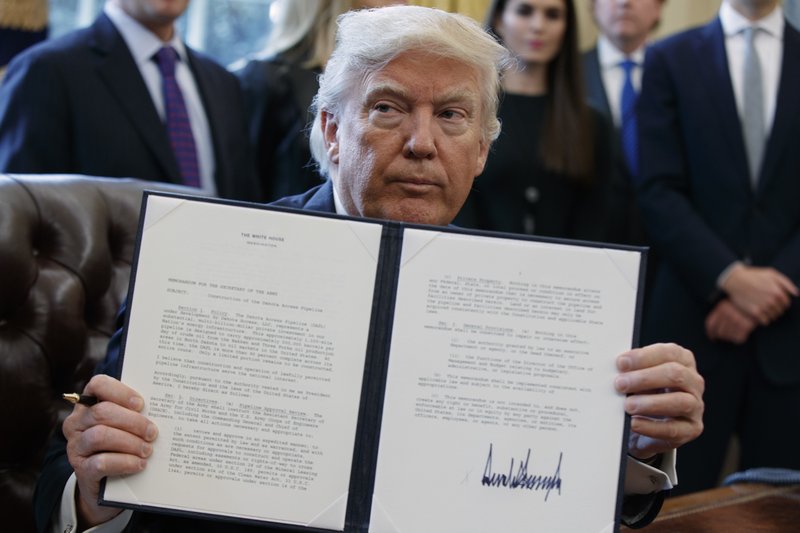
Dealing a blow to former President Barack Obama‘s legacy on climate change, President Donald Trump signed executive actions Tuesday to advance the construction of the Keystone XL and Dakota Access oil pipelines, a move cheered by congressional Republicans and decried by environmentalists. Trump told reporters at the White House that the actions on the pipelines will be subject to the terms and conditions being negotiated by U.S. officials. “From now on we are going to start making pipelines in the United States,” Trump said from the Oval Office. Obama killed the proposed Keystone XL pipeline in late 2015, declaring it would have undercut U.S. efforts to clinch a global climate change deal that was a centerpiece of his environmental legacy. The pipeline would run from Canada to U.S. refineries in the Gulf Coast. A presidential permit is needed to approve the pipeline because it would cross the U.S border. The Army decided last year to explore alternate routes for the Dakota pipeline after the Standing Rock Sioux tribe and its supporters said the pipeline threatened drinking water and Native American cultural sites. The company developing the 1,200-mile pipeline, Texas-based Energy Transfer Partners, disputes that and says the pipeline will be safe. The Dakota pipeline is set to carry North Dakota oil through South Dakota and Iowa to a shipping point in Illinois. “Today’s news is a breath of fresh air, and proof that President Trump won’t let radical special-interest groups stand in the way of doing what’s best for American workers,” said Sen. John Cornyn of Texas, the second-ranking Republican in the Senate. In July, the Army Corps of Engineers granted the company needed permits, but in September the agency said further analysis was needed. On Dec. 4, the assistant army secretary for civil works, Jo-Ellen Darcy, declined to allow the pipeline to be built under Lake Oahe because she said alternate routes needed to be considered. Energy Transfer Partners called the decision politically motivated and said that Obama was delaying the matter until he left office. Nearly 600 pipeline opponents have been arrested in North Dakota since last year. An encampment on Corps land along the pipeline route was home to thousands of protesters who call themselves “water protectors,” though the camp’s population has thinned due to harsh winter weather and a plea by Standing Rock Chairman Dave Archambault for the camp to disband. Trump touted the stalled Keystone project during a late October campaign swing through Florida, saying: “We’re going to approve energy infrastructure projects like the Keystone pipeline and many more.” He listed the project among his top priorities for the first 100 days of his administration, saying it could provide “a lot of jobs, a lot of good things.” Trump also supports the Dakota pipeline. Until last year, Trump owned a small amount of stock in Energy Transfer Partners and at least $100,000 in Phillips 66, an energy company that owns one-quarter of the pipeline. Trump sold the shares last year as part of a wide-ranging stock divestment, a spokesman said. A spokesman said in December that Trump’s support for the Dakota project “has nothing to do with his personal investments and everything to do with promoting policies that benefit all Americans.” Environmental groups blasted the order as a bid by Trump to serve the oil industry. Trump’s nominee for secretary of state, Rex Tillerson, is a former Exxon Mobil CEO, and his pick for energy secretary, former Texas Gov. Rick Perry, owns stock in Energy Transfers. “Donald Trump has been in office for four days and he’s already proving to be the dangerous threat to our climate we feared he would be,” said Michael Brune, executive director of the Sierra Club. He and other activists said the fight against the projects was not over. “It’s a dark day for reason, but we will continue the fight,” said Bill McKibben, co-founder of the environmental group 350.org and a leader of a five-year fight against Keystone XL. McKibben added: “People will mobilize again.” Republished with permission of The Associated Press.
Alabama lawmakers react to President Obama’s rejection of Keystone XL pipeline
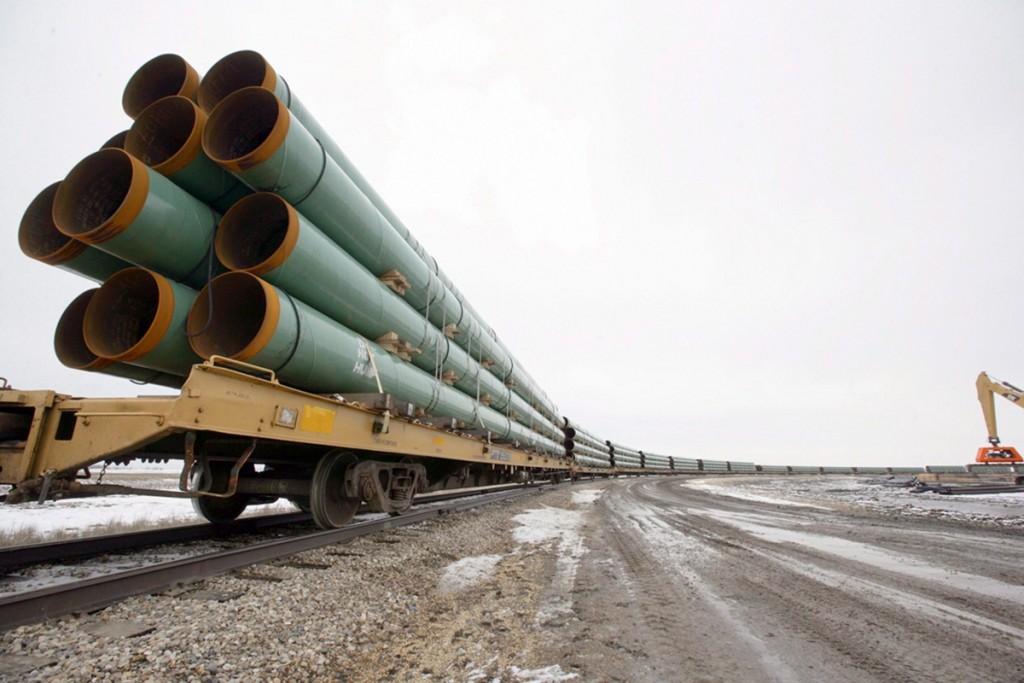
Alabama lawmakers are reacting to President Barack Obama‘s decision to reject the Keystone XL pipeline after a lengthy seven-year State Department review of the controversial project. Obama’s denied the 1,179-mile pipeline that would have carried 800,000 barrels a day of petroleum from the Canadian oil sands to the Gulf Coast Friday afternoon citing concerns about its impact on the climate. “America is now a global leader when it comes to taking serious action to fight climate change, and frankly, approving this project would have undercut that leadership,” Obama explained. The entire Alabama Congressional delegation — including lone Democrat U.S. Rep. Terri Sewell (AL-07) — voted for Keystone. Here’s what the Alabama lawmakers have to say about Obama’s rejection of the Keystone XL pipeline: U.S. Sen. Richard Shelby via Facebook: Unsurprisingly, President Obama rejected the Keystone XL Pipeline today. Keystone would create jobs and decrease energy bills for American families while boosting our nation’s energy independence. The rejection of this job-creating project stands as further proof that this Administration is more concerned with playing partisan politics than improving our economy. U.S. Rep. Bradley Byrne (AL-01): It is disappointing, but not surprising, that President Obama has decided to put the views of radical environmentalists over what’s in the best interest of the American people. The Keystone Pipeline project would create thousands of jobs, and it is a shame the President won’t allow it to move forward. U.S. Rep. Mike Rogers (AL-03): With the rejection of the Keystone XL Pipeline, the Obama Administration once again stands in the way of job creation. With instability in the Middle East, North American energy is exactly what this country needs, but instead Obama’s policy agenda includes rejection of both reliable energy and American jobs. I am extremely disappointed, but not surprised, that this Administration is playing politics with our country’s economy.
