
White House officials to kick off big Donald Trump impeachment week
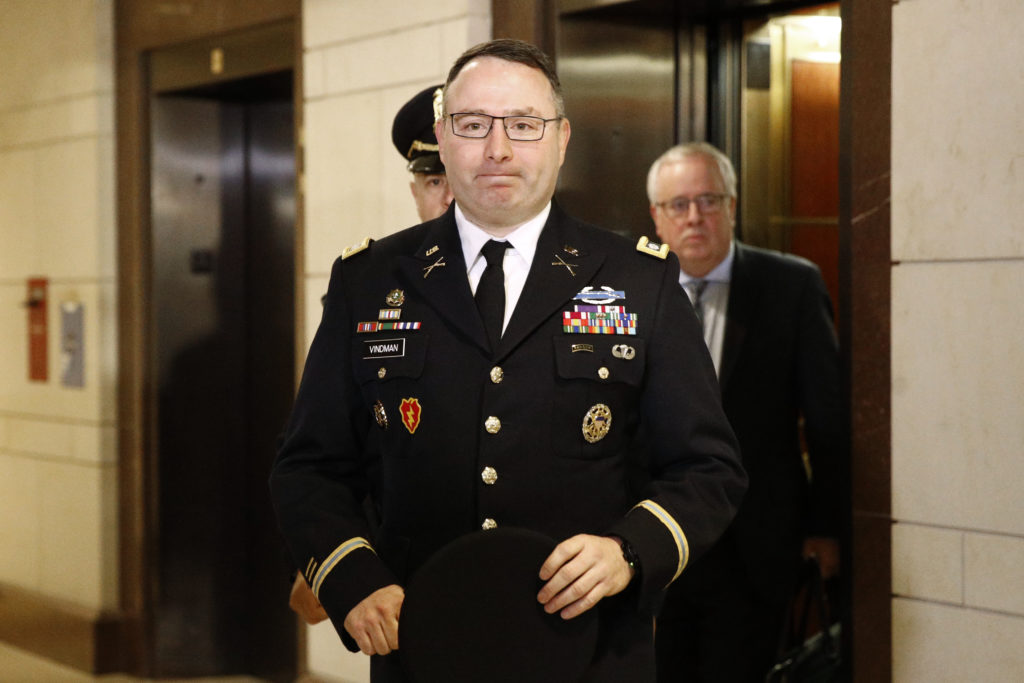
Two top national security aides who listened to President Donald Trump’s July call with Ukraine’s president are preparing to testify Tuesday at House impeachment hearings as the inquiry reaches deeper into the White House. Lt. Col. Alexander Vindman, an Army officer at the National Security Council, and Jennifer Williams, his counterpart at Vice President Mike Pence’s office, say they had concerns as Trump spoke on July 25 with the newly elected Ukraine president about political investigations into Joe Biden. After they appear Tuesday morning, the House will hear in the afternoon from former NSC official Timothy Morrison and Kurt Volker, the former Ukraine special envoy. In all, nine current and former U.S. officials are testifying as the House’s impeachment inquiry accelerates. Democrats say Trump’s pressure on Ukraine to investigate his Democratic rivals as he withheld U.S. military aid Ukraine needed to resist Russian aggression may be grounds for removing the 45th president. Trump says he did no such thing and the Democrats just want him gone. Vindman and the other witnesses have testified in earlier, closed-door sessions. Their depositions have been publicly released, and they’ll face direction questions from lawmakers on Tuesday. “I did not think it was proper to demand that a foreign government investigate a U.S. citizen,” said Vindman, a decorated Iraq War veteran. He said there was “no doubt” what Trump wanted from Ukrainian President Volodymyr Zelenskiy. It wasn’t the first time Vindman, a 20-year military officer, was alarmed over the administration’s push to have Ukraine investigate Democrats, he testified. Earlier, during an unsettling July 10 meeting at the White House, Ambassador Gordon Sondland told visiting Ukraine officials that they would need to “deliver” before next steps, which was a meeting Zelenskiy wanted with Trump, the officer testified. “He was talking about the 2016 elections and an investigation into the Bidens and Burisma,” Vindman testified, referring to the gas company in Ukraine where Hunter Biden served on the board. “The Ukrainians would have to deliver an investigation into the Bidens,” he said. “There was no ambiguity.” On both occasions, Vindman said, he took his concerns about the shifting Ukraine policy to the lead counsel at the NSC, John Eisenberg. Williams, a longtime State Department official who is detailed to Pence’s national security team, said she too had concerns during the phone call, which the aides monitored as is standard practice. When the White House produced a rough transcript later that day, she put it in the vice president’s briefing materials. “I just don’t know if he read it,” Williams testified in a closed-door House interview. Pence’s role throughout the impeachment inquiry has been unclear, and the vice president’s aide is sure to be questioned by lawmakers looking for answers. Trump has already attacked Williams, associating her with “Never Trumpers,” even though there is no indication the career State Department official has shown any partisanship. The president wants to see a robust defense by his GOP allies on Capitol Hill, but so far so far Republicans have offered a changing strategy as the fast-moving probe spills into public view. They’re expected to mount a more aggressive attack on the witnesses as they try to protect Trump. In particular, Republicans are expected to try to undercut Vindman, suggesting he reported his concerns outside his chain of command, which would have been Morrison, not the NSC lawyer. Under earlier questioning, Republicans wanted Vindman to disclose who else he may have spoken to about his concerns, as the GOP inch closer to publicly naming the still anonymous whistleblower whose report sparked the inquiry. GOP Sen. Ron Johnson, who was deeply involved in other White House meetings about Ukraine, offered a sneak preview of this strategy late Monday when he compared Vindman, a Purple Heart veteran, to the “bureaucrats” who “never accepted Trump as legitimate.” “They react by leaking to the press and participating in the ongoing effort to sabotage his policies and, if possible, remove him from office.” It is entirely possible that Vindman fits this profile, said Johnson, Republican-Wisconsin. The White House has instructed officials not to appear, and most have received congressional subpoenas to compel their testimony. The witnesses are testifying under penalty of perjury, and Sondland already has had to amend his earlier account amid contradicting testimony from other current and former U.S. officials. Sondland, the wealthy donor whose routine boasting about his proximity to Trump has brought the investigation to the president’s doorstep, is set to testify Wednesday. Others have testified that he was part of a shadow diplomatic effort with the president’s personal lawyer, Rudy Giuliani, outside of official channels that raised alarms. Morrison has referred to Burisma as a “bucket of issues” — the Bidens, Democrats, investigations — he had tried to “stay away” from. Sondland met with a Zelenskiy aide on the sidelines of a Sept. 1 gathering in Warsaw, and Morrison, who was watching the encounter from across the room, testified that the ambassador told him moments later he pushed the Ukrainian for the Burisma investigation as a way for Ukraine to gain access to the military funds. Volker provided investigators with a package of text messages with Sondland and another diplomat, William Taylor, the charge d’affaires in Ukraine, who grew alarmed at the linkage of the investigations to the aid. Taylor, who testified publicly last week, called that “crazy.” A wealthy hotelier who donated $1 million to Trump’s inauguration, Sondland is the only person interviewed to date who had direct conversations with the president about the Ukraine situation. Morrison said Sondland and Trump had spoken about five times between July 15 and Sept. 11 — the weeks that $391 million in U.S. assistance was withheld from Ukraine before it was released. Trump has said he barely knows Sondland. The committee will also hear on Wednesday from Laura Cooper, a deputy assistant secretary of defense, and David Hale, a State Department official. On Thursday, David Holmes, a State Department official in Kyiv, and Fiona Hill, a former top NSC staff member for Europe and Russia, will
Nancy Pelosi invites Donald Trump to testify as new witnesses prepare

House Speaker Nancy Pelosi invited President Donald Trump to testify in front of investigators in the House impeachment inquiry ahead of a week that will see several key witnesses appear publicly. Pushing back against accusations from the Republican president that the process has been stacked against him, Pelosi said Trump is welcome to appear or answer questions in writing, if he chooses. “If he has information that is exculpatory, that means ex, taking away, culpable, blame, then we look forward to seeing it,” she said in an interview that aired Sunday on CBS’ “Face the Nation.” Trump “could come right before the committee and talk, speak all the truth that he wants if he wants,” she said. Senate Democratic leader Chuck Schumer echoed that suggestion. “If Donald Trump doesn’t agree with what he’s hearing, doesn’t like what he’s hearing, he shouldn’t tweet. He should come to the committee and testify under oath. And he should allow all those around him to come to the committee and testify under oath,” Schumer told reporters. He said the White House’s insistence on blocking witnesses from cooperating begs the question: “What is he hiding?” The comments come as the House Intelligence Committee prepares for a second week of public hearings as part of its inquiry, including with the man who is arguably the most important witness. Gordon Sondland, Trump’s ambassador to the European Union, is among the only people interviewed to date who had direct conversations with the president about the situation because the White House has blocked others from cooperating with what it dismisses as a sham investigation. And testimony suggests he was intimately involved in discussions that are at the heart of the investigation into whether Trump held up U.S. military aid to Ukraine to try to pressure the country’s president to announce an investigation into Democrats, including former Vice President Joe Biden, a leading 2020 candidate, and Biden’s son Hunter. Multiple witnesses overheard a phone call in which Trump and Sondland reportedly discussed efforts to push for the investigations. In private testimony to impeachment investigators made public Saturday, Tim Morrison, a former National Security Council aide and longtime Republican defense hawk, said Sondland told him he was discussing Ukraine matters directly with Trump. Morrison said Sondland and Trump had spoken approximately five times between July 15 and Sept. 11 — the weeks that $391 million in U.S. assistance was withheld from Ukraine before it was released. And he recounted that Sondland told a top Ukrainian official in a meeting that the vital U.S. military assistance might be freed up if the country’s top prosecutor “would go to the mike and announce that he was opening the Burisma investigation.” Burisma is the gas company that hired Hunter Biden. Morrison’s testimony contradicted much of what Sondland told congressional investigators during his own closed-door deposition, which the ambassador later amended. Trump has said he has no recollection of the overheard call and has suggested he barely knew Sondland, a wealthy donor to his 2016 campaign. But Democrats are hoping he sheds new light on the discussions. “I’m not going to try to prejudge his testimony,” Rep. Jim Himes, Democrat-Conneticut, said on “Fox News Sunday.” But he suggested, “it was not lost on Ambassador Sondland what happened to the president’s close associate Roger Stone for lying to Congress, to Michael Cohen for lying to Congress. My guess is that Ambassador Sondland is going to do his level best to tell the truth, because otherwise he may have a very unpleasant legal future in front of him.” The committee also will be interviewing a long list of others. On Tuesday, it’ll hear from Morrison along with Jennifer Williams, an aide to Vice President Mike Pence, Alexander Vindman, the director for European affairs at the National Security Council, and Kurt Volker, the former U.S. special envoy to Ukraine. On Wednesday the committee will hear from Sondland in addition to Laura Cooper, a deputy assistant secretary of defense, and David Hale, a State Department official. And on Thursday, Fiona Hill, a former top NSC staffer for Europe and Russia, will appear. Trump, meanwhile, continued to tweet and retweet a steady stream of commentary from supporters as he bashed “The Crazed, Do Nothing Democrats” for “turning Impeachment into a routine partisan weapon.” “That is very bad for our Country, and not what the Founders had in mind!!!!” he wrote. He also tweeted a doctored video exchange between Rep. Adam Schiff, the Democratic chairman of the Intelligence Committee, and Republican Rep. Jim Jordan, in which Schiff said he did not know the identity of the whistleblower whose complaint triggered the inquiry. The clip has been altered to show Schiff wearing a referee’s uniform and loudly blowing a whistle. In her CBS interview, Pelosi vowed to protect the whistleblower, whom Trump has said should be forced to come forward despite longstanding whistleblower protections. “I will make sure he does not intimidate the whistleblower,” Pelosi said. Trump has been under fire for his treatment of one of the witnesses, the former ambassador to Ukraine, Marie Yovanovitch, whom Trump criticized by tweet as she was testifying last week. That attack prompted accusations of witness intimidation from Democrats and even some criticism from Republicans, who have been largely united in their defense of Trump “I think, along with most people, I find the president’s tweet generally unfortunate,” said Ohio Republican Rep. Mike Turner on CNN’s “State of the Union.” Still, he insisted that tweets were “certainly not impeachable and it’s certainly not criminal. And it’s certainly not witness intimidation,” even if Yovanovitch said she felt intimidated by the attacks. Rep. Chris Stewart, Republican-Utah, said Trump “communicates in ways that sometimes I wouldn’t,” but dismissed the significance of the attacks. “If your basis for impeachment is going to include a tweet, that shows how weak the evidence for that impeachment is,” he said on ABC’s “This Week.” And the backlash didn’t stop Trump from lashing out at yet another witness, this time Pence aide Williams. He directed her in a Sunday tweet
New whistleblower may give house democrats fresh information
House Democrats leading an impeachment inquiry of President Donald Trump’s dealings with Ukraine may have fresh information to work with after a new whistleblower stepped forward with what the person’s lawyer said were firsthand knowledge of key events. With Congress out for another week and many Republicans reticent to speak out, a text from attorney Mark Zaid that a second individual had emerged and could corroborate the original whistleblower’s complaint gripped Washington and potentially heightened the stakes for Trump. Zaid, who represents both whistleblowers, told The Associated Press that the new whistleblower works in the intelligence field and has spoken to the intelligence community’s internal watchdog. The original whistleblower, a CIA officer, filed a formal complaint with the inspector general in August that triggered the impeachment inquiry. The document alleged that Trump had used a July telephone call with Ukraine President Volodymyr Zelenskiy to investigate a political rival, Joe Biden, and his son Hunter, prompting a White House cover-up. The push came even though there was no evidence of wrongdoing by the former vice president or his son, who served on the board of a Ukrainian gas company. Trump and his supporters deny that he did anything improper, but the White House has struggled to come up with a unified response. A second whistleblower with direct knowledge could undermine efforts by Trump and his allies to discredit the original complaint. They have called it politically motivated, claimed it was filed improperly and dismissed it as unreliable because it was based on secondhand or thirdhand information. A rough transcript of Trump’s call with Zelenskiy, released by the White House, has already corroborated the complaint’s central claim that Trump sought to pressure Ukraine on the investigation. Text messages from State Department officials revealed other details, including that Ukraine was promised a visit with Trump if the government would agree to investigate the 2016 election and a Ukrainian gas company tied to Biden’s son — the outline of a potential quid pro quo. Rep. Jim Himes, Democrat-Connecticut, a member of the House Intelligence Committee, said word of a second whistleblower indicates a larger shift inside the government. “The president’s real problem is that his behavior has finally gotten to a place where people are saying, ‘Enough,’” Himes said. Democrats have zeroed in on the State Department in the opening phase of their impeachment investigation. The Intelligence, Oversight and Foreign Affairs committees have already interviewed Kurt Volker, a former special envoy to Ukraine who provided the text messages, and least two other witnesses are set for depositions this week: Gordon Sondland, the U.S. ambassador to the European Union, and Marie Yovanovitch, who was abruptly ousted as the U.S. ambassador to Ukraine in May. Sen. Lindsey Graham, Republican-South Carolina, one of Trump’s most vocal backers, provided perhaps the strongest defense of the Republican president. He said there was nothing wrong with Trump’s July conversation with Zelenskiy and said the accusations look like a “political setup.” As for Trump, rather than visiting his nearby golf course in Sterling, Virginia, for a second day, he stayed at the White House on Sunday, where he tweeted and retweeted, with the Bidens a main target. “The great Scam is being revealed!” Trump wrote at one point, continuing to paint himself as the victim of a “deep state” and hostile Democrats. Aside from Trump’s attempt to pressure Zelenskiy, the July call has raised questions about whether Trump held back near $400 million in critical American military aid to Ukraine as leverage for an investigation of Burisma, a Ukrainian gas company. Hunter Biden served on the board of Burisma at the same time his father was leading the Obama administration’s diplomatic dealings with Ukraine. Though the timing raised concerns among anti-corruption advocates, there has been no evidence of wrongdoing by either Biden. Joe Biden, a leading candidate for the 2020 Democratic presidential nomination, wrote in The Washington Post that he had a message for Trump and “those who facilitate his abuses of power. … Please know that I’m not going anywhere. You won’t destroy me, and you won’t destroy my family.” Additional details about the origins of Trump’s July 25 call with Zelenskiy have emerged over the weekend. Energy Secretary Rick Perry had encouraged Trump to speak with the Ukrainian leader, but on energy and economic issues, according to spokeswoman Shaylyn Hynes. She said Perry’s interest in Ukraine is part of U.S. efforts to boost Western energy ties to Eastern Europe. Trump, who has repeatedly has described his conversation with Zelenskiy as “perfect,” told House Republicans on Friday night that it was Perry who teed up the July call, according to a person familiar with Trump’s comments who was granted anonymity to discuss them. The person said Trump did not suggest that Perry had anything to do with the pressure to investigate the Bidens. Himes appeared on CBS’ “Face the Nation” while Graham spoke on Fox News Channel’s “Sunday Morning Futures.” By Eric Tucker, Richard Lardner and Jill Colvin Associated Press Associated Press writers Alan Fram, Ellen Knickmeyer and Mary Clare Jalonick contributed to this report. Republished with the permission of the Associated Press.
