Daniel Sutter: The cost of employees

Most Americans have to work for a living. We must trade for the goods and services we want to consume, and for most of us, we trade our labor. Conflict over two legal work classifications, employees and independent contractors, illustrate how government’s rules can imperil economic prosperity. People must work for a living, but people who want a job done, must secure assistance voluntarily through compensation. Difficult, physically demanding, boring, and dangerous tasks will require extra compensation. Regulation heavily burdens business. According to a U.S. Small Business Administration study, federal regulations cost small businesses over $10,000 per employee. The National Small Business Association found that small businesses face $83,000 in regulatory costs during their first year of operation when owners struggle just to survive. Around 30 percent of a business’ labor cost is for benefits and paperwork. How much do government rules affect hiring? Rules affecting employees include the minimum wage, overtime pay, workplace safety rules, collective bargaining and the National Labor Relations Act, the Americans with Disabilities Act, the Civil Rights Act, immigration eligibility, worker’s compensation, and unemployment compensation. Many regulatory rules do not apply to independent contractors. Furthermore, requirements imposed on larger businesses are generally based on employees, not contractors. Consumers must eventually pay for a business’ costs of complying with state and federal laws and rules. And costs tied specifically to employment reduce hiring to do tasks which create value in our economy. Half of small businesses report having held off hiring due to regulation. Why do politicians impose so many rules on employment? In part, because mandates cost the government little; politicians do not spend tax dollars to boost wages or pay insurance premiums. The complexity of employment relations also matters, helping sustain an illusion of significant benefits to workers. Businesses care about the full cost of an employee, meaning the wage or salary plus the cost of benefits, training, required paperwork, and so forth. When government mandates better terms for employees on one item, businesses can trim back others to contain the cost. For instance, less on-the-job training or flexibility in scheduling can offset the cost of a higher minimum wage. The adjustments can cancel out mandated benefits. A college student might consider an $8 per hour job with flexibility to adjust work hours around exams equal to a $10/hour with no flexibility. Raising the minimum wage to $10/hour may lead employers to eliminate flexibility, leaving the college student no better off. Such offsets of government policies often go unnoticed. Supporters celebrate a hike in the minimum wage, or mandatory overtime pay, or required health insurance. Adjustments like a loss of scheduling flexibility may never get linked back to the policy. The mandate appears like a better deal than in reality. As rules increased the cost of employment, businesses have not surprisingly tried reclassifying employees as independent contractors. The IRS and state governments enforce rules regarding these classifications, but some employers clearly try to bend the law. Efforts by state and federal regulators to protect traditional employment, however, also frustrate Americans seeking new self-employment options. Work flexibility will be crucial to realize the full potential of the sharing economy. Exploiting opportunities for sharing will require many people to perform small tasks. Scooter rental companies like Spin and Lime, for instance, need people to charge their electric vehicles left on city sidewalks. Power and gardening tools sit in garages most of the time and could be widely shared. Getting tools to paying users and back to their owners will require on-demand delivery service. Each rental is unlikely to generate enough surplus value to cover employees’ costly regulations. A market economy enables voluntary action in pursuit of our goals. The labor market forces people to pay for tasks they want performed. Burdensome government rules should not prevent willing parties from agreeing to deals to get work done. ••• Daniel Sutter is the Charles G. Koch Professor of Economics with the Manuel H. Johnson Center for Political Economy at Troy University and host of Econversations on TrojanVision. The opinions expressed in this column are the author’s and do not necessarily reflect the views of Troy University.
Donald Trump courts business, labor in delicate balancing act
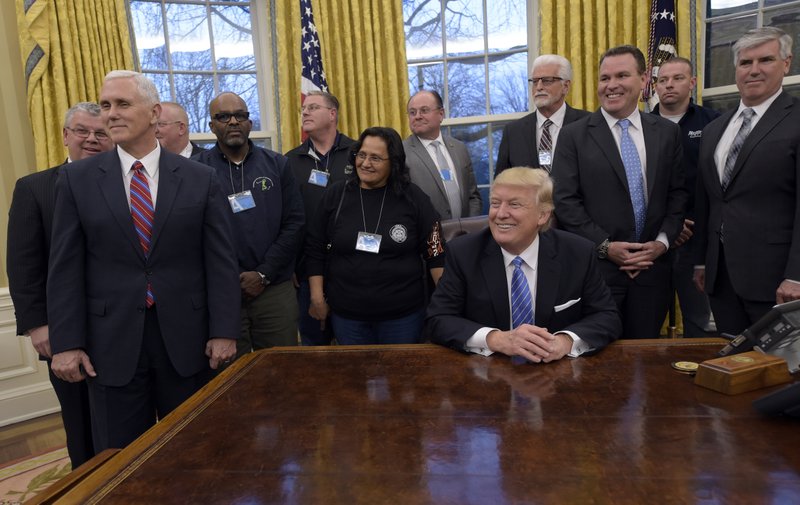
President Donald Trump‘s opening work day offered a look at his tricky balancing act between American businesses and the working-class voters who propelled his march to the White House. The name of the game, Trump tweeted before dawn: “Jobs.” He then met with American business executives to both charm and threaten them into doing business in the U.S. The real estate titan later served notice he was pulling the U.S. out of participating in a proposed Pacific trade pact and promised to renegotiate a 23-year-old agreement with Canada and Mexico — both of which, Trump has said, are bad for jobs. Trump also bore down on the one sector of the American economy he says has too many jobs: The federal government, whose hiring and wages he froze with the stroke of an executive order pen. Before the day was out, Trump had gathered union leaders — from those representing sheet metal workers to carpenters — to listen to their concerns and hear their applause over his assault on what he called “ridiculous” trade deals. It’s all part of an audacious plan to grow the economy by 4 percent a year while shrinking the trade gap and creating 25 million jobs over the next decade — despite obstacles that have vexed presidents of both parties for decades. “We’re going to put a lot of people back to work; we’re going to use common sense,” Trump insisted Monday. At one point, he called reporters back into his meeting with labor leaders to hear Doug McCarron of the United Brotherhood of Carpenter praise Trump’s inaugural address. The speech “hit home for the people who have been hurting,” said McCarron, who had endorsed Hillary Clinton in the presidential race. Trump’s approach tracks with exit polls that showed two-thirds of white voters without a college degree chose him over Clinton. These voters comprised nearly half of all of Trump’s voters, according to the survey conducted for The Associated Press and television networks by Edison Research. In an AP-NORC poll last January, 82 percent of non-college educated white voters called reducing unemployment a very or extremely important issue for the next president, putting it among their top economic issues. There was ample evidence, too, that those voters were not recovering economically from the recession with the rest of the nation. In an April 2016 AP-NORC poll, 7 in 10 non-college whites said their pay had stayed the same or lost ground in previous years. Trump seemed well-aware of his constituency — promising during the campaign that bringing American jobs back was a top priority for him, too. After the election, he boasted several times of persuading the heads of American companies to cancel plans to move. In one notable case, Trump took credit in December for keeping what he said were 1,100 jobs at the Carrier Corp. factory in Indianapolis from being outsourced to Mexico. The number was closer to 800. United Steelworkers Local 1999 President Chuck Jones accused the president-elect of exaggerating, and a Twitter war erupted. Trump fumed that Jones had done “a terrible job representing American workers.” Trump spent Monday trying to make the case that he can do better. But on workplace issues, it remains unclear how strong a friend Trump is to labor and the working class Americans who powered his victory. Some of the new president’s actions on Monday were symbolic: The U.S.’s participation in the Trans-Pacific Partnership, for example, was already dead due to withering enthusiasm among Republicans, Democrats and labor unions, among others. Business leaders have long been under pressure to operate inside the nation’s borders. And he wouldn’t say when he’d start renegotiating NAFTA, the 1994 free trade agreement blamed by many for inspiring American businesses to send good-paying jobs to less expensive shores. It was enough to win some plaudits from the Twittersphere — AFL-CIO President Richard Trumka called the move on TPP “an important first step toward a trade policy that works for working people,” but did not mention Trump’s name in the statement. In fact, other parts of Trump’s agenda conflict with labor’s wish list, a conflict personified by his choice to lead the department charged with enforcing workplace rules. Fast food executive Andrew Puzder, CEO of the parent company of Hardees, Carl’s Jr., and other chains, has said that large increases in the minimum wage — one of labor’s top priorities — would lead to job losses. He wrote in a May 2016 op-ed that President Barack Obama‘s overtime rule would be “another barrier to the middle class rather than a springboard” for workers. A pair of pro-labor interest groups, Jobs for Justice and the Economic Policy Institute, have set up a web site and Twitter hashtag devoted to Puzder’s nomination called, “#antilaborsecretary.” And 22 Senate Democrats are calling for Puzder’s confirmation hearing Feb. 2 to include current and former workers who have complained of poor or illegal treatment at his restaurants. The workers’ stories, the senators wrote, raise concerns about Puzder’s “commitment to enforcing federal labor laws — the secretary of labor’s chief responsibility.” For his part, Puzder tweeted Jan. 16: “I am looking forward to my hearing.” Republished with permission of The Associated Press.
Hillary Clinton, Bernie Sanders make final pushes ahead of New York primary
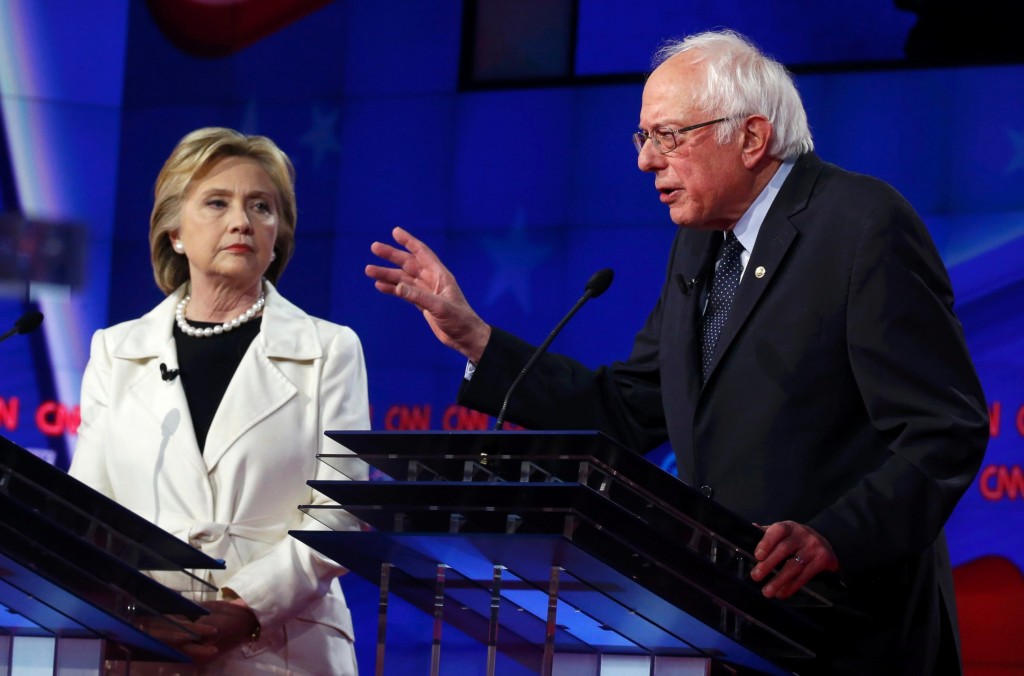
Hillary Clinton greeted recently-unionized workers at a Queens car wash during her final day of campaigning ahead of the New York primary. Clinton cited the workers as evidence of how “real change happens.” “It didn’t happen overnight,” she told a small crowd at the Hi-Tek Wash & Lube. “You work at it every day.” The remark echoes her recent attacks on rival Bernie Sanders, who she says promises an impossible-to-achieve “political revolution.” Earlier on Monday, she stopped at a hospital in Yonkers and urged workers to support her at the polls. Clinton will join New York Senator Kirsten Gillibrand for a rally in the afternoon. Clinton also said the White House should take a “hard look” at whether to declassify 28 pages of the 9/11 commission report. Families of victims and some members of Congress say the government has suppressed information about the attack. Clinton is campaigning with Sen. Charles Schumer, who joined the effort. She’s also backing legislation that would allow the Saudi government to be held responsible for any role in the attacks in US courts. Meanwhile, Sanders is backing legislation that would let Americans sue Saudi Arabia over the 9/11 terrorist attacks. The bill is opposed by the Obama administration but is important to families of 9/11 victims, some of whom believe Saudi officials played some part in the attacks. Sanders spoke in favor of the legislation, saying it’s important to have a full understanding of the “the possible role of the Saudi government in 9/11.” U.S. inquiries have not reported a link between the Saudi government or its senior officials and the attacks. But Sanders notes that some conclusions remain classified. Sanders says Saudi Arabia promotes an extreme and “very destructive” version of Islam. Fifteen of the 19 hijackers in the September 2001 attacks, which destroyed the World Trade Center and killed thousands, were citizens of Saudi Arabia. Republished with permission of the Associated Press.
Right-to-work amendment passed in Alabama Senate

The Alabama Senate has passed legislation reiterating Alabama’s position as a so-called “right-to-work” state. Senators on Thursday passed the amendment 25 votes to 9. Alabama voters will now have the chance to approve the amendment at the ballot box. Right-to-work states prohibit companies from requiring workers to pay union dues as a condition of employment. Alabama law already has the prohibition, but Republicans said adding the amendment to the state Constitution will give businesses additional assurances. In a debate on the Senate floor, Minority Leader Quinton Ross, a Democrat, called the amendment “asinine” and a waste of time and money. Ross says lawmakers have more important issues they should address. Republished with permission of the Associated Press.
Local “Fight for 15” campaign draws moderate turnout in Birmingham
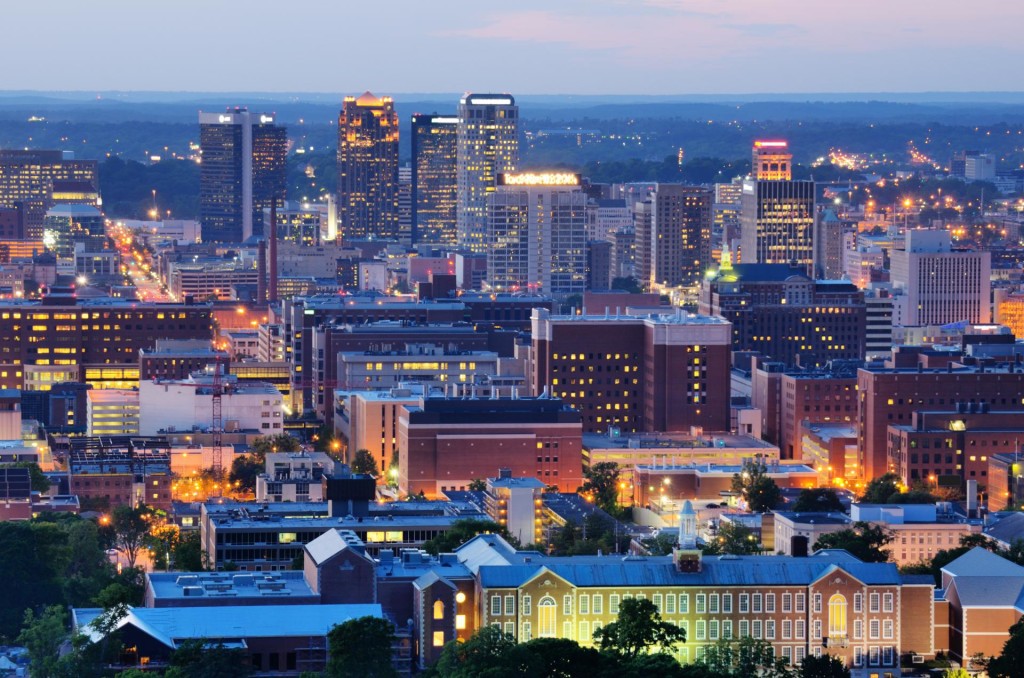
Across the nation, some 270 Occupy Wall Street-flavored campaigns urging statehouses, local governments and even Congress to increase the minimum wage to $15 an hour took place Tuesday. Democratic presidential candidate and Vermont Sen. Bernie Sanders even told protesters assembled outside the U.S. Capitol, “You’re having a profound impact.” But in downtown Birmingham? Not as much. According to reports, a crowd of around 30 gathered to stand in solidarity with labor and social justice activists around the nation calling for a higher minimum wage, including Pastor Gwendolyn Webb, a longtime leader of left-leaning movements dating back to the Civil Rights era. One protester called a $15 hourly wage “number where people can see a future,” where a normal worker can save and plan beyond the paycheck-to-paycheck grind. Protests also took place Tuesday night in Tuscaloosa, where they were joined by workers from the Hyundai plant in Selma. Don’t expect them to have the same kind of influence they had in New York for instance, where Gov. Mario Cuomo announced Tuesday he will pay all state workers in New York City $15 per hour, and all state workers that amount by 2021, however. Though Sanders joined in the call for “15 bucks and a union” Tuesday, Alabama is a famously supply-side state, and many blue-collar voters here seem to like that just fine. GOP leaders who routinely dominate the more labor-friendly Democrats at the ballot box say low taxes, low wages, and less regulation is what makes Alabama – which has had something of a manufacturing renaissance in recent years – competitive against its neighbors for jobs and development.
Women’s group: 45 percent of Alabama workers get no paid sick days

The National Partnership for Women & Families has published a new fact sheet that examines the state of sick leave policy on Alabama’s workforce. The study shows workers in the state have slightly less access to paid days off when they are or their children are sick, in keeping with a troublesome national fact of life for workers. “In Alabama, an estimated 671,099 private sector workers, or 44.6 percent of the workforce, cannot earn a single paid sick day to use to recover from common illnesses or seek medical care,” reads the report, released Wednesday. “Nationwide, more than 43 million private sector workers – nearly 40 percent of the workforce – cannot earn paid sick time.” “When workers do not have access to paid sick days, the consequences can be significant. For a typical family in the United States without paid sick days, for example, 3.5 days lost to illness are equivalent to the family’s entire monthly grocery budget,” the studied continued. Among the study’s findings: More than 145,000 people in Alabama work in restaurants – an industry in which, nationally, 90 percent of workers cannot earn paid sick days; Overall, 35.6 percent of Alabama jobs are considered low wage, and few low-wage jobs allow workers to earn paid sick days; and More than 700,000 children in Alabama live in families in which all parents work, but parents with paid sick days often cannot use them to care for children. The study also says sick-leave policies adverse to workers both in Alabama and nationally disproportionately affect minority populations. The state is home to some 960,000 African-American workers, whose rate of access to paid sick days is even lower than the statewide 45 percent. Moreover, the Partnership says, paid sick days are good for industry as well as workers. “Employee turnover is expensive – on average, one fifth of an employee’s annual salary,” the report said. “Paid sick days result in reduced turnover,18 which leads to reduced hiring and training costs for businesses.” They also help reduce unnecessary health care costs, which lowers cost pressure on taxpayers and policyholders. “Universal access to paid sick days would eliminate an estimated 1.3 million emergency room visits each year, saving $1.1 billion annually in costs to individuals, private insurers and public programs, such as Medicare and Medicaid.” The National Partnership entitled their release containing the new findings “What Does It Mean When Nearly 45 Percent of Alabama’s Workers Cannot Earn a Single Paid Sick Day?” Debra Ness, the Washington, D.C.-based nonpartisan advocacy group’s president, was quick to fill in the blanks. “Our nation’s failure to establish a paid sick days standard is harming people in Alabama and across the country,” Ness said. “It is absolutely unacceptable that so many hardworking people and their families risk grave financial hardship if they get the flu, strep throat or another common illness because they cannot earn basic paid sick days, even after years at their jobs. Lawmakers at all levels need to look closely at what is at stake and take action.”