
Senate takes over Donald Trump’s impeachment after House handoff
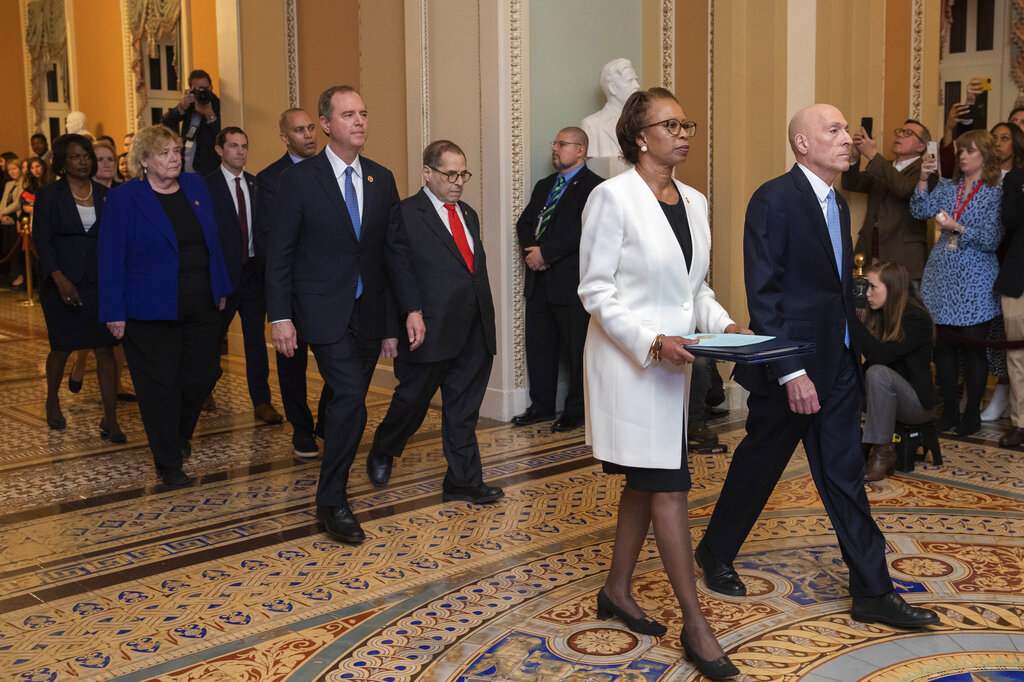
The team of impeachment managers escorted the document to the Senate in a dramatic procession.
EPA rethinking air pollution rule for power plants
The Trump administration is considering rewriting another Obama-era rule controlling hazardous emissions from coal-fired power plants, this one on mercury and other pollutants. Environmental Protection Agency spokeswoman Molly Block said Wednesday that the agency is still preparing its proposal for consideration by the White House’s Office of Management and Budget and that there are few details to release. The EPA is looking at whether the 2012 rule on power plant emissions was necessary, among other issues, Block said. The Obama administration rule set limits for emissions of mercury, arsenic and other toxic air pollutants from coal- and oil-fired power plants. The U.S. Energy Information Administration said last year that almost all the country’s coal-fired power plants were now in compliance with the 2012 rule. Democratic Sen. Tom Carper of Delaware and Republican Sen. Lamar Alexander of Tennessee urged the EPA in a joint letter to keep the 2012 limits in place, saying the rules has cut mercury emissions from power plants by 90 percent. The EPA announced earlier this month that it was moving to relax federal oversight of emissions from coal-fired power plants under a separate Obama-era rule from 2015. Republished with the permission of the Associated Press.
Doug Jones introduces bipartisan legislation to delay Trump’s auto tariffs
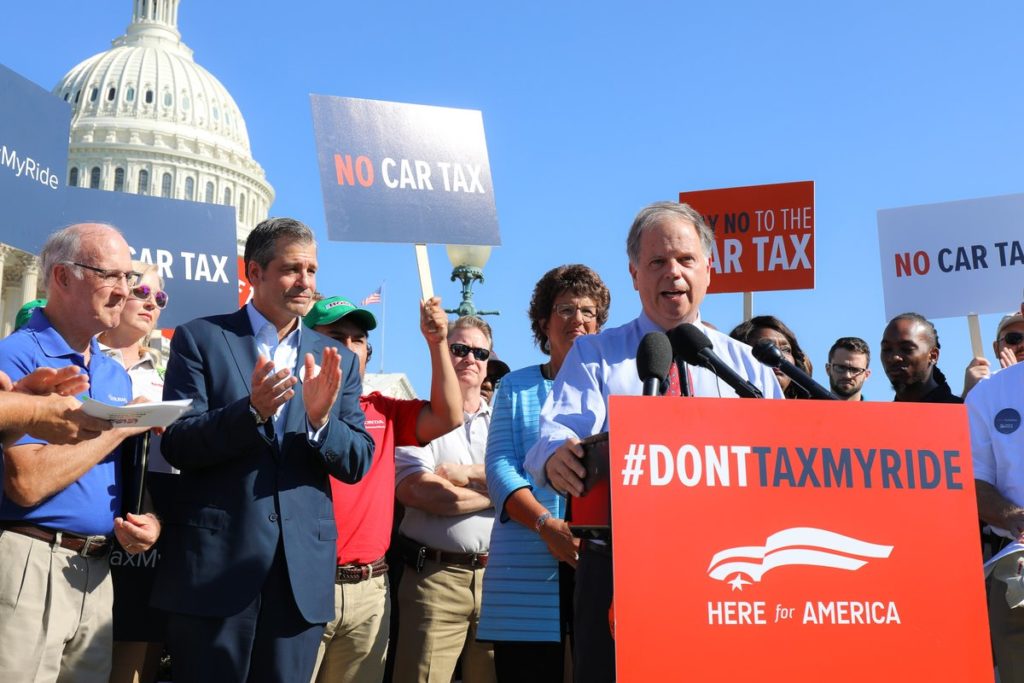
Alabama’s junior U.S. Senator, Democrat Doug Jones is doubling-down on his disapproval of the Trump administration’s new tariffs on foreign-made cars and auto parts by introducing legislation to delay them. A critic of the tariffs from the beginning, Jones joined his Republican colleague, Tennessee-Republican U.S. Sen. Lamar Alexander on Wednesday and introduced the Automotive Jobs Act of 2018, a bipartisan bill to delay President Trump’s recently proposed 25-percent tariff on imported cars, trucks, and auto parts. At the President’s direction, the U.S. Commerce Department initiated a Section 232 investigation in May to determine whether imported automobiles, trucks, and parts are a threat to U.S. national security and to subsequently levy tariffs. The senators’ legislation requires the International Trade Commission (ITC) to conduct a comprehensive study of the well-being, health, and vitality of the United States automotive industry before tariffs could be applied. “These tariffs are a tax on American consumers and they’re going to cost Alabama jobs,” said Jones. “I share the President’s goal to reinvigorate manufacturing and secure trade deals that benefit our country, but not at the expense of one of Alabama’s biggest job creators. This bipartisan legislation will hold the Administration accountable by ensuring it has all of the facts about the positive impact American automakers have on their communities, regardless of where they’re headquartered. With that information in hand, the Administration could no longer make the ridiculous claim that this industry is somehow a national security threat.” “This bill would delay the administration’s proposed 25 percent tariff on automobiles and automotive parts imported into the United States until the President has a second opinion from the International Trade Commission about the effect those tariffs would have on the more than 7 million jobs in the American automotive industry,” added Alexander. He continued, “About 136,000 of those auto jobs are in Tennessee, one third of our state’s manufacturing jobs. The president has gotten the world’s attention with his tariffs, but what deserves more attention is his long term solution – zero tariffs, zero barriers, which is, as the president said at the G7 summit in June, ‘the way it should be.’ Taking steps in the direction of reciprocity—insisting that other countries do for us what we do for them—rather than a trade war, will be much better for the American worker.” Last month, the senators wrote a letter to U.S. Department of Commerce Secretary Wilbur Ross urging him to reconsider the tariffs. This legislation addresses the key concerns the senators raised in their letter to Secretary Ross. As part of the mandated study, the ITC will be required to assess, among other things: The number of automobiles assembled in the United States that are exported each year and to which countries; The percentage of component parts of automobiles assembled in the United States that are imported; The number of component parts for automobiles that are not produced in the United States and would thus not be available to United States automotive producers if prohibitively high duties were imposed on imports of those parts; and, The effect an increase in automotive manufacturing costs would have on jobs in the United States. The ITC will be required to deliver the report to Congress and is to include policy recommendations based on the study. Under this legislation, these tariffs cannot be applied until the report is delivered. Last week, Jones also stood up against the tariffs by join the “Here For America’s Washington D.C. “Drive-In” during which over one hundred international auto employees pulled up to the U.S. Capitol in a caravan of American made vehicles. Watch Jones’ floor speech on the legislation below: Jones is not alone One very important Alabama official happens to agree with Jones: Governor Kay Ivey. Ivey, who released a statement and wrote a letter to U.S. Secretary of Commerce Wilbur Ross and several members of the Alabama congressional delegation in June expressed her concerns saying that “estimates show that a ten percent decrease in Alabama-made vehicle exports could result in the loss of approximately 4,000 jobs in Alabama.” “Such a loss would be devastating to thousands of families across our state,” Ivey continued. “These are Alabama families who are dependent on the income from working in these facilities.”
Dems force delays in votes on Jeff Sessions, Steve Mnuchin, Tom Price
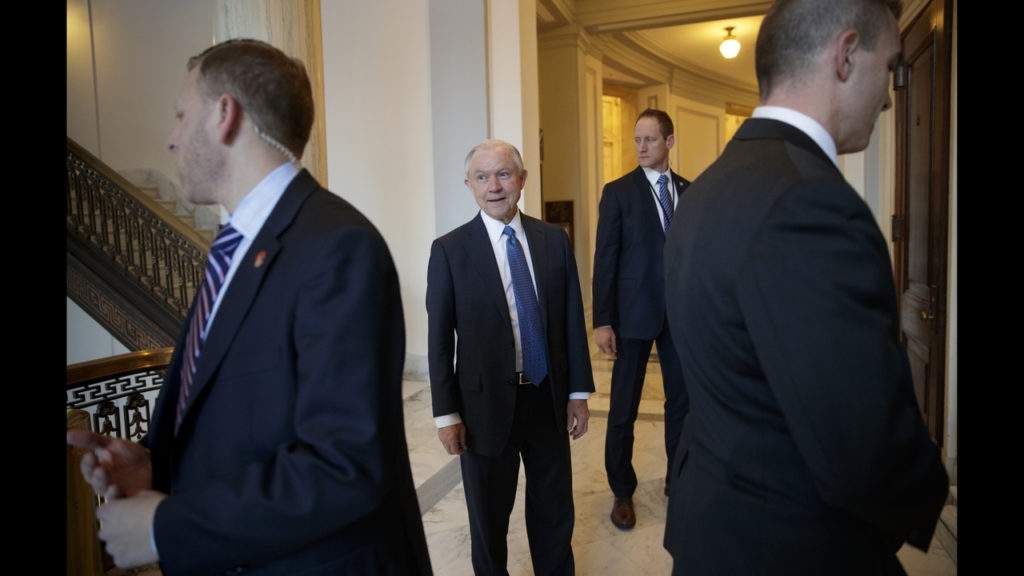
Democrats forced delays Tuesday in planned Senate committee votes on President Donald Trump‘s picks for Health and Treasury secretaries and attorney general, amid growing Democratic surliness over the administration’s aggressive early moves against refugees and an expected bitter battle over filling the Supreme Court vacancy. Democrats abruptly boycotted a Senate Finance Committee meeting called to vote on Rep. Tom Price, R-Ga., the Health nominee and Steve Mnuchin, Trump’s Treasury selection, saying both had misled Congress about their financial backgrounds. The Democrats’ action prevented the Finance panel from acting because under committee rules, 13 of its members — including at least one Democrat — must be present for votes. It was unclear when the panel would reschedule to votes. At the Senate Judiciary Committee, a meeting considering Sen. Jeff Sessions, R-Ala., to be attorney general lasted so long — chiefly because of lengthy Democratic speeches — that Chairman Charles Grassley, R-Iowa, said the panel would meet again Wednesday. The meeting on Sessions’ nomination was coming with Democrats and demonstrators around the country in an uproar over Trump’s executive order temporarily blocking refugees. Even some Republicans were warning it could hinder anti-terrorism efforts. Not everything ground to a halt. The Senate education committee voted 12-11 to send Trump’s pick to head the Education Department, Betsy DeVos, to the full Senate for a confirmation vote. The Senate Energy and Natural Resources Committee quickly approved former Texas Gov. Rick Perry as Energy secretary by 16-7, and Rep. Ryan Zinke, R-Mont., to head Interior by 16-6. And the full Senate easily confirmed Elaine Chao to become transportation secretary by a 93-6 vote. Chao was labor secretary under President George W. Bush, and is wife of Senate Majority Leader Mitch McConnell, R-Ky. Just before the Finance committee was scheduled to vote on Price and Mnuchin, Democrats called a briefing for reporters and announced their plan to force a delay. Sen. Debbie Stabenow, D-Mich., said Price and Mnuchin would hold positions “that directly affect peoples’ lives every day. The truth matters.” Finance Committee Chairman Orrin Hatch, R-Utah, accused Democrats of “a lack of desire to fulfill their constitutional responsibilities.” “They ought to stop posturing and acting like idiots,” he said. In 2013 when Democrats controlled the Senate, Republicans boycotted a committee vote on Gina McCarthy to head the Environmental Protection Agency, temporarily stalling it. Democrats cited one report in The Wall Street Journal that Price received a special, discounted offer to buy stock in a biomedical company, which contradicted his testimony to Congress. They said another report in The Columbus Dispatch showed documents revealing that Mnuchin had not been truthful with the Senate in the confirmation process in comments about how his bank OneWest had handled home foreclosures. Republicans have supported both men, and both have strongly defended their actions. Democrats have opposed Price, a seven-term congressional veteran, for his staunch backing of his party’s drive to scuttle Obama’s health care law and to reshape Medicare and Medicaid, which help older and low-income people afford medical care. They’ve also assailed Price for buying stocks of health care firms, accusing him of using insider information and conflicts of interest for backing legislation that could help his investments. Price says his trades were largely managed by brokers and that he’s followed congressional ethics rules. Democrats have criticized Mnuchin for not initially revealing nearly $100 million in assets, and were expected to vote against both nominees. They’ve also accused him of failing to protect homeowners from foreclosures and criticized him for not initially disclosing all his assets. DeVos, a wealthy GOP donor and conservative activist, has long supported charter schools and allowing school choice. That’s prompted opposition from Democrats and teachers’ unions who view her stance as a threat to federal dollars that support public education. Critics have also mocked her for suggesting that guns could be justified in schools to protect students from grizzly bears. Two prominent Republicans on the education committee, Sens. Susan Collins of Maine and Lisa Murkowski of Alaska, said they remained uncertain if they will vote for her on the Senate floor. Murkowski said DeVos has yet to prove that she deeply cares about America’s struggling schools and its children. Republished with permission of the Associated Press.
Sean Spicer says 20 percent tax on Mexican imports just an option

The Latest on President Donald Trump (all times EST): 4:50 p.m. White House Press Secretary Sean Spicer now says slapping a 20 percent tax on imports from Mexico is just one of several options on the table for paying for a wall along the southern border. Spicer says President Donald Trump has yet to make a final decision about how the U.S. will recoup the costs of his proposed border wall. Spicer had said earlier Thursday that Trump wanted to slap a 20 percent tax on all imports from Mexico and predicted the tax would generate $10 billion a year. He had told reporters on Air Force One that Trump has discussed the idea with congressional leaders and wanted to include the measure in a comprehensive tax reform package. But Trump’s chief of staff Reince Priebus said later that the administration has “a buffet of options” to pay for the wall. ___ 4:45 p.m. President Donald Trump still knows how to win a television time slot. ABC reached 7.5 million viewers for its Wednesday night interview special of the president speaking to anchor David Muir. It was billed as Trump’s first network television interview since his inauguration last week. The special beat every other program competing at 10 p.m., according to the Nielsen company. CBS’ “Code Black” drama came in second with 5.6 million viewers. ___ 4:45 p.m. A Democratic congressman says he got a call from President Donald Trump, who wants to meet with him to discuss the price of prescription drugs. Maryland Rep. Elijah Cummings said Thursday he received the short but cordial call a day earlier “to my surprise.” Cummings says Trump told him they would not agree on everything, but they could find some common ground on trying to address the rising costs of prescription drugs. Cummings says he’s looking forward to the meeting, which hasn’t been scheduled yet. Cummings also says Trump asked about the congressman’s special assistant, Katie Malone, who was injured in a fire at her home this month that killed six of her nine children. Cummings says the president said he wanted to make a contribution to help the family and expressed sincere sympathy. ___ 4:40 p.m. President Donald Trump has signed his first presidential proclamation, declaring this week “National School Choice Week.” The proclamation states that because education is important, parents should have the right to a “meaningful choice” about where their children goes to school. Charter schools and school choice are expected to be major elements of federal education policy in Trump’s administration. Betsy DeVos, Trump’s nominee for education secretary, has spent more than two decades advocating for school choice programs. Such programs provide students and parents with an alternative to a traditional public school education. DeVos is awaiting a Senate vote on her nomination. The proclamation adds that a renewed commitment to expanding school choice can make a great education possible for every child in America. ___ 3:35 p.m. President Donald Trump wants to pay for his proposed southern border wall by slapping a 20 percent tax on imports from Mexico. White House spokesman Sean Spicer says Trump has discussed the idea with congressional leaders and wants to include the measure in a comprehensive tax reform package. Spicer spoke to reporters on Air Force One as Trump flew back from a Republican retreat in Philadelphia. He says that taxing imports from Mexico would generate $10 billion a year and “easily pay for the wall.” Spicer says discussions are continuing with lawmakers to make sure the plan is “done right.” But he says it “clearly provides funding” for the wall. ___ 3:30 p.m. President Donald Trump’s chief White House strategist says that the media should “keep its mouth shut.” In an interview with The New York Times, published Thursday, Bannon said that the media is the “opposition party” of the new administration and “should be embarrassed and humiliated” by the unanticipated election result. The article cites Bannon as referring to himself at one point as “Darth Vader.” Asked if he was concerned that press secretary Sean Spicer lost credibility after a forceful opening press conference peppered with false information, Bannon replied, “we think that’s a badge of honor.” He adds, “The media has zero integrity, zero intelligence and no hard work.” ___ 3:15 p.m. Vice President Mike Pence is offering Republican lawmakers a preview of the upcoming Supreme Court pick. He says President Donald Trump will nominate a “strict constructionist” to the high court. Pence is speaking to House and Senate Republicans at a retreat in Philadelphia. He notes Trump plans to announce the Supreme Court pick next week and says he can “already tip you off.” Pence says the choice will be a “strict constructionist,” or a jurist who supports a narrow reading of the U.S. Constitution. The vice president says the choice will have a “top-notch legal mind” and a “commitment to the Constitution.” ___ 2:45 p.m. The United Nations hopes that any measures President Donald Trump takes on refugees are temporary, citing U.S. leadership in resettling people forced to flee their homes. U.N. spokesman Stephane Dujarric told reporters Thursday that taking in refugees is especially important when the world has seen the largest movement of migrants since World War II. He said it’s a basic principle of the United Nations that “refugees need solidarity and need help,” and at this time there’s never been a greater need for their protection. A draft executive order obtained by The Associated Press shows Trump intends to stop accepting Syrian refugees and to suspend the United States’ broader refugee program for 120 days. According to the U.N., refugees total nearly 21.3 million, half of them under age 18. ___ 1:45 p.m. President Donald Trump is claiming that he and Mexican President Enrique Peña Nieto agreed jointly to cancel their planned meeting over disagreements about who will pay for Trump’s promised southern border wall. Trump says during a Republican House and Senate retreat in Philadelphia that, “The president of Mexico and
Jeb Bush lauded at Tennessee GOP event, but will state vote follow?
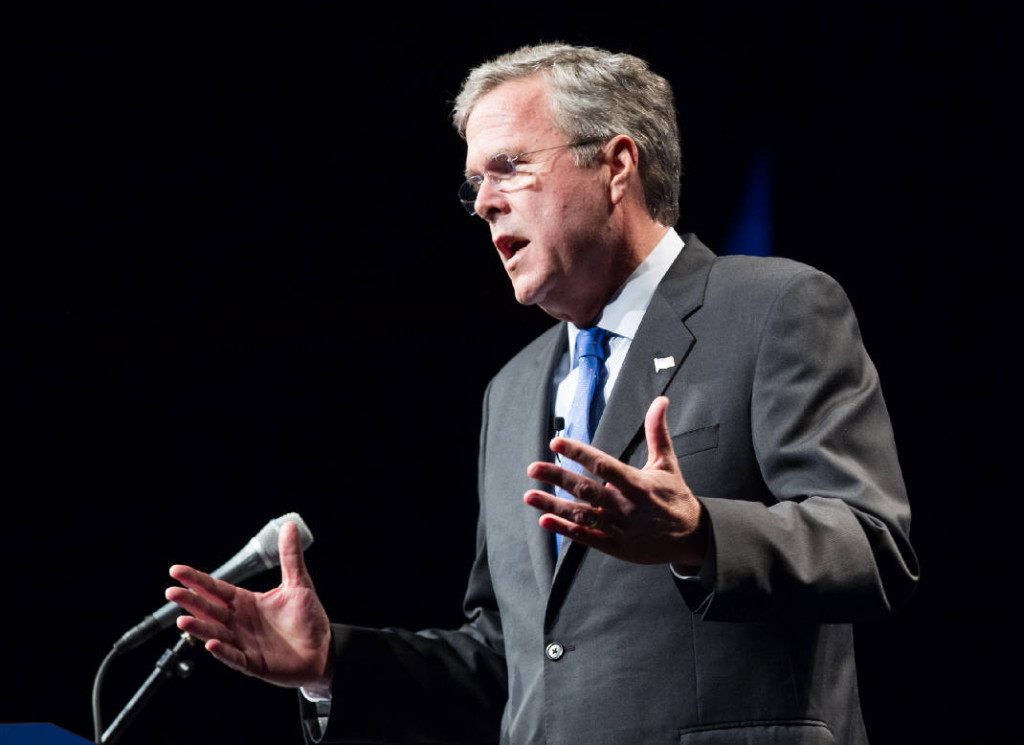
The speakers at the weekend Tennessee Republican Party fundraiser took turns heaping praise on former Florida Gov. Jeb Bush, keynote speaker at the annual Statesmen’s Dinner. While Gov. Bill Haslam and Sens. Lamar Alexander and Bob Corker stopped short of an official endorsement of the likely presidential candidate, their comments did more than hint that they would welcome his entry into the race. “If we want to win the presidency we’re going to have to appeal to a broad number of Americans that we haven’t been appealing to over the last several years,” Alexander said. “He’s shown a capacity to do that.” Corker said he sees in Bush a like-minded approach to staking out positions that he considers right even if they aren’t politically popular. “Governor, I’ve been watching you,” Corker said. “I’ve seen a lot of people changing positions over the course of this election — you have not. And for that I respect you greatly.” But even if Bush ends up gaining the support of the heavy hitters in the state GOP, it’s uncertain whether primary voters in Tennessee will follow suit. Despite endorsements from Haslam and Alexander in 2012, former Massachusetts Gov. Mitt Romney lost in Tennessee to former Pennsylvania Sen. Rick Santorum. And another social conservative, former Arkansas Gov. Mike Huckabee, won the primary over eventual nominee John McCain in 2008. Both Santorum and Huckabee have announced they are running again in 2016. “It is very predictable that Haslam, Corker, and Alexander would ally with Bush and continue pushing big government, one size fits all solutions like Common Core and Obamacare expansion,” said Ben Cunningham, the president of the Nashville Tea Party. “The conservative activist base of the Tennessee Republican party has drifted away from the Haslam dynasty and their allies in much the same way that tea party conservatives nationally have drifted away from the Bush dynasty,” he said. Haslam at the fundraiser called Bush one of the best governors of the past two decades, citing his accomplishments in budgeting, job creation and education. “I’ve obviously been impressed with this record, but I’m even more impressed with who he is as a person and who is he is as a husband and father and as a member of his community,” Haslam said. Alexander in his re-election last year leaned heavily on Huckabee and Sen. Rand Paul of Kentucky, another Republican presidential aspirant to prevail in a closer-than-expected GOP primary against a Tea Party-styled opponent. But Alexander was coy about whether he now owes either a favor, or whether he will ultimately support Bush. “I don’t know yet,” he told reporters before the event. “I have great admiration for Mike Huckabee and I have great admiration for Jeb Bush. And I like Rand Paul a lot, too.” State Rep. Bill Dunn, a Republican of Knoxville, was a prominent supporter of Santorum in the 2012 race, but said he has not yet made up his mind among the 2016 batch of candidates. He said state Republicans don’t necessarily have to be at odds with each other over who they want to support for the nomination. “I don’t think social conservatives reject the fiscal conservative,” he said. “We just put a different priority on it.” Republished with permission of The Associated Press.
