
Donald Trump faces questions about whether he’ll drag down the Republican Party after his indictments
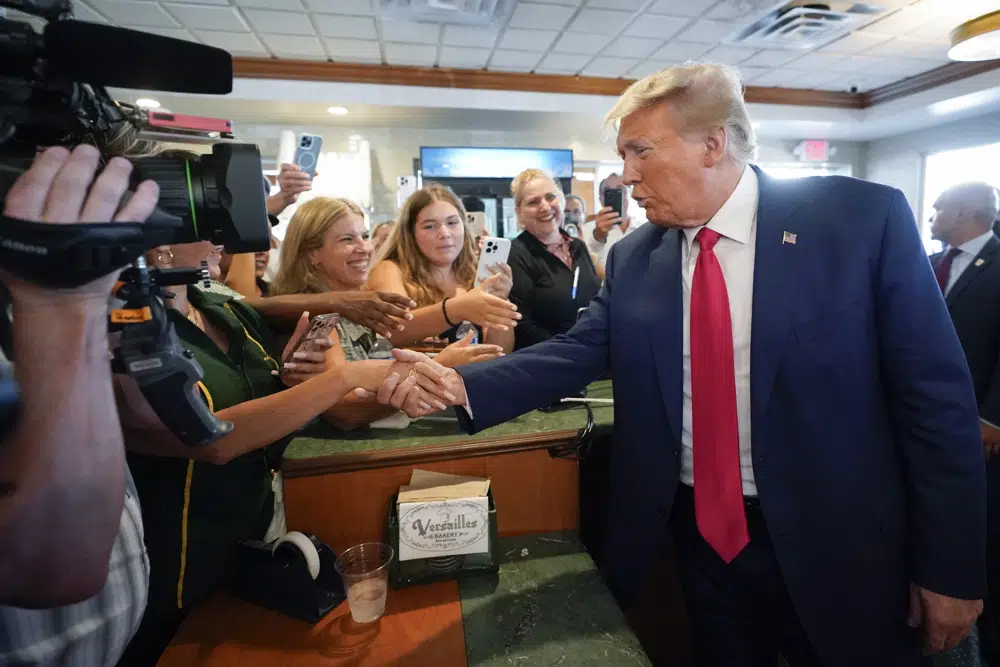
Donald Trump’s grip on the Republican faithful was evident from the moment he left the federal courthouse in Miami last week. Fresh off becoming the first former president to face criminal charges levied by the government he once oversaw, Trump’s motorcade moved through a crowd of hundreds of mostly adoring fans. He met more supporters at a Cuban restaurant in Little Havana, a Miami neighborhood that, like much of south Florida, has swung toward Republicans in recent years. A federal indictment on charges of mishandling the nation’s most sensitive national security secrets would doom any other White House hopeful. But Trump’s reception in Miami — and the more than $7 million he raised after the indictment — was a reminder of the central tension coursing through the Republican Party as the 2024 presidential primary gets underway. For now, no one comes close to Trump in his command of the voters who will decide the GOP’s nominee next year. But Trump’s path beyond the primary is far more perilous as he faces significant and growing questions about his ability to appeal to a broader, more moderate set of voters in a possible general election matchup against President Joe Biden. If Trump fails, he risks not just losing the White House contest but also dragging down other Republican candidates on the ballot as the party aims to retake the U.S. Senate and keep the House. Former Maryland Gov. Larry Hogan is among those warning Republicans that what is popular in a primary may not carry the general election. The frequent Trump critic backed a moderate Republican to succeed him in last year’s governor’s race. But Trump’s preferred candidate carried the primary and was soundly defeated in the general election, a result that played out in key races across the country. “We had three losing cycles in a row,” Hogan said. “It’s pretty hard to lose the White House, but we did it. It’s pretty hard to lose the House, the Senate, and the White House, but we did that also. And in the last election when we should have won the Senate back, picked up governor seats, and picked up 50 seats in the House … Republicans did not make gains really.” Trump is not the only GOP contender facing such concerns. Florida Gov. Ron DeSantis’ national electability has been called into question after he signed into law a state ban on abortions performed after six weeks, delighting conservatives but leaving him as an outlier among broader voters. While many Americans back some restrictions on abortion, especially after the first trimester, many do not agree with the most extreme measures pushed in Republican-led states such as Florida, according to polling that also showed most Americans support a federal law allowing access to abortion nationwide. DeSantis also alienated some Republicans when he appeared to dismiss Russia’s brutal invasion of Ukraine as a “territorial dispute,” comments he later had to walk back. No one in the race, however, carries the same level of baggage as Trump, particularly after the latest indictment, which follows charges in New York City that he paid hush money to porn actor Stormy Daniels to cover up an affair. He’s unlikely to attract new support after the allegations in Florida, which center on allegations that he took and refused to return boxes of classified documents, including some that could put military members and other sources at risk if disclosed. The hand-wringing over the GOP’s future began well before Trump’s latest indictment. In announcing her presidential campaign in February, former South Carolina Gov. Nikki Haley, who was Trump’s ambassador to the United Nations, was blunt in addressing the party’s general election challenge. “We’ve lost the popular vote in seven of the last eight presidential elections,” she said. “Our cause is right, but we have failed to win the confidence of a majority of Americans.” Since Trump’s federal indictment in Miami, some of his rivals have begun to test how far they can go in criticizing him, positioning themselves in a way that may be helpful in a general election but also tempering their remarks by blasting the Department of Justice for bringing charges. While Trump’s rivals may not be ready to fully take him on, the party establishment is increasingly active in trying to block his acolytes from being nominated in down ballot races or encouraging hopefuls to change the subject from its losing messages of the past. The Republican National Committee, for example, conducted a review of the GOP’s recent performance. A draft report, which did not mention Trump by name, concluded that the party needs to move beyond “relitigating previous elections,” an apparent allusion to the incessant but debunked claims he won the 2020 presidential contest. The National Republican Senatorial Committee, the campaign arm of the Senate GOP, also has said it’s shifting tactics after opting to sit out last year’s primary elections and let voters decide the nominees. After failing to retake Senate control, the organization now says it will play in primaries if needed, providing money and other resources to candidates it believes have the best chance to win a general election. The organization already got news it hoped for when Doug Mastriano, a far-right Pennsylvania lawmaker who was endorsed by Trump last year and lost badly to the Democratic governor candidate, opted not to run for the Senate in 2024. Republicans are hopeful that former hedge fund CEO David McCormick, who lost last year’s primary to another Trump-backed candidate, will run again and take on Democratic Sen. Bob Casey. Trump, who has falsely called the charges against him a political prosecution, insists that he had redefined the GOP, saying earlier this year that “the old Republican Party is gone, and it’s never coming back.” The former president and his supporters point to his 2016 victory as evidence of his ability to win, noting he won Ohio and Florida when the GOP nominees in 2012 and 2008 could not and was the first Republican presidential candidate to win Michigan, Wisconsin, and Pennsylvania in decades. “We forever revolutionized the electoral map for Republicans,” Trump
Former New Jersey Gov. Chris Christie kicks off 2024 Republican presidential bid with swipes at Donald Trump
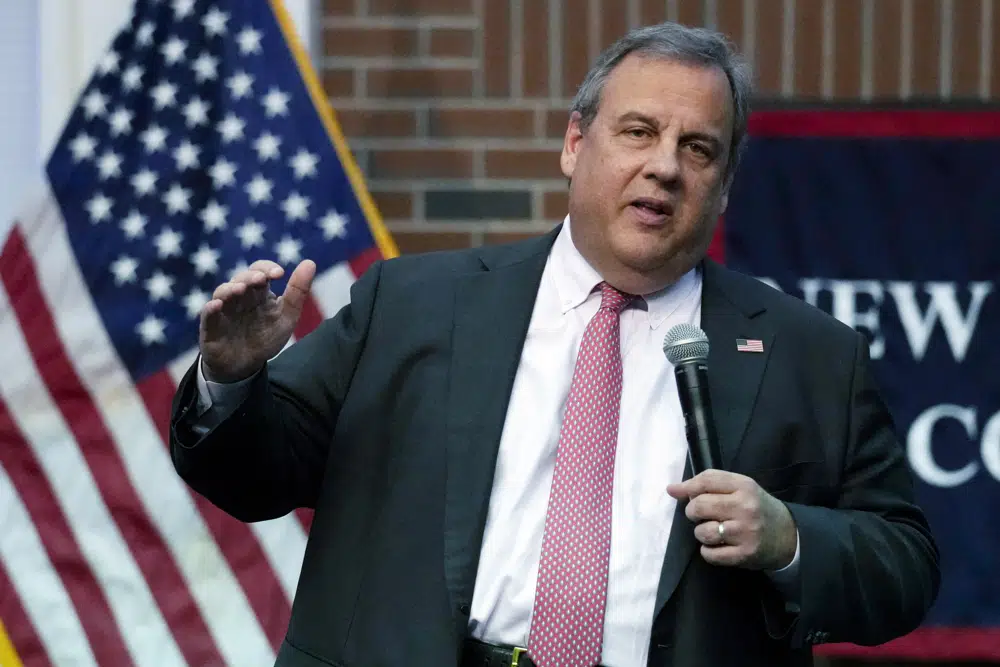
Republican former New Jersey Gov. Chris Christie kicked off his presidential campaign Tuesday evening, promising to be the only candidate in a crowded GOP primary field willing to directly take on former President Donald Trump. Christie, who also ran for president in 2016, began his bid under the slogan “Because the truth matters” with a town hall in New Hampshire, which holds the nation’s first Republican primary following Iowa’s leadoff caucuses. After losing the nomination to Trump seven years ago, the former governor and federal prosecutor went on to become a close off-and-on adviser before breaking with the former president over his refusal to accept the results of the 2020 election. “Donald Trump made us smaller by dividing us even further and pitting us one against the other,” Christie said, suggesting that the former president was part of a broader political effort to “paint all Republicans with just one brush.” He added that President Joe Biden “is doing the same thing, just on the other side.” Christie enters a growing primary field that already includes Trump, Florida Gov. Ron DeSantis, former United Nations Ambassador Nikki Haley, and U.S. Sen. Tim Scott of South Carolina. Former Vice President Mike Pence will be formally launching his own campaign in Iowa on Wednesday. During his time as governor, Christie established a reputation as a fighter with a knack for creating viral moments of confrontation. But he faces an uphill battle to the nomination in a party that remains closely aligned with the former president, despite Trump’s reelection loss in 2020 and Republicans’ poorer-than-expected showing in the 2022 midterm elections. Christie has become a fierce Trump critic in recent years and is now casting himself as the only Republican presidential candidate willing to openly pick fights with the former president — while also warning that the party failing to fully confront him will spark a repeat of the 2016 GOP primary, when Trump rolled over a host of alternatives with more political experience who split the support of voters opposing him. Anti-Trump Republicans are particularly eager to see Christie spar with Trump on a debate stage — if, of course, Trump agrees to participate in primary debates and Christie meets the stringent fundraising criteria set by the Republican National Committee for participation. JP Marzullo, a former state representative and former vice chairman of the New Hampshire Republican Party, previously backed Trump but is now supporting Christie. “I think he’ll actually unite some of the voters, and he’ll get to independents,” Marzullo said of the former governor, adding, “I think it’s time for a change.” Christie’s campaign will test the appetite among Republican voters for someone who has expressed support for many of Trump’s policies but has criticized the former president’s conduct. The former governor has rejected Trump’s lies that the 2020 election was stolen and has urged the party to move on or risk future losses. Other Republicans with similar views, including former Maryland Gov. Larry Hogan and New Hampshire Gov. Chris Sununu, have opted against their own campaigns, expressing concerns that having more candidates in the race will only benefit Trump. Christie was at one point seen as one of the Republican Party’s brightest political stars as the popular Republican governor of a Democratic state. But despite persistent urging from top donors and party officials, he declined to run for president in 2012. By the time he announced in 2016, his reputation had been tarnished by the “Bridgegate” scandal in which aides were accused of wreaking traffic havoc in Fort Lee, New Jersey, in an apparent effort to punish the city’s mayor for failing to endorse his reelection bid. In the packed 2016 GOP primary, Christie portrayed himself as a brash, tough-talking East Coaster who could “tell it like it is” — only to be eclipsed by the brasher Trump. Christie opting to start his 2024 bid at a New Hampshire town hall recalled his first run at the White House, when he focused on the state, holding dozens of New Hampshire town hall events only to finish sixth in its primary. He dropped out of that race afterward. Two weeks later, Christie stunned even some former aides when he endorsed Trump, becoming the first sitting governor and former rival to get behind the emerging GOP front-runner. His announcement undercut rival Marco Rubio at a crucial moment — the day after a debate that had been seen as a possible turning point in the race — helping to pave the way for Trump’s nomination and eventual win. “The line of supporting Donald Trump starts behind me,” Christie has said. The former governor, who has known Trump for nearly 20 years, has had a complicated friendship with the former developer and reality TV star. At times, he was one of Trump’s closest advisers: He was on the shortlist to serve as Trump’s vice president, oversaw Trump’s early White House transition efforts, said he was offered — and turned down — multiple Cabinet positions, and helped Trump prepare for each of his general election debates in 2016 and 2020. (It was during those debate preparations that Christie believes he caught COVID-19, landing him in intensive care.) But Christie also clashed with Trump at times and has described the former president’s refusal to accept his 2020 election loss to Democrat Joe Biden as a breaking point. In appearances and interviews, Christie says he was “incredibly disappointed and disillusioned” by Trump’s refusal to concede, which culminated in his followers’ violent storming of the Capitol on January 6 in an effort to halt the certification of Biden’s win. Republished with the permission of The Associated Press.
Ex-Arkansas Gov. Asa Hutchinson launches GOP 2024 bid, calls on Donald Trump to drop out
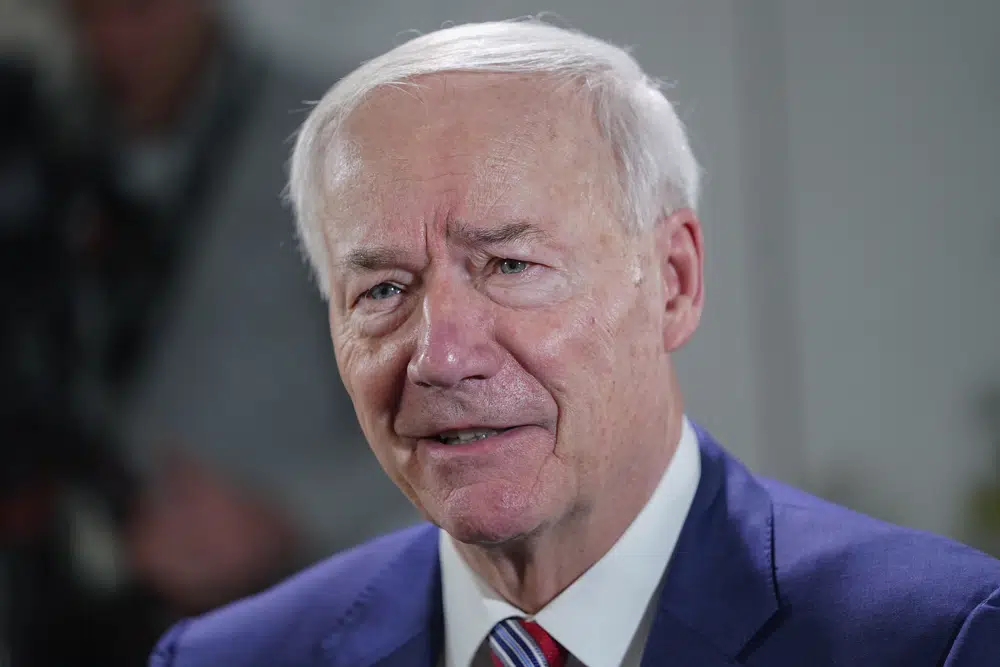
Asa Hutchinson, who spent two terms as governor of Arkansas, will seek the Republican presidential nomination, positioning himself as an alternative to Donald Trump just days after the former president was indicted by a grand jury in New York. In an interview that aired Sunday on ABC’s “This Week,” Hutchinson said Trump should drop out of the race, arguing “the office is more important than any individual person.” “I’m running because I believe that I am the right time for America, the right candidate for our country and its future,” he said. “I’m convinced that people want leaders that appeal to the best of America and not simply appeal to our worst instincts.” Hutchinson is the first Republican to announce a campaign after Trump became the first former U.S. president to face criminal charges. His candidacy will test the GOP’s appetite for those who speak out against Trump. Others who have criticized Trump, including former Maryland Gov. Larry Hogan, have opted against a campaign, sensing the difficulty of prevailing in a primary. And in a sign of Trump’s continued grip on the Republican base, most in the party — even those considering challenging him for the nomination — have defended him against the New York indictment. That, at least for now, leaves Hutchinson as a distinct outlier among Republicans. In addition to Trump, Hutchinson joins a Republican field that also includes former U.N. Ambassador Nikki Haley and entrepreneur Vivek Ramaswamy. Florida Gov. Ron DeSantis is expected to jump into the race in the summer, while U.S. Sen. Tim Scott of South Carolina, former Secretary of State Mike Pompeo, and former Vice President Mike Pence are among those considering bids. Hutchinson, 72, left office in January after eight years as governor. He has ramped up his criticism of the former president in recent months, calling another Trump presidential nomination the “worst scenario” for Republicans and saying it will likely benefit President Joe Biden’s chances in 2024. The former governor, who was term-limited, has been a fixture in Arkansas politics since the 1980s when the state was predominantly Democratic. A former congressman, he was one of the House managers prosecuting the impeachment case against President Bill Clinton. Hutchinson served as President George W. Bush’s head of the Drug Enforcement Administration and was an undersecretary of the Department of Homeland Security. As governor, Hutchinson championed a series of income tax cuts as the state’s budget surpluses grew. He signed several abortion restrictions into law, including a ban on the procedure that took effect when the U.S. Supreme Court struck down Roe v. Wade last year. Hutchinson, however, has said he regretted that the measure did not include exceptions for rape or incest. Hutchinson earned the ire of Trump and social conservatives last year when he vetoed legislation banning gender-affirming medical care for children. Arkansas’ majority-Republican Legislature overrode Hutchinson’s veto and enacted the ban, which has been temporarily blocked by a federal judge. Trump called Hutchinson a “RINO” — a Republican In Name Only — for the veto. Hutchinson’s successor, former White House press secretary Sarah Huckabee Sanders, has said she would have signed the legislation. Hutchinson, who signed other restrictions on transgender youth into law, said the Arkansas ban went too far and that he would have signed the measure if it had focused only on surgery. Hutchinson endorsed Sanders’ bid for governor. Sanders hasn’t publicly endorsed Trump or anyone else yet in the 2024 presidential race. She has avoided direct criticism of her predecessor, even as she split from him on several policies. Among the bills she’s signed since taking office is legislation intended to reinstate the ban on gender-affirming care for minors that Hutchinson opposed by making it easier to sue providers of such care. She’s also dissolved five panels Hutchinson had formed to advise him on the state’s response to the COVID-19 pandemic, saying she wanted the state to focus on other health challenges. Although he has supported Trump’s policies, Hutchinson has become increasingly critical of the former president’s rhetoric and lies about the 2020 presidential election. He said Trump’s call to terminate parts of the Constitution to overturn the election hurt the country. Hutchinson also criticized Trump for meeting with white nationalist leader Nick Fuentes and the rapper Ye, who has praised Adolf Hitler and spewed antisemitic conspiracy theories. Hutchinson has contrasted that meeting to his own background as a U.S. attorney who prosecuted white supremacists in Arkansas in the 1980s. An opponent of the federal health care law, Hutchinson, after taking office, supported keeping Arkansas’ version of Medicaid expansion. But he championed a work requirement for the law that was blocked by a federal judge. During the COVID-19 pandemic, Hutchinson tried to push back against misinformation about the virus with daily news conferences and a series of town halls he held around the state aimed at encouraging people to get vaccinated. Hutchinson infuriated death penalty opponents in 2017 when he ordered eight executions over a two-week period, scheduling them before one of the state’s lethal injection drugs was set to expire. The state ultimately carried out four of the executions. The former governor is known more for talking policy than for fiery speeches, often flanked by charts and graphs at his news conferences at the state Capitol. Instead of picking fights on Twitter, he tweets out Bible verses every Sunday morning. Hutchinson, who graduated from the evangelical college Bob Jones University in South Carolina, said in the ABC interview that he considers himself part of the evangelical community. “I believe that the evangelical community understands that we need to have a leader that can distance themselves from some of the bad instincts that drive Mr. Trump,” he said. “And I hope that we can do that in the future.” Republished with the permission of The Associated Press.
Tommy Tuberville welcomes Nikki Haley to 2024 presidential race
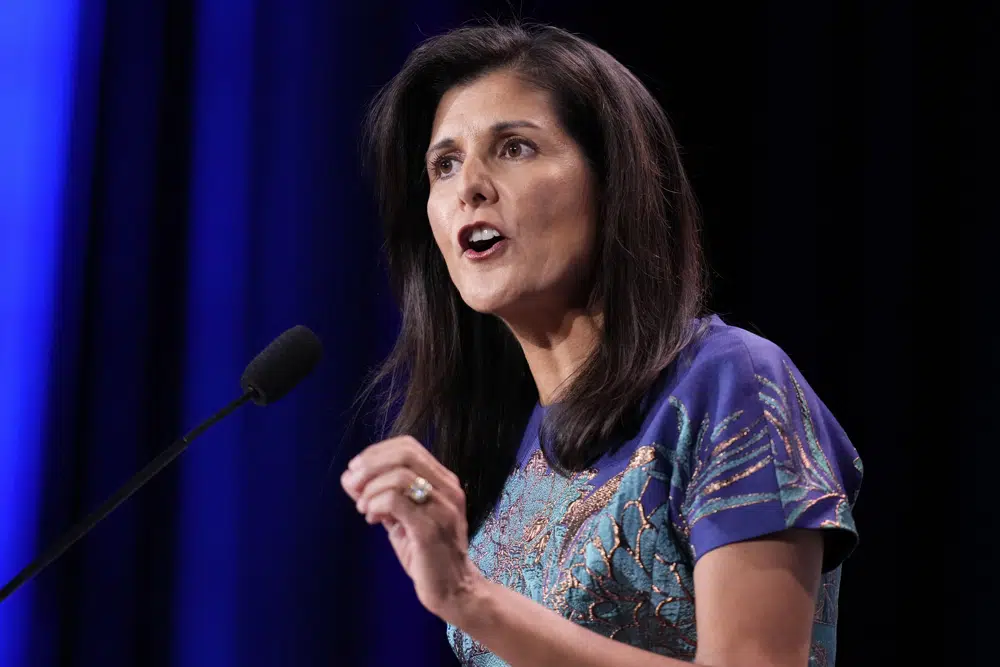
On Monday, former South Carolina Governor and UN ambassador Nikki Haley announced her candidacy for the Republican nomination for President of the United States. U.S. Senator Tommy Tuberville, who has already announced his endorsement of former President Donald Trump, welcomed Haley’s entrance into the 2024 presidential race. Tuberville told reporters that she would be a “great candidate.” Tuberville favors a large GOP primary field and said that he has recently spoken with Trump and told the former President that he hopes “they all get in.” “He needs the challenge as well as anybody,” Tuberville said. “They need to work for it. They need to fight for it.” In the 2020 election, President Trump endorsed Tuberville in his Republican primary battle for U.S. Senate with former Trump Attorney General Sen. Jeff Sessions. Tuberville had spent forty years as a teacher and coach – including stints as head football coach at Ole Miss, Auburn, Texas Tech, and Cincinnati – prior to that 2020 first run for public office. At this point, the only announced GOP candidates for the Republican nomination for 2024 are Haley and Trump, but that is expected to change quickly. Florida Gov. Ron DeSantis, former Vice President Mike Pence, and former Secretary of State Mike Pompeo are widely believed to be seriously looking at entering the race. According to the Hill, former Arkansas Gov. Asa Hutchinson, New Hampshire Gov. John Sununu, former Maryland Gov. Larry Hogan, U.S. Sen. Rick Scott, and Virginia Gov. Glenn Youngkin are also possible presidential candidates. GOP Senators who oppose a third Trump presidential run fear that a crowded GOP primary field makes it easier for Trump to emerge as the eventual GOP nominee. “Look, we were all concerned with the fact that we had 15 or 16 or 17 individuals vying for attention in the last one,” said Sen. Mike Rounds (South Dakota) told the Hill referring to the 2016 election. “We really don’t want to see that happen again. We just don’t.” U.S. Sen. Katie Britt was endorsed by Trump in her 2022 GOP primary battle with then-Congressman Mo Brooks and war veteran and defense contractor Mike Durant. Britt, however, cannot make an endorsement in the Presidential primary because she is serving on the national Republican steering committee. Trump faced a crowded field in 2016 that included U.S. Sens. Ted Cruz, Marco Rubio, Rand Paul, Rick Santorum, and Lindsey Graham, as well as former Florida Gov. Jeb Bush, former Ohio Governor John Kasich, former Arkansas Gov. Mike Huckabee, then-New Jersey Gov. Chris Christie, businesswoman Carly Fiorina, former Virginia Gov. Mike Gilmore, former New York Gov. George Pataki, then Louisiana Gov. Bobby Jindal, and Dr. Ben Carson. Trump won the 2016 Alabama Republican Primary despite the crowded field. Trump went on to win the Republican nomination and then beat former Secretary of State Hillary Clinton in the general election. Trump was unseated by former Vice President Joe Biden in 2020. Biden appears to be virtually unopposed at this point for the 2024 Democratic nomination for President. The 2024 Alabama Republican Primary is only 55 weeks away on March 5. DeSantis will speak to the Alabama Republican Party in Birmingham on March 9. To connect with the author of this story, or to comment, email brandonmreporter@gmail.com.
GOP governors to Joe Biden: Student loan plan will be costly for American taxpayers
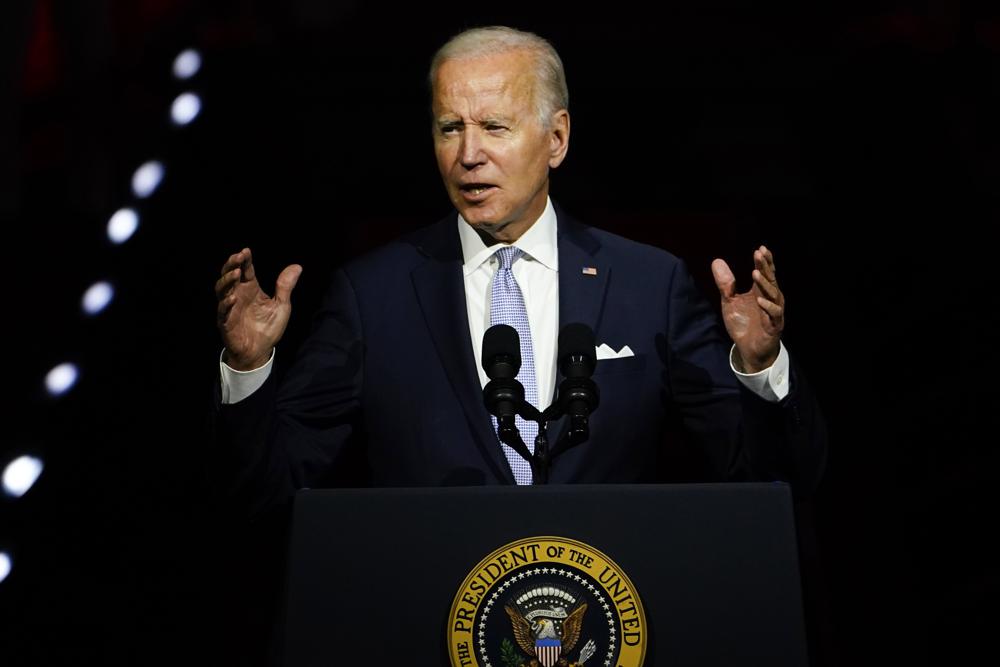
President Joe Biden’s student loan forgiveness plan will be costly for American taxpayers, a coalition of GOP governors said in a letter sent Monday to the White House. The letter, signed by 22 GOP governors, tells Biden to “withdraw” the plan, citing cost estimates of up to $600 billion, or $2,000 per American taxpayer. “As governors, we support making higher education more affordable and accessible for students in our states, but we fundamentally oppose your plan to force American taxpayers to pay off the student loan debt of an elite few,” the coalition wrote. The coalition includes Alabama Gov. Kay Ivey, Alaska Gov. Mike Dunleavy, Arizona Gov. Doug Ducey, Arkansas Gov. Asa Hutchinson, Florida Gov. Ron DeSantis, Georgia Gov. Brian Kemp, Idaho Gov. Brad Little, Iowa Gov. Kim Reynolds, Maryland Gov. Larry Hogan, Missouri Gov. Mike Parson, Montana Gov. Greg Gianforte, Nebraska Gov. Pete Ricketts, New Hampshire Gov. Chris Sununu, North Dakota Gov. Doug Burgum, Ohio Gov. Mike DeWine, Oklahoma Gov. Kevin Stitt, South Carolina Gov. Henry McMaster, South Dakota Gov. Kristi Noem, Tennessee Gov. Bill Lee, Texas Gov. Greg Abbott, Utah Gov. Spencer Cox, and Wyoming Gov. Mark Gordon. “At a time when inflation is sky high due to your unprecedented tax-and-spend agenda, your plan will encourage more student borrowing, incentivize higher tuition rates, and drive-up inflation even further, negatively impacting every American,” the governors added. Biden announced the plan last month during an address from the White House. “Many people – many people can’t qualify for a mortgage or buy a home because the debt they continue to carry,” Biden said. “A lot of folks are even putting off starting families because of the cost, and the dream of starting or owning your business is just way off in the distance with a debt that’s – that so many are saddled with.” The plan forgives $10,000 in federal student loan debt for those who make less than $125,000 annually, while federal Pell Grant recipients will be forgiven $20,000. The Committee for a Responsible Federal Budget has estimated that the plan’s total cost would be $440 to $600 billion. Republished with the permission of The Center Square.
Mounting losses show limits of Donald Trump’s power

Donald Trump opened May by lifting a trailing Senate candidate in Ohio to the Republican nomination, seemingly cementing the former president’s kingmaker status before another possible White House run. He’s ending the month, however, stinging from a string of defeats that suggests a diminishing stature. Trump faced a series of setbacks in Tuesday’s primary elections as voters rejected his efforts to unseat two top targets for retribution: Georgia’s Republican governor and secretary of state, both of whom had rebuffed Trump’s extraordinary pressure to overturn the results of the 2020 presidential election. But the magnitude of defeat in the governor’s race — more than 50 percentage points — was especially stunning and raised questions about whether Republican voters are beginning to move on from Trump. Nearly six years after the one-time reality television star launched what seemed to be an improbable campaign for the White House, the “Make America Great Again” movement Trump helmed isn’t going anywhere. But voters are increasingly vocal in saying that the party’s future is about more than Trump. “I like Trump a lot, but Trump is in the past,” said David Butler of Woodstock, Georgia, who voted for Gov. Brian Kemp on Tuesday and said Trump’s endorsements had “no” impact “whatsoever” on his thinking. It was the same for Will Parbhoo, a 22-year-old dental assistant who also voted for Kemp. “I’m not really a Trumper,” he said after voting. “I didn’t like him to begin with. With all the election stuff, I was like, ‘Dude, move on.’” One thing Parbhoo liked about the current governor? “Kemp is focused on Georgia,” he said. Trump sought to play down the losses by his favored candidates, saying on his social media platform Wednesday that he had a “very big and successful evening of political Endorsements” and insisting some races “were not possible to win.” Still, the pattern of high-profile defeats is hard to ignore. After JD Vance vaulted from third to first place following Trump’s late-stage endorsement in the Ohio Senate primary, the dynamics took a turn. Trump’s pick in Nebraska’s primary for governor, Charles Herbster, lost his race after allegations surfaced that he had groped women. In Idaho a week later, the governor beat a Trump-backed challenger. In North Carolina, voters rebuffed Trump’s plea to give a scandal-plagued congressman a second chance. And in Pennsylvania, a marquee Senate primary featuring Trump-endorsed celebrity heart surgeon Mehmet Oz remains too close to call. But his biggest upset was in Georgia, a crucial swing state, where former Sen. David Perdue, whom Trump had lobbied to run and helped clear the field for, lost to Kemp. The governor was among Trump’s top targets after he refused to overturn the results of the 2020 White House election in his state. Georgia Secretary of State Brad Raffensperger, who defied Trump’s call to “find” the votes to change the outcome two years ago — a call that is now under investigation — also won his party’s nomination. Attorney General Chris Carr and Insurance Commissioner John King — all opposed by Trump — were also successful in their primaires. In Alabama, Rep. Mo Brooks, whose Senate endorsement Trump rescinded as he struggled to gain traction, made it to a runoff, having gained support after Trump dropped him. Trump has endorsed in nearly 200 races, from governor to county commissioner, often inserting himself into contests that aren’t particularly competitive and helping bolster his compilation of wins. Some of his work, even in races with multiple candidates, has paid off. His early support helped football great Herschel Walker and Rep. Ted Budd sail to their respective Senate primary nominations in Georgia and North Carolina. Sarah Huckabee Sanders, Trump’s former press secretary, easily won the GOP nomination for governor in Arkansas. And even in Georgia, all of the candidates Trump endorsed in open races won or will head to runoffs. Some allies say Trump’s endorsement tally is a poor measure of his influence, even if Trump constantly promotes that record. They argue that voters may support the former president and be eager for him to run again but may not be persuaded by his selections, especially in races with governors such as Kemp, who have long histories with voters. And even without Trump on the ballot, the party has been transformed in Trump’s image, with candidates adopting his “America First” platform, mimicking his tactics, and parroting his lies about a stolen election. But with Trump out of office and relegated to posting on his own social media platform, other voices are beginning to fill the void. Fox News host Tucker Carlson, the most-watched personality on cable television, has become a driving ideological force in the party. Republicans such as the conspiracy-embracing Rep. Marjorie Taylor Greene, who won her party’s nomination for reelection Tuesday, have taken up his mantle in Washington. Meanwhile, potential presidential rivals to Trump are waiting in the wings for 2024. Former Vice President Mike Pence, who has been distancing himself from Trump, rallied with Kemp in suburban Atlanta on Monday evening and told the crowd that “elections are about the future” — an implicit knock on his former boss. Trump has also spawned a new generation of candidates who have channeled his “MAGA” brand but who have done so independent of his support and see themselves as its next iteration. “MAGA doesn’t belong to him,” Kathy Barnette, the Pennsylvania Senate candidate whose late-stage surge stunned party insiders, said in an interview. “Trump coined the word. He does not own it.” While the left, she said, may see the “MAGA movement” as a “cult of Trump voters,” she said it goes far beyond one man. She argued that Trump had succeeded in 2016 because he aligned himself with voters’ concerns and said out loud what people were already thinking, particularly on immigration. She said she tried in her race to do the same. “I do believe Trump has an important voice still,” she added, but “he needs to get better advisers, and in addition to that, he needs to do better himself in remembering why we aligned with him. And it wasn’t because we were aligning with his
States adding to financial pressure on Russia over war

Seeking to tighten the financial squeeze on Russia over its war against Ukraine, governors, and lawmakers in numerous U.S. states were taking actions Monday to pull state investments from Russian companies while encouraging private entities to do the same. The effect of sanctions by U.S. states often pales in comparison to national ones, but state officials said they wanted to show solidarity with Ukraine and do what they could to build upon the penalties imposed on Russia by the U.S. government and other Western nations. Georgia House Speaker David Ralston, a Republican, got a bipartisan standing ovation Monday when he told representatives he would seek to have the state’s retirement funds quickly divested from any Russian assets. “I don’t know about y’all, but I don’t want one penny of Georgians’ money going to subsidize Vladimir Putin,” Ralston said. “While our role in international affairs is limited, we make clear we stand with those who want to live in peace.” Some actions have been largely symbolic. The governors of Arizona, Pennsylvania, and Tennessee ordered their capitols lit with the blue and yellow colors of Ukraine’s flag. Minnesota Gov. Tim Walz, a Democrat, and Ohio Gov. Mike DeWine, a Republican, issued a joint statement condemning Russia’s invasion of Ukraine as co-chairs of the presidentially appointed Council of Governors. Other state actions have potential teeth. On Monday, the Indiana House passed legislation that would block Russian-controlled businesses and nonprofits from acquiring property in Indiana for one year. It now goes to the Senate. “Indiana will not be a safe haven for ill-gotten Russian funds, nor for its oligarchs trying to find financial shelter in the wake of Putin’s unconscionable invasion of Ukraine,” Democratic state Rep. Ryan Dvorak said while proposing the amendment last week. New York Gov. Kathy Hochul signed an executive order Sunday forbidding her state from doing business with Russia. She ordered state agencies to divest money and assets from companies or institutions aiding Russia in its war against Ukraine. The Democratic governor also said New York would welcome Ukrainian refugees, noting that New York already is home to the largest Ukrainian population in the U.S. Pennsylvania lawmakers said Monday they will file legislation requiring state pension funds to pull investments connected to the Russian government and its critical supporters. The state Treasury Department also has begun divesting its minimal holdings in Russian-based companies. In a memo to fellow senators, Democratic state Sen. Sharif Street said Pennsylvania “must wield our economic power to ensure that Russia faces grave consequences for their flagrant violations of international law and human cooperation.” Pennsylvania House Majority Leader Kerry Benninghoff, a Republican seeking co-sponsors for the legislation, said state lawmakers “have a moral obligation to ensure that our public fund investments are not inadvertently supporting those who are engaging in an unprovoked invasion of their democratically elected neighbors.” Arkansas lawmakers have filed proposals authorizing banks in the state to freeze the assets of Russian oligarchs and to require a boycott of Russian-made goods. A bipartisan group of California lawmakers said Monday they also will introduce legislation to divest public money from Russian state entities. Colorado Gov. Jared Polis, a Democrat, has banned state agencies from doing business with Russian state-owned firms and their subcontractors. Colorado’s $61 billion state pension fund is pulling $8 million from a Russian state-owned bank identified in federal sanctions. Governors in Connecticut, New Jersey, Virginia, and Washington also have ordered a review of whether any state money is going to Russian companies or investments supporting the Russian government. A North Dakota investment board was due to meet later this week to discuss its investments in Russia. “If our state can put one brick in the wall around Putin, it will be a good thing, and we intend to do all that we can in this regard,” said Washington Gov. Jay Inslee, a Democrat. Two prominent Republican governors, Florida’s Ron DeSantis and South Dakota’s Kristi Noem, who are widely seen as angling for a White House bid, mostly took aim at President Joe Biden rather than issue executive orders targeting Russia. They criticized his energy policies and said that had made it difficult to slap sanctions on Russia’s exports of oil and gas. Other governors are seeking to sever good-will relationships between their home states and those in Russia. Republican Gov. Larry Hogan announced Monday that he’s dissolving Maryland’s decades-old sister-state relationship with Russia’s Leningrad region after the invasion of Ukraine. Virginia Gov. Glenn Youngkin, a Republican, asked the cities of Norfolk and Roanoke to end their sister city partnerships with Russian cities. Iowa Gov. Kim Reynolds, a Republican, called for an end to its sister-state relationship with Stavrapol Krai, Russia, and a strengthening of its sister-state relationship with Cherkasy Oblast, Ukraine. Several states have expressed a willingness to provide housing to Ukrainian refugees. The Washington state House and Senate each have added amendments to their budget proposals setting aside $19 million to provide services and temporary housing to refugees who come from Ukraine. Texas Gov. Greg Abbott, a Republican, posted on Twitter over the weekend that he has asked restaurants and retailers “ to voluntarily remove all Russian products from their shelves.” Officials in Alabama, Iowa, New Hampshire, Ohio, Pennsylvania, Utah, Vermont, Virginia, and West Virginia — all states that control the sale of alcohol — have directed Russian-sourced alcohol to be removed from store shelves. “Utah stands in solidarity with Ukraine and will not support Russian enterprises, no matter how small the exchange,” Republican Utah Gov. Spencer Cox said. Republished with the permission of the Associated Press.
Larry Hogan named co-chair of Appalachian Regional Commission
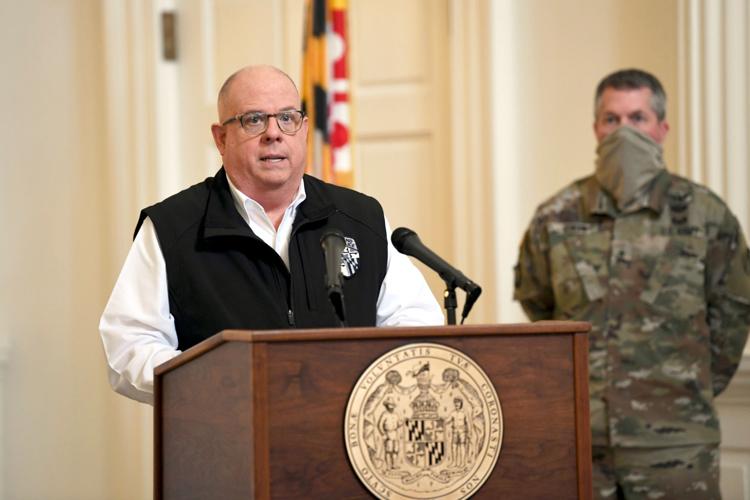
Maryland’s governor has been appointed co-chair of the Appalachian Regional Commission. Gov. Larry Hogan announced in a news release that after being nominated in October 2021 to the post, he was officially chosen to serve as co-chair for 2022 on Monday. “It’s a great honor to be the first Maryland governor in 30 years to serve as co-chair of the Appalachian Regional Commission,” Hogan said in the release. “The commission is a unique partnership, and this is a particularly critical time for us to work together across state and party lines to advance the economic growth and vitality of the region. I look forward to working closely with Federal Co-Chair Gayle Manchin and all my colleagues on the Commission.” The Appalachian Regional Commission is a conglomerate of 13 states operating in a federal-state partnership. The organization’s goals are to invest in economic growth across 423 counties in Alabama, Georgia, Kentucky, Mississippi, New York, North Carolina, Ohio, Pennsylvania, South Carolina, Tennessee, Virginia, West Virginia, and Maryland. Hogan, according to the release, replaces Virginia Gov. Ralph Northam as co-chair, working with federal co-chair Manchin. Hogan is the state’s first co-chair since 1992 when Gov. William Donald Schaefer held the post. The commission invested more than $162 million in the region, according to the release, in FY21. The investment was designed to capture an additional $1.04 billion in private investments to retain almost 21,000 jobs. In addition, the investments trained more than 25,000 students, workers, and leaders to learn new skills. The organization’s 2022-26 Strategic Plan seeks investments in highway development, job training, higher education supports to train workers for careers and building businesses while creating job growth with quality, high-paying jobs. Manchin, who was sworn in as the commission’s federal co-chair in May 2021, said she was honored to welcome Hogan as the co-chair. “I look forward to collaborating with him and all of our Appalachian governors as we work toward the shared mission of bringing opportunity, hope, and economic parity to all 26 million of our Appalachian neighbors,” Manchin said in the release. “On behalf of the Commission, I also want to thank Virginia Governor Ralph Northam for his work during his tenure as states’ co-chair in 2021.” By Brent Addleman | The Center Square Republished with the permission of The Center Square.
Joe Biden signs $1T infrastructure deal with bipartisan crowd
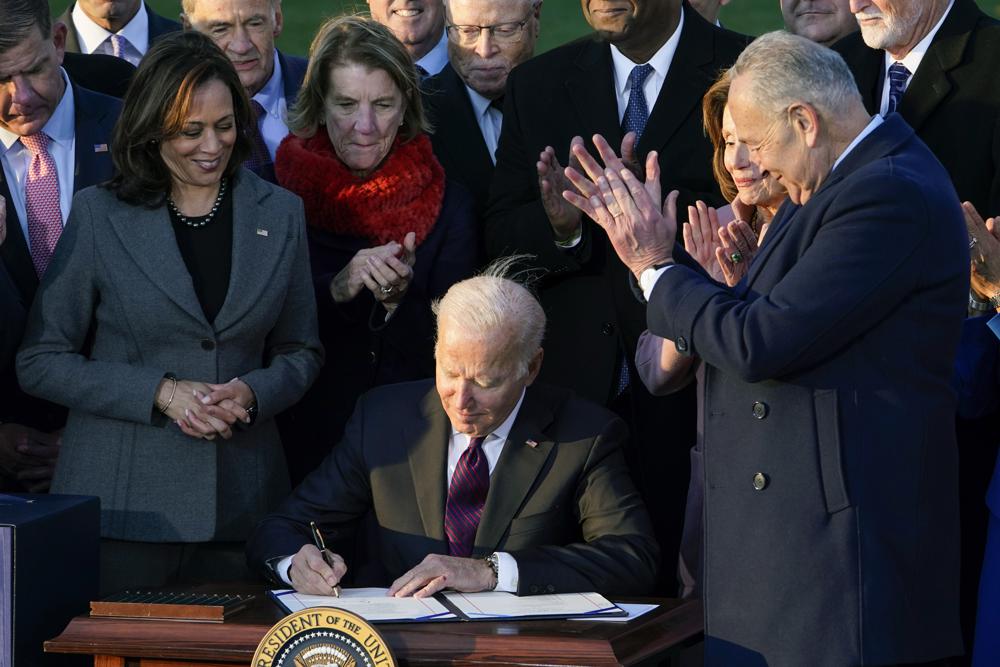
President Joe Biden signed his hard-fought $1 trillion infrastructure deal into law Monday before a bipartisan, celebratory crowd on the White House lawn, declaring that the new infusion of cash for roads, bridges, ports, and more is going to make life “change for the better” for the American people. But prospects are tougher for further bipartisanship ahead of the 2022 midterm elections as Biden pivots back to more difficult negotiations over his broader $1.85 trillion social spending package. The president hopes to use the infrastructure law to build back his popularity, which has taken a hit amid rising inflation and the inability to fully shake the public health and economic risks from COVID-19. “My message to the American people is this: America is moving again and your life is going to change for the better,” he said. With the bipartisan deal, the president had to choose between his promise of fostering national unity and a commitment to transformative change. The final measure whittled down much of his initial vision for infrastructure. Yet the administration hopes to sell the new law as a success that bridged partisan divides and will elevate the country with clean drinking water, high-speed internet, and a shift away from fossil fuels. “Folks, too often in Washington, the reason we didn’t get things done is because we insisted on getting everything we want. Everything,” Biden said. “With this law, we focused on getting things done. I ran for president because the only way to move our country forward in my view was through compromise and consensus.” Biden will get outside Washington to sell the plan more broadly in the coming days. He intends to go to New Hampshire on Tuesday to visit a bridge on the state’s “red list” for repair, and he will go to Detroit on Wednesday for a stop at General Motors’ electric vehicle assembly plant, while other officials also fan out across the country. The president went to the Port of Baltimore last week to highlight how the supply chain investments from the law could limit inflation and strengthen supply chains, a key concern of voters who are dealing with higher prices. “We see this as is an opportunity because we know that the president’s agenda is quite popular,” White House press secretary Jen Psaki said Monday before the signing. The outreach to voters can move “beyond the legislative process to talk about how this is going to help them. And we’re hoping that’s going to have an impact.” Biden held off on signing the hard-fought infrastructure deal after it passed on Nov. 5 until legislators would be back from a congressional recess and could join in a splashy bipartisan event. On Sunday night before the signing, the White House announced Mitch Landrieu, the former New Orleans mayor, would help manage and coordinate the implementation of the infrastructure spending. The gathering Monday on the White House lawn was uniquely upbeat with a brass band and peppy speeches, a contrast to the drama and tensions when the fate of the package was in doubt for several months. The speakers lauded the measure for creating jobs, combating inflation, and responding to the needs of voters. Ohio Sen. Rob Portman, a Republican who helped negotiate the package, celebrated Biden’s willingness to jettison much of his initial proposal to help bring GOP lawmakers on board. Portman even credited former President Donald Trump for raising awareness about infrastructure, even though the loser of the 2020 election voiced intense opposition to the ultimate agreement. “This bipartisan support for this bill comes because it makes sense for our constituents, but the approach from the center out should be the norm, not the exception,” Portman said. The signing included governors and mayors of both parties and labor and business leaders. In addition to House Speaker Nancy Pelosi and Senate Majority Leader Chuck Schumer, the guest list included Republicans such as Louisiana Sen. Bill Cassidy, Maine Sen. Susan Collins, New York Rep. Tom Reed, Alaska Rep. Don Young, and Maryland Gov. Larry Hogan. In order to achieve a bipartisan deal, the president had to cut back his initial ambition to spend $2.3 trillion on infrastructure by more than half. The bill that becomes law on Monday in reality includes about $550 billion in new spending over 10 years, since some of the expenditures in the package were already planned. The agreement ultimately got support from 19 Senate Republicans, including Senate GOP leader Mitch McConnell. Thirteen House Republicans also voted for the infrastructure bill. An angry Trump issued a statement attacking “Old Crow” McConnell and other Republicans for cooperating on “a terrible Democrat Socialist Infrastructure Plan.” McConnell said the country “desperately needs” the new infrastructure money, but he skipped Monday’s signing ceremony, telling WHAS radio in Louisville, Kentucky, that he had “other things” to do. Historians, economists, and engineers interviewed by The Associated Press welcomed Biden’s efforts. But they stressed that $1 trillion was not nearly enough to overcome the government’s failure for decades to maintain and upgrade the country’s infrastructure. The politics essentially forced a trade-off in terms of potential impact not just on the climate but on the ability to outpace the rest of the world this century and remain the dominant economic power. “We’ve got to be sober here about what our infrastructure gap is in terms of a level of investment and go into this eyes wide open, that this is not going to solve our infrastructure problems across the nation,” said David Van Slyke, dean of the Maxwell School of Citizenship and Public Affairs at Syracuse University. Biden also tried unsuccessfully to tie the infrastructure package to the passage of a broader package of $1.85 trillion in proposed spending on families, health care, and a shift to renewable energy that could help address climate change. That measure has yet to gain sufficient support from the narrow Democratic majorities in the Senate and House. Biden continues to work to appease Democratic skeptics of the broader package such as
Dividing party, Republicans poised to challenge Joe Biden win

Republicans mounting an unprecedented challenge to Joe Biden’s election win are setting up a congressional showdown on Wednesday that threatens to divide their party and the country for years to come. With protestors already gathering in Washington to support President Donald Trump, the House and the Senate will convene a joint session to count the electoral votes cast in November’s election. Trump has repeatedly said there was widespread fraud, but his claims have been roundly rejected by Republican and Democratic election officials in state after state and by judges, including at the Supreme Court, further cementing Biden’s victory. Trump sees the joint session of Congress as one of his final attempts to overturn the results, even though there is no credible path for that to happen. Echoing Trump’s baseless claims, some of his Republican allies in Congress plan to formally object to the results, focusing on six battleground states — Arizona, Georgia, Michigan, Nevada, Pennsylvania, and Wisconsin. But a growing number of their GOP colleagues, especially in the Senate, said they would not sign on. If an objection has support from both a House member and a senator in writing, then both chambers will vote on it. That could happen three or more times on Wednesday as Republican Sens. Josh Hawley of Missouri, Ted Cruz of Texas, and Kelly Loeffler of Georgia, along with at least ten other GOP senators, have indicated they will support at least some of the House challenges. It is unclear just what the Republican senators will do, but the process could drag into the night as the two chambers will have to consider each objection individually. There could be more than 100 Republicans in the House willing to object. The challenge to the presidential election is on a scale unseen since the aftermath of the Civil War, though the typically routine process of confirming Electoral College votes has been hit with brief objections before. In 2017, several House Democrats challenged Trump’s win, but Biden, who presided at the time as the vice president, swiftly dismissed them to assert Trump’s victory. In 2005, a challenge by a Democratic House member and a Democratic senator to George W. Bush’s victory in Ohio was quickly dismissed by both chambers. The effort this week is expected to be much broader but is all but certain to fail. Biden is set to be inaugurated Jan. 20. Republicans had not yet settled on a full strategy the night before the joint session. A late-night meeting on Monday convened by Cruz reached few conclusions, according to two Republicans familiar with the situation and granted anonymity to discuss it. Cruz will object to electoral results from Arizona, another Republican said — likely to be the first objection considered, in a state Biden won. Hawley has said he will object to the Pennsylvania results, and Loeffler may object to Georgia, where she was vying to keep her seat in a runoff election on Tuesday. With mounting desperation, Trump declared at a campaign rally for Loeffler and David Perdue in Georgia Monday that he would “fight like hell” to hold on to the presidency and he appealed to Republican lawmakers to reverse his election loss. Perdue is seeking another six years in the Senate, but his term expired Sunday. The days ahead will be defining for his presidency. Trump is whipping up crowds and people are gathering in Washington, where security is on alert. Lawmakers are being told to arrive early at the Capitol and some are considering sleeping overnight in their offices to ensure they can safely access the building amid the protests. Vice President Mike Pence will be closely watched as he presides over the session. He is under growing pressure from Trump and others to tip the results in Trump’s favor. But Pence has a ceremonial role that does not give him the power to affect the outcome. “I promise you this: On Wednesday, we’ll have our day in Congress,” Pence said while himself campaigning in Georgia ahead of Tuesday’s runoff elections that will determine control of the Senate. But he did not detail what that meant. The high-stakes decisions on whether to ally with Trump are splitting the Republican Party. A range of Republican officials — including Gov. Larry Hogan of Maryland; Rep. Liz Cheney of Wyoming, the third-ranking House GOP leader; and former House Speaker Paul Ryan — have criticized the GOP efforts to overturn the election. And more than a dozen Republican senators have said they will not support the effort. “The 2020 election is over,” said a statement Sunday from a bipartisan group of 10 senators, including Republicans Susan Collins of Maine, Lisa Murkowski of Alaska, Bill Cassidy of Louisiana, and Mitt Romney of Utah. Several others have said they, too, will not back objections, including Republican Sens. John Thune of South Dakota, the No. 2 Republican in the Senate who said last month he thought any challenges would go down “like a shot dog.” In a statement Tuesday, South Carolina Sen. Tim Scott said that as he reads the Constitution, “there is no constitutionally viable means for the Congress to overturn an election wherein the states have certified and sent their electors.” Senate Majority Leader Mitch McConnell has tried to prevent his party from engaging in the battle, which could help define the GOP in the post-Trump era and create lingering resentments among Republican voters. Both Hawley and Cruz are potential 2024 presidential contenders, vying for Trump’s base of supporters. Some other potential candidates, including Arkansas Sen. Tom Cotton, have chosen not to challenge the results. Cruz’s coalition of 13 senators has said it will vote to reject the Electoral College tallies unless Congress launches a commission to immediately conduct an audit of the election results. Congress is unlikely to agree to that. Facing the criticism from many in his own party, Cruz has attempted to put a finer point on his challenge. The commission remains his focus, he has said, not to undo the election
Republicans condemn ‘scheme’ to undo election for Donald Trump

The unprecedented Republican effort to overturn the presidential election has been condemned by an outpouring of current and former GOP officials warning the effort to sow doubt in Joe Biden’s win and keep President Donald Trump in office is undermining Americans’ faith in democracy. Trump has enlisted support from a dozen Republican senators and up to 100 House Republicans to challenge the Electoral College vote when Congress convenes in a joint session to confirm President-elect Joe Biden’s 306-232 win. With Biden set to be inaugurated Jan. 20, Trump is intensifying efforts to prevent the traditional transfer of power, ripping the party apart. Despite Trump’s claims of voter fraud, state officials have insisted the elections ran smoothly and there was no evidence of fraud or other problems that would change the outcome. The states have certified their results as fair and valid. Of the more than 50 lawsuits the president and his allies have filed challenging election results, nearly all have been dismissed or dropped. He’s also lost twice at the U.S. Supreme Court. On a call disclosed Sunday, Trump can be heard pressuring Georgia officials to “find” him more votes. But some senior lawmakers, including prominent Republicans, are pushing back. “The 2020 election is over,” said a statement Sunday from a bipartisan group of 10 senators, including Republicans Susan Collins of Maine, Lisa Murkowski of Alaska, Bill Cassidy of Louisiana, and Mitt Romney of Utah. The senators wrote that further attempts to cast doubt on the election are “contrary to the clearly expressed will of the American people and only serve to undermine Americans’ confidence in the already determined election results.” Republican Gov. Larry Hogan of Maryland said, “The scheme by members of Congress to reject the certification of the presidential election makes a mockery of our system and who we are as Americans.” Former House Speaker Paul Ryan, a Republican, said in a statement that “Biden’s victory is entirely legitimate” and that efforts to sow doubt about the election “strike at the foundation of our republic.” Rep. Liz Cheney of Wyoming, the third-ranking House Republican, warned in a memo to colleagues that objections to the Electoral College results “set an exceptionally dangerous precedent.” One of the more outspoken conservatives in Congress, Arkansas Republican Sen. Tom Cotton, said he will not oppose the counting of certified electoral votes on Jan. 6. “I’m grateful for what the president accomplished over the past four years, which is why I campaigned vigorously for his reelection. But objecting to certified electoral votes won’t give him a second term—it will only embolden those Democrats who want to erode further our system of constitutional government.” Cotton said he favors further investigation of any election problems, separate from the counting of the certified Electoral College results. Other prominent former officials also criticized the ongoing attack on election results. In a brief op-ed in The Washington Post, the 10 living former defense secretaries — half who served Republican presidents — said “the time for questioning the results has passed; the time for the formal counting of the electoral college votes, as prescribed in the Constitution and statute, has arrived.” The unusual challenge to the presidential election, on a scale unseen since the aftermath of the Civil War, clouded the opening of the new Congress and is set to consume its first days. The House and Senate will meet Wednesday in a joint session to accept the Electoral College vote, a typically routine process that’s now expected to be a prolonged fight. Trump is refusing to concede, and pressure is mounting on Vice President Mike Pence to ensure victory while presiding in what is typically a ceremonial role over the congressional session. Trump is whipping up crowds for a rally in Washington. The president tweeted Sunday against the election tallies and Republicans not on his side. Biden’s transition spokesman, Mike Gwin, dismissed the senators’ effort as a “stunt” that won’t change the fact that Biden will be sworn in Jan. 20. House Speaker Nancy Pelosi said in a letter to colleagues that while there is “no doubt” of Biden’s victory, their job now “is to convince more of the American people to trust in our democratic system.” The effort in the Senate was being led by Sens. Josh Hawley, R-Mo., and Ted Cruz, R-Texas. Hawley defended his actions in a lengthy email to colleagues, explaining that his Missouri constituents have been “loud and clear” with their belief that Biden’s defeat of Trump was unfair. “It is my responsibility as a senator to raise their concerns,” Hawley wrote late Saturday. Hawley plans to object to the state tally from Pennsylvania. But that state’s Republican senator, Pat Toomey, criticized the attack on Pennsylvania’s election system and said the results that named Biden the winner are valid. Cruz’s coalition of 11 Republican senators vows to reject the Electoral College tallies unless Congress launches a commission to immediately conduct an audit of the election results. They are zeroing in on the states where Trump has raised unfounded claims of voter fraud. Congress is unlikely to agree to their demand. The group, which presented no new evidence of election problems, includes Sens. Ron Johnson of Wisconsin, James Lankford of Oklahoma, Steve Daines of Montana, John Kennedy of Louisiana, Marsha Blackburn of Tennessee, and Mike Braun of Indiana. New senators in the group are Cynthia Lummis of Wyoming, Roger Marshall of Kansas, Bill Hagerty of Tennessee, and Tommy Tuberville of Alabama. The convening of the joint session to count the Electoral College votes has faced objections before. In 2017, several House Democrats challenged Trump’s win but Biden, who presided at the time as the vice president, swiftly dismissed them to assert Trump’s victory. Rarely have the protests approached this level of intensity. The moment is a defining one for the Republican Party in a post-Trump era. Both Hawley and Cruz are potential 2024 presidential contenders, cementing their alignment with Trump’s base of supporters. Others are trying to forge a different path for the GOP. Pence will be carefully watched as he presides over what is expected
Lawmakers press Donald Trump on relief bill as jobless aid expires
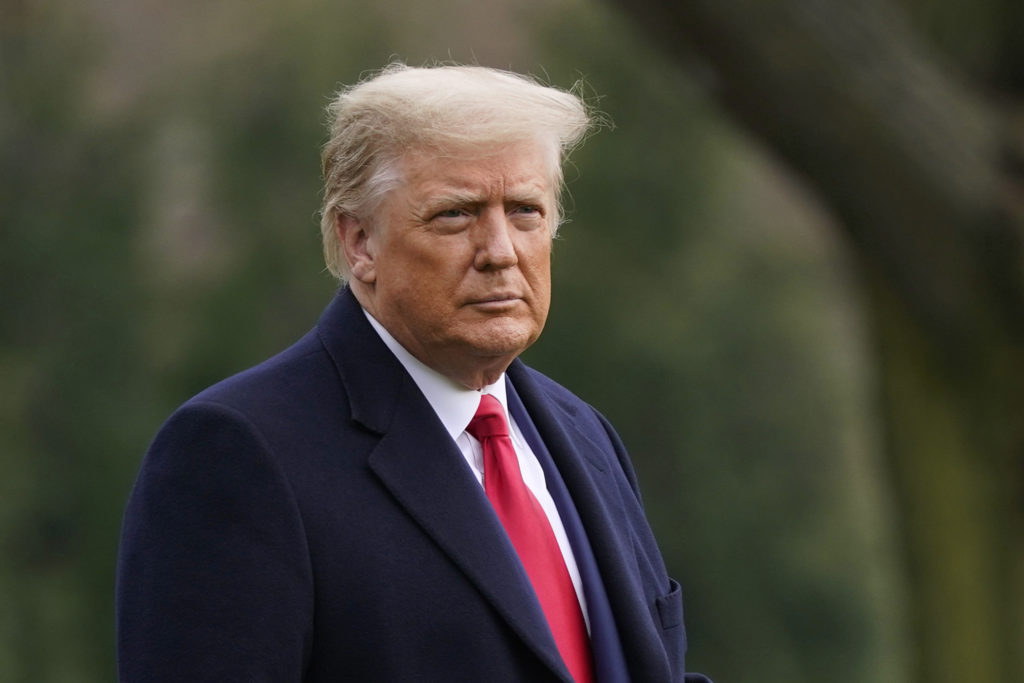
President Donald Trump appeared no closer to signing an end-of-year COVID relief and spending bill Sunday as unemployment aid expired, the government barrels toward a mid-pandemic shutdown and lawmakers implored him to break the impasse he created after Congress approved the deal. Trump blindsided members of both parties with a demand for larger COVID relief checks, imperiling not only a massive package of economic and public-health assistance but the basic functions of government itself. The package passed with wide margins in the House and Senate and with the understanding of members of both parties that Trump supported it. Now, the federal government will run out of money at 12:01 a.m. Tuesday if Trump refuses to sign the bill in time as he spends the holidays in Florida. In the face of economic hardship and spreading disease, lawmakers urged Trump on Sunday to sign the legislation immediately, then have Congress follow up with more. Aside from unemployment benefits and relief payments to families, money for vaccine distribution, businesses, cash-starved public transit systems and more is on the line. Protections against evictions also hang in the balance. “What the president is doing right now is unbelievably cruel,” Sen. Bernie Sanders of Vermont said Sunday. “So many people are hurting. … It is really insane and this president has got to finally … do the right thing for the American people and stop worrying about his ego.” Republican Sen. Pat Toomey of Pennsylvania, with more measured words, agreed Trump should sign the bill, then make the case for more. “We’ve got a bill right now that his administration helped negotiate,” he said. “I think we ought to get that done.” The same point was echoed by Maryland Gov. Larry Hogan, a Republican who’s criticized Trump’s pandemic response and his efforts to undo the election results. “I just gave up guessing what he might do next,” he said. Republican Rep. Adam Kinzinger of Illinois said too much is at stake for Trump to “play this old switcheroo game.” “I don’t get the point,” he said. “I don’t understand what’s being done, why, unless it’s just to create chaos and show power and be upset because you lost the election.” Trump was spending Sunday golfing at his West Palm Beach course. He has given no indication he plans to sign the bill as he spends the last days of his presidency in a rage. Indeed, his dissatisfaction with the legislation seems only to have grown in recent days as he has criticized it both privately to club members and publicly on Twitter. As the impasse dragged on, Dr. Anthony Fauci of the National Institutes of Health warned that the country is at a “critical point” in COVID-19 infections, with the Christmas and New Year’s holidays posing the threat of a “surge upon a surge” as people congregate with families and others, against the advice of public-health officials. “As we get into the next few weeks, it might actually get worse,” he said on CNN’s “State of the Union.” Days ago, Democrats said they would call House lawmakers back to Washington for a vote Monday on Trump’s proposal to send out $2,000 relief checks, instead of the $600 approved by Congress. The idea is likely to die in the Republican-controlled Senate. Democrats were also considering a vote Monday on a stop-gap measure aimed at keeping the government running until Democrat Joe Biden is inaugurated Jan. 20. Washington has been reeling since Trump turned on the deal, without warning, after it had won sweeping approval in both houses of Congress and after the White House had assured Republican leaders that Trump would support it. Instead, he assailed the bill’s plan to provide $600 COVID relief checks to most Americans — insisting it should be $2,000. House Republicans swiftly rejected that idea during a rare Christmas Eve session. But Trump has not been swayed despite the pandemic gripping the nation. The impact of the sidelined aid is already being felt. Lauren Bauer of the Brookings Institution has calculated that at least 11 million people were losing aid from the programs immediately without additional relief; millions more would exhaust other unemployment benefits within weeks. How and when people would be affected by the lapse depended on the state they lived in, the program they were relying on and when they applied for benefits. In some states, people on regular unemployment insurance would continue to receive payments under a program that extends benefits when the jobless rate surpassed a certain threshold, said Andrew Stettner, an unemployment insurance expert and senior fellow at the Century Foundation think tank. About 9.5 million people, however, had been relying on the Pandemic Unemployment Assistance program that expired altogether Saturday. That program made unemployment insurance available to freelancers, gig workers and others who were normally not eligible. After receiving their last checks, those recipients would not be able to file for more aid, Stettner said. The relief was attached to a $1.4 trillion government funding bill to keep the federal government operating through September, which would mean that failing to sign it by Tuesday would trigger a federal shutdown. “Now to be put in a lurch, after the president’s own person negotiated something that the president doesn’t want, it’s just — it’s surprising,” Kinzinger said. “But we will have to find a way out.” Kinzinger and Fauci spoke on CNN’s “State of the Union,” and Hogan and Sanders on ABC’s “This Week.” Republished with the permission of the Associated Press.
