
Darryl Paulson: Obama’s electoral legacy: After 8 years, we get a Donald Trump

(Part 2 of the Obama legacy) With the inauguration of Donald Trump, it is a good time to review the electoral impact of eight years of the Obama White House. One of the impacts is the election of Trump which surprised the entire political universe. Whatever Obama may have achieved in public policy, it is that policy which is in great part responsible for setting “the post-World War II record for losses by the White House party,” according to Larry Sabato. Democrats lost over 1,000 seats at the state and national level. However important the Obama policies may have been, it is fair to argue that those policies contained the seeds of Democratic losses. The Wall Street and big bank bailouts led to the creation of the Tea Party. The Tea Party became a primary vehicle to organize disaffected Republicans against bailouts for Wall Street and not Main Street. Combined with opposition to the Affordable Care Act (ACA), mobilized Republicans took over control of both the House and Senate, and effectively denying Obama the needed votes to carry out the rest of his agenda. After the 2016 election, Democrats held 11 fewer Senate seats than they did Jan. 20, 2009, a 16 percent decrease. Democrats hold 62 fewer House seats than in 2009, a drop of 24 percent. They also lost control of the White House giving Republicans complete control of the national government. At the state level, the number of Democrat governors fell from 28 to 16, a 43 percent decline. In 2009, Democrats controlled both houses in 27 states; after 2016, the number dropped to dual control of only 14 states, a 48 percent drop. On top of this, Democrats lost 959 seats in the state legislatures, weakening them for years to come. These losses mean that Democrats will have a difficult time in passing their agenda at the state and national level. It also means that the Democratic bench of future leaders has been wiped out, making it difficult for them to find and finance competitive candidates. Finally, since Democrats foolishly changed the filibuster rules in 2013, cabinet nominees and most court appointees will need only 51 votes to be confirmed. This creates the possibility for more extreme nominees to win confirmation. One of the few positive thing for Democrats is that it is difficult to imagine them losing many more seats. The out-party normally makes gains in midterm elections. Unfortunately for Democrats, they must defend 25 of the 33 Senate seats up for election in 2018, and Trump won 10 of the 25 states that Democrats must defend. If the Democrats could pick up only two Senate seats in 2016 when Republicans had to defend 24 of the 34 seats, it is hard to imagine them doing better in 2018 when they must defend two out of every three Senate seats up for election. Without Obama on the ballot in 2016 and 2018, fewer young and minority voters will turn out at the polls. Although Democrats have dominated among young voters, few of them turn out, especially in off-year elections. Democrats have complicated their problem with young voters by having an array of senior citizen leaders. Nancy Pelosi has been the ranking Democratic leader for 6 terms, as has second-ranking Democrat Steny Hoyer. Third-ranking Democrat James Clyburn has served five terms as leader. Pelosi is 76, and Hoyer and Clyburn are 77. Although Democrats have been devastated during Obama’s tenure, he is not solely responsible. Obama is only the third Democratic president to twice win a popular vote majority, along with Andrew Jackson and Franklin Roosevelt. Democratic National Party Chair Debbie Wasserman Schultz, a Congresswomen from Florida, was widely viewed as an ineffective spokesperson for the party and was eventually ousted for what many Democrats viewed as her favoritism for Hillary Clinton over Bernie Sanders during the Democratic primaries. Obama appointed Wasserman Schultz to become chair of the Democratic Party and, critics contend, for standing by her for far too long. Politics is a strange beast. Six months ago, almost everyone believed the Republican Party was on its last legs, and the Trump nomination would doom them forever. Today the Republicans control all three branches of the federal government, and it appears that the Democrats are on life support. Who knows what tomorrow will bring? ••• Darryl Paulson is Emeritus Professor of Government at the University of South Florida St. Petersburg.
Darryl Paulson: Voters don’t understand or like the Electoral College
Here are a few basic facts about the electoral-college system. First, very few voters understand how it works. Second, most voters hate the system. Third, the system is almost impossible to change. Those who drafted the Constitution had little trust in democracy. James Madison, in The Federalist Papers, wrote that unfettered majorities tend toward “tyranny.” John Adams, signer of the Declaration of Independence and second President, noted that “Democracy never lasts long. It soon wastes, exhausts, and murders itself. There never was a democracy that did not commit suicide.” Reflecting their distrust of democracy, the drafters of the Constitution wanted to create a process where the president would be indirectly selected. Direct election was rejected because they believed that most voters were incapable of making a wise choice. Voters would likely vote for a well-known person, especially one from a voter’s home state. A Committee of Eleven was appointed and they recommended a compromise where each state would appoint presidential electors equal to the number of representatives and senators. The electors would cast a vote for president and vice president. The candidate with the most votes would be president and the candidate with the second highest vote would be vice president. The compromise was accepted and Alexander Hamilton described the electoral-college plan “if the manner of it be not perfect, it is at least excellent.” The compromise worked until the 1800 presidential election when electors cast an equal number of votes for Thomas Jefferson, who the Anti-Federalists wanted to be president and Aaron Burr, who they wanted as vice president. After 36 ballots, the House selected Jefferson as president. The 12th Amendment, adopted in 1804, separated the electoral vote for president and vice president. There is little doubt that Americans hate the Electoral College system and prefer the direct election of the president. The system has allowed the election of four presidents who lost the popular vote, but won the electoral vote. In 1824, Andrew Jackson won the popular vote, but lost when the House selected John Quincy Adams. In 1876, Samuel Tilden won the popular vote by a quarter million votes, but lost the electoral vote to Republican Rutherford B. Hayes. In 1888, Grover Cleveland received more popular votes but lost to Republican Benjamin Harrison. Finally, in 2000, Democrat Al Gore won the popular vote, but lost the election when Florida’s electoral votes were awarded to George W. Bush. Another complaint about the electoral college is that the winner-take-all feature does not reflect the popular will. A candidate with a plurality of the popular vote would win all of a state’s electoral votes in a three or four person race. Critics contend that the system discourages candidates from campaigning in states that they are sure to win or lose. No sense wasting time and money campaigning in those states. Instead, all of the attention is focused on a half-dozen competitive states like Florida and Ohio. If no candidate gets a majority of the electoral votes (270), the election is thrown into the House of Representatives. Each state, regardless of population, gets one vote. The least populated state has one vote; the most populated state gets one vote. If a state delegation’s vote is equally split, they get no vote until the deadlock is broken. Although reforms of the system have been pushed, the likelihood of reform is small. Small states, which have disproportionate power under the plan, are not likely to give up that power to support direct election. Supporters of direct election argue that it is the most democratic, which is precisely why the drafters of the Constitution dismissed it. Supporters also argue that it would force candidates to conduct national campaigns since every vote would matter. Critics of direct election argue that it would create gridlock in close elections. Imagine having to review over 100 million votes in a close election to see if they should be counted or dismissed. Would voters have confidence if a candidate won by a few thousand votes? What does the electoral-college system tell us about 2016. Hillary Clinton is a flawed candidate seeking a third consecutive win for Democrats, something that is difficult to do. However, we know that Republicans are not happy with either Donald Trump or Ted Cruz. The possibility of a contested convention further muddies Republican chances. A look at the electoral-college maps shows that Democrats usually win fewer states than Republicans, but they win the states with large numbers of electoral votes. While the electoral-college map of America looks overwhelmingly red, it is likely the Republicans will end up feeling blue. Larry Sabato, of the University of Virginia, projects that in a Clinton-Trump election, Clinton is likely to win 347 electoral votes to Trump’s 191. If so, an easy Clinton victory means there will be no pressure to reform the electoral-college system. *** Darryl Paulson is Professor Emeritus of Government at USF St. Petersburg.
Larry Sabato’s Crystal Ball portends a potential Democratic blowout presidential election
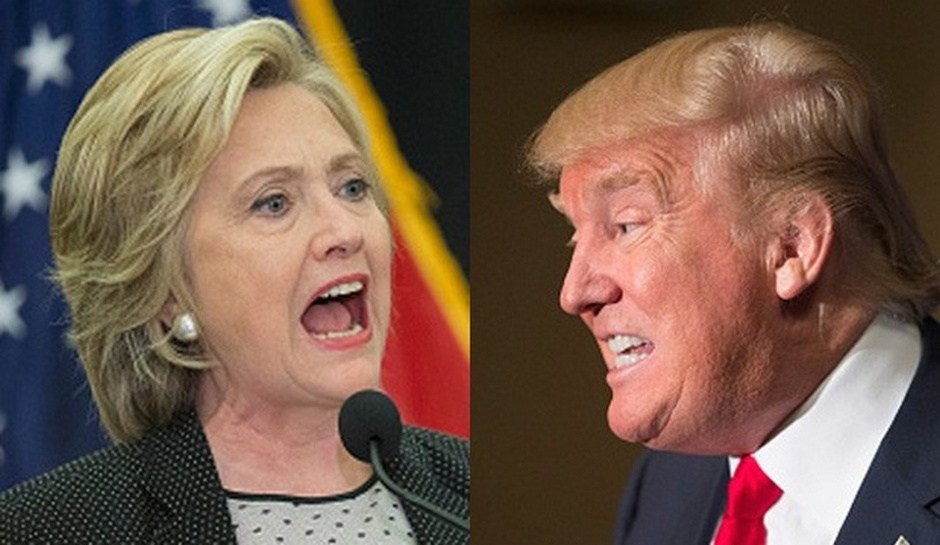
University of Virginia political science professor Larry Sabato latest “Crystal Ball” prediction of the 2016 presidential election spells gloom for the Republican Party this November. The longtime political analyst is predicting that if it’s a Hillary Clinton–Donald Trump matchup, it will be an electoral college blowout, 347-191. Sabato’s Crystal Ball is a weekly online political newsletter and website that analyzes American politics. In the new column, written by Sabato, Kyle Kondik, and Geoffrey Skelley, the authors acknowledge that while it’s an “extra-early, ridiculously premature projection” that could change after the conventions and a possible third-party candidacy. However at the moment, the electoral map doesn’t look very competitive for the GOP going into November. Nearly a year ago, Sabato put Florida into the “toss-up” column, but no longer. Now the Sunshine State is being put into the same bucket of other swing states like Virginia, Ohio, New Hampshire, Nevada, Iowa and Colorado. The Sabado Crystal Ball has now moved all seven states from “toss-up” last May, to now “leaning Democratic.” “While some will fall to the Democrats less readily than others, it is difficult to see any that Trump is likely to grab,” the authors write, adding that four normally Republican states (Arizona, Georgia, Indiana, and Missouri) “would be somewhat less secure for the GOP than usual.” But what about the possibility of Trump expanding the electoral map, as some pundits have speculated could happen with his stances on trade and other issues that could bring along disaffected white workers? “The problem is, there is little evidence that the non-college voters supporting Trump in the primaries are defectors from the Democrats; most have been backing GOP candidates fairly consistently, so the net addition for Trump could be small,” the authors write. “Nor do we buy the theory that increased Republican primary turnout this year means Trump is going to bring out millions more white and primarily male voters that weren’t excited by John McCain in 2008 and Mitt Romney in 2012. Maybe there will be higher white male voter participation, but there will probably be augmented, heavily Democratic minority turnout to balance it.” Although a Clinton-Trump matchup could be an electoral embarrassment for the GOP, Sabato says that because of the political polarization in the country, this would not be an overwhelming victory for the Democrats with the popular vote, as were the blowouts in 1964 and 1972. He sees Clinton taking less than 55% of the two-party vote. The Crystal Ball believes that Ted Cruz would definitely be an electoral improvement for the Republicans, but he would not have enough to secure victory over Clinton. He writes that the “irony” is that Clinton was always an eminently beatable candidate, but more mainstream candidates like John Kasich and Marco Rubio simply haven’t inspired Republican voters.
“Crystal Ball” suggests Marco Rubio offer John Kasich VP spot in exchange for his backing
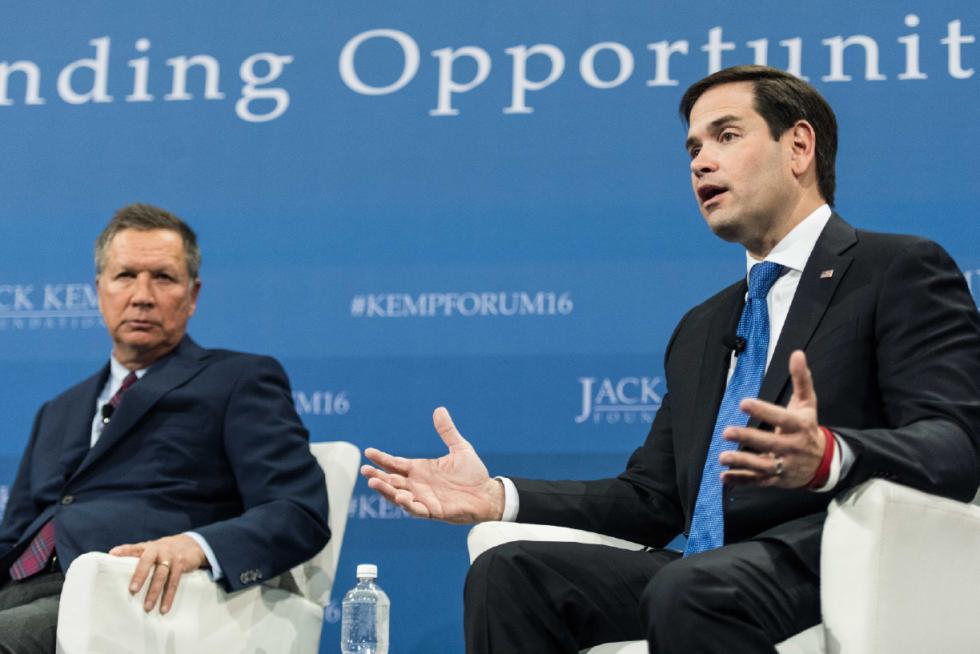
As Marco Rubio continues to gain steam in the race for the Republican nomination, a leading political expert is looking into his crystal ball to make a few predictions. Larry Sabato, the director of the University of Virginia’s Center for Politics and editor in chief of “Sabato’s Crystal Ball,” suggested Rubio “consider a daring gambit.” The bold move? Openly offering John Kasich “the vice presidential slot in exchange for Ohio governor’s support.” In the Saturday “Crystal Ball” piece, Sabato and his team said Ronald Reagan did something similar in his 1976 campaign. It was right before the Republican convention, and “while it didn’t work out it shook up conventional wisdom. It is a tactic worth considering.” The “Crystal Ball” story continues: “If Rubio can somehow push Kasich out after Bush’s exit, it seems reasonable to think that the lion’s share of their supporters would go to him, and in a three-way race, that could be enough for Rubio to start getting the victories he has failed to secure so far. However, Kasich seems inclined to continue to run, and the Republican power brokers who favor a Rubio-Kasich ticket probably won’t take the risks necessary to make this happen.” Kasich came in fifth in South Carolina on Saturday, with 7.6 percent support. Jeb Bush came in fourth with 7.8 percent of the vote. Bush announced Saturday he was bowing out of the race. Kasich is still plugging along, on Sunday telling John Dickerson on Face the Nation that his team is “going to go on March the 1st to a number of states where we think we’re going to do well.” “So it’s a matter of continuing on … and being able to take advantage of grassroots,” he said on the show. “We now have some Bush people who have come our way, both from a political point of view and a fundraising point of view and we’re going to keep struggling to make sure that we can be out there, keep putting the resources to be in a position of doing well.” Rubio came in second in South Carolina with 22.5 percent of the vote. He now heads to Nevada, where Republicans will caucus on Feb. 23. Recent polling averages show Rubio is battling it out with Ted Cruz for second in Nevada.
2016 presidential election predictions we can already make
In the past few decades, swing states, once major wild cards in presidential politics are becoming scarcer. When Florida decided the 2000 election with 537 votes, 12 states helped elect the president by less than five percentage points. In 2012, the number of swing states dropped to four. For today’s Electoral College, 40 of 50 states have voted for the same party in all four elections since 2000, writes Larry Sabato, Kyle Kondik and Geoffrey Skelley in today’s POLITICO. Of the 10 exceptions, three were flukes: New Mexico’s vote was “razor-thin” in going for Al Gore in 2000 Al Gore, as well as 2004 when George W. Bush won the state. Indiana and North Carolina were trending Democratic, narrowly electing Barack Obama in 2008, mostly because of a strong field game and advertising by Obama’s campaign. Hoosiers tend to be Republican, as do the Tar Heels, by a slight margin. Sabato estimates seven real swing states: Colorado, Florida, Nevada, Ohio, and Virginia – each backing Bush and Obama twice. Iowa and New Hampshire went Democratic in three of the past four presidential contests. It should them come as little surprise that the particular seven states start as the clear toss-ups on the first Electoral Map for 2016. Sabato writes: It’s effectively the same map we featured for much of the 2012 cycle, and it unmistakably suggests the Democratic nominee should start the election as at least a marginal Electoral College favorite over his or (probably) her Republican rival. However, at the starting gate it is wiser to argue that the next election is basically a 50-50 proposition. How can that be when Democrats are so much closer to the magic number of 270 than Republicans? At heart, it’s because the past is often not a good guide to the future. With regularity in modern history, the Electoral College’s alleged lock for one party has been picked by the other party, usually at eight-year intervals. A few states that appear to be solidly in one party’s column can switch in any given year because of short-term (Indiana) or long-term (Virginia) forces. Other states that merely lean to one party require less of a push to change allegiances. North Carolina tilts to the GOP and Wisconsin to the Democrats, but it doesn’t require much imagination to foresee the winning party flipping one or the other. To win in 2016, all Democrats have to do is hold off GOP gains and limit any blue-to-red transformations. If those state that Sabato sees as lean, likely, and safe Democratic, the nominee needs just 23 of the 85 toss-up electoral ballots. In addition, in the case a lean Democratic state such as Wisconsin falls to the Republicans, those lost votes can be easily made up with a handful of toss-ups. For Republicans, Sabato says winning poses a considerably greater challenge. First, he or she must hold all the usual R states, plus patching together another 64 electoral votes, or 79 votes if North Carolina goes Democrat. To do so, a GOP candidate would have to sweep of a handful of swing states – an unlikely scenario, unless a few election cycle essentials turn against Democrats — Obama’s job approval, the economy, war and the like. At this point in the election cycle, we can already make two predictions: Republicans will not win if they lose either Florida or Ohio. Although the two states are somewhat slightly more Republican than the U.S. as a whole, if the GOP wants any chance if success, they will pick a nominee appealing to both Sunshine and Buckeye State voters. Second, a Democratic path to the White House might be possible without Virginia, but anything more than a percent or two (either way) will be a definite failure. Virginia was slightly more Democratic than the nation in 2012, Sabato notes, for the first time since FDR, and there are rising population trends more favorable to Democrats. “If you plan to go where the action will be,” he concludes, “you can already safely book those autumn 2016 travel packages to Columbus, Denver, Des Moines, Las Vegas, Manchester, Richmond and Tampa.”
