
Senate race between Jones, Tuberville tops Alabama ballot
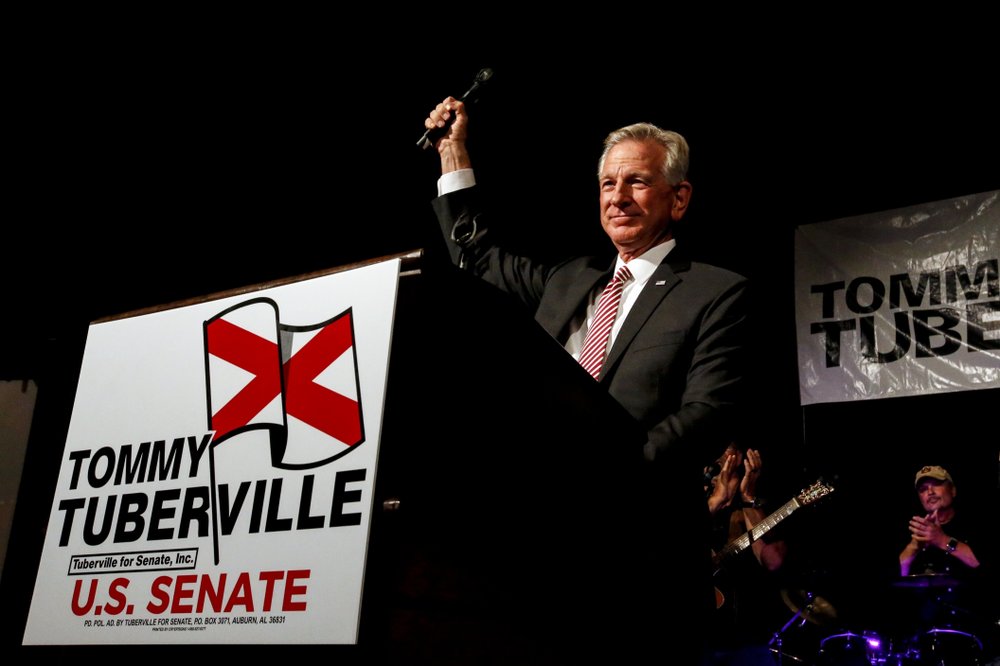
In addition to voting for president, Alabama voters will also decide a U.S. Senate race and multiple other offices and issues on Tuesday. Here is a look at Election Day in Alabama: PRESIDENT Very popular among the conservatives who dominate Alabama politics, Republicans are hopeful President Donald Trump will carry the state against Democrat Joe Biden. Trump carried 62% of the roughly 2.1 million votes cast in Alabama in his race against Hillary Clinton in 2016, and there’s little indication Trump’s popularity has waned in the deep-red state despite problems including impeachment and the coronavirus pandemic. But while some GOP candidates in Alabama have staked their campaigns on aggressively supporting Trump for a second term, increased Democratic turnout could narrow the president’s margin against Biden. While Alabama Democrats are more energized and organized than they were four years ago, the number of yard signs and roadside shops selling Trump paraphernalia across Alabama are visible proof of Biden’s uphill battle in reclaiming a state that a Democratic last carried in a presidential election in 1976, when Jimmy Carter from neighboring Georgia was on the ballot. U.S. SENATE Republicans trying to maintain control of the U.S. Senate are staking their hopes on former college football coach Tommy Tuberville defeating first-term Democratic Sen. Doug Jones, who won the seat in a special election in 2017. Tuberville, who has never held public office and last coached four years ago, is among the candidates who’ve aligned themselves most closely with Trump, even declaring in the primary campaign: “God sent us Donald Trump.” Viewed as an underdog in a Republican-controlled state, Jones mocked Tuberville as “Coach Clueless” and chided him for his refusal to debate. Jones won the seat previously held by Trump’s first attorney general, Jeff Sessions, after GOP Senate candidate Roy Moore was publicly accused of sexual misconduct involving young women decades ago. With GOP incumbents in danger elsewhere, Republicans hope Tuberville can knock off Jones. U.S. HOUSE The state will have at least two new members of Congress after voters pick winners in races for two open U.S. House seats in south Alabama. The Republican chairman of the Mobile County Commission, Jerry Carl, is trying to keep GOP control in the southwest Alabama seat now held by Rep. Bradley Byrne. Carl is facing Democrat James Averhart, a retired Marine who runs a nonprofit group and directs the Mobile-area office of the NAACP. In southeast Alabama’s 2nd District, Republican Barry Moore of Enterprise and Democrat Phyllis Harvey-Hall are vying for the job of GOP Rep. Martha Roby, who didn’t seek reelection. Moore is a former state representative and business owner, while Harvey-Hall is an educator from Montgomery. Two Republican House members are also hoping to win reelection. Rep. Mike Rogers of Saks is seeking a 10th term in east Alabama’s 3rd District against Democrat Adia Winfrey, while Rep. Robert Aderholt of Haleyville is seeking a 13th term in office against Democrat Rick Neighbors in the 4th District, which includes much of north Alabama. Reps. Mo Brooks of Huntsville; Gary Palmer of Hoover; and Terri Sewell of Selma were unopposed in the general election. CONSTITUTIONAL AMENDMENTS Six statewide constitutional amendments are on the ballot, including one that would remove racist language from the state’s 1901 constitution, which was passed to ensure white supremacy in Alabama. Sponsored by Rep. Merika Coleman of Birmingham, Amendment 4 would allow a recompilation of the state constitution to remove wording that prohibited mixed-race marriage and mandated racially segregated schools. While no longer in effect, supporters of the amendment say the prohibitions are an embarrassment and should be removed. Recommended changes to the constitution would be submitted to lawmakers in 2022 for approval, and voters would again be asked to approve the stripped-down document. Voters defeated similar measures twice before, most recently in 2012. Amendment 1 is a mostly symbolic measure pushed by Republicans that says only U.S. citizens have the right to vote, which already is the law nationally. The Alabama Constitution currently states that every male citizen can vote, although the 19th Amendment provided women’s suffrage in 1920. Amendment 2 would allow the full Alabama Supreme Court to appoint the director of the state’s court system, a task now performed solely by the chief justice, and make other changes to the judicial system. Amendment 3 would extend the amount of time that appointed district and circuit judges can serve. Amendments 5 and 6 would protect anyone who kills someone in self-defense in a church in Franklin and Lauderdale counties. Alabama’s “stand your ground” law already applies inside churches, the attorney general’s office has said, but backers support more specific provisions. PSC PRESIDENT Republican Twinkle Andress Cavanaugh is seeking reelection as president of the utility-regulating Alabama Public Service Commission against Democrat Laura Casey. Cavanaugh, seeking her third term, was the first woman to serve as chair of the Alabama Republican Party and has closely aligned herself with President Trump while espousing conservative orthodoxy. She says keeping power rates low helps families and business development. Casey contends the three-member PSC, all Republicans, is more interested in protecting the state’s largest electrical utility, Alabama Power Co., than consumers. She recently lost an appeal to the Alabama Supreme Court, which rejected her right to videotape a hearing held before the PSC about solar energy fees. STATE SCHOOL BOARD The ballot on Tuesday includes three contested seats on the Alabama State Board of Education. In the District 1 race in southwest Alabama, Republican board vice president Jackie Zeigler, a retired principal, is opposed by Democratic nominee Tom Holmes, a retired state employee who also led a disabilities advocacy program. Republican Stephanie Bell is touting her experience supporting programs, including the Alabama Reading Initiative, as she seeks an eighth term representing the 3rd District of central Alabama. She is opposed by Jarralynne Agee, provost and vice president of academic affairs at Miles College in Birmingham. In the 5th District, which includes much of Alabama’s Black Belt region, Democrat Tonya Smith Chestnut and Republican Lesa
Alabama Supreme Court rules PSC hearing not a public meeting
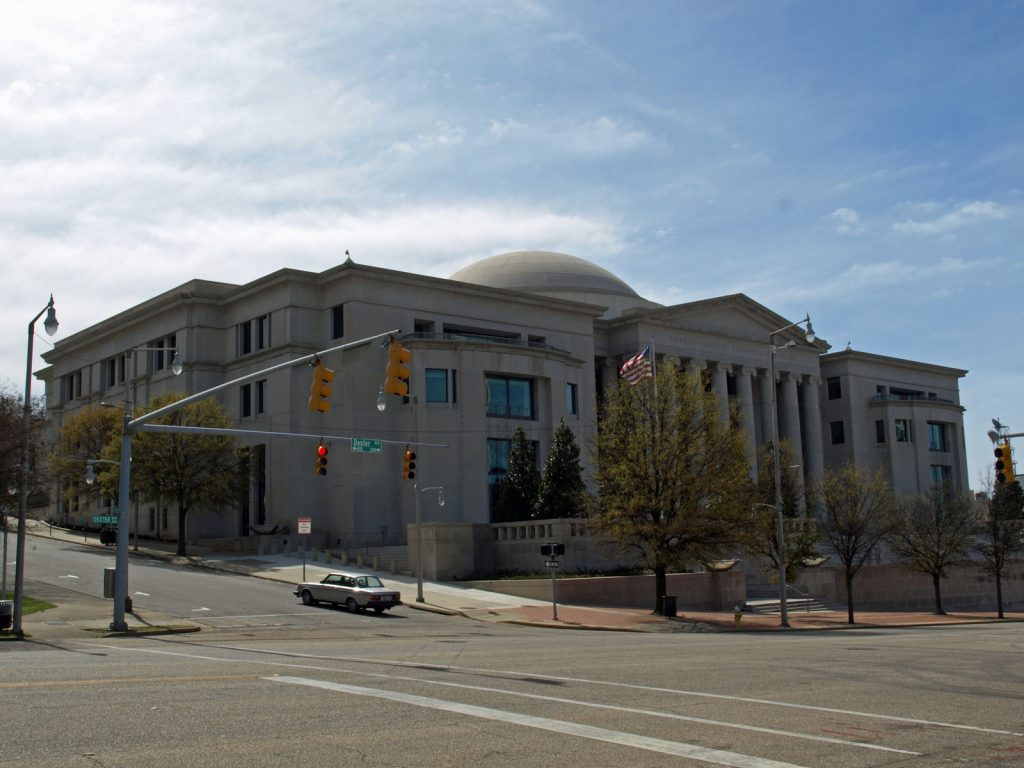
The all-Republican court upheld a lower court ruling that said the all-Republican Alabama Public Service Commission had a right to remove Laura Casey.
Supreme Court weighs whether state agency’s meetings can be recorded
A candidate for Public Service Commission president was escorted out of a commission hearing for recording the meeting.
Lawsuit filed after recording banned at utility rate hearing
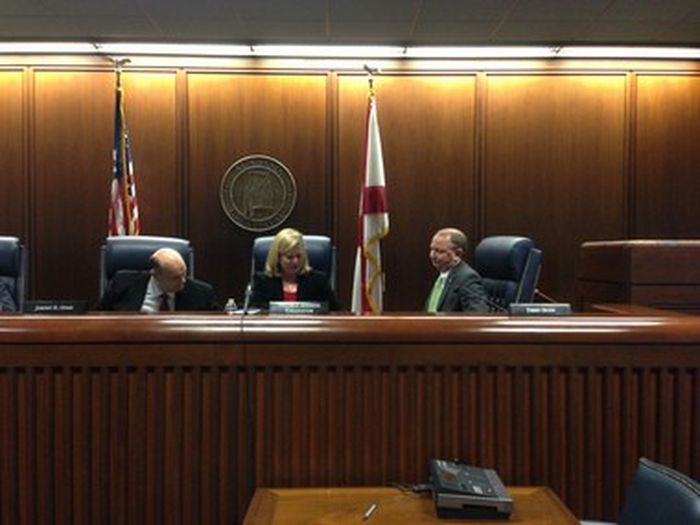
A lawsuit filed Thursday accuses the Alabama Public Service Commission of violating the Open Meetings Act by preventing audience members from recording a recent hearing. The lawsuit was filed by Laura Casey, a Democratic candidate for PSC president. Casey was one of three people ejected from the hearing last month for recording or live-streaming. The case asks for a court declaration that the utility regulatory commission violated the state’s Open Meetings Act which allows the recording of public meetings. It also asks for a fine. The hearing centered on a challenge to fees charged by Alabama Power on customers who use solar panels, or other means, to generate part of their own electricity. The meeting was open to the public as the three PSC members sat and heard testimony about why they thought the fees were or weren’t justified. The commission has not announced a decision. Administrative Law Judge John Garner told audience members during the hearing that they couldn’t record because it was a legal proceeding. The ejected audience members were told they could return only if they agreed to stop recording. The lawsuit names the commissioners as defendants. Republished with the Permission of the Associated Press.
