
VA requires COVID-19 vaccination for health care workers

The Department of Veterans Affairs on Monday became the first major federal agency to require health care workers to get COVID-19 vaccines, as the aggressive delta variant spreads across the nation and some communities report troubling increases in hospitalizations among unvaccinated people. The VA’s move came on a day when nearly 60 leading medical and health care organizations issued a call for health care facilities to require their workers to get vaccinated. No federal law stands in the way of employers requiring vaccinations, but like mask mandates, the issue has been politicized in a society that’s divided on matters of public health. “With more than 300 million doses administered in the United States and nearly 4 billion doses administered worldwide, we know the vaccines are safe and highly effective at preventing severe illness and death from COVID-19,” Dr. Susan Bailey, immediate past president of the American Medical Association, said in a statement. “Increased vaccinations among health care personnel will not only reduce the spread of COVID-19 but also reduce the harmful toll this virus is taking within the health care workforce and those we are striving to serve.” Although vaccination among physicians is nearly universal — 96% according to an AMA survey — that’s not the case for many other people working at health care facilities. In nursing homes, only about 60% of staffers are vaccinated, compared with about 80% of residents, according to recent numbers from Medicare. And COVID-19 cases are rising. At the VA, vaccines will now be mandatory for certain medical personnel — including physicians, dentists, podiatrists, optometrists, registered nurses, physician assistants, and others who work in departmental facilities or provide direct care to veterans, said VA Secretary Veterans Affairs Secretary Denis McDonough. Employees will have eight weeks to be fully vaccinated. “It’s the best way to keep veterans safe, especially as the delta variant spreads across the country,” McDonough said in a statement. “Whenever a veteran or VA employee sets foot in a VA facility, they deserve to know that we have done everything in our power to protect them from COVID-19. “With this mandate, we can once again make — and keep — that fundamental promise,” he added. It was unclear what would happen to VA employees who refuse to be vaccinated. The agency said vaccination will be required “absent a medical or religious exemption.” The longstanding policy in the health care industry is for staff to stay up-to-date with vaccinations, such as annual flu shots. Exceptions for medical reasons include known allergies. In addition to the AMA, the medical and health care groups calling for mandatory vaccines for health workers included the American Academy of Nursing, the American Public Health Association, the American Pharmacists Association, and, for the first time, a nursing home industry group. LeadingAge, which represents nonprofit nursing homes and eldercare facilities, had previously advocated educating nursing home employees about the benefits of getting their shots. Also joining the call was the National Medical Association, the leading professional group representing Black physicians. “Unfortunately, many health care and long-term care personnel remain unvaccinated,” the groups said in a statement. “We stand with the growing number of experts and institutions that support the requirement for universal vaccination of health workers.” Earlier this year, the U.S. Equal Employment Opportunity Commission said current federal laws do not prevent an employer from requiring employees physically entering the workplace to be vaccinated against COVID-19. The Centers for Disease Control and Prevention has heavily promoted vaccinations as a way to slow the pandemic and save lives. However, the agency has not recommended that state or local officials or employers mandate vaccinations for their employees. “The politics is really tricky because President Biden hasn’t ordered mandatory vaccinations for federal workers,” said Lawrence Gostin, a public health law expert at Georgetown University. “And it would seem hypocritical if CDC made that recommendation” to businesses or state and local officials, he said. A CDC spokeswoman would not comment. To make matters more complicated, the COVID-19 vaccines have yet to win full approval from the Food and Drug Administration. They continue to be provided under emergency use authorization, and the lack of full approval has fed into hesitancy among some people. Still, the FDA’s emergency approval process was thorough and didn’t skip the extensive testing required of any vaccine. Of the three manufacturers of vaccines approved in the U.S., Pfizer and Moderna have applied for full approval, and a Pfizer decision is expected soon. The COVID-19 vaccines were not brewed overnight, either. They were the fruit of more than 10 years of behind-the-scenes research and huge injections of funding that laid the groundwork for them to be rolled out so quickly. Katie Smith Sloan, CEO of LeadingAge, said it’s time to go beyond the power of persuasion. “As COVID-19 variants emerge and proliferate, we can start saving more lives today by ensuring staff are fully vaccinated,” she said. Republished with the permission of the Associated Press.
Donald Trump aide: ‘We’re not going to control the pandemic’
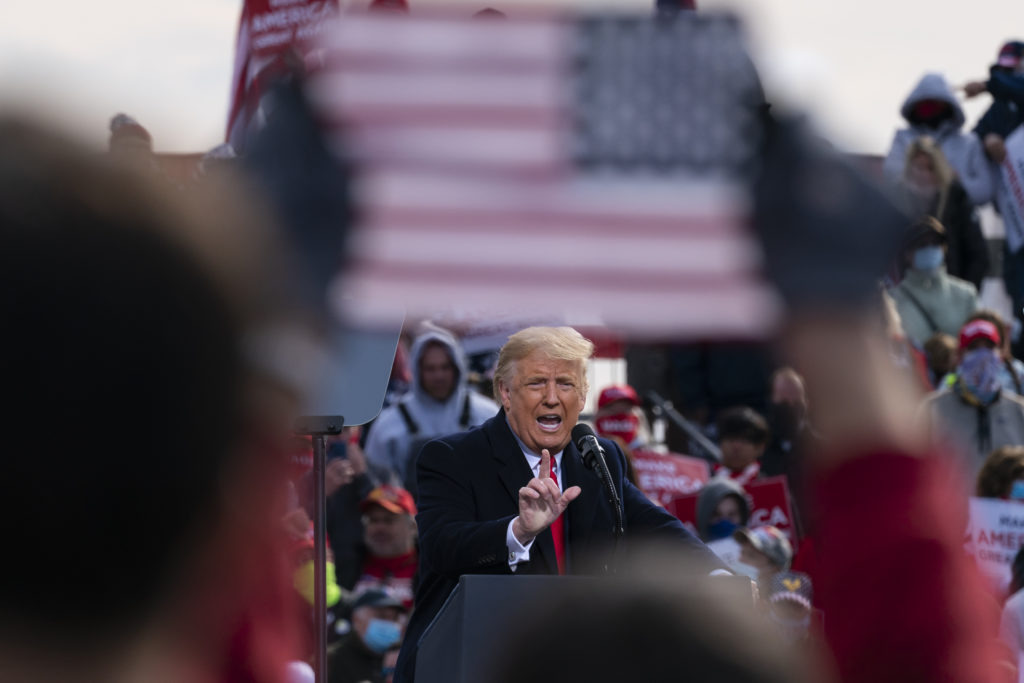
The coronavirus has reached the upper echelons of the White House again, with an outbreak among aides to Vice President Mike Pence just over a week from Election Day. A top White House official declared: “We’re not going to control the pandemic.” Officials on Sunday also scoffed at the notion of Pence dialing back in-person campaigning despite positive tests among several people in his office. Pence, who leads the White House’s coronavirus task force, was back out on the road Sunday and has an aggressive travel schedule planned for the final days of the campaign. White House chief of staff Mark Meadows, pressed to explain why the pandemic cannot be reined in, said, “Because it is a contagious virus just like the flu.” He told CNN’s ”State of the Union” that the government was focused on getting effective therapeutics and vaccines to market. Pence, who tested negative on Sunday, according to his office, held a rain-soaked early evening rally in Kinston, North Carolina, a state that Trump won in 2016 and is crucial to his reelection hopes. The vice president had a shout-out for supporters who braved what he called “this night of tempest, to stand in the rain and stand firm” for Donald Trump. He gave no nod to the coronavirus infection rippling through his staff, and dismissed Democrat Joe Biden’s description of the COVID-19 threat as an unwarranted dose of gloom and doom. The president, for his part, rallied backers in New Hampshire and visited an orchard in Levant, Maine, where he signed autographs and assured a crush of mostly unmasked supporters that a “red wave” was coming on Nov. 3. He and first lady Melania Trump wrapped up the busy weekend by hosting costumed children for a socially distanced Halloween trick-or-treating on the White House grounds. Biden attended church and participated in a virtual get-out-the-vote concert. He said in a statement that Meadows was effectively waving “the white flag of defeat” and “a candid acknowledgement of what President Trump’s strategy has clearly been from the beginning of this crisis.” In a brief exchange with reporters before the orchard visit, Trump demurred when asked if Pence should step off the campaign trail as a precaution. “You’d have to ask him,” Trump said. The White House said none of the staff traveling with Trump on Sunday had been in close contact with any individuals in the vice president’s office who had tested positive. But public health experts said that Pence’s decision to keep up in-person campaigning was flouting common sense. Lawrence Gostin, a public health expert at Georgetown University’s law school, said Pence in his decision to forgoing quarantine was violating his own task force’s recommendations. “It’s one standard for the vice president and another for all the rest of us,” Gostin said. The U.S. set a daily record Friday for new confirmed coronavirus infections and nearly matched it Saturday with 83,178, data published by Johns Hopkins University shows. Close to 8.6 million Americans have contracted the coronavirus since the pandemic began, and about 225,000 have died; both totals are the world’s highest. About half the states have seen their highest daily infection numbers so far at some point in October. Trump, campaigning in Londonderry, New Hampshire, said the rising rate of infections was nothing to be concerned about. ”You know why we have cases so much?”′ Trump asked a shoulder-to-shoulder crowd. “Because all we do is test.” Entering the final full week before the Nov. 3 election, it’s clear the Trump team remains committed to full-throttle campaigning. Trump himself has resumed a hectic schedule since recovering from his own recent coronavirus case, and planned to campaign Monday in Pennsylvania. Pence will campaign in Minnesota that day and return to North Carolina on Tuesday. Despite the rising virus numbers, the White House says the U.S. economy needs to fully reopen and it has tried to counter Biden’s criticism that Trump is not doing enough to contain the worst U.S. public health crisis in more than a century. Trump and his aides again on Sunday lashed out on Biden, falsely asserting Biden was determined to lock down the economy, while the president is centering his attention on getting therapies and vaccines to market. “We want normal life to resume,” Trump said. “We just want normal life.” Biden, in fact, has said he would only shut down the country if that is what government scientists advise. He has said that if elected he would make the case for why a national mask mandate might be necessary and would go to the governors to help increase Americans’ mask-wearing. Pence’s office says there are no plans to curtail campaigning. In addition to chief of staff Marc Short, who tested positive Saturday, a “couple” other aides also have also contracted the disease, Meadows said. Meadows said Pence will wear a mask — “because the doctors have advised him to do that” — but take it off when he gives a speech, as the vice president did on Sunday in North Carolina. Even with Pence’s latest negative test, symptoms, including fever, cough and fatigue, may appear two to 14 days after exposure to the virus, according to the Centers for Disease Control and Prevention. Some asymptomatic individuals test positive two to three days before developing symptoms. The White House says Pence was considered in “close contact” with Short under CDC guidelines. The guidelines require that essential workers exposed to someone with the coronavirus closely monitor for symptoms of COVID-19 and wear a mask whenever around other people. After consulting with the White House Medical Unit, Pence intended to maintain his schedule “in accordance with the CDC guidelines for essential personnel,” said Devin O’Malley, a Pence spokesman. Meadows sidestepped questions about whether Pence’s campaigning fit into the spirit of the CDC’s guidelines for essential work. “He’s not just campaigning, he’s working,” Meadows said. The candidates have demonstrated remarkably different attitudes about what they see as safe behavior in the homestretch of a campaign that, as
Republicans, with exception of Donald Trump, now push mask-wearing
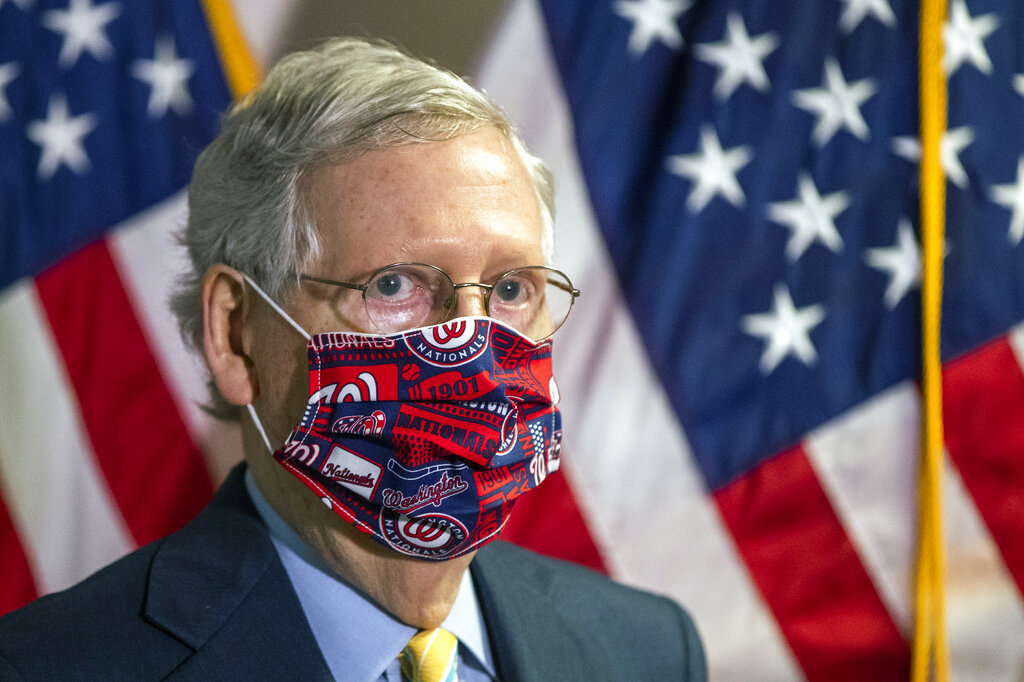
GOP officials are pushing back against the notion that masks are about politics, as President Donald Trump suggests, and telling Americans they can help save lives.
Donald Trump faces credibility test as he plays down virus threat

Trump conducted a lengthy press conference Wednesday evening aimed at reassuring everyone that he has the crisis well in hand.
