
Legislative session weekly wrap-up: State of the State, income tax cut, term limits
Alabama lawmakers are officially back to work; the 2018 legislative session kicked off on Tuesday. Because it is an election year, many legislators expect a short session that could end by late April allowing them more time to campaign ahead of the June 5 primaries. Overall, it was a fairly light week. Tuesday was dominated by Gov. Kay Ivey’s first State of the State address and Thursday by Senate Republicans introducing their legislative priorities for the year including an income tax cut, and the House passing a term limits bill. Here are the highlights out of Montgomery this week: In the Governor’s office: Ivey gives her first State of the State address: On Tuesday night, Ivey gave her first State of the State address before a joint session of the Alabama Legislature. She painted an optimistic outlook of the state as she told the crowd the dark cloud over the state has been lifted, the ship of state steadied. She also touched on various policy initiatives she hopes to accomplish in the new year. State of Emergency issued due to widespread flu outbreak: Ivey declared a State Public Health Emergency on Thursday. Healthcare facilities are overwhelmed due to the influx of flu patients, and Ivey’s emergency declaration allows those facilities to implement “alternative standards of care” plans to preserve lives. Senate news: Republican’s 2018 legislative agenda unveiled: The Alabama Senate Republican Caucus announced their legislative priorities for the 2018 legislative session at a press conference on Thursday morning at the Statehouse. The “Fighting for Alabama” agenda will focus on legislation to spur economic growth, encourage infrastructure improvements, and protect children. Bill proposed for state income tax cut: Alabama Senate Republicans on Thursday announced they have proposed a bill that would allow more taxpayers to take the maximum standard deduction on their state income taxes. House news: Bill passed to impose term limits on members of the U.S. Congress: On Thursday, the state House passed a resolution calling for there to be a Article V convention of the states to impose term limits on members of the federal government. The single-issue amendment convention would allow the American people to term limit Congress without needing federal lawmakers’ approval. This process, was designed by America’s Founders specifically to rein in abuses of power coming from members of the U.S. House and Senate.With the success in the Alabama House, the resolution is expected to pass the Alabama Senate this session as well, placing Alabama at the forefront of states proposing an amendment for term limits on the U.S. Congress. Will ridesharing soon be a reality for all of Alabama?: Mountain Brook-Republican State Rep. David Faulkner and Greensboro-Democratic State Sen. Bobby Singleton are soon introducing a bill that would create a ridesharing network across the state for companies like Uber and Lyft, making ridesharing operations available statewide.
Senate GOP announces “Fighting for Alabama” 2018 legislative agenda
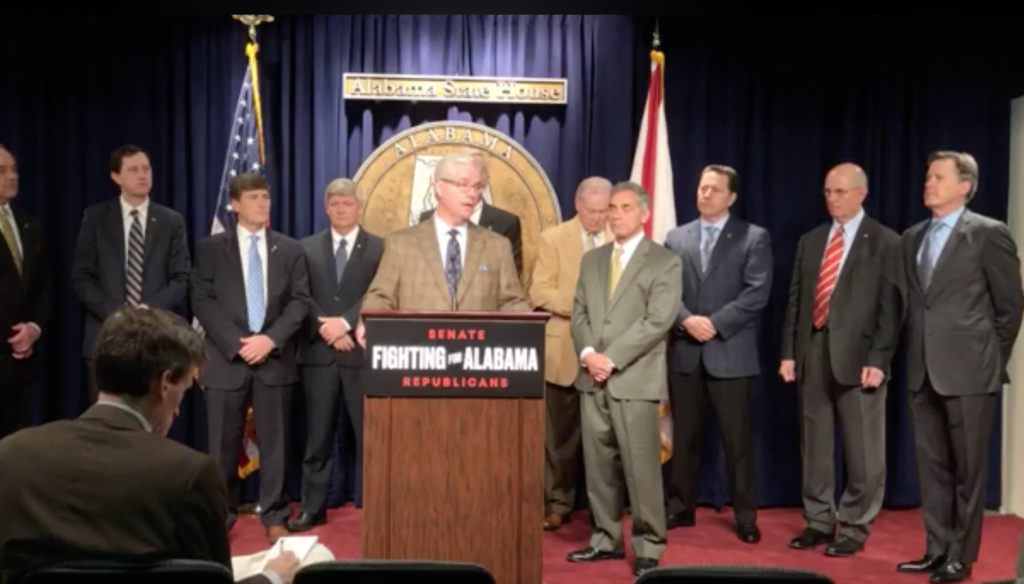
The Alabama Senate Republican Caucus announced their legislative priorities for the 2018 legislative session at a press conference on Thursday morning at the Statehouse. Anniston-Republican and Senate President Pro Tem Del Marsh, Jasper-Republican and Senate Majority Leader Greg Reed, and other Republican state senators presented four legislative priorities, in addition to their primary objective of passing balanced budgets, for the new year. The “Fighting for Alabama” agenda will focus on legislation to spur economic growth, encourage infrastructure improvements, and protect children. “An efficient and accountable state government is in the best interest of all Alabamians,” said Marsh. “We want to focus on good governance that will positively impact the lives of Alabamians.” According to the news conference, bills accomplishing these goals will be given priority as they move through Senate committees, along with top placement on the calendar when debated on the Senate floor for final passage. “Our top priority is passing balanced, responsible budgets. Beyond that, we have an agenda that’s focused on cutting taxes and bringing job growth to every part of Alabama,” stated Reed. “We are going to continue to focus on common-sense, conservative solutions to the challenges facing Alabama.” The “Fighting for Alabama” Senate Republican Agenda includes the following items: Provide an Income Tax Break Expanding the adjusted gross income range for a maximum standard deduction on Alabama income tax would provide a significant tax break for hardworking Alabama families. Grow Broadband and Telecom Services in Rural Alabama By providing incentives to telecom companies to invest in rural Alabama, we will ensure all of our citizens have fast and reliable access to the internet. Studies show that faster internet leads to more investment and higher paychecks. Make Child Sex Trafficking a Capital Offense This Legislature is committed to protecting the most vulnerable Alabamians. Making child sex trafficking a capital offense will help ensure that predators are never allowed to harm children again. Save Money in Alabama’s Biggest Budget Item – Medicaid The Alabama Legislature has worked diligently to be good stewards of the budgets we manage. Federal law requires state Medicaid agencies to recover from the estates of deceased recipients, but Alabama is the only state without a Medicaid estate recovery process – establishing a streamlined process for Medicaid to place liens on property to recover medical assistance payments will protect taxpayers’ dollars. Watch the caucus unveil their agenda:
Paul Ryan promises to overhaul tax code this year despite hurdles
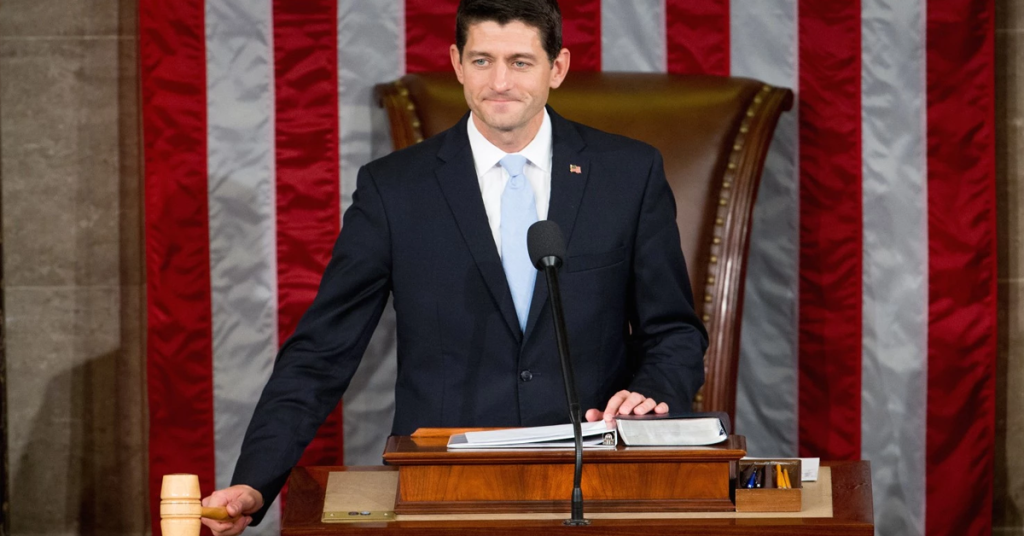
House Speaker Paul Ryan is promising to overhaul the tax code by the end of the year despite political divisions among Republicans and a crowded legislative agenda for Congress. Ryan is due to give a speech on tax reform Tuesday afternoon to the National Association of Manufacturers. In excerpts released by his office, Ryan says Republicans, who control Congress and the White House, have a rare opportunity to re-write the tax code for businesses and individuals. “We are going to get this done in 2017. We need to get this done in 2017. We cannot let this once-in-a-generation moment slip,” Ryan says in prepared remarks. “Transformational tax reform can be done, and we are moving forward. Full speed ahead.” According to Ryan’s office, the Wisconsin Republican will “warn against accepting half measures or believing there is a path to reform without obstacles and political challenges.” That’s an apparent jab at a growing number of Republicans who simply want to cut taxes rather than simplify the tax system and make it more efficient. Ryan’s office says he will make the case for permanent tax reform – rather than a temporary tax cut. The obstacles in Congress are many. Ryan supports a new tax on imports to help finance a lower overall tax rate for corporations, and to encourage U.S. companies to stay in the United States. The tax, however, has no support in the Senate and is vigorously opposed by retailers who worry that it will increase the cost of consumer goods. Ryan’s office said, “He will not litigate the issues currently being resolved between the House, Senate, and (Trump) administration, but he will describe the important components of any reform.” Republicans are planning to pass a tax package under a procedure in which they need only a simple majority in the Senate – preventing Democrats from blocking it. Under the procedure, the tax package cannot add to long-term budget deficits. That means for every tax cut, there has to be a tax increase, at least over the long term. There’s more. In order to take advantage of the procedure, Republicans in the House and Senate must pass a budget resolution. That won’t be easy because there are big disagreements among Republicans over spending levels for the military and for domestic programs. Also, the legislative calendar is crowded with other hard-to-do initiatives. The Senate is currently grappling with how to repeal and replace President Barack Obama‘s health care law. The House already passed a bill but it was not well-received in the Senate. Congress is facing an Oct. 1 deadline to fund the government, and sometime this fall, Congress will have to extend the authority of the federal government to borrow money or risk an unprecedented default. All of these issues are heavy political lifts that will take time and political capital to resolve. Republished with permission of The Associated Press.
Donald Trump’s legislative agenda slows to crawl in Congress

President Donald Trump‘s agenda has slowed to a crawl in Congress. Daily distractions and a pair of major controversies in the past week are diverting lawmakers from their day jobs. While the Trump administration delegates many decisions on legislation to more experienced GOP leaders in Congress, Trump’s low poll ratings and the turmoil at the White House are additional complications. The slowing pace was evident even before Tuesday’s explosive story in The New York Times that ousted FBI Director James Comey wrote in a memo that Trump asked him to end an investigation into former national security adviser Michael Flynn. That came 24 hours after The Washington Post revealed that Trump may have disclosed classified information to Russian officials in a meeting in the Oval Office last week. “I think it would be helpful to have less drama emanating from the White House,” said Senate Majority Leader Mitch McConnell, R-Ky. What GOP senators and House members aren’t doing right now is passing major legislation, and it’s not just the marquee items like health care and a tax overhaul that are dragging. The Senate has no legislation on its agenda this week – business is instead limited to three low-profile nominations. The House – fresh off an 11-day recess – is devoting the week to mostly symbolic, feel-good legislation designed to show support for law enforcement. Another 11-day recess, for Memorial Day this time, is just around the corner. Separately, a small group of Senate Republicans is meeting in hopes of finding a way forward on keeping Trump’s promise to repeal and replace the Affordable Care Act. But that effort appears likely to take several weeks – with no guarantee of success. “It’s hard to make things happen here, right? It’s really hard. I mean you’ve got all kinds of forces working against you,” said Sen. Bob Corker, R-Tenn. “And so unless everybody’s aligned, everybody, throughout the White House and the Cabinet, it’s almost impossible. I think they’re all very aware of that and hopefully they’re going to move to address that.” In the meantime, must-do legislation on the military, children’s health and a full slate of spending bills are all slipping behind schedule. Trump’s promised wall along the U.S.-Mexico border is dead in the water after being rejected during negotiations on a catchall spending bill – the only major bipartisan legislation to advance this year – and his promised $1 trillion infrastructure bill is still on the drawing board. Trump’s tax plan is simply a set of talking points and for procedural reasons is on hold until health care is completed. “I don’t think I’ve ever seen an administration that was so lacking in substantive proposals this late in the beginning of their term,” said No. 2 House Democrat Steny Hoyer of Maryland. “The tax bill is a one-page minimal suggestion of what might be considered. There is no jobs bill. There is no infrastructure bill.” And while lawmakers and the Trump administration are spinning their wheels, the clock ticks toward potential crises this fall, as deadlines collide on several measures, including legislation to prevent a government shutdown and a bill to increase the government’s borrowing cap and avert a potentially catastrophic default on U.S. government obligations. A popular program that provides health care to children of parents ineligible for Medicaid expires at the end of September, as does the federal flood insurance program and authorization for the Federal Aviation Administration. Work on a congressional budget measure – which is the linchpin to follow-up legislation to cut tax rates – is months behind schedule. The House and Senate Appropriations panels, typically a swarm of activity at this time of the year, seem stumped as they await marching orders. Trump’s budget finally arrives next week, promising a balanced federal ledger within 10 years. But the Trump budget could complicate matters more, in large part because it calls for domestic cuts that lawmakers have no interest in. Trump doesn’t appear very interested in the budget – its release has been scheduled for when he’s out of the country – and its promise of balance rests on rosy assumptions of economic growth and a sweeping round of unrealistic cuts to programs like Medicaid. The GOP-controlled Congress has had just a handful of legislative successes since it convened in January. The most significant bill, so far, was a long-delayed House health care measure that squeaked through earlier this month. The House bill polls poorly with voters, however, and faces a wholesale rewrite in the Senate. So far, just a single piece of major legislation has advanced that required the votes of Democrats – a catchall $1.1 trillion spending bill opposed by more than 100 House Republicans. Beyond that, many of the bills Trump has signed into law were fast-track measures to rescind regulations issued by former President Barack Obama last year. The clock ran out on further repeals and this week, the biggest Senate vote is on confirming Iowa GOP Gov. Terry Branstad as ambassador to China. “Well, we have nominations and we’ve repealed billions of dollars of regulations,” said Sen. Cory Gardner, R-Colo. “Hopefully we’ll see some other action come to the floor.” Republished with permission of The Associated Press.
House GOP Caucus announces 2017 “Alabama Proud” legislative agenda
The Alabama House Republican Caucus announced Thursday the measures that will be included in its official legislative agenda for the 2017 regular session. Titled the “Alabama Proud,” the legislative agenda seeks to highlight, improve and protect the aspects that make the state of Alabama “a special place to live, work, and raise our children.” “Alabamians are a fiercely proud people who appreciate the traditions, qualities, and deeply held conservative beliefs that make our state unique,” said Decatur-Republican and House Majority Leader Micky Hammon. “Our agenda demonstrates that members of the Alabama House Republican Caucus share the deep pride in our state, especially the strong progress that has been made in areas like education, economic development, and protecting traditional values.” Alabama House Speaker Mac McCutcheon reiterated the progress the Caucus has made over the past several years. “The House Republican Caucus is proud to serve the people of our state and is equally proud to continue our efforts to uphold the rights, values, and beliefs that Alabamians hold dear,” McCutcheon added. “We have taken the time to listen to the people of Alabama and based on their feedback, I believe they will be proud to support the initiatives in this agenda.” The “Alabama Proud” legislative agenda includes includes the following priorities: Pride in our teachers and students: Prioritized funding for the state’s nationally-recognized “First Class” Pre-Kindergarten program. Also support for the implementation of the Electronic Notification System recommended by the School Safety Task Force and will take steps to ensure it is available to all school districts across Alabama. Pride in our borders: legislation that would reinforce and strengthen existing law by withholding funding from any cities, counties, or public colleges and universities that defy immigration laws and declare themselves “sanctuary” areas that harbor illegal aliens. Pride in our history: legislation that would prevent the removal of long-standing monuments, statues and memorials and a bill that requires mandatory civics education and makes successful passage of a citizenship exam a prerequisite for high school graduation. Pride in Alabama values: the House Republican leadership will schedule a “Pro-Life Day” within the session and include two important measures on the work agenda – a constitutional amendment declaring Alabama a pro-life state so we will be prepared to take action when Roe v. Wade is overturned by the U.S. Supreme Court, and a bill protecting doctors, nurses, and other medical personnel from being forced to perform abortion procedures that violate their moral beliefs. Pride in economic development: a measure calling upon the governor to revive the Office of Small Business Development and provide business owners with a one-stop shop to fill their needs, answer their questions, and assist them with various governmental requirements. Pride in government reform: measures praising and continuing the reform-minded work of the Joint Legislative Budget Reform Task Force and the Consumer Lending Task Force, and a resolution calling upon the U.S. Congress to work cooperatively with President Donald Trump in implementing the ambitious government reform agenda that he voiced across the nation throughout the presidential campaign. The agenda bills were proposed by Republican House members and were vetted by the Caucus’s Agenda Committee, which was chaired by Rep. Chris Pringle (R – Mobile) and included Rep. Chris Blackshear (R – Phenix City), Rep. David Faulkner (R – Mountain Brook), Rep. Bob Fincher (R – Woodland), Rep. Mark Tuggle (R – Alexander City), Rep. Connie Rowe (R – Jasper), and Rep. Ritchie Whorton (R-Scottsboro) as members. “When we brought the agenda before the full Caucus, it was approved unanimously because it truly reflects the bedrock conservative beliefs of most Republicans,” Pringle said. “I am confident that the bills in our ‘Alabama Proud’ agenda will secure quick approval when brought up for consideration on the House floor.” Copies of the proposed legislation are not yet available. The 2017 legislative session convenes Tuesday, Feb. 7.
Alabama legislative agenda preview: March 7 – March 11, 2016
Alabama lawmakers will return to Montgomery Tuesday as the legislative session resumes, with the House convening at 1 p.m. and the Senate an hour later. Both chambers are still planning to tackle the General Fund and Education Trust Fund budgets before spring break, as well as a host of issues slated to be taken up this week. The Senate will debate SB89 from Sen. Arthur Orr (R-Decatur), which would require all Alabama public school students to pass a civics test to graduate – private schools could opt-in if they chose to. Also on the Senate’s agenda is SB148 from Sen. Jim McClendon (R-Springville), which would require all passengers in a vehicle to wear a safety belt. The legislation came up in last week’s session but was stalled due to opposition regarding further legislation on people’s car-riding habits. The Senate will also take up SB114 from Sen. Paul Sanford (R-Sanford), which would regulate “fantasy contests” in the state, and SB14 from Sen. Gerald Allen (R-Tuscaloosa), which would allow people to carry a firearm in their vehicle without a permit. Allen’s legislation was hotly contested in a recent committee hearing, when state law enforcement officers argued that the bill would make their jobs more difficult and dangerous. The House will also take up a bill aimed at regulating so-called “fantasy contests,” as well HB2 from Rep. Tommy Hanes (R-Scottboro), which would require wireless communications providers to supply law enforcement agencies with location information upon request. Perhaps the bills with highest interest to be taken up in the House this week are HB46 from Rep. Alan Boothe (R-Troy), which would allow Alabama distilleries to begin selling bottles for off-premise consumption, and HB13 from Rep. Alan Harper (R-Northport), which would allow the public to vote on whether or not to institute a state lottery. Committee hearings will get underway Tuesday morning before the start of session, though the majority will take place on Wednesday. The Senate Committee on Health and Human Services will hear discussion on two bills that will likely attract the outrage of Democrats – HB45 from Rep. April Weaver (R-Alabaster), which would outlaw the already-illegal practice of selling fetal tissue, and SB9 from Allen, which would prohibit abortions if providers don’t first determine a fetal heartbeat. The Senate Committee on General Fund Finance and Taxation will hear from Sen. Vivian Figures (D-Mobile) regarding SB136, a bill which would put forth a constitutional amendment to add an additional 5-mill tax to state properties, with the proceeds going to help Medicaid. The House Economic Development and Tourism Committee will hold public hearings regarding two alcohol-related bills – SB219 from Sen. William Beasley (R-Clayton), which would allow retail licensees and state liquor stores to conduct liquor and wine tastings, and HB325 from Rep. James Buskey (D-Mobile), which would allow businesses with a building split between wet and dry counties to serve alcohol. The House Committee on General Fund Ways and Means will take up the General Fund via SB125, which has already passed the Senate,
