
Trump hotel may be political capital of the nation’s capital
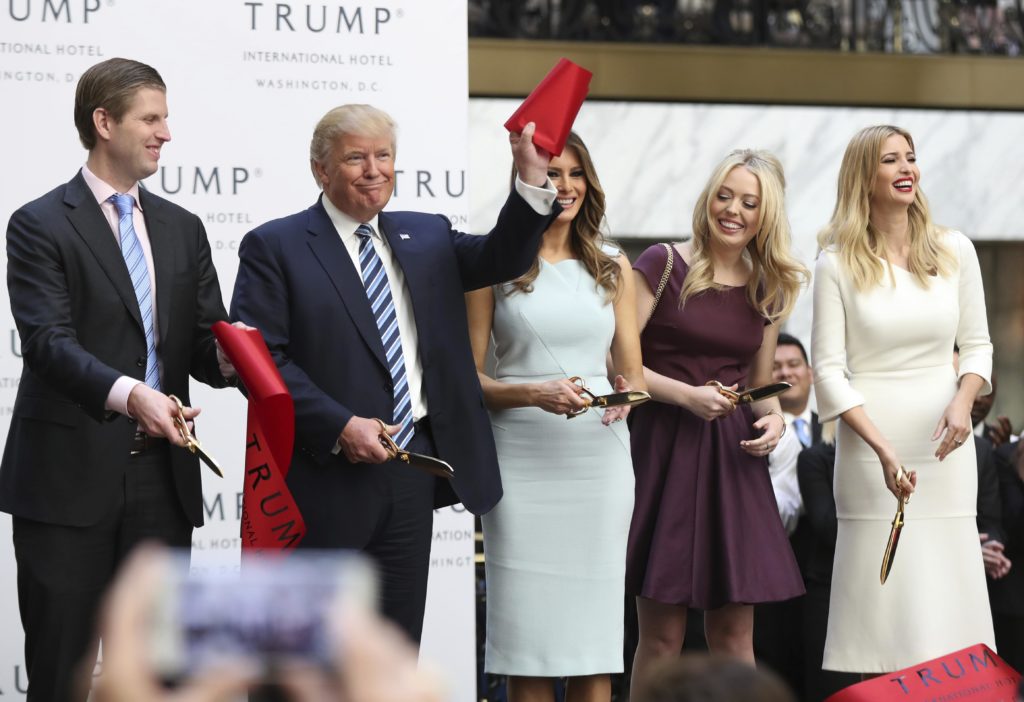
At a circular booth in the middle of the Trump International Hotel’s balcony restaurant, President Donald Trump dined on his steak — well-done, with ketchup — while chatting up British Brexit politician Nigel Farage. A few days later, major Republican donors Doug Deason and Doug Manchester, in town for the president’s address to Congress, sipped coffee at the hotel with Rep. Darrell Issa, R-Calif. After Trump’s speech, Treasury Secretary Steven Mnuchin returned to his Washington residence — the hotel — and strode past the gigantic American flag in the soaring lobby. With his tiny terrier tucked under an arm, Mnuchin stepped into an elevator with reality TV star and hotel guest Dog the Bounty Hunter, who particularly enjoyed the Trump-stamped chocolates in his room. It’s just another week at the new political capital of the nation’s capital. The $200 million hotel inside the federally owned Old Post Office building has become the place to see, be seen, drink, network — even live — for the still-emerging Trump set. It’s a rich environment for lobbyists and anyone hoping to rub elbows with Trump-related politicos — despite a veil of ethics questions that hangs overhead. “I’ve never come through this lobby and not seen someone I know,” says Deason, a Dallas-based fundraiser for Trump’s election campaign. For Republican Party players, it’s the only place to stay. “I can tell you this hotel will be the most successful hotel in Washington, D.C.,” says Manchester, adding that he would know because he has developed the second-largest Marriott and second-largest Hyatt in the world. Manchester says Trump’s hotel will attract people based on its location near the White House and Congress, the quality renovation and the management team. Then there’s also the access. Although Trump says he is not involved in the day-to-day operations of his businesses, he retains a financial interest in them. A stay at the hotel gives someone trying to win over Trump on a policy issue or political decision a potential chit. That’s what concerns ethics lawyers who had wanted Trump to sell off his companies as previous presidents have done. “President Trump is in effect inviting people and companies and countries to channel money to him through the hotel,” said Kathleen Clark, a former ethics lawyer for the District of Columbia and a law professor at Washington University in St. Louis. She said the “pay to play” danger is even greater than it would be if people wanted to donate to a campaign to influence a politician’s thinking. Spending money at a Trump property “is about personally enriching Donald Trump, who happens to be the president of the United States.” The White House strongly disputes there’s any ethical danger in Trump’s business arrangements. Trump can see his hotel from the White House. When a Fox News interviewer mentioned that to him recently, Trump responded, “Isn’t that beautiful?” But while the interviewer pointed out that he can see the property from his desk in the Oval Office, Trump said, “I’m so focused on what I’m doing here that I don’t even think about it.” Still, Trump couldn’t resist the short trip over there for dinner on his only weekend night out in Washington since becoming president. A reporter for the website Independent Journal Review was tipped off about Trump’s dining plans and sat at a table near him. He noted the president’s dinner fare and companions, who also included daughter Ivanka Trump and her husband, Trump adviser Jared Kushner. On other nights, the posh hotel is the kind of place where on a mid-February evening, you could bump into Trump television personality Katrina Pierson having cocktails with Lynne Patton, a former Trump Organization executive who’s now working at the Department of Housing and Urban Development. Trump campaign and inauguration hands Tom Barrack, Boris Epshteyn, Nick Ayers and Rick Gates are among the many who have stayed there in recent weeks. Rooms start at above $500 most nights, according to the hotel’s website and a receptionist. That’s up hundreds of dollars from when the hotel first opened, not long before Election Day. Patricia Tang, the hotel’s director of sales and marketing, declined to answer questions about how business is going. The hotel has become a staging area for big political events. Eric and Donald Trump Jr. posed for dozens of selfies with admirers at the hotel that bears their name before attending their father’s White House ceremony in late January to announce Judge Neil Gorsuch as the president’s pick for the Supreme Court. Deason ran into the Trumps and fellow Texas donor Gentry Beach while at a meeting at the hotel that day with Trump’s campaign adviser Rudy Giuliani. During inauguration week, when Trump himself repeatedly visited, the hotel was “literally the center of the universe,” Deason said. Last Tuesday, as Trump gave his first address to Congress, lobbyists and politicos watched the four large flat screens above the bar, two tuned to Fox news and two to CNN. In what hotel staff said was an effort to avoid some of the obvious politics of the place, the TVs were muted, so people followed along on their own devices. As Trump wrapped up, applause rose through the lobby and bar. Mnuchin waved to admirers gathered in the bar as he strolled through after Trump’s speech. Mnuchin is one of the New Yorkers working in Washington who call it home during the week. White House economic adviser Gary Cohn is another. Linda McMahon, who heads the Small Business Administration, also has been staying there. Administration officials “have been personally paying a fair market rate” for their accommodations, White House spokeswoman Lindsay Walters said. Even Trump’s closest friends pay to stay. Billionaire Phil Ruffin, Trump’s partner for his Las Vegas residential tower, said he shelled out $18,000 per night while he was in town for the inauguration, which he said surprised him since he’d given $1 million to Trump’s inauguration committee. Ruffin says he lightly complained about the high rate to the president.
Right to the end, Donald Trump campaign spent less than Hillary Clinton’s
Donald Trump‘s campaign spent about $94 million in its final push for the White House, according to new fundraising reports filed Thursday. The Republican continued his campaign-long trend of spending far less than Democratic rival Hillary Clinton. Her campaign blew through almost $132 million in its closing weeks, according to reports filed Thursday with the Federal Election Commission. The latest reports cover Oct. 20 through Nov. 28. Over the course of the primary and general elections, the Trump campaign raised about $340 million. That included $66 million that the billionaire businessman contributed from his own pocket. The Clinton campaign, which maintained a longer and more concerted fundraising focus, brought in about $581 million. Brad Parscale, Trump’s digital director who was empowered with spending decisions across the campaign, credited strategic last-minute investments with helping propel the political newcomer to victory. Specifically, he told The Associated Press, the campaign and Republican Party spent about $5 million in get-out-the-vote digital advertising targeted in the final few days to Michigan, Wisconsin, Pennsylvania and Florida. That proved critical; some of those states were won by razor-thin margins. “You think, what if we hadn’t spent that?” Parscale said. “We might not have won.” Another investment that he said paid dividends was $7 million to air a two-minute “closing” television commercial. “Our movement is about replacing the failed and corrupt political establishment with a new government controlled by you, the American people,” he said as images from his rallies rolled across the screen. The final FEC report showed the extent of the Trump advertising splurge. The campaign spent nearly $39 million on last-minute TV ads and another $29 million on digital advertising and consulting work done by Parscale’s firm. Clinton’s campaign placed a far greater emphasis than Trump on television advertising, a more traditional way of reaching swaths of voters. She spent $72 million on TV ads and about $16 million on internet ads in the final weeks. The former secretary of state also spent more than $12 million on travel — about double what Trump spent. Clinton, who not only had a money advantage over Trump but a staffing edge, spent more than $4 million on a nearly 900-strong payroll. Still, Clinton’s top campaign aides have acknowledged in post-election appearances that it didn’t always spend money in the right places. Her campaign manager Robby Mook said at a gathering of political strategists and journalists last week at Harvard University that he regretted not putting more staff in Michigan. When the state certified its results — 20 days after the election— Trump had won by just under 11,000 votes. Outside groups that spent money on the presidential election also filed reports Thursday. Trump got help from the super political action committees Future 45, Make America Number 1 and Rebuilding America Now. Future 45 and a partner nonprofit that does not disclose donors spent late in the campaign but became Trump’s biggest outside investors. Las Vegas casino magnate Sheldon Adelson and his wife, Miriam, together gave $10 million to Future 45 in the final weeks of the campaign, the new reports show. Former wrestling executive Linda McMahon, who Trump named this week as head of the Small Business Administration, gave $1 million to the group in October. She’d earlier given $6 million to Rebuilding America Now. Make America Number 1 benefited from a $1 million donation by PayPal co-founder Peter Thiel, now an executive on the Trump transition team. On Clinton’s side, Priorities USA — which raised and spent more than any super PAC in history — landed $16 million in the final weeks of the campaign. That brought its total haul to about $192 million. Some of the group’s final seven-figure contributions came from its most loyal donors: media mogul Haim Saban and investors James Simons and Donald Sussman. The 2016 election is over — but the fundraising continues. The president-elect has raised millions of dollars since Nov. 8. That money is coming in mostly through purchased merchandise such as hats and ornaments and is paying for Trump’s “thank you” tour, which took him to Ohio and Iowa on Thursday. Republished with permission of The Associated Press.
