
A swing state no more? GOP confidence grows in Florida
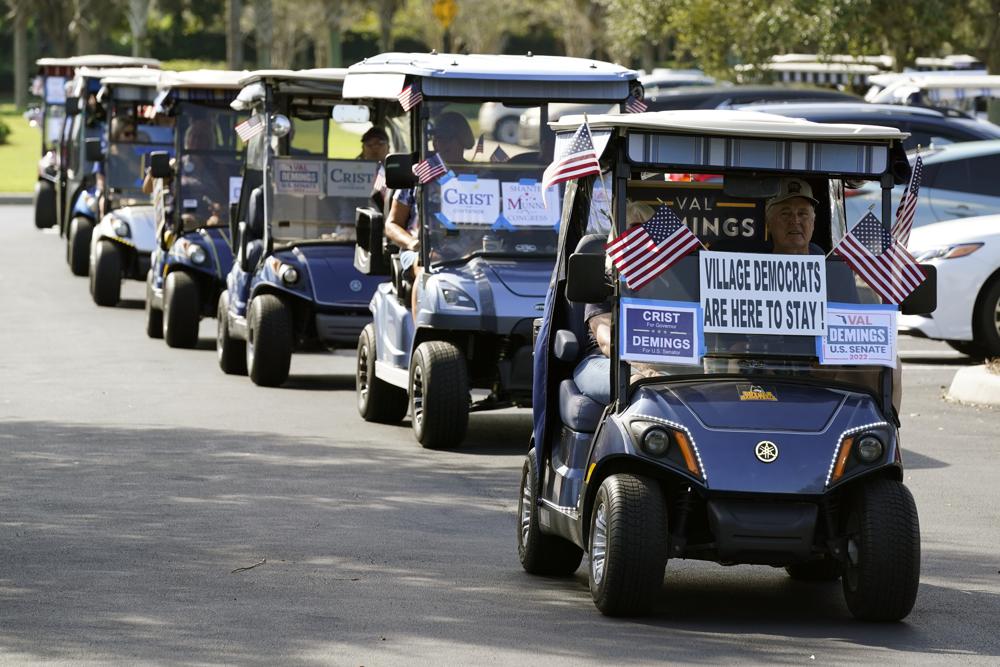
Democrats are increasingly concerned that Florida, once the nation’s premier swing state, may slip away this fall and beyond as emboldened Republicans capitalize on divisive cultural issues and population shifts in crucial contests for governor and the U.S. Senate. The anxiety was apparent last week during a golf cart parade of Democrats featuring Senate candidate Val Demings at The Villages, a retirement community just north of the Interstate 4 corridor. It was once a politically mixed part of the state where elections were often decided, but now some Democrats now say they feel increasingly isolated. “I am terrified,” said 77-year-old Sue Sullivan, lamenting the state’s rightward shift. “There are very few Democrats around here.” In an interview, Demings, a congresswoman and former Orlando police chief challenging Republican Sen. Marco Rubio, conceded that her party’s midterm message isn’t resonating as she had hoped. “We have to do a better job of telling our stories and clearly demonstrating who’s truly on the side of people who have to go to work every day,” she said. The frustration is the culmination of nearly a decade of Republican inroads in Florida, where candidates have honed deeply conservative social and economic messages to build something of a coalition that includes rural voters and Latinos, particularly Cuban Americans. Donald Trump’s win here in 2016 signaled the evolution after the state twice backed Barack Obama. And while he lost the White House in 2020, Trump carried Florida by more than 3 percentage points, a remarkable margin in a state where elections were regularly decided by less than a percentage point. President Joe Biden will visit the state on November 1, exactly one week before Election Day, to rally Democrats. Demings said she’s had two conversations with the president about campaigning together, but she could not confirm any joint appearances. And Charlie Crist, the Democratic nominee for governor, said he would attend a private fundraiser with Biden on the day of the rally, but he wasn’t sure whether they would appear together in public. “If we could squeeze in a little public airtime, that’d be a wonderful thing I would welcome,” Crist said in an interview. Still, the GOP is bullish that it can keep notching victories, even in longtime Democratic strongholds. Some Republicans are optimistic the party could carry Miami-Dade County, a once unthinkable prospect that would virtually eliminate the Democrats’ path to victory in statewide contests, including presidential elections. And in southwest Florida’s Lee County, a major Republican stronghold, not even a devastating hurricane appears to have dented the GOP’s momentum. In fact, Republicans and Democrats privately agree that Hurricane Ian, which left more than 100 dead, may have helped Republican Gov. Ron DeSantis broaden his appeal. On Monday, he’ll participate in a debate against Crist in which he’ll likely highlight his stewardship of the state during a searing crisis. But the 44-year-old Republican governor has spent much of his first term focused on sensitive social issues. He’s signed new laws banning abortions at 15 weeks of pregnancy with no exceptions for rape or incest, along with blocking critical race theory and LGBTQ issues from many Florida schools. He has also stripped millions of dollars from a major league baseball team that spoke out against gun violence and led efforts to eliminate Disney’s special tax status for condemning his so-called “Don’t Say Gay” bill. On the eve of the hurricane, DeSantis shipped dozens of Venezuelan immigrants from Texas to Martha’s Vineyard to call attention to illegal immigration at the U.S.-Mexico border. Crist, a former congressman and onetime governor himself, acknowledged some voters “dig” DeSantis’ focus on cultural issues, “but most Floridians are good, decent people.” He noted that at least one Hispanic radio host has compared DeSantis to former Cuban dictator Fidel Castro. “Customarily, when you come out of a primary, people will move to the middle. He’s clearly not doing that, to say the least,” Crist said of his Republican rival. But to the horror of many Democrats, DeSantis could become the first Floridian to win a governor’s race by more than 1 point since 2006. That kind of showing might lift Rubio in the U.S. Senate election while helping the GOP win as many as 20 of the state’s 28 U.S. House seats. Should DeSantis win big as expected, his allies believe he would have the political capital to launch a successful presidential campaign in 2024 — whether Trump runs or not. “It’s shocking, and it’s scary,” state Democratic Party Chair Manny Diaz said about DeSantis’ repeated willingness to use the power of his office to attack political rivals, whether individual opponents or iconic corporations like Disney. DeSantis, who declined an interview request, has found success by bucking the conventional wisdom before. He beat Democrat Andrew Gillum four years ago by 32,436 votes out of more than 8.2 million cast, a margin so narrow that it required a recount. But in the four years since then, Republicans have erased a voter registration advantage that Florida Democrats had guarded for decades. When registration closed for the 2018 election, Democrats enjoyed a 263,269-vote advantage. As of September 30, Republicans had a lead of 292,533 voters — a swing of nearly 556,000 registered voters over DeSantis’ first term. “We’re no longer a swing state. We’re actually annihilating the Democrats,” said Florida GOP Chairman Joe Gruters, a leading DeSantis ally. And while he says his party has focused on traditional kitchen-table issues, such as gas prices and inflation, Gruters leaned into cultural fights — especially the Florida GOP’s opposition to sexual education and LGBTQ issues in elementary schools — that have defined DeSantis’ tenure. “I don’t want anyone else teaching my kids about the birds and the bees and gender fluidity issues,” Gruters said. Strategists in both parties believe Florida’s political shift is due to multiple factors, but there is general agreement that Republicans have benefited from an influx of new voters since DeSantis emerged as the leader of the GOP resistance to the pandemic-related public health measures. Every day on average over the year between 2020 and 2021, 667 more people
College coaches, administrators urging players to vaccinate
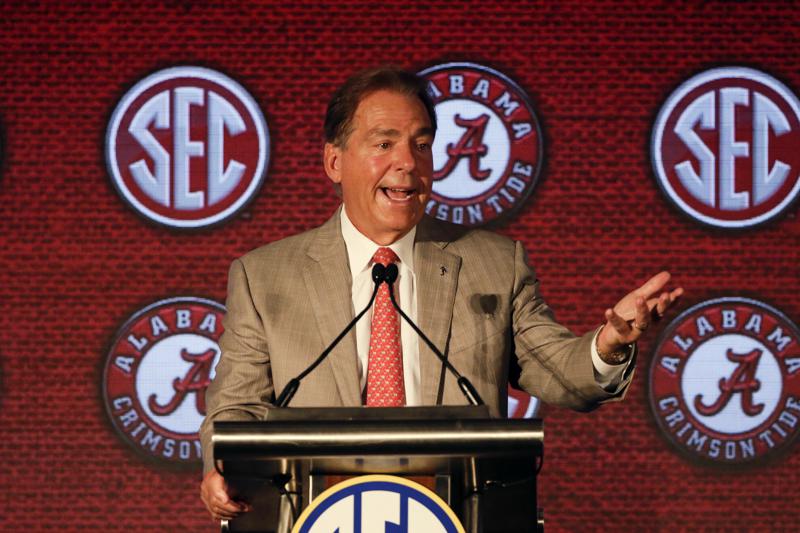
Over the summer, Crimson Tide coach Nick Saban urged his fellow Alabama residents to get vaccinated against the coronavirus in a public service announcement. The thinking was that one of the most popular people in Alabama might help since the state has one of the lowest percentages of vaccinated people in the nation. The video shows cheerleaders, the Big Al mascot, and scenes from Bryant-Denny Stadium with the unmistakable message: Protection against COVID-19 can help everyone get back to normal. It is also a point of emphasis for the defending national champion Crimson Tide and every other team hoping to minimize the risk of impacts from COVID-19 this season after last year’s disrupted effort that saw dozens of games postponed or canceled. It’s a priority and, in some cases, a challenge. Universities are struggling with whether they can legally require students to be vaccinated before returning to campuses, though Notre Dame, Michigan, UCLA, Washington, and others have taken that step. Many others, certainly across the South, have not, leaving coaches like Saban to emphasize that vaccination decisions are a personal choice but one that can impact the team. In the Southeastern Conference, Commissioner Greg Sankey said this week that six of the 14 football teams have at least 80% of their roster vaccinated — a number that ”needs to grow and grow rapidly.” The six teams include Alabama since Saban indicated “pretty close to 90%” of his players, are fully vaccinated, nearly triple the rate for the state’s overall population. Not every coach or program divulged their numbers at their respective leagues’ media days. The ones that did varied fairly widely. Oklahoma State coach Mike Gundy said his team was about 55% vaccinated as of six weeks ago. “I don’t know where we’re at now,” Gundy said last week. “But as an individual, they have to make a decision if that’s something they want to do. We all know the pros and cons of it.” The cons, besides personal health, include missing at least 10 days of practice and games in quarantine. And the chore of regular testing. Players who don’t get vaccinated likely face multiple COVID-19 tests weekly, just like last season. “I think that conflict of sticking something up your nose three times a week, all the headaches of wearing a mask, I think it wears people out,” Pitt coach Pat Narduzzi said. “I don’t want anything to do with it.” Coaches like Oklahoma’s Lincoln Riley and Saban can point to other sports to emphasize the potential impact of not getting vaccinated. Saban, who missed the game against rival Auburn last year after a positive COVID-19 test, points to the New York Yankees having six players recently sidelined by the coronavirus and North Carolina State having to drop out of the College World Series. “So every player has a personal decision to make to evaluate the risk of COVID relative to vaccine, and then they have a competitive decision to make on how it impacts their ability to play in games because with the vaccine you probably have a better chance,” Saban said. “Without it, you have a bigger chance that something could happen that may keep you from being on the field, which doesn’t enhance your personal development. Then how does it affect the team if you bring it to the team?” Riley said his team saw “a big uptick” in vaccinations after PGA Tour star Jon Rahm had to withdraw from The Memorial with a six-shot lead because of a positive COVID-19 test. “One day, a guy’s about to make a million and a half (dollars) and cruise to a six-shot victory,” Riley said. “And then all of a sudden, he’s out of there, and he’s vaccinated the next week.” He said, “a significant amount” of his team is vaccinated. “But, you know, the reality of the matter is we’re football coaches, and we’re football players,” Riley said. “And if you don’t get vaccinated, you’re going to be held to … a different standard, and you’re going to have the opportunity to lose games and not be available.” Georgia coach Kirby Smart had each of his vaccinated assistants talk to the team about their reasons for getting the shots. Smart said his team is “over 85%” vaccinated. “What it’s really about is being able to save our season, being able to keep our players safe,” he said. “We want to keep our coaches and staff safe. We want to keep our family members safe, and that comes through vaccinations.” Miami coach Manny Diaz didn’t mince words on the importance of players getting vaccinated. He said the Hurricanes, who open Sept. 4 against Alabama, will be above 85% vaccinated once some players get their second shot. “Whatever opinions we have are fine and dandy, but if you want to have a football team with as least disruption as possible, here’s a way to do it,” Diaz said. Atlantic Coast Conference Commissioner Jim Phillips said the league’s athletic directors discussed potential scenarios when a team might not be able to play a game. Sankey was clear that forfeits — not postponements, like last year — were on the table in the SEC this season: “That means your team needs to be healthy to compete, and if not, that game won’t be rescheduled.” Miami safety Bubba Bolden doesn’t like vaccines or taking medicine but made an exception this time. Bolden did say he understands why some teammates “are very against it.” “I was kind of against it,” he said. “And then I see some of my family members get it. And then, obviously, I didn’t want to miss a game due to COVID. I didn’t want to get any of my teammates sick. … So I got unselfish and decided to get it.” Republished with the permission of the Associated Press.
