
HUD Secretary Fudge announces $50 million grant to revitalize neighborhoods in Birmingham

On Wednesday, U.S. Department of Housing and Urban Development (HUD) Secretary Marcia Fudge came to Birmingham to announce a $50 million HUD Choice Neighborhoods Implementation (CNI) Grant to revitalize the Smithfield, College Hills, and Graymont neighborhoods. Fudge made the announcement at a press conference Wednesday morning, where she was joined by Congresswoman Terri Sewell (D-AL07), Birmingham Mayor Randall Woodfin, Housing Authority of the Birmingham District (HABD) President and CEO Dontrelle Young-Foster, as well as community members. The historic funding will be used to construct nearly one thousand mixed-income affordable housing units. “This is a truly exciting and historic day for the City of Birmingham!” said Rep. Sewell. “With this monumental $50 million grant from the Department of Housing and Urban Development, we will be able to revitalize the historic Smithfield, College Hills, and Graymont neighborhoods with new, affordable housing units. Not only will this project allow residents to live more comfortably and affordably, but it will attract millions in new investments. I want to thank Mayor Woodfin, the Housing Authority of the Birmingham District, and the Birmingham City Council for their collaboration on this important project. We are so grateful to Secretary Fudge for traveling to Birmingham and the entire Biden-Harris Administration for continuing to pour into our communities.” “This investment represents HUD’s commitment to creating new housing for Birmingham residents and communities across the country,” said HUD Sec. Fudge. “When we envision the future of public housing investment, we think of programs like Choice Neighborhoods. These awards promote the innovative collaboration needed to tackle the affordable housing crisis. A community-driven, whole-of-government approach to neighborhood revitalization is what leads to impactful changes in the neighborhoods that need it the most.” “This $50 million grant will be transformative for the Smithfield community and its residents,” said Mayor Woodfin on Facebook. “The City of Birmingham will match these grant funds with $35 million over 8 years.” “The City plans to purchase Parker High’s 11 surplus acres of land and make way for the construction of 350 new affordable multi-family units on that land,” Woodfin added. “An estimated 1,100 new affordable housing units will be built across the entire Smithfield community.” Woodfin said the “entire plan is estimated to generate $242 million in new economic activity in our community.” “The awarding of this grant has changed the destiny of our community,” Woodfin said. “With the support of the federal government and our local partners, we will wrap our arms around this area to create a new Smithfield, one that honors its rich legacy as well as being a pioneer for innovative neighborhoods for the future.” The $50 million in funding is part of a $370 million nationwide investment by the Biden Administration’s Department of Housing and Urban Development. HABD received the maximum possible award under the Choice Neighborhoods Implementation Grant Program, which helps revitalize and transform distressed public and/or assisted housing and neighborhoods across the country. The Housing Authority of the Birmingham District (HABD) and the City of Birmingham were awarded a $50,000,000 Choice Neighborhoods Implementation Grant for the Smithfield Court public housing property and surrounding Smithfield, College Hill, and Graymont neighborhoods. The City of Birmingham and the Housing Authority of the Birmingham District have led a community-driven effort to change the narrative for the Smithfield, College Hill, and Graymont neighborhoods. The resulting plan for neighborhood investment was written with input from residents and community stakeholders. Their plan aligns with other once-in-a-generation investments, including a $10.8 million Good Jobs Challenge grant from the U.S. Department of Commerce’s Economic Development Administration, a planned workforce/high-tech library hub, the University of Alabama at Birmingham’s Blazer Core’ City as Classroom,’ Live Health Smart Alabama expansion area programs, and 60 new for sale homes. Choice Neighborhoods hopes to build on this local momentum as part of a larger effort to transform these historic neighborhoods into areas of opportunity for generations to come. The Choice Neighborhoods Transformation Plan calls for redeveloping the 456 severely distressed public housing units that comprise the 88-year-old Smithfield Court. The new Smithfield Court will include 920 new mixed-income apartments for families and seniors, including a one-for-one replacement of the original public housing units. To connect with the author of this story or to comment, email brandonmreporter@gmail.com.
HUD Secretary Marcia Fudge to visit Birmingham today

U.S. Department of Housing and Urban Development (HUD) Secretary Marcia Fudge will visit Birmingham today to make a major announcement. She will be joined by Congresswoman Terri Sewell and Birmingham Mayor Randall Woodfin. Sec. Fudge is expected to announce a major federal investment in affordable housing and community development. “I look forward to welcoming Housing and Urban Development Secretary Marcia Fudge to the City of Birmingham this Wednesday and to participate in the major announcement and tour,” said Rep. Sewell. “I have been working with the City of Birmingham to address the housing needs in the Smithfield, College Hills, and Graymont neighborhoods. If awarded, this funding would be the catalyst for transformational change in the City of Birmingham.” Secretary Fudge is the 18th Secretary of the U.S. Department of Housing and Urban Development. Secretary Fudge served as U.S. Representative for the 11th Congressional District of Ohio from 2008 to March 9, 2021. She was a member of several Congressional Caucuses and past Chair of the Congressional Black Caucus. In 1999, Secretary Fudge was elected the first female and first African American mayor of Warrensville Heights, Ohio, a position she held for two terms. As a former mayor, Secretary Fudge has seen firsthand the need for economic development and affordable housing. She prioritized improving the City’s tax base and expanded opportunities for affordable housing. Secretary Fudge’s career in public service began in the Cuyahoga County Prosecutor’s Office, rising to the rank of Director of Budget and Finance. While the Birmingham-Hoover metropolitan area remains the largest metro area in the state, Birmingham itself has been in a long slow decline since its zenith at over 340,900 people in 1960. Today Birmingham has a population of just over 192,557. Fast-growing Huntsville is now the largest city in Alabama. Montgomery, though also in decline, has a slightly larger population than Birmingham. Recent annexation elections in Mobile mean that that city has vaulted into second place ahead of both Birmingham and Montgomery. Birmingham officials are eager to address the decaying housing problem as well as crime in order to stem the tide of migration out of the city limits. Fudge will join Woodfin, Sewell, and community leaders at a press conference to announce the expected federal investment in affordable housing for the city. They will also be joined by Dontrelle Young-Foster, President, and CEO of the Housing Authority of the Birmingham District (HABD), and Karen Lawrence, Smithfield Court Resident. The announcement is scheduled for 10:20 a.m. CT in the Smithfield Court Community. To connect with the author of this story or to comment, email brandonmreporter@gmail.com.
HUD Secretary heads to Birmingham to sell Joe Biden’s $1 trillion agenda
Housing and Urban Development Secretary Marcia L. Fudge will be in Birmingham to promote the Biden-Harris Administration’s Build Back Better agenda. The visit comes after the Senate approved a Joe Biden’s $1 trillion infrastructure plan. The plan includes investments in housing construction and rehabilitation, economic development, and community revitalization. The Build Back Better Plan has goals for subsidies that will enable the construction or repair of more than 1 million affordable rental housing units and funding to build and rehabilitate more than 500,000 homes for low- and middle-income homebuyers. Secretary Fudge will be joined by Birmingham Mayor Randall Woodfin, Rep. Terri Sewell, and Birmingham Housing Authority President David Northern Sr. The event will be held at 10 am on Wednesday at the Villas at Titusville in Birmingham. Also on the agenda is a roundtable on affordable housing and community revitalization with community leaders and a tour of Southtown Court public housing community at 2:45 pm. Fudge is the 18th Secretary of the U.S. Department of Housing and Urban Development. She served as U.S. Representative for the 11th Congressional District of Ohio from 2008 to March 2021. She was a member of several Congressional Caucuses and past Chair of the Congressional Black Caucus. I’m so excited to be joining Mayor @randallwoodfin to welcome HUD Secretary Marcia Fudge (@SecFudge) to Birmingham!! Follow along tomorrow as we discuss @POTUS’ plan to invest in affordable housing, revitalize our communities, and #BuildBackBetter!👏🏾 https://t.co/ArkRTIp40K — Rep. Terri A. Sewell (@RepTerriSewell) August 10, 2021
Joe Biden’s ‘Jobs Cabinet’ to sell infrastructure
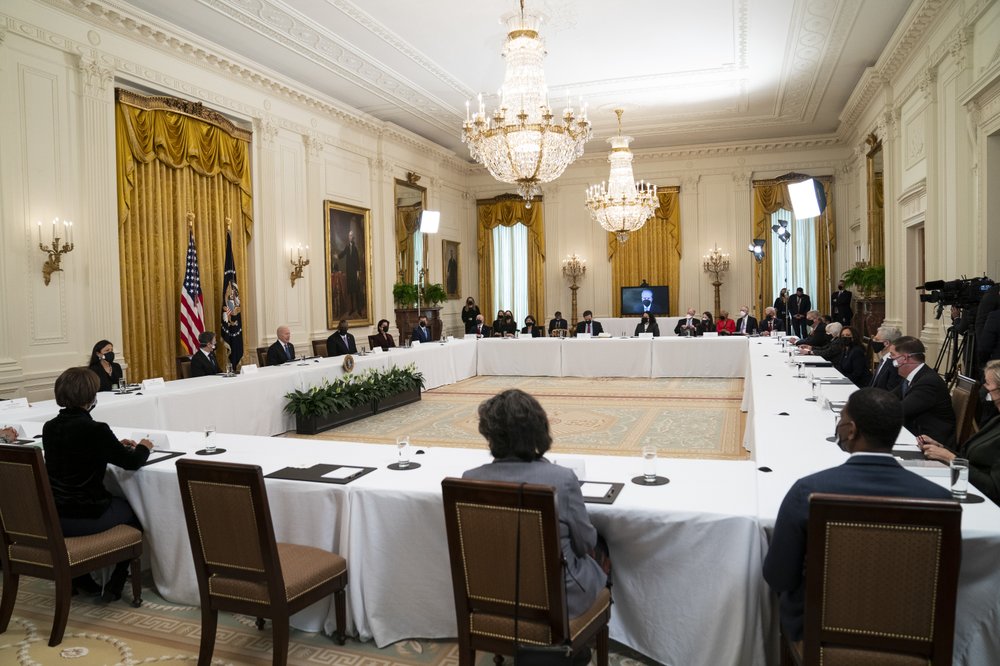
President Joe Biden set about convincing America it needs his $2.3 trillion infrastructure plan on Thursday, deputizing a five-member “jobs Cabinet” to help in the effort. But the enormity of his task was clear as Senate Minority Leader Mitch McConnell’s vowed to oppose the plan “every step of the way.” Speaking in Kentucky, McConnell said he personally likes Biden, and they’ve been friends a long time. But the president will get no cooperation from the GOP, which objects to the corporate tax increases in the plan and says they would hurt America’s ability to compete in a global economy. “We have some big philosophical differences, and that’s going to make it more and more difficult for us to reach bipartisan agreements,” the Republican leader said. White House chief of staff Ron Klain said the key to any outreach is that the proposal’s ideas are already popular. Americans want smooth roads, safe bridges, reliable public transit, electric vehicles, drinkable water, new schools, and investments in manufacturing, among the plan’s many components, he said. “We kind of think it’s just right,” Klain said in a televised interview with the news organization Politico. “But we’re happy to have a conversation with people, less about the price tag, more about what are the elements that should be in the plan that people think are missing.” Those conversations could be limited to Democrats as McConnell declared: “I’m going to fight them every step of the way.” Biden told his Cabinet at its first meeting that he is enlisting several of them to help with the push: Transportation Secretary Pete Buttigieg, Energy Secretary Jennifer Granholm, Housing and Urban Development Secretary Marcia Fudge, Labor Secretary Marty Walsh, and Commerce Secretary Gina Raimondo. “Working with my team here at the White House, each Cabinet member will represent me in dealings with Congress, engage the public in selling the plan and help organize the details as we refine it and move forward,” Biden said. The task will involve lots of salesmanship for a legacy-making piece of legislation that Biden announced in a Wednesday speech. His administration must sway Congress. It needs to rally voters. It’s also looking to outside economists to back the plan. It’s monitoring Wall Street for any celebrations or jitters. It’s forming alliances with advocates while dealing with critics of the plan’s corporate tax hikes and project details. And Biden’s administration also intends, per the plan, to cajole other nations to stop slashing their own tax rates in what has been a race-to-the-bottom to attract and retain multinational businesses. Biden’s vehicle for financing his infrastructure plans is a key dividing line. Republicans object to raising the corporate tax rate to 28% from 21%, one of the many changes so that business taxes would fund infrastructure. Republicans had cut the corporate rate from 35% in 2017, a hallmark policy achievement of Donald Trump’s presidency. Within Washington and corporate board rooms, the administration is attracting its share of accolades and rebukes on his proposal. In Biden’s own party, liberal Democrats in Congress want him to go bigger. And Democrats representing high-tax states want to remove a 2017 tax code change that limited deductions of state and local taxes for individuals. House Speaker Nancy Pelosi expressed no qualms about the proposal’s scope. “It was in the tradition of America — to think big,” Pelosi said at a press conference Thursday. “And now, in this century, President Biden is undertaking something in the tradition of thinking big, being transformational, and creating jobs for America.” While many leading business groups oppose the higher taxes, some major companies see reason for optimism because of the innovations that would be encouraged by the plan. Automakers Ford, General Motors, and Toyota endorsed the general concepts of Biden’s plan, which calls for the construction of 500,000 electric vehicle charging stations by 2030 in what would be a shift away from gasoline-powered cars. But some environmentalists said the plan’s shift away from fossil fuels that cause climate change was not substantial enough. “Biden has pledged to cut carbon emissions 50% and decarbonize our electricity sector, but this proposal won’t even come close,” said Brett Hartl, government affairs director at the Center for Biological Diversity. The White House was quick to address the climate change concerns. Climate adviser Gina McCarthy said the administration expects the infrastructure package to include Biden’s pledge to set a national standard requiring utilities to produce 100% carbon-free electricity by 2035. The proposed electricity standard “is going to be fairly robust, and it’s going to be inclusive,” McCarthy said. “I think we can get to the results that we’re looking for in a number of different ways. If a clean energy standard can be done, we think it should be done.’’ For every criticism of the plan’s details, there were also plaudits for its broader approach. Harvard University economist Larry Summers, a former treasury secretary, endorsed Biden’s plan after previously criticizing the $1.9 trillion coronavirus relief plan because of its size and debt-based financing. He downplayed any risks from corporate tax hikes since low-interest rates mean the costs of obtaining capital are already low for many companies. “I am excited,” Summers said on Twitter. “The economy’s capacity will go up.” The plan also carries a political dimension as organized labor is mobilizing to get the package passed, an important push given the steady recent Republican gains among working-class voters. Biden’s plan, with its focus on construction and manufacturing jobs, has the potential to reverse some of that slide — and the unions that backed him in 2020 are promising to help deliver votes on infrastructure. “Our members are an army a half-million strong, that will make calls, visit members of Congress and rally for good jobs building our nation’s infrastructure,” said Terry O’Sullivan, general president of Laborers International Union of North America, one of the largest construction trades unions. “We did it with boots on the ground to get President Biden elected.” Republished with the permission of the Associated Press.
In historic pick, Joe Biden taps Deb Haaland as interior secretary
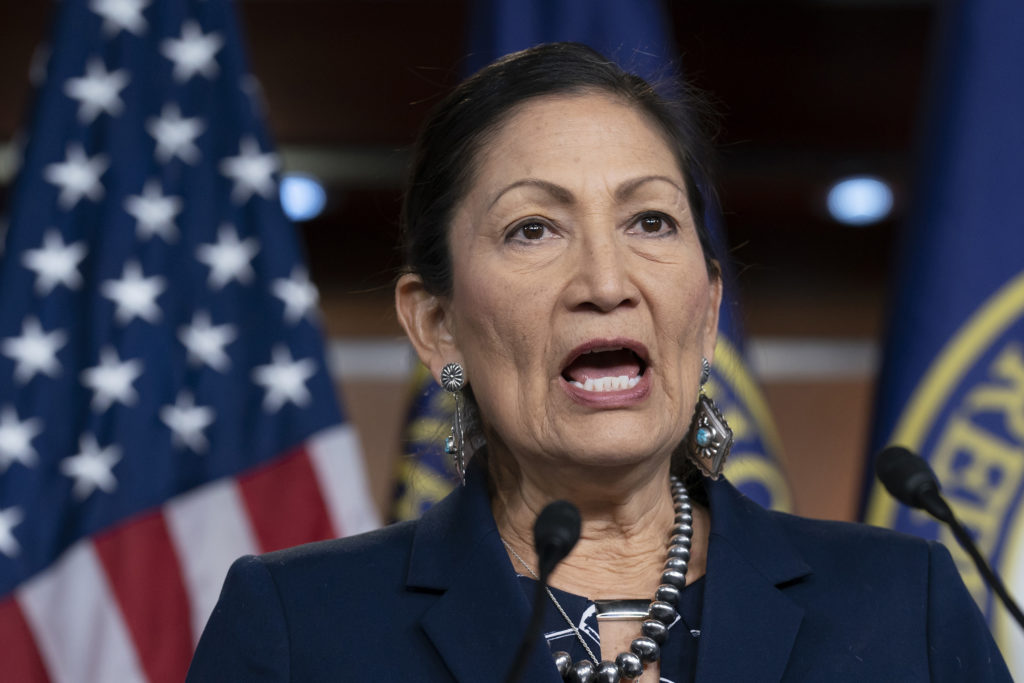
President-elect Joe Biden selected New Mexico Rep. Deb Haaland as his nominee for interior secretary on Thursday, a historic pick that would make her the first Native American to lead the powerful federal agency that has wielded influence over the nation’s tribes for generations. Tribal leaders and activists around the country, along with many Democratic figures, cheered Haaland’s selection after urging Biden for weeks to choose her to lead the Department of Interior. They stood behind her candidacy even when concerns that Democrats might risk their majority in the House if Haaland yielded her seat in Congress appeared to threaten her nomination. With Haaland’s nomination, Indigenous people will for the first time in their lifetimes see a Native American at the table where the highest decisions are made — and so will everyone else, said OJ Semans, a Rosebud Sioux vote activist who was in Georgia on Thursday helping get out the Native vote for two Senate runoffs. “It’s made people aware that Indians still exist,” he said. Haaland, 60, is a member of the Pueblo of Laguna and, as she likes to say, a 35th-generation resident of New Mexico. The role of interior secretary would put her in charge of an agency that has tremendous sway not only over the nearly 600 federally recognized tribes, but also over much of the nation’s vast public lands, waterways, wildlife, national parks, and mineral wealth. Haaland tweeted after the news was made public that “growing up in my mother’s Pueblo household made me fierce. “I’ll be fierce for all of us, our planet, and all of our protected land,” she pledged. Biden plans to introduce Haaland — and other picks for his Cabinet — at an event Saturday in Wilmington, Delaware. Her selection breaks a 245-year record of non-Native officials, mostly male, serving as the top federal official over American Indian affairs. The federal government often worked to dispossess Native Americans of their land and, until recently, to assimilate them into white culture. “You’ve got to understand — you’re taking Interior full circle,” said Arizona Rep. Raul Grijalva, chair of the House Natural Resources Committee and a champion of Haaland for the job. “For years, its legacy was the disenfranchisement of the Native people of this country, of displacement, of cultural genocide.” With Haaland’s nomination, “that in itself is a huge message,” Grijalva said. Navajo Nation President Jonathan Nez called it “truly a historic and unprecedented day for all Indigenous people.” “I am SO ELATED,” the head of progressive Democrats’ Sunrise Movement, Varshini Prakash, tweeted. “This will be the first time an Indigenous person – and a badass climate champion woman at that – will hold any presidential cabinet position. Congratulations to @JoeBiden for making history.″ Get-out-the-vote activists believe their efforts, and the Native vote, helped flip Arizona in particular for Biden and secure the presidency. “There’s a feeling something is changing,” said Ashley Nicole McCray, a member of the Absentee Kiowa tribe of Oklahoma and of an indigenous environmental coalition. “Finally, we’ve come to this point where Indigenous sentiment is no longer being silenced.” But Biden’s pick could further deplete, at least temporarily, the narrow majority Democrats maintain in the House. Biden has already selected several lawmakers from the chamber, including Louisiana Rep. Cedric Richmond and Ohio Rep. Marcia Fudge, to serve in his administration. Some on Biden’s transition team had expressed concerns about dipping further into the already thinned Democratic House majority for another senior administration posting. But Biden decided that the barrier-breaking aspect of her nomination and her experience as vice chair of the House Committee on Natural Resources made her the right pick for the moment. The president-elect has been methodically filling the posts in his Cabinet, adding North Carolina environmental official Michael Regan as his nominee to lead the Environmental Protection Agency. Biden introduced former South Bend, Indiana, mayor Pete Buttigieg earlier this week as his transportation secretary and announced Thursday that former Michigan Gov. Jennifer Granholm was his nominee for energy secretary. In a statement Thursday night, Biden said he had assembled a “brilliant, tested, trailblazing team” that “will be ready on day one to confront the existential threat of climate change.” “They share my belief that we have no time to waste to confront the climate crisis, protect our air and drinking water, and deliver justice to communities that have long shouldered the burdens of environmental harms,” the president-elect said. House Speaker Nancy Pelosi made it clear Wednesday that Biden had her blessing to choose Haaland, saying she would make an “excellent choice” as interior secretary. South Carolina Rep. James Clyburn, the No. 3 Democrat in the House and a close Biden ally, also supported Haaland for the job. Haaland is one of the first two Native American women in the House. She told The Associated Press before her nomination that see the difference her position in Congress made for ordinary Native Americans who came to her with business before the federal government. “They felt comfortable just launching into the issues they wanted,” Haaland told the AP in an interview before her appointment. They would say, for example, “Oh, we don’t have to explain tribal sovereignty to you,” meaning tribes’ constitutionally guaranteed status as independent nations. Haaland previously worked as head of New Mexico’s Democratic Party, as tribal administrator, and as an administrator for an organization providing services for adults with developmental disabilities. Born to a Marine veteran father and a Navy veteran mother, Haaland describes herself as a single mother who sometimes had to rely on food stamps. She says she is still paying off student loans after college and law school for herself and college for her daughter. New Mexico Sen. Tom Udall, who is retiring after 22 years in Congress and was initially considered the front-runner for interior secretary, congratulated Haaland on her selection, calling it “momentous and well-earned.’’ Previously, the highest-ranking administration official known to have Native American heritage was Charles Curtis, who served as Herbert Hoover’s vice president and whose mother was one-quarter Kaw tribe.
Nancy Pelosi has ‘candid’ talk with potential rival for speaker
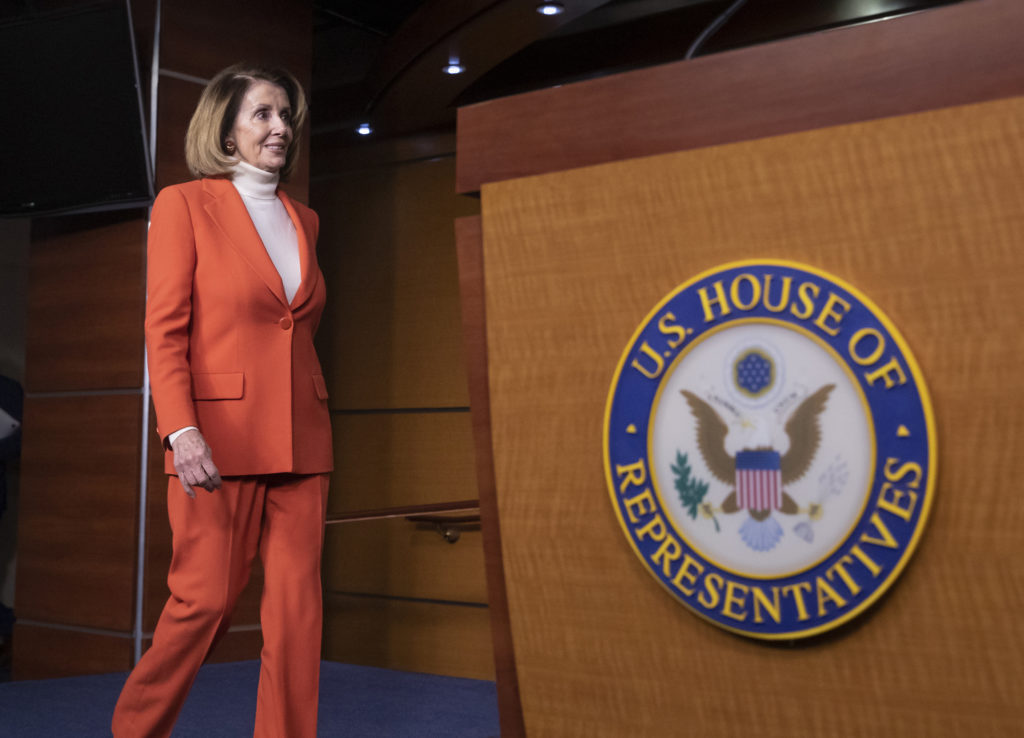
Nancy Pelosi met privately Friday with her top potential rival for House speaker, Rep. Marcia Fudge, as the Democratic leader works to gather support and fend off a challenge from a small but persistent group determined to stop her from reclaiming the gavel. Fudge said the two had “a very open and frank discussion,” including about “the feeling in the caucus of people who are feeling left out and left behind” and the need for a transition to new leadership. “We talked about some succession planning,” Fudge told reporters. “She did not share them with me. But I think it is something our caucus is interested in knowing.” The Democratic leader and the Ohio Democratic congresswoman met in Pelosi’s stately office, steps from the House floor, for about 45 minutes as lawmakers left town for the Thanksgiving recess without a resolution to the leadership struggle. “We had a candid and respectful conversation,” Pelosi said. Fudge said she shared with Pelosi “the growing support that I have and why I’m considering a bid to run for speaker.” Democrats are expected to take an internal caucus vote when they return after Thanksgiving and Fudge said she would decide by then if she is running. “To her credit, she wanted to know what my concerns were. We discussed them,” Fudge said. “What she asked me was, basically, how we could get to a point where I’m supportive.” If it was up to most of the Democratic Party, Pelosi would be the obvious choice to become speaker of the House in the new Congress, when Democrats have the majority. But within the ranks there’s a small but persistent group pushing to topple her return as the first woman with the gavel. Some say it’s time to give younger lawmakers a chance to rise. Pelosi, 78, made history when she became the first female speaker of the House in 2007. She assumed the post after Democrats took control of the House in midterm elections during former President George W. Bush‘s second term. She appears be winning the outside game for a return to the speakership, amassing endorsements from a who’s who of the nation’s Democrats: former Vice President Al Gore and former Secretary of State John Kerry. Inside the Capitol she has support from influential lawmakers, Rep. John Lewis, D-Ga., the civil rights leader, and Rep. Adam Schiff of California, who’s in line to chair the Intelligence Committee, among others. Most recently Pelosi got the nod from MoveOn.org as a coalition of liberals sound the alarm against an overthrow being orchestrated by mostly centrist Democrats who want to prevent the San Franciscan from being the face of the party. It noted her work passing the Affordable Care Act and tweeted: “Were it not for her skilled and effective leadership, the ACA would not be law today. Dems must reject attempts to defeat her and move caucus to the right.” The Congressional Progressive Caucus also met Thursday with Pelosi and emerged pleased with her commitment to boost their ranks on key committees and provide funding for lower-level leadership offices that set policy and communications for the caucus. The group has not yet endorsed anyone, but Rep. Pramila Jayapal, D-Wash., a co-chair of the caucus, said Democrats need a leader who can hit the ground running “to deliver real results.” The show of strength is a reflection on Pelosi’s 15-year tenure as party leader but also her place in history as the first woman to hold — and potentially return — to the speaker’s office after an election that ushered in a record number of women candidates. It’s not lost on supporters that a group made up of mostly men is leading the effort to oust her. On the list of 17 names who’ve signed onto a letter against her, just three are women. Pelosi’s opponents started rallying Thursday behind Fudge’s possible bid for the job, even though her potential campaign is splitting votes in the powerful Black Caucus. Fudge, recently re-elected to a 7th term, is an ally of Ohio Democratic Rep. Tim Ryan, who mounted an unsuccessful campaign against Pelosi two years ago and is a leader of the current effort to topple her. “The country needs to come together, our caucus needs to come together,” Ryan said. “We need to heal and Marcia Fudge is one of the people who could make that happen.” Pelosi has fended off challenges before, but this one — fueled by newcomers calling for change and frustrated incumbents who feel shut out of leadership after her many years at the helm — poses perhaps the biggest threat yet. With a narrow Democratic majority, now at about 230 seats, she does not have much cushion to secure the 218 votes needed on the floor if all Republicans vote against her, as expected. Some House races remain undecided and the Democratic majority could grow slightly. There is a chance the math could shift in Pelosi’s favor if lawmakers are absent or simply vote “present,” meaning she would need fewer than 218 votes for an absolute majority. The full chamber will elect the next speaker Jan. 3. Pelosi has said she has “overwhelming support” to become the next speaker. Republished with permission from the Associated Press.
