
Jeb Bush vs. Marco Rubio rivalry intensifies as Iowa caucuses draw closer
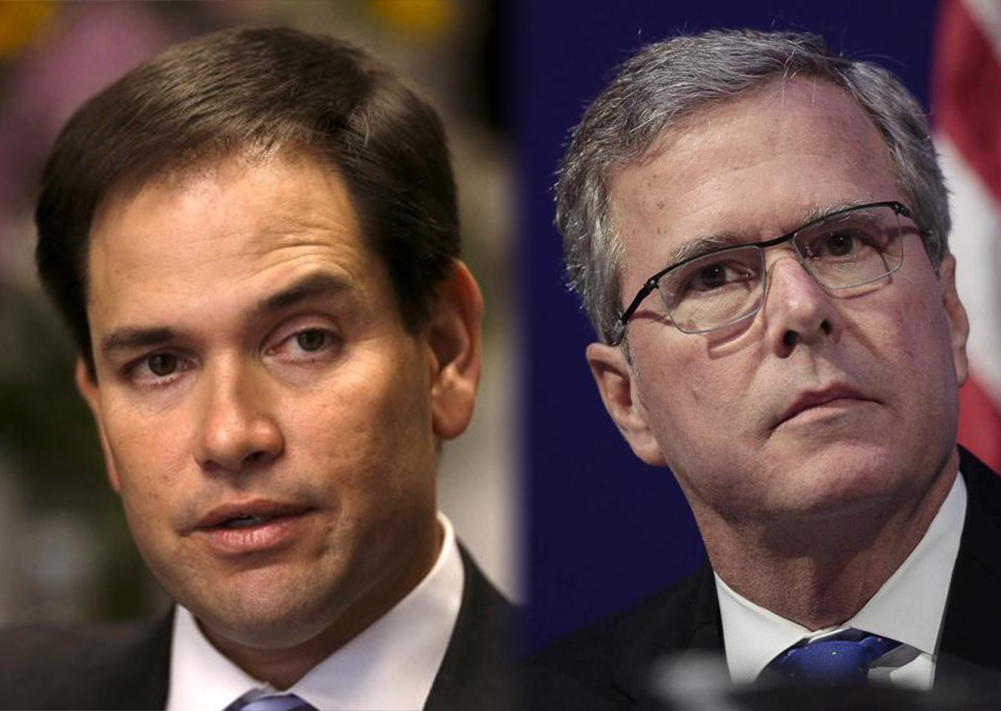
Neither Jeb Bush nor Marco Rubio emphasized the need to do well in Iowa in the early months of the 2016 presidential campaign. But that’s changed as their rivalry intensifies and pressure mounts to emerge from the Feb. 1 caucuses as the favorite among mainstream conservatives. Neither has visited Iowa as often as more socially conservative candidates such as Texas Sen. Ted Cruz, and both lack the star power of rivals billionaire Donald Trump and newcomer Ben Carson. But the key, unveiled by Bush in a donor conference and reinforced after Wednesday’s debate, is how they fare against each other, and Iowa is the first test. “They’re competing for the same segment of Iowa Republicans,” said former state party chairman Matt Strawn, who said that vote still “absolutely is up for grabs.” As a result, they are adding resources in the state and spending more time courting voters. Bush and Rubio were among 10 presidential candidates to appear at the Iowa Republican Party’s Growth and Opportunity forum, a tailgate-themed festival at the Iowa State Fairgrounds in Des Moines, and the last multicandidate event before the caucuses. Bush, a former Florida governor, was seen as a potential front-runner based on his early fundraising success. But he has failed to catch fire since this summer. Meanwhile, the younger Rubio has called for a new generation of leaders but has struggled to grab the national limelight. But at the Des Moines forum on Saturday, Rubio tried to capitalize on a strong showing at Wednesday night’s national debate and an increasing curiosity about him. Rubio told more than 1,000 Iowa GOP faithful that the nation is on the wrong path and assured them there “is a road that will allow us to be the freest and will allow us to leave our children better off,” he said. “To do that we must turn the page, and allow new leaders and new principles.” The jab at Bush, the 62-year-old son and brother of former presidents, is more subtle than Bush’s now outright battle with Rubio for missing Senate votes while campaigning for the White House, a criticism Bush raised during Wednesday’s debate. On Saturday, Bush again mentioned Rubio’s Senate attendance, with an Iowa twist: “If you’re elected to serve, you should do what Chuck Grassley does: You should show up to vote,” Bush said, referring to Iowa’s senior senator. To date, the better-funded Bush has invested more and earlier in a political organization, with at least 10 staffers in the state, as well as having as a senior national adviser David Kochel, a veteran Iowa GOP operative. Rubio, who has had a leaner operation, has 30 people working across the first four nominating states — Iowa, New Hampshire, South Carolina and Nevada. “I think Bush has an organizational advantage,” Iowa Republican Chairman Jeff Kaufmann said. “But I think Rubio has a momentum advantage. Also, I think he has an advantage coming out of the debate.” Now Rubio’s fundraising is also rising. Billionaire investor Paul Singer on Friday announced his support for Rubio in a letter to his extensive network of Republican fundraisers, encouraging them to follow his lead. Bush’s team views Rubio as his most dangerous competitor for voters and donors who want to see a traditional nominee. Wednesday night’s attack from Bush backfired. During a post-debate conference call, Bush’s team told supporters the debate did not go well and tried to reassure skittish donors the turnaround loomed ahead. After his speech, Rubio was mobbed by supporters and journalists. He shook hands, signed books and posed for photos for an hour, joking easily with the crowd. “Just make sure you’re here in February,” he said to a woman who told him she spends time in Florida. Bush’s stand decorated by hay bales offered cotton candy. But even Bush supporters acknowledge that he needs to improve his game. “I think he’s taken some hits because of poor debate performances,” said Don Pugsley, 68, of Des Moines. He also said Bush has given strong performances before smaller audiences in Iowa. Bush acknowledged amid pictures and autograph requests in a crush of supporters and reporters that he needs to improve debating. “I have enough humility to know that I’ve got to get better,” he told reporters. “I’m going to get better. I have enough self-awareness to know that.” Republished with permission of The Associated Press.
Unpopular at home, Bobby Jindal getting little traction for 2016
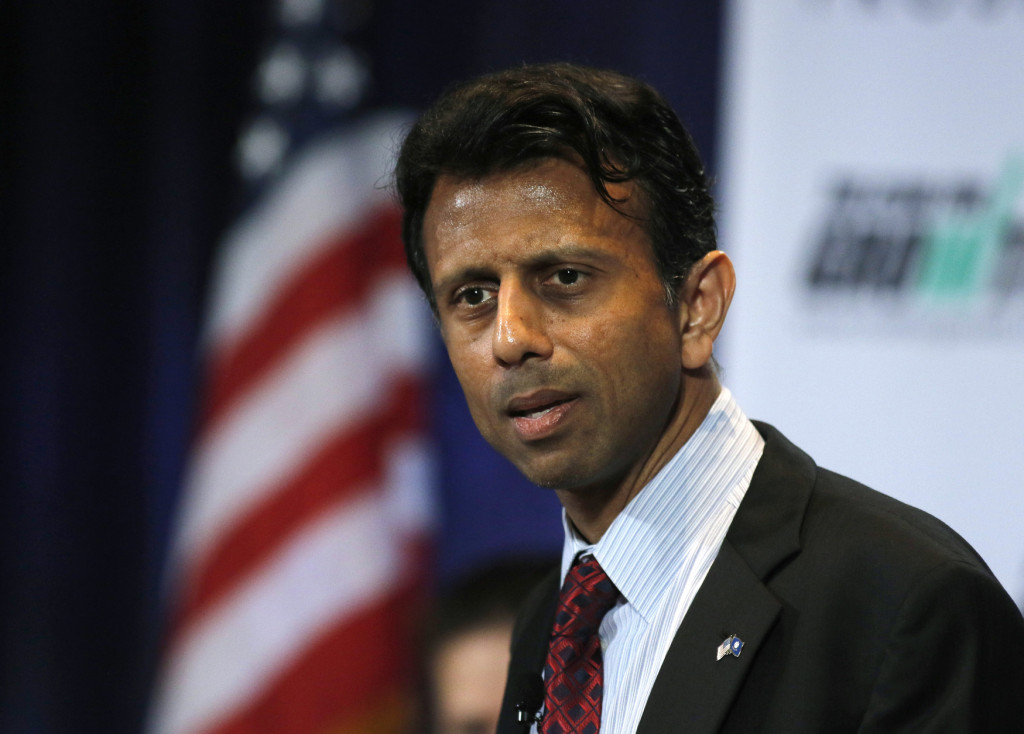
Republican Gov. Bobby Jindal‘s focus on states important in the presidential campaign is drawing lots of criticism at home and doing little apparent good for his 2016 prospects. Lost — at least for now — in a pack of better-known White House contenders, Jindal is taking heat in Louisiana for a $1.6 billion budget shortfall that threatens colleges and health care services with deep cuts. Lawmakers from both parties say his national political ambitions are a distraction. “People, I believe, would love to separate themselves from him,” said Republican state Sen. Robert Adley. Despite frequent travel, his attention to national issues, a good relationship with religious conservatives and plenty of sharp rhetoric against President Barack Obama, Jindal is making little impact in the Republican race. Even so, it’s early in the contest, and the term-limited governor is expected to announce a presidential bid after state lawmakers wrap up their Legislative Session in mid-June. He’s sent political aides to Iowa and recently announced hiring a political operative for New Hampshire. A Catholic convert raised by Hindu parents, Jindal has pivoted from his reputation as a policy wonk to make his religious beliefs the centerpiece of a possible White House campaign. He’s courted evangelical Christians through meetings with pastors and aggressively promoted “religious liberty” in speeches. So far, however, party leaders and key donors have been slow to embrace his national ambitions. And he’s competing for the religious conservative vote against more well-known contenders, like Texas U.S. Sen. Ted Cruz and former Arkansas Gov. Mike Huckabee. “The good news for Governor Jindal is he’s making a good impression with Iowa’s evangelical leaders,” said former Iowa Republican Party chairman Matt Strawn. “The bad news for Governor Jindal is that there’s about a half dozen candidates that are also trying to fish in that pond.” Among Louisiana residents, Jindal’s approval has dipped into the high 20s and low 30s in recent surveys. The governor suggests that’s because “reform is always controversial. Democracy is messy. “But the end result has been a stronger, more prosperous Louisiana for our children,” Jindal told lawmakers last week as the state’s annual Legislative Session began. Yet Jindal’s tax proposals have misfired with lawmakers, who are working on their own budget-balancing ideas in a state where the Legislature traditionally takes its lead on spending plans from the governor. Many South Carolina Republicans who turned out recently to hear Wisconsin Gov. Scott Walker and former Florida Gov. Jeb Bush said they are looking to governors as they decide on a 2016 candidate. Few mentioned Jindal among their top choices. Cary Powell, who works in financial services in Myrtle Beach, likes what Jindal has done in Louisiana and said, “I don’t know why he’s not taking off.” Jindal, said Norm Fay, a Massachusetts native who retired to South Carolina, is a “smart, good conservative.” But, “He can’t win.” Fay explained that he was referring to Jindal’s slight build, his mannerisms and his speaking delivery — all mocked in 2009 when Jindal delivered the GOP response to Obama’s first address to Congress. Matt Mackowiak, a Texas-based Republican strategist, said the Louisiana governor has time to gain traction. “I wouldn’t call it hopeless. The race is still wide open,” he said. But: “Almost everyone in the field is more well-known than he is. Is it an uphill battle? Yes.” Mackowiak said Jindal needs to make more visits to Iowa after Louisiana’s Legislature wraps up its work in two months. More frequent trips, though, risk exacerbating tensions back home. Jindal has been away from Louisiana 45 of the first 100 days of this year, according to an Associated Press tally. His absenteeism is so frequent it sparked an April Fool’s joke from Republican state Sen. Dan Claitor, who tweeted April 1: “Bobby spotted at the Capitol. (April Fool).” Overseas travel has also raised eyebrows. He drew widespread criticism for a London speech in which he repeated heavily disputed claims that Muslims have established “no-go zones” in European neighborhoods that operate outside of local civic control. Even Republicans running to succeed him as governor have picked up on the perception that Jindal has governed Louisiana as if it’s a platform for the White House. One candidate, Republican Sen. David Vitter, said if elected governor, “I’m not going to worry about what national political groups think.” Republished with permission of The Associated Press.
