
Native American health clinics offering vaccine to visitors
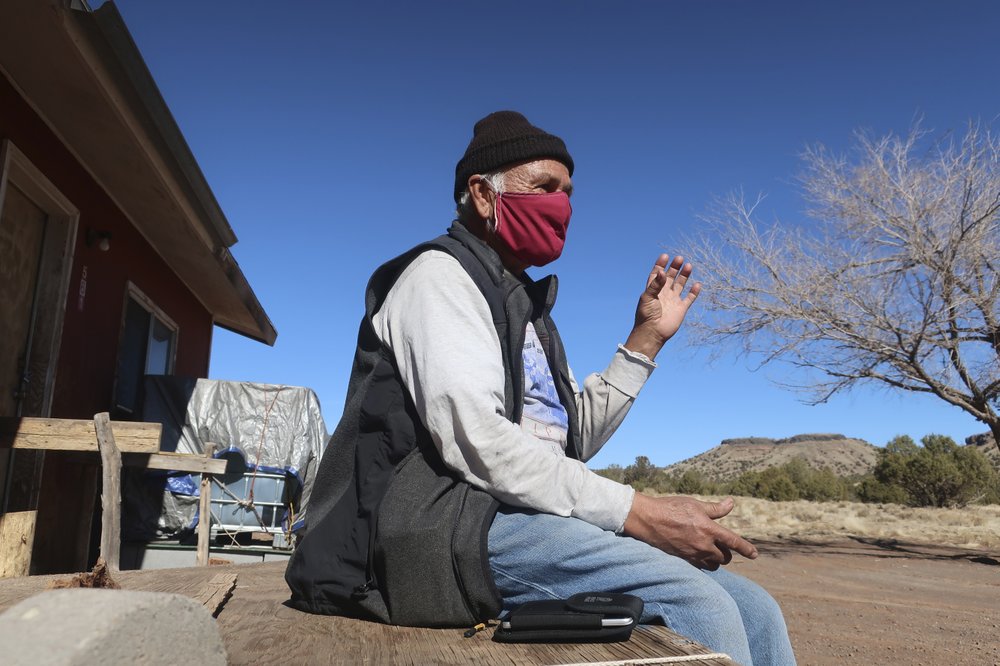
The Indian Health Service announced Monday that it is shifting its vaccine distribution system to target individual hospitals and clinics with high demand for shots and taper supplies to hubs where most eligible patients have received doses. The U.S. agency is part of a two-pronged national effort to immunize Indigenous communities that also relies on state health agencies. Native Americans have been disproportionately sickened and killed by the pandemic, and are also now at the forefront of federal efforts to deploy vaccine shots in the United States. Dr. Matthew Clark, a safety and monitoring specialist with the agency’s vaccine task force, says that the new distribution model “is intended to improve efficiency by allowing locations with high demand and sufficient capacity to receive additional doses and facilities where the majority of eligible individuals have already been vaccinated to receive only the doses they need.” Additionally, most Indian Health Service facilities are beginning to offer vaccines to the general population after successfully immunizing vulnerable tribal members. It’s a push toward so-called herd immunity that still depends on development of a vaccine for children. Older teenagers already are the focus of some vaccination efforts in scattered Native American communities. “Many sites have prioritized their 16- and 17-year-olds for the Pfizer vaccine in an attempt to get kids vaccinated and return to school,” said Dr. Julianna Reece, chief medical officer for the Albuquerque-area Indian Health Service that covers portions of New Mexico, Colorado, Texas, and Utah. The Indian Health Service has administered more than 940,000 total vaccine doses across the U.S. and plans to hit the million-dose mark before April. “As we have been successful in vaccinating the high-risk groups, there are a lot of local sites that have been able to expand access to vaccination to include those with close social and economic ties with our tribal communities,” Clark said in a media briefing by telephone. “This is an important part of our effort to achieve community immunity.” More than 80,000 people in the Indian Health Service’s Navajo-area unit have been fully vaccinated since the pandemic began. The service unit primarily covers the Navajo Nation in Arizona, New Mexico, and Utah, and the San Juan Southern Paiute Tribe. Other Native Americans and non-Natives also receive service at the Navajo-area health facilities. Loretta Christensen, chief medical officer for the Navajo-area, said nearly 50% of the eligible patient population has received a complete course of two vaccination shots. She said the goal is to reach 80% of the eligible population with initial vaccine doses in April. The Indian Health Service also is stepping up efforts to monitor the trajectory of the virus in many areas with the distribution of rapid home test kits at no cost to users, starting later this week. The agency has been submitting COVID-19 positive test samples from the Navajo area to identify potentially dangerous variants of the coronavirus. Republished with the permission of the Associated Press.
Alabama Policy Institute creates judicial support system, ACLL

Birmingham’s conservative nonprofit group the Alabama Policy Institute (API), announced the launch of the Alabama Center for Law & Liberty (ACLL). The ACLL will serve as API’s legal arm and help defend API’s policies in the courts. Founded in 1989, API is an independent, nonprofit group that researches and advocates for conservative policies, including defense of free markets, limited government, and strong families. However, the group much defend those policies in the courts. The ACLL will be the voice in the judicial system. Matthew Clark will serve as the Executive Director of ACLL. After graduating from Liberty University School of Law, he worked on the Alabama Supreme Court as a staff attorney. Since 2016 he has worked at the Foundation for Moral Law in Montgomery. Clark stated, “It is a great honor to serve as the ACLL’s first Executive Director. My vision for the ACLL is to ensure that Alabama remains an outpost of freedom in the United States by defending our constitutional rights in the courtrooms.” When asked about protecting limited government, Clark commented, “On the federal level, Congress is considering dangerous legislation, such as the Equality Act and the For the People Act, which would rob the people of freedom of conscience and the right to election integrity. On the state level, while we agree that COVID-19 is dangerous, we also believe that it is dangerous to let one person make all the decisions on how to deal with the crisis instead of letting the people’s representatives make the decisions. And on the local level, the ACLL is concerned about the Alabama cities that have enacted SOGI ordinances that force Christian small business owners to choose between their livelihoods and their consciences.” “The ACLL stands ready to defend Alabamians who have had their constitutional rights infringed, in hopes that Alabama remains an outpost of freedom in the United States,” Clark concluded. Phil Williams, Chief Policy Officer for the Alabama Policy Institute, posted on Twitter, “Very excited to announce that @alabamapolicy Institute just launched the Alabama Center for Law & Liberty! We’re going to fight for conservative values in every venue, including the Courts!” Very excited to announce that @alabamapolicy Institute just launched the Alabama Center for Law & Liberty! We're going to fight for conservative values in every venue, including the Courts! #alpolitics @AlabamaLaw https://t.co/pKqUYpBpzV — Phil Williams (@SenPhilWilliams) March 22, 2021
