
Rep. Mike Rogers and colleagues comment on Russia’s de-ratification of Nuclear Test Ban Treaty
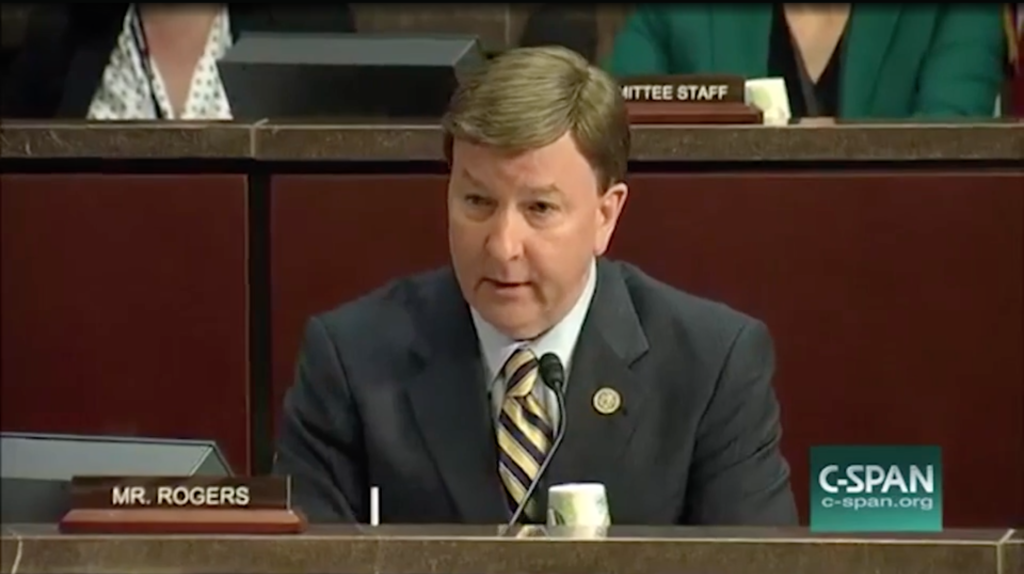
On Tuesday, Russia announced that Russia has de-ratified the Comprehensive Nuclear Test Ban Treaty (CNTBT). Congressman Mike Rogers (R-AL03) and senior GOP Armed Services Leadership members released a statement in response to the Russian announcement. “Russia’s ‘de-ratification’ of the Comprehensive Nuclear Test Ban Treaty lays bare Putin’s disdain for anything that might interfere with his nuclear ambitions,” Rogers and the other Congress members wrote. “The CTBT, rejected by the Senate in 1999, is a hollow, fatally-flawed regime. Despite this obvious truth, the Biden administration continues to waste time and money looking for ways to prop up this irrelevant treaty in hopes of reducing the role of nuclear weapons in U.S. defense. The administration should not allow a single additional U.S. taxpayer dollars to go towards implementing ineffective agreements. Instead, it should focus on holding our adversaries accountable for their actions and modernizing an aging nuclear deterrent that is increasingly not fit for the growing 21st-century threats.” In addition to Rogers, the letter was also signed by House Foreign Affairs Committee Chairman Michael McCaul (R-Texas), Senate Armed Services Committee Ranking Member Roger Wicker (R-Mississippi), and Senate Foreign Relations Committee Ranking Member Jim Risch (R-Idaho). The House Armed Services Committee said Russia’s “de-ratification” of the CTBT is the latest in a series of Russian moves that demonstrate just how ineffective the treaty has been in curbing Putin’s nuclear ambitions. Rogers claims that Russia consistently ignores the primary purpose of the agreement, conducting multiple nuclear tests at the Novaya Zemlya Test Site to inform its development of new and novel nuclear weapons. Rogers also accused Moscow of exploiting its control of the CTBT’s International Monitoring System by deactivating radiation sensors to hide evidence of a failed test of its dangerous SKYFALL nuclear-powered cruise missile. Rogers claimed that even with these actions, the Biden administration continues to waste taxpayer money looking for ways to prop up the treaty, which failed Senate ratification in 1999. Rogers claims that these efforts have amounted to nothing more than attempts to undercut support for our Department of Defense and Department of Energy efforts to rebuild our aging deterrent as well as signal to our adversaries that we will ignore their violations of arms control agreements to the detriment of our own national security. Rogers said that the administration’s actions come at a uniquely dangerous time, highlighted by the bipartisan Congressional Commission on the Strategic Posture of the United States’ conclusion that the U.S. faces “the unprecedented existential challenge of facing two nuclear-armed peer adversaries.” Rogers is in his eleventh term representing Alabama’s Third Congressional District. To connect with the author of this story or to comment, email brandonmreporter@gmail.com.
House committee chairman Michael McCaul says Sen. Tommy Tuberville is ‘paralyzing’ the Pentagon by blocking promotions
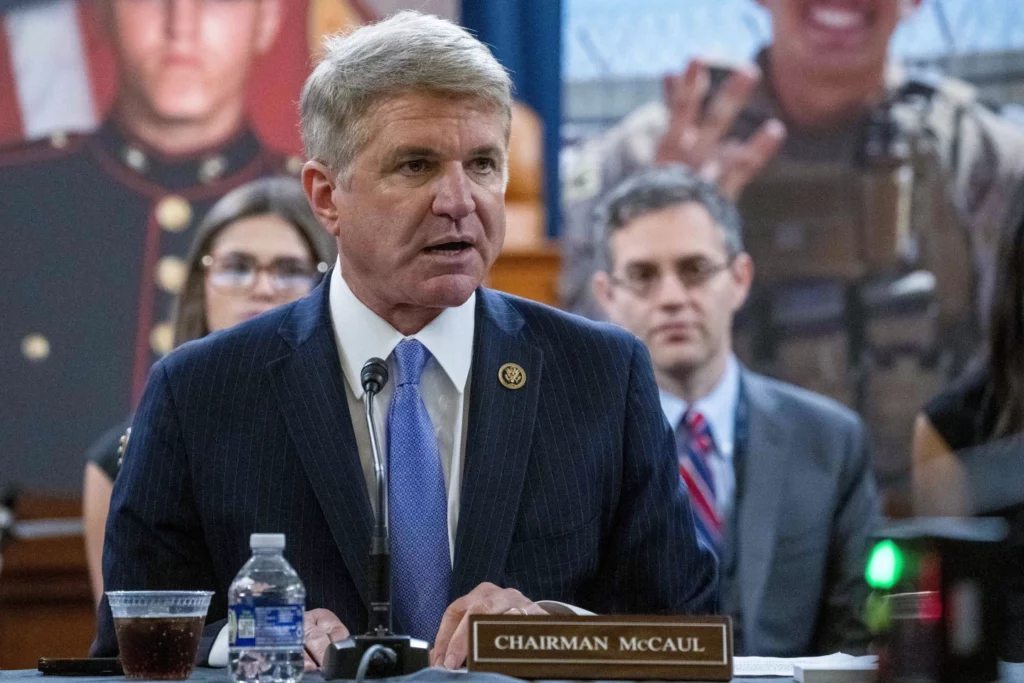
The chairman of the House Foreign Affairs Committee is slamming a fellow Republican in the Senate for waging an unprecedented attempt to change Pentagon abortion policy by holding up hundreds of military nominations and promotions. Rep. Michael McCaul, R-Texas, told CNN’s “State of the Union” on Sunday that Alabama Sen. Tommy Tuberville is “paralyzing the Department of Defense.” “The idea that one man in the Senate can hold this up for months, I understand, maybe promotions, but nominations,” McCaul said. He added, “I think that is a national security problem and a national security issue. And I really wish he would reconsider this.” Tuberville’s move has forced less experienced leaders into top jobs and raised concerns at the Pentagon about military readiness. Defense officials say Tuberville is jeopardizing American national security. Senators in both parties, including Republican leader Mitch McConnell of Kentucky, also have criticized Tuberville. Tuberville has refused to budge, saying will not drop the holds unless majority Democrats allow a vote on the policy. Democrats argue that a vote for every nominee could tie up the Senate floor for months, and they do not want to give in to Tuberville’s demands and encourage similar blockades of nominees in the future. McCaul said on CNN that the House would be tackling the issue of abortion in the military as part of a sweeping defense spending bill making its way through Congress. In the meantime, he said, “To hold up the top brass from being promoted and lower brass, I think, is paralyzing our Department of Defense.” Republished with the permission of The Associated Press.
Rep. Mike Rogers says that the U.S. will not be intimidated by China and Russia
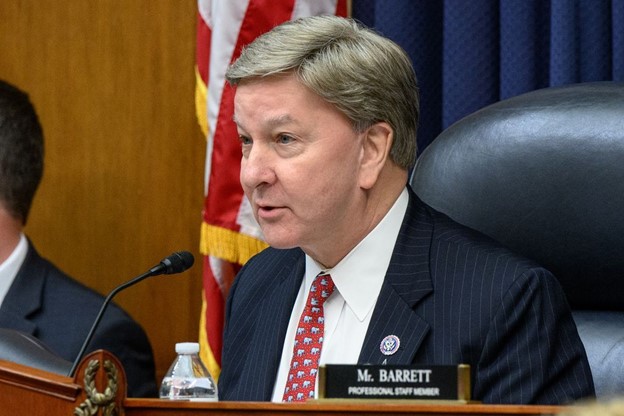
Congressman Mike Rogers (R-AL03) released a statement on China and Russia’s continued cooperation – including a recent joint naval patrol near Alaska. “Continued cooperation between China and Russia is a stark reminder of the challenge we face: for the first time in history, the United States must deter two near-peer nuclear adversaries simultaneously,” Rogers said. “It’s clear that China and Russia’s recent naval patrol was meant to intimidate the United States. By investing in the modernization of our nuclear deterrent, the bedrock of U.S. national security, the FY24 National Defense Authorization Act sends a strong message to both China and Russia: The United States cannot be intimidated.” The 2024 NDAA increases the amount of money the United States spends on nuclear weapons by 110% over FY2023 to $32 billion. China has passed the United States as the largest Navy in the world. “While this administration dithers, the CCP is rapidly growing and modernizing its navy,” Rogers said. “It already controls the largest Navy in the world. Our fleet of 296 ships was eclipsed years ago by a Chinese fleet of over 350 ships. In two short years, the DoD predicts the CCP will control over 400 battle force ships. I don’t understand how this administration can conclude reducing the size of our fleet will somehow deter China.” China has also passed the U.S. in the number of ICBM launchers deployed – though the U.S. has a larger total number of warheads. “The head of U.S. Strategic Command has informed us that China has surpassed the U.S. in the number of ICBM launchers – this should serve as a wake-up call for the United States,” Rogers and other congressional leaders wrote. “It is not an understatement to say that the Chinese nuclear modernization program is advancing faster than most believed possible. We have no time to waste in adjusting our nuclear force posture to deter both Russia and China. This will have to mean higher numbers and new capabilities.” Russia’s recent invasion of Ukraine and Russian President Vladimir Putin’s increased belligerence has effectively ended the three decades of peaceful relations between Russia and the West following the collapse of the USSR. “Putin’s unprovoked, full-scale invasion of Ukraine has lasted a year too long,” Reps. Rogers, Michael McCaul, and Mike Turner wrote. “The people of Ukraine have shown unmatched strength and courage, and with the aid of Western weaponry, they have decimated Russia’s war machine. In supporting Ukraine’s fight, House Republicans have also continued to conduct robust oversight of U.S. assistance – protecting the American taxpayer while ensuring these weapons continue to make an impact on the battlefield.” China President Xi Jinping meanwhile has been open about his own territorial ambitions toward Taiwan. President Joe Biden has said that the U.S. would intervene militarily if China were to invade Taiwan, saying the burden to protect Taiwan is “even stronger’ after Russia’s invasion of Ukraine. It was one of the most forceful presidential statements in support of self-governing in decades. Mike Rogers is the Chairman of the House Armed Services Committee that is tasked with writing the House version of the NDAA. Rogers is in his eleventh term representing Alabama’s Third Congressional District. To connect with the author of this story or to comment, email brandonmreporter@gmail.com.
Rep. Mike Rogers and colleagues warn that Russians are helping China obtain plutonium
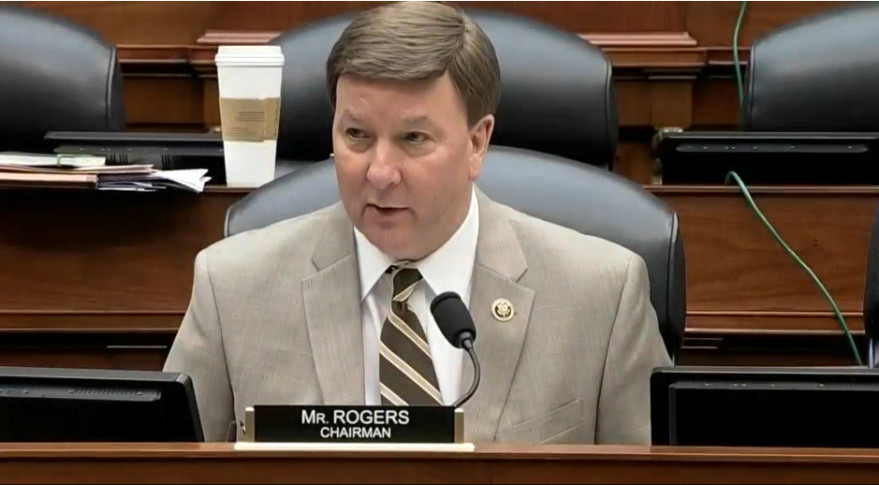
On Thursday, House Armed Services Committee Chairman Mike Rogers, House Foreign Affairs Committee Chairman Michael McCaul, and House Permanent Select Committee on Intelligence Chairman Mike Turner urged National Security Advisor Jake Sullivan, Secretary of State Antony Blinken, Secretary of Defense Lloyd Austin, Secretary of the Treasury Janet Yellen, Secretary of Energy Jennifer Granholm, Secretary of Commerce Gina Raimondo, and Director of National Intelligence Avril Haines, to utilize the full application of sanctions, export controls, and diplomacy, to hinder the nuclear cooperation between Russia’s Rosatom and China. In the letter, Rogers and the other Chairmen wrote, “Russia’s state-owned nuclear energy corporation, Rosatom, is helping the People’s Republic of China (PRC) acquire enough weapons-grade plutonium to fuel its strategic nuclear breakout. Beyond fueling the PRC’s strategic nuclear breakout, then-U.S. Strategic Command commander Admiral Charles Richard called “breathtaking,” Rosatom helps fuel Putin’s war efforts in Ukraine. We call on the Administration to view this cooperation for what it is, a direct threat to U.S. security and more evidence that Russia and China are working in tandem against the United States. The Administration should use all tools at its disposal to stop Rosatom and the PRC’s dangerous cooperation.” “Despite these malign activities, Rosatom’s position in the global market is only getting stronger,” Rogers et al. wrote. “The longer we wait to act, the more difficult it will be to address Rosatom’s nefarious and malign dealings. Putin uses these funds to fund his war machine and keep his favorite weapons programs on schedule. In short, every dollar and euro that Rosatom brings in directly finances the death and destruction we see in Ukraine, China’s nuclear weapon expansion, and is a direct threat to the American way of life.” The chairmen say in the letter is based on “Our classified correspondence from earlier this year.” “Russia’s role in China’s nuclear energy program is well documented,” the Chairmen wrote. “Rosatom opened an office in Beijing in 2016 and partnered extensively with the PRC’s China National Nuclear Corporation (CNNC) on major projects worth billions. On May 19, 2021, Xi Jinping and Vladimir Putin tuned in via video link to witness the commencement ceremony of two of the countries’ major nuclear energy cooperation projects, the Tianwan Nuclear Power Plant and Xudabao Nuclear Power Plant.” “Rosatom now appears to be supplying equipment and highly enriched uranium (HEU) for the PRC’ CFR-600 sodium-cooled fast breeder nuclear reactors, which will produce plutonium, fissile material critical to the PRC’s nuclear breakout,” the Chairmen wrote. “Russian deliveries of HEU to the PRC are slated to begin this year. The Department of Defense’s 2022 report to Congress on the Military and Security Developments Involving the People’s Republic of China noted the key role that increased weapons-grade plutonium production is key to the PRC nuclear program, stating: “The PRC is also supporting this expansion by increasing its capacity to produce and separate plutonium by constructing fast breeder reactors and reprocessing facilities.” The DoD report also cites the CFR-600 reactors and notes that each will be capable of producing “enough plutonium for dozens of nuclear warheads annually.” This buildup puts the PRC in violation of Article VI of the NPT, requiring states to make good-faith efforts to cease an arms race and to engage in good-faith arms control negotiations. Make no mistake, the PRC and Russia’s actions constitute an acceleration of their ongoing arms race.” According to the U.S. Intelligence National Threat Assessment, “China is building hundreds of new ICBM silos.” “Moscow continues to develop long-range nuclear-capable missile and underwater delivery systems meant to penetrate or bypass U.S. missile defenses,” said the report. “Russia is expanding and modernizing its large, diverse, and modern set of nonstrategic systems, which are capable of delivering nuclear or conventional warheads because Moscow believes such systems offer options to deter adversaries, control the escalation of potential hostilities, and counter U.S. and allied conventional forces.” In response to China and Russia’s modernization of their strategic forces, including the development of hypersonics, the U.S. is rushing to deploy hypersonics. The U.S. Air Force is expected to deploy Air-launched Rapid Response Weapon, a boost-glide vehicle, as soon as this fall. Russia has begun deploying its conventionally armed Kinzhal hypersonic missiles in Ukraine. Kyiv says that it is unable to defend itself against the strikes. Rogers is in his eleventh term representing Alabama’s Third Congressional District. To connect with the author of this story or to comment, email brandonmreporter@gmail.com.
Mike Rogers and colleagues comment on Annual Threat Assessment

Committee on Armed Services Chairman Mike Rogers, Committee on Homeland Security Chairman Mark E. Green, MD, Committee on Foreign Affairs Chairman Michael McCaul, and Permanent Select Committee on Intelligence Chairman Mike Turner issued a joint statement following the release of the non-classified part of the 2023 Annual Threat Assessment of the U.S. Intelligence Community. “As a nation, we are facing a myriad of threats like never before, from foreign malign actors seeking to undermine our way of life to increasingly aggressive adversaries attempting to displace the United States as a leading power on the world stage,” Chairmen Rogers, McCaul, and Turner said. “This ODNI threat assessment only reinforces the fact that China, Russia, Iran, al-Qaeda, ISIS, and North Korea all present grave threats to our national security that demand sustained attention from Congress.” “From cyber threats to attacks on U.S. critical infrastructure and brazen acts of espionage, our adversaries are pushing boundaries to see how far the United States will let them go,” Rogers and the other Congressmen continued. “We have witnessed this in Russia’s full-scale invasion of Ukraine, al-Qaeda’s growing confidence following the Taliban’s seizure of power in Afghanistan, the rebuilding of ISIS, the Chinese Communist Party’s consistent acts of espionage and cyber intrusions in addition to their military build-up and rapid nuclear expansion, as well as North Korea’s missile tests aimed in the direction of U.S. allies. We have also witnessed this with other transnational issues, including a devastating opioid crisis in the U.S., fueled by the production and trafficking of illicit fentanyl and precursor chemicals by nefarious actors.” “It is evident from this threat assessment that the tactics the CCP uses to accomplish its goals have not worked entirely in its favor, leaving our nation at a tipping point,” Rogers et. al. continued. “The CCP must not be underestimated, but the U.S. can still triumph in a peer-to-peer competition with the CCP if our government acts in a swift and unified manner. Ultimately, this threat assessment only reinforces the concerns we have about the U.S. threat posture under the Biden administration. Our committees will continue working together to combat these threats and strengthen our national security, while demanding the Biden administration hold our adversaries accountable in response to acts of aggression.” The full text of the 2023 edition of the unclassified Annual Threat Assessment of the U.S. Intelligence Community was presented in testimony to Congress by the U.S. director of National Intelligence. The full report is nearly a 40-page document that provides the best official U.S. summary of both the threats the free world faces and of the combined mix of both military and civil threats now available. According to the Assessment, “Russia’s unprovoked full-scale invasion of Ukraine has highlighted that the era of nation-state competition and conflict has not been relegated to the past but instead has emerged as a defining characteristic of the current era. While Russia is challenging the United States and some norms in the international order in its war of territorial aggression, China has the capability to directly attempt to alter the rules-based global order in every realm and across multiple regions, as a near-peer competitor that is increasingly pushing to change global norms and potentially threatening its neighbors. Russia’s military action against Ukraine demonstrates that it remains a revanchist power, intent on using whatever tools are needed to try to reestablish a perceived sphere of influence despite what its neighbors desire for themselves and is willing to push back on Washington both locally and globally. Besides these strategic competitors, local and regional powers are seeking to exert their influence, often at the cost of neighbors and the world order itself. Iran will remain a regional menace with broader malign influence activities, and North Korea will expand its WMD capabilities while being a disruptive player on the regional and world stages.” Mike Rogers is in his eleventh term representing Alabama’s Third Congressional District. To connect with the author of this story or to comment, email brandonmreporter@gmail.com.
Mike Rogers comments on the anniversary of the Russian invasion of Ukraine

Friday marked the one-year anniversary of the start of the war between Russia and Ukraine. Congressman Mike Rogers, Chairman of the House Armed Services Committee, Michael McCaul, Chairman of the House Foreign Affairs Committee, and Mike Turner, the Chairman of the House Permanent Select Committee on Intelligence, released a joint statement to mark the one-year anniversary of the war. “[Vladimir] Putin’s unprovoked, full-scale invasion of Ukraine has lasted a year too long,” Rogers, McCaul, and Turner wrote. “The people of Ukraine have shown unmatched strength and courage, and with the aid of western weaponry, they have decimated Russia’s war machine. In supporting Ukraine’s fight, House Republicans have also continued to conduct robust oversight of U.S. assistance – protecting the American taxpayer while ensuring these weapons continue to make an impact on the battlefield.” “The gruesome Russian war crimes and atrocities must end,” the three Congressmen wrote. “President [Joe] Biden needs to stop dragging his feet on providing the lethal aid necessary to end this war. Continued half-measures by the Biden administration will only drive up the cost of this war in lives and dollars.” Most international and military observers had expected the vaunted Russian army to roll over undermanned Ukraine. Instead of folding to the onslaught, the Ukrainians stopped an assault on their capitol at Kiev, sunk the Russian Navy’s flagship on the Black Sea, and thwarted a Russian advance on Kherson and Mariupol intended to cut the Ukrainians. The Ukrainians followed that with a late summer and fall offensive that pushed the Russians back to the heavily contested Donbas region and recaptured the cities of Kharkiv and Bakhmut. Now Russia appears poised to launch a major spring offensive. The U.S. and its western allies have committed tanks, combat vehicles, rocket launchers, Lancer antitank missiles, artillery, and money to help Ukraine defend its territorial integrity. The war has seen massive battles with tanks versus tanks and artillery versus artillery. This is the most intense combat that has taken place in Europe since World War II. The Pentagon estimates that over 200,000 people have died on both sides. Thousands of Ukrainian civilians have been killed, and 8 million persons have been displaced. The Biden administration has announced another round of aid for Ukraine. “Today, in Kyiv, I am meeting with President [Volodymyr] Zelenskyy and his team for an extended discussion on our support for Ukraine.” President Biden said in a statement. “I will announce another delivery of critical equipment, including artillery ammunition, anti-armor systems, and air surveillance radars to help protect the Ukrainian people from aerial bombardments. And I will share that later this week, we will announce additional sanctions against elites and companies that are trying to evade or backfill Russia’s war machine. Over the last year, the United States has built a coalition of nations from the Atlantic to the Pacific to help defend Ukraine with unprecedented military, economic, and humanitarian support – and that support will endure.” Russia and Ukraine have a long-shared history that dates back to the Kievan Rus in the tenth century. Rogers is in his eleventh term representing Alabama’s Third Congressional District. He previously served in the Alabama House of Representatives and on the Calhoun County Commission. He and his family live in Saks. To connect with the author of this story or to comment, email brandonmreporter@gmail.com.
Mike Rogers leads congressional delegation to Romania and Poland to oversee Ukrainian aid
In his role as the Chairman of the powerful House Armed Services Committee, Congressman Mike Rogers led a Congressional Delegation (CODEL) to Romania and Poland to conduct oversight of the U.S. aid being sent to Ukraine. U.S. Reps. John Garamendi (D-California), Donald Norcross (D-New Jersey), Lisa McClain (R-Michigan), Andrew Clyde (R-Georgia), Nicole Malliotakis (R-New York), Mark Alford (R-Missouri), and Chairman Rogers released a statement following their trip. “The American people have every right to know that U.S. military equipment donated to Ukraine is being used for its intended purpose – Ukraine’s fight for national survival,” Rogers et al. said. “As a bipartisan Congressional delegation, we traveled to Poland and Romania to conduct oversight of this process. We came away with a clear understanding of the various safeguards the U.S. government, in partnership with the Ukrainians and other nations, have put in place to ensure each article is accounted for and tracked to the frontline of the war.” “We traveled to the International Donation Collection Center in Poland to see firsthand the accounting and tracking practices which provide accurate counts of shipments into Ukraine,” the congressional members continued. “While there, we also met with General [Antonio] Aguto and the Department of Defense’s Security Assistance Group Ukraine, who provided us with a comprehensive briefing which detailed how the U.S. tracks our donations directly to the frontline. We left that briefing confident in our ability to track U.S. equipment from the moment it leaves our possession and makes it into the hands of Ukrainian warfighters.” “We also relayed the concerns of Americans with the following message: should we confirm that any defense articles are siphoned off, diverted, or missing the flow of U.S. equipment would cease to be tenable,” Rogers and the group continued. “Our job of oversight is not done, and we will continue to monitor U.S. equipment flowing into Ukraine.” There have been some unsubstantiated reports that some of the first-world weaponry the United States and its allies have sent to Ukraine has found its way to international black markets arms dealers. On Sunday, National Security Council spokesman John Kirby said that the U.S. has no timeline for the end of American support to Ukraine. “We don’t know; we would like to see it end now,” Kirby said in an interview on “Fox News Sunday.” “As [President Biden] has said … we’re going to support Ukraine for as long as it takes, and he means that. As long as it takes.” The U.S. has sent $110 million to Ukraine, including 155 mm Paladin self-propelled howitzers, Stryker armored vehicles, Bradley infantry fighting vehicles, HMARS multiple launch rocket systems (MLRS), and even M1 Abrams main battle tanks. Congressman Michael McCaul (R-Texas), who chairs the House Foreign Affairs Committee, called for sending Ukraine F16 fighter jets. “We need to throw/ everything we can into this fight so that they can win, and [Volodymyr] Zelenskyy is going to tell us that soon, as well,” McCaul said. “He had a speech at the conference saying the same thing. And I think the momentum is building for this to happen.” “I hope so,” McCaul said when asked if the U.S. would send Ukraine the fighter jets. President Joe Biden will also travel to Poland to meet with allies on the Ukraine situation. Kirby said that Biden has no plans to personally enter Ukraine. “We obviously are maintaining a high degree of solidarity with the Ukrainian people,” Kirby said. “The United States leads the world in terms of contributions, whether it’s humanitarian assistance or military weapons to Ukraine, and we’re going to continue to use our convening power, to marshall the world, to galvanize support for Ukraine, but there are no plans for the president to enter Ukraine on this trip,” On Sunday U.S, Secretary of State Antony Blinken warned that China is considering supplying weaponry to aid Russia in its war in Ukraine. Mike Rogers is in his eleventh term representing Alabama’s Third Congressional District. To connect with the author of this story or to comment, email brandonmreporter@gmail.com.
House GOP votes to oust Democrat Ilhan Omar from major committee

The Republican-led House voted after raucous debate Thursday to oust Democratic Rep. Ilhan Omar from the chamber’s Foreign Affairs Committee, citing her anti-Israel comments, in a dramatic response to Democrats last session booting far-right GOP lawmakers over incendiary remarks. House Speaker Kevin McCarthy was able to solidify Republicans to take action against the Somali-born Muslim in the new Congress, although some GOP lawmakers had expressed reservations. Removal of lawmakers from House committees was essentially unprecedented until the Democratic ousters two years ago of hard-right Republican Reps. Marjorie Taylor Greene of Georgia and Paul Gosar of Arizona. The 218-211 vote, along party lines, came after a heated, voices-raised debate in which Democrats accused the GOP of going after Omar based on her race. Omar, who has apologized for 2019 remarks widely seen as antisemitic, defended herself on the House floor, asking if anyone was surprised she was being targeted. Democratic colleagues hugged her during the vote. “My voice will get louder and stronger, and my leadership will be celebrated around the world, as it has been,” Omar said in a closing speech. House Republicans focused on six statements she has made that “under the totality of the circumstances, disqualify her from serving on the Committee of Foreign Affairs,” said Rep. Michael Guest of Mississippi, the incoming chairman of the House Ethics Committee. “All members, both Republicans and Democrats alike who seek to serve on Foreign Affairs, should be held to the highest standard of conduct due to the international sensitivity and national security concerns under the jurisdiction of this committee,” Guest said. Republicans have clashed with Omar since she arrived in Congress, and former President Donald Trump frequently taunted her at his rallies in ways that appealed to his supporters. The resolution proposed by Rep. Max Miller, R-Ohio, a former official in the Trump administration, declared, “Omar’s comments have brought dishonor to the House of Representatives.” Democratic leader Hakeem Jeffries of New York said Omar has at times “made mistakes” and used antisemitic tropes that were condemned by House Democrats four years ago. But that’s not what Thursday’s vote was about, he said. “It’s about political revenge,” Jeffries said. Rep. Alexandria Ocasio-Cortez, D-N.Y., went further, referring to the Sept. 11, 2001, attack as she called the GOP’s action part of one of the “disgusting legacies after 9/11, the targeting and racism against Muslim-Americans throughout the United States of America. And this is an extension of that legacy.” She added, “This is about targeting women of color.” McCarthy denied the Republican decision to oust Omar was a tit-for-tat after the Greene and Gosar removals under Democrats, though he had warned in late 2021 that such a response might be expected if Republicans won back the House majority. “This is nothing like the last Congress,” he said Thursday. He noted that Omar can remain on other panels, just not Foreign Affairs, after her anti-Israel comments. Omar is one of the first two Muslim women elected to Congress. She is also the first to wear a hijab in the House chamber after floor rules were changed to allow members to wear head coverings for religious reasons. She quickly generated controversy after joining Congress in 2019 with a pair of tweets that suggested lawmakers who supported Israel were motivated by money. In the first, she criticized the American Israel Public Affairs Committee or AIPAC. “It’s all about the Benjamins, baby,” she wrote, invoking slang about $100 bills. Asked on Twitter who she thought was paying members of Congress to support Israel, Omar responded, “AIPAC!” Omar’s remarks sparked a public rebuke from then-House Speaker Nancy Pelosi and other Democrats who made clear that she had overstepped. She soon apologized. “We have to always be willing to step back and think through criticism, just as I expect people to hear me when others attack me about my identity,” Omar tweeted. “This is why I unequivocally apologize.” Also, in a May 2021 tweet, she made reference to Israel as “an apartheid state” over its treatment of Palestinians. Democrats rallied Thursday in a fiery defense of Omar and the experiences she brings to Congress. “This clearly isn’t about what Ilhan Omar said as much as who she is — being a smart, outspoken Black woman of the Muslim faith is apparently the issue,” said Rep. Mark Pocan, D-Wis. Black, Latino, and progressive lawmakers, in particular, spoke of her unique voice in the House and criticized Republicans for what they called a racist attack. “Racist gaslighting,” said Rep. Cori Bush, D-Mo. A “revenge resolution,” said Rep. Pramila Jayapal of Washington, the chair of the progressive caucus. “It’s so painful to watch,” said Rep. Rashida Tlaib, D-Mich., who joined Congress with Omar as the first two female Muslims elected to the House. “To Congresswoman Omar, I am so sorry that our country is failing you today through this chamber,” Tlaib said through tears. “You belong on that committee.” In the weeks leading up to the vote, the chairman of the committee, Rep. Michael McCaul of Texas, argued for excluding Omar from the panel during a recent closed-door meeting with fellow Republicans. “It’s just that her worldview of Israel is so diametrically opposed to the committee’s,” McCaul told reporters in describing his stance. “I don’t mind having differences of opinion, but this goes beyond that.” At the White House, press secretary Karine Jean-Pierre said of the ouster, “It’s a political stunt.” McCarthy has already blocked Reps. Adam Schiff and Eric Swalwell, both California Democrats, from rejoining the House Intelligence Committee once the GOP took control of the chamber in January. While appointments to the intelligence panel are the prerogative of the speaker, the action on Omar required a House vote. Several Republicans skeptical of removing Omar wanted “due process” for lawmakers who face removal. McCarthy said he told them he would work with Democrats on creating a due process system, but acknowledged it’s still a work in progress. One Republican, Rep. David Joyce of Ohio, voted present. In the last Congress, several Republicans had joined Democrats in removing Greene and Gosar from
Mike Rogers concerned Russia may have violated START treaty
Congressman Mike Rogers released a letter raising concerns that Russia may be in violation of the new START Treaty. Rogers is the Chairman of the powerful House Armed Services Committee. The letter was made jointly with Rep. Michael McCaul, Chairman of the House Foreign Affairs Committee, and Rep. Mike Turner, the Chairman of the House Permanent Select Committee on Intelligence. The three chairmen addressed the letter to Secretary of State Antony Blinken, Secretary of Defense Lloyd Austin, and Director of National Intelligence Avril Haines. They expressed their concerns that Russia has failed to uphold key tenets of the New START Treaty. “Russia’s unilateral cancellation of the BCC and refusal to restart New START inspections, another key tenet of the treaty, coupled with other statements by its government officials, at a minimum, raise serious compliance concerns regarding the Federation’s adherence to the New START Treaty,” Rogers and the other Republican Chairmen wrote. “This would occur during a uniquely dangerous time when both Russia and China are expanding and modernizing their arsenals, Iran, a state sponsor of terror, continues to expand its nuclear program, and North Korea rattles its nuclear saber.” “We are writing to you today to express our concerns regarding the Russian Federation’s compliance with the New Strategic Arms Reduction Treaty (New START) and the danger its potential non-compliance poses to the future of arms control,” the members wrote. “President Biden gifted Vladimir Putin a clean, five-year extension to New START at the beginning of his administration despite concerns about the treaty, including the weakness of its verification regime and its failure to address Russia’s overwhelming advantage in nonstrategic nuclear weapons. Subsequently ignoring noncompliance, specifically in the context of Russia’s history of violating arms control commitments, would further undermine its own credibility in arms control.” The Congressmen requested that the administration provide a special out-of-cycle determination on compliance by the Russian Federation to the terms of New START that addresses the following: “• Whether Russia’s unilateral cancelation of the BCC, refusal to restart treaty-mandated inspections, or any other issue has resulted in Russian non-compliance or material breach of the Treaty. • Whether Russia has at any point since 2020 exceeded any New START caps and if those violations create a strategic imbalance endangering U.S. national security. • Whether Russia has, over the course of the treaty, used technical compliance as a pretense to violate the spirit of the treaty. • An assessment of the efficacy New START verification regime, to include the BCC and onsite inspections, given Russia’s recent statements and actions.” The START Treaty (Strategic Arms Reduction Treaty) limits the number of weapons of mass destruction that the United States and the Russian Federation can deploy. The new START Treaty limits the United States to just 659 deployed intercontinental ballistic missiles, deployed submarine-launched ballistic missiles, and deployed heavy bombers (the B52, B1, B2, and the new B21). Russia is limited to just 540. Since each launch system is able to launch multiple warheads on their deployed ICBMs, SLBMs, and heavy bombers, START also limits the number of nuclear warheads the superpowers can have. START limits the U.S. to just 1420 warheads, while Russia can have 1549. The treaty also strictly limits the number of missile launchers, ballistic missile submarines, and heavy bombers the two nations can have – both deployed and non-deployed. The U.S. is limited to only 800, while Russia is limited to only 759 total. If the two nations break out of the new START Treaty, that could potentially lead to a renewed arms race. There is already an arms race between the U.S., Russia, and China over who can be the first to develop and deploy hypersonic missiles. Hypersonics travel much faster than ICBMs or SLBMs, much fast than any nation’s known existing anti-missile or surface-to-air missile defense systems can operate at, and do not need to have a nuclear warhead to do devastating damage to a military, industrial, or population center target. On Thursday, the United States reversed its policy and agreed to supply Ukraine with new M1 Abrams tanks for its war with Russia. Ukraine has thanked the U.S. for the main battle tanks and is now asking for F16 fighter bombers. Mike Rogers was made Chairman of the House Armed Services Committee earlier this month. He is in his eleventh term representing the people of Alabama’s Third Congressional District. To connect with the author of this story, or to comment, email brandonmreporter@gmail.com.
Senate passes bill to boost computer chip production in U.S.
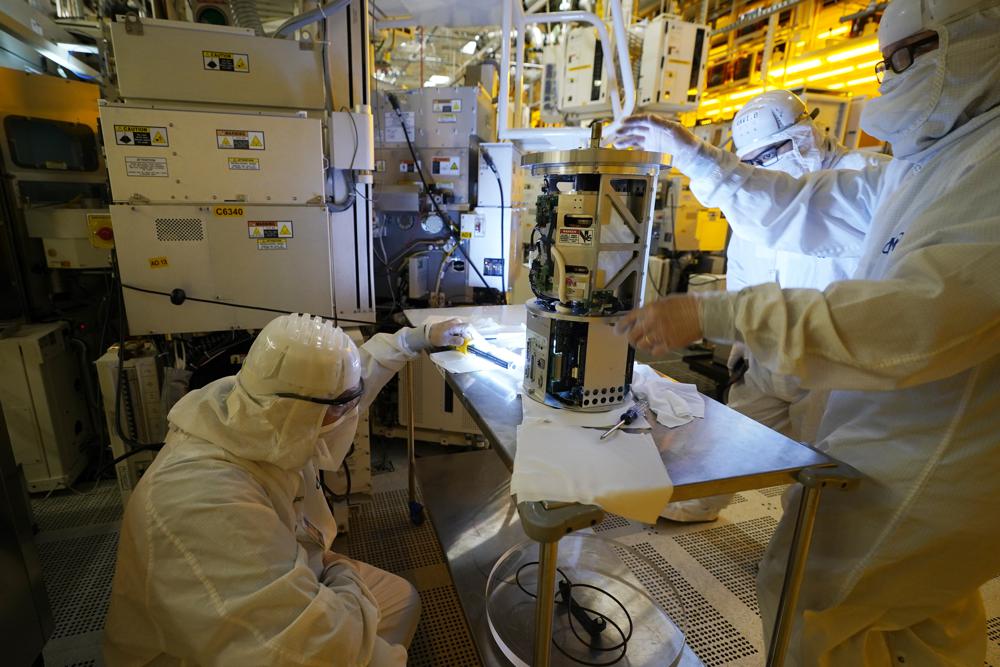
A bill designed to encourage more semiconductor companies to build chip plants in the United States passed the Senate on Wednesday as lawmakers raced to finish work on a key priority of the Biden administration. The $280 billion measure, which awaits a House vote, includes federal grants and tax breaks for companies that construct their chip facilities in the U.S. The legislation also directs Congress to significantly increase spending on high-tech research programs that lawmakers say will help the country stay economically competitive in the decades ahead. Senate passage came by a 64-33 vote. The House vote is expected later this week as lawmakers try to wrap up business before returning to their home states and districts in August. House Speaker Nancy Pelosi, D-Calif., has said she is confident there is enough GOP support to overcome potential defections from Democrats who view the subsidy effort to boost semiconductor companies as a misplaced priority. Seventeen Republicans voted for the measure. Sen. Bernie Sanders, I-Vt., broke ranks with Democrats in voting against the bill. Proponents of the legislation say other countries are spending billions of dollars to lure chipmakers. Backers say the U.S. must do the same or risk losing a secure supply of the semiconductors that power automobiles, computers, appliances, and some of the military’s most advanced weapons systems. Senate Majority Leader Chuck Schumer, D-N.Y., said the bill represented one of the nation’s largest investments in science and manufacturing in decades and that with the Senate’s approval, “we say that America’s best years are yet to come.” Opponents have been critical of the bill’s price tag. It is projected to increase federal deficits by about $79 billion over ten years. President Joe Biden said the bill would create jobs and lower costs on a wide range of products from cars to dishwashers. “For decades, some ‘experts’ said we needed to give up on manufacturing in America. I never believed that. Manufacturing jobs are back,” Biden said. “Thanks to this bill, we are going to have even more of them. The House should promptly pass it and send this bill to my desk.” The bill has been in the works for years, starting with efforts by Schumer and Sen. Todd Young, R-Ind., to increase the government’s investment in high-tech research and development. While the bill has taken several twists and turns, one constant theme that lawmakers repeatedly emphasized during Wednesday’s debate was the need to keep up with China’s massive investments in cutting-edge technology. China’s government is planning on “winning the (artificial intelligence) race, winning future wars and winning the future,” Young said. “And the truth is, if we’re being honest with ourselves, Beijing is well on its way to accomplishing these goals.” Sen. Roger Wicker, R-Miss., said: “Regrettably, we are not in the driver’s seat on a range of important technologies. China is.” Congress, he said, now has “a chance to move us back in the right direction and put America back into a place to win the game.” The bill provides more than $52 billion in grants and other incentives for the semiconductor industry, as well as a 25% tax credit for those companies that invest in chip plants in the U.S. It calls for increased spending on various research programs that would total about $200 billion over ten years, though Congress will have to follow through by approving that money in future spending bills. Despite years of work, the bill’s future did not look so promising about a month ago. That’s when Senate Republican leader Mitch McConnell tweeted that there would be no chips legislation as long as Democrats pursued a party-line package of energy and economic initiatives. GOP support is critical in the Senate to get the 60 votes needed to overcome a filibuster. But when Sen. Joe Manchin of West Virginia quashed the idea of imposing higher taxes on the rich and corporations, key Republicans said that was an opening to go forward on semiconductors. Meanwhile, the Biden administration pushed to get a bill passed before the August recess, even if meant considerably narrowing the focus to just the $52 billion in semiconductor incentives. Commerce Secretary Gina Raimondo told lawmakers behind the scenes and publicly that semiconductor companies were making plans on how to meet the increased demand for chips. She said the growth in the industry would move forward with or without the United States and if lawmakers didn’t act quite soon, those companies would simply choose to build in other countries offering significant financial incentives. Schumer said that after McConnell’s statement, he called the CEOs of chipmakers and companies such as General Motors and Ford and reached out to “unlikely allies” like the U.S. Chamber of Commerce and the Business Roundtable. He urged them to reach out to Republican senators about the importance of the bill. “And they changed things,” Schumer told The Associated Press. “They really, for the first time, industry really helped a good government program.” The House could take up the bill as soon as Thursday. While most Republicans are expected to oppose it, some of the ranking Republicans on committees dealing with national security — Reps. Michael McCaul of Texas, Michael Turner of Ohio, and John Katko of New York — support the measure. So do many of the Republicans on a bipartisan group called the Problem Solvers Caucus, which is made up of moderates from both parties. Republished with the permission of The Associated Press.
Joe Biden says remark on Vladimir Putin’s power was about ‘moral outrage’
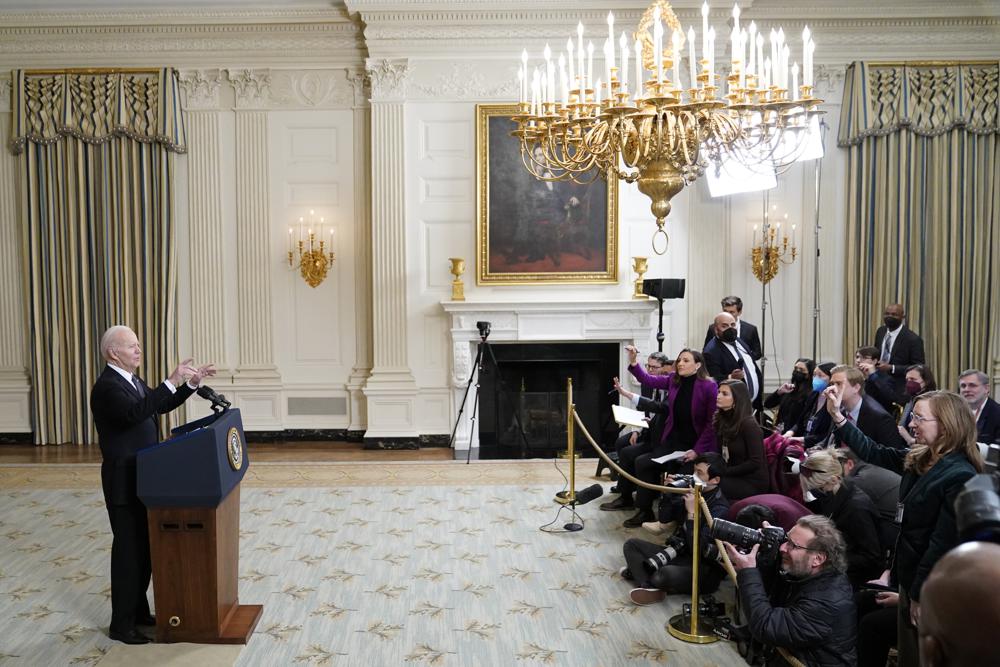
President Joe Biden said Monday that he would make “no apologies” and wasn’t “walking anything back” after his weekend comment that Russian President Vladimir Putin “cannot remain in power,” attempting to turn the page on a controversy that clouded his recent trip to Europe. The president also insisted he’s not calling for regime change in Moscow, which would have represented a dramatic shift toward direct confrontation with another nuclear-armed country. “I was expressing the moral outrage that I felt toward this man,” Biden said. “I wasn’t articulating a policy change.” The president’s jarring remark about Putin, which came at the end of a Saturday speech in Warsaw that was intended to rally democracies for a long global struggle against autocracy, drew criticism in the United States and rattled some allies in Western Europe. Richard Haass, president of the Council on Foreign Relations, said he believed Biden’s comments Monday were “an effective way for the president to move beyond what was an unforced error.” Haass had originally been concerned that aggressive American rhetoric could “make Putin feel like he had little to lose by hanging tough or even escalating.” Biden rejected the idea that his comment could escalate tensions over the war in Ukraine or that it would fuel Russian propaganda about Western aggression. “Nobody believes … I was talking about taking down Putin,” Biden said, adding that “the last thing I want to do is engage in a land war or a nuclear war with Russia.” He said he was expressing an “aspiration” rather than a goal of American foreign policy. “People like this shouldn’t be ruling countries. But they do,” he said. “The fact they do doesn’t mean I can’t express my outrage about it.” Biden’s remark in Warsaw ricocheted around the globe despite the White House’s swift attempts to clarify that the president only meant that Putin “cannot be allowed to exercise power over his neighbors or the region.” On Monday, United Nations Secretary General Antonio Guterres responded to Biden’s speech by saying that “we need de-escalation. We need military de-escalation and rhetoric de-escalation.” Although Biden has frequently touted American unity with European allies since the invasion of Ukraine began, he appears to have caused some discomfort by targeting Putin in Warsaw. French President Emmanuel Macron said Sunday he “wouldn’t use those terms, because I continue to speak to President Putin, because what do we want to do collectively? We want to stop the war that Russia launched in Ukraine, without waging war and without escalation.” Secretary of State Antony Blinken was forced to continue clarifying Biden’s speech during a trip through the Middle East, where he had intended to focus on solidifying American partnerships as the administration seeks a renewed nuclear agreement with Iran. Speaking at a news conference in Jerusalem, Blinken said Biden meant that “Putin cannot be empowered to wage war or engage in aggression against Ukraine or anyone else.” Biden has previously gone further than expected when speaking about Putin, describing him as a “war criminal” at a time when administration officials were saying they were still conducting a review of the matter. White House press secretary Jen Psaki said then that Biden was “speaking from the heart” rather than articulating a legal conclusion. Republicans questioned why Biden decided to go off-script in Warsaw when dealing with a combustible conflict. Some said his provocative rhetoric was strange given his otherwise cautious approach, such as refusing to facilitate the transfer of Polish fighter jets to Ukraine’s military. “If we’re so worried about provoking him that we couldn’t even send MiGs into Ukraine, how is this any different?” Rep. Michael McCaul, R-Texas, told CNN’s “State of the Union” on Sunday. “In fact, I would say it’s more provocative than sending MiGs into Ukraine.” The U.S. has been rushing weapons like anti-tank missiles into Ukraine and is considering providing anti-ship missiles to make it harder for Russia to mount an amphibious offensive along the Black Sea coast. Ukrainian President Volodymyr Zelenskyy remains exasperated with the pace of military assistance, accusing Western leaders of cowardice and repeating his request for tanks and fighter jets. Republished with the permission of the Associated Press.
Congressman Mike Rogers joins colleauges to voice concern over safety of Olympic athletes in China
Congressman Mike Rogers joined China Task Force Chairman Michael McCaul and House Republican Leader Kevin McCarthy in sending a letter to Board Chair of the U.S. Olympic & Paralympic Committee (USOPC) Susanne Lyons. The letter expresses concern and the importance of ensuring U.S. Olympians are educated on how to stay safe during the Olympics. Additionally, they commented on the Chinese Communist Party’s (CCP) gross human rights abuses, including genocide. The letter specifically asks that Olympians are informated on how to keep themselves safe. The Beijing Organizing Committee and the CCP has made clear that they will have an unprecedented level of control over the athletes. The letter also asks that the USOPC prepare athletes with the knowledge they need about their rights while in China and also requests an explanation of what steps have been taken to ensure the safety of athletes who may exercise their freedom of speech. “The United States Olympic and Paralympic Committee (USOPC) has a responsibility to ensure our athletes are prepared for these unprecedented Olympic games,” the lawmakers wrote. “Congress legislatively empowered the USOPC with the exclusive privilege of representing the United States in the Olympic community. American values are a core part of the USOPC’s Congressional charter, including a duty to ‘promote a safe environment in sports.’ In recent weeks, Congress has acted to further increase the preparedness and safety of American athletes representing the United States in human rights-violating countries, by codifying the American Values and Security in International Athletics Act.” The Republican-led China Task Force aims to help reinforce Congressional efforts to counter current and emerging cross-jurisdictional threats from China. The letter was also signed by China Task Force Members Reps. Andy Barr (R-KY), Liz Cheney (R-WY), Mike Gallagher (R-WI), Michael Waltz (R-FL), Darin LaHood (R-IL), Guy Reschenthaler (R-PA), Chris Stewart (R-UT), Neal Dunn (R-FL), Mark Green (R-TN), Mike Garcia (R-CA), Austin Scott (R-GA), Diana Harshbarger (R-TN), and Young Kim (R-CA). Rogers stated on Twitter, “The abhorrent reality of the Olympics occurring in a genocidal state will leave a permanent stain on the legacy of Beining 2022 and the International Olympic Committee.” The full text of the letter is below: Dear Chair Lyons, The 2022 Winter Olympic Games in Beijing will be the first Olympic games to take place in a country that is conducting an ongoing genocide. Therefore, these games are an unprecedented threat to American values, inalienable human rights, and the spirit of the Olympics. It is vital that our athletes arrive fully informed about the reality of the genocide occurring in China, as well as the broad range of other human rights abuses and malign actions committed by the Chinese government and Communist Party. The United States Olympic and Paralympic Committee (USOPC) has a responsibility to ensure our athletes are prepared for these unprecedented Olympic games. Congress legislatively empowered the USOPC with the exclusive privilege of representing the United States in the Olympic community. American values are a core part of the USOPC’s Congressional charter, including a duty to “promote a safe environment in sports.”1 In recent weeks, Congress has acted to further increase the preparedness and safety of American athletes representing the United States in human rights-violating countries, by codifying the American Values and Security in International Athletics Act2. The abhorrent reality of the Olympics occurring in a genocidal state will leave a permanent stain on the legacy of Beijing 2022 and the International Olympic Committee. The USOPC has a responsibility to ensure our athletes know that Congress and the Administration have designated the Chinese Communist Party’s crimes against Uyghurs as genocide, a term the U.S. government reserves for history’s most grave human rights atrocities. Over one million Uyghurs and members of other religious and ethnic minorities have been forced into concentration camps, been subject to abusive brainwashing and political indoctrination, have had their families forcibly separated, have been put to forced labor, and have been subject to sexual violence and efforts to reduce their population’s birth rate. We also remain seriously concerned that the American delegation to Beijing may be unprepared for personal security risks, particularly for individuals who exercise their freedom of speech. The “closed loop management system” enforced by the Beijing Organizing Committee – allegedly in response to the pandemic – will give the Chinese government an unprecedented level of control over international athletes, while at the same time hindering access by the U.S. State Department. The Department has been forthright that its consular access to athletes in need remains uncertain, and that the entirety of its China Travel Advisory applies to the games, including major threats of arbitrary detention “for sending private electronic messages critical of the PRC government,” a lack of due process, and the use of propaganda campaigns to target U.S. citizens. These risks are very likely to be heightened given the Chinese government’s total control inside the “closed loop” and the pervasive surveillance the CCP demands over events prioritized in its external propaganda efforts. This week, a Beijing Organizing Committee official issued a veiled threat to those who would speak out, saying “Any behavior or speech that is against the Olympic spirit, especially against the Chinese laws and regulations, are also subject to certain punishment.” Public statements from yourself and other USOPC officials acknowledge the danger, but sadly such statements indicate that our athletes are being encouraged to self-censor: “The laws of China are distinct and different… The expectation is we abide by the rules of that country.” Rather than push American athletes to follow the CCP’s party line, the USOPC should empower Team USA with the resources to understand the human rights crisis they face when representing our country in China and take action to ensure their safety. We urge you in the strongest terms to ensure that Team USA is fully informed about the human rights situation in China, including its ongoing genocide, and request that you reply with: An explanation of USOPC’s efforts to educate American participants in Beijing 2022 about the Chinese Communist Party’s malign actions including its
